
obra/
superpowers

obra/superpowersSkills
An agentic skills framework & software development methodology that works.
285k
1 add
This repo packages practical UX and design-system knowledge as skills your agent can load when a request fits. The skills cover hierarchy, typography, accessibility, interaction patterns, layout, and review checklists, so the agent can make more consistent UI decisions.
Builders who want their agent to design and review interfaces with reusable UX guidance.
You can ask for UI work and get design choices that follow the same patterns, accessibility rules, and system logic every time.
Skills like `brand-visual-language`, `color-mode-and-theme`, and `algorithmic-color-palette` help the agent handle brand color, shape, and theme decisions.
Skills like `modular-scale-typography`, `elevation-and-depth`, `button-states`, and `sizing-units` define repeatable scales and component behavior.
Skills like `layout-paradigms-and-consistency`, `gestalt-ui-organisation`, `responsive-paradigms`, and `scroll-areas` guide page structure and spacing.
Skills like `form-design`, `tab-navigation`, `modal-and-overlay-patterns`, and `data-display-and-selection` cover common UI patterns and states.
Skills like `nielsen-usability-heuristics`, `wcag-accessibility`, and `user-flows-and-guided-paths` give the agent review criteria and flow guidance.
Skills like `extract-design`, `clone-website`, `generate-ui-from-brand`, and `dembrandt` connect the agent to live design-token extraction and UI generation.
npx skills add dembrandt/dembrandt-skills --all
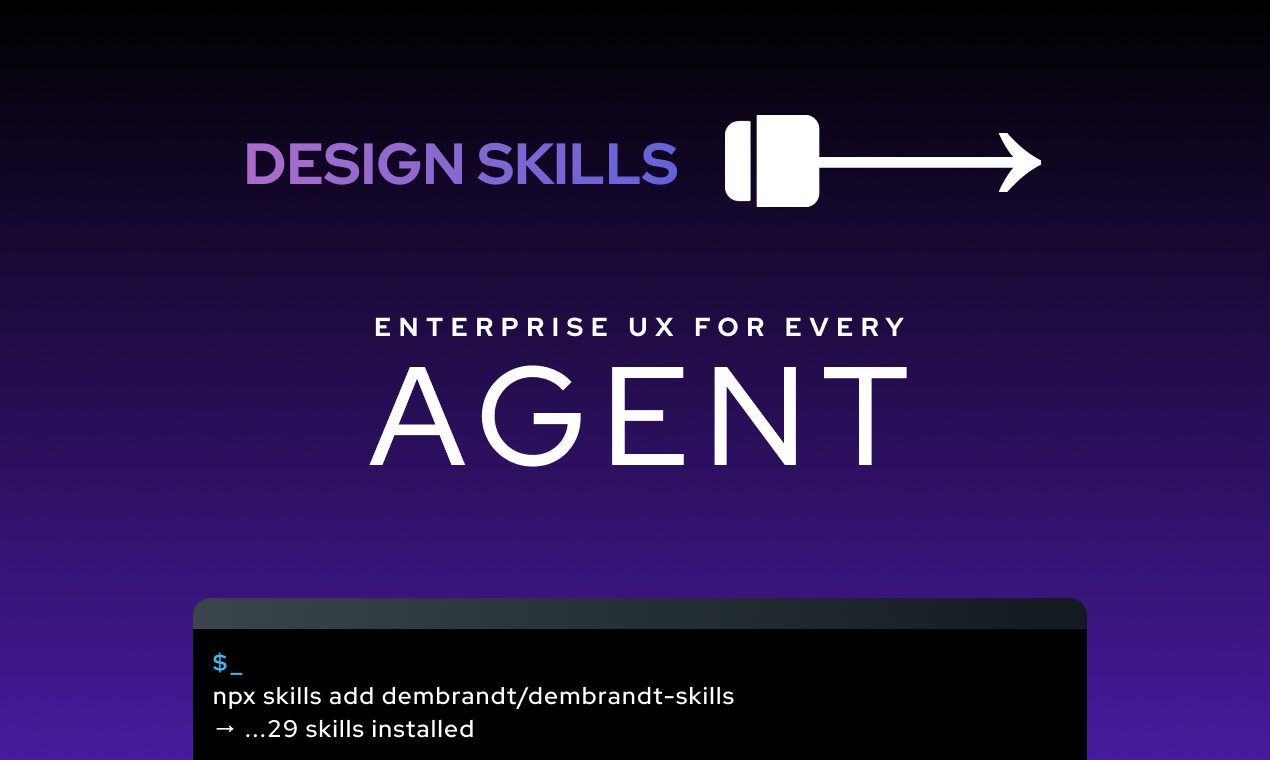
UX and design-system skills for AI agents. Install once, and your agent knows how to design.
npx skills add dembrandt/dembrandt-skills --all
--all installs every skill at once. They load only when a prompt needs them, so there is no runtime cost to having them all. Want to pick by hand? Drop --all for an interactive picker. Add --global to install across all your projects.
A skill is just instructions your agent reads. You don't run it. The agent reads each skill's description and loads the matching one when your request fits.
dembrandt skill runs the whole pipeline.No special syntax. You can name a skill to force it ("use the layout skill"), but you rarely need to. Run npx skills list to see what's installed.
Most skills are pure knowledge and work on their own. Two of them, extract-design and generate-ui-from-brand, read real design tokens off a live website. That needs the dembrandt engine. Connect it as an MCP server. There is nothing to install first, npx fetches it on first run:
{
  "mcpServers": {
    "dembrandt": {
      "command": "npx",
      "args": ["-y", "--package", "dembrandt", "dembrandt-mcp"]
    }
  }
}
Add this to your agent's MCP config. In Claude Code, this repo already ships a .mcp.json, so it connects automatically when you work in the project. Prefer the CLI? npx -y dembrandt https://stripe.com works without any config.
Opinionated, practical skills covering the fundamentals of good UI: hierarchy, typography, accessibility, interaction patterns. Distilled from working across hundreds of products and domains: enterprise tools, SaaS, financial platforms, e-commerce, consumer apps, and more. The kind of UX knowledge that usually lives with a senior designer or consultant.
Works with Claude Code and any agent harness that supports the Open Agent Skills format.
"I have one brand colour: #133174. Build me a full UI palette."
"My font sizes feel random. Set up a proper type scale."
"Review this interface for usability issues."
"We have buttons, inputs, and badges that look like they're from three different products."
"Design a multi-step onboarding flow for a B2B SaaS tool."
"Does this pass WCAG 2.2 AA?"
"Extract the design system from stripe.com." (needs the engine, see Connect the engine)
Brand & Visual Identity
| Skill | What it covers |
|---|---|
brand-visual-language | Shape language, icon style, typography tone |
color-mode-and-theme | Light vs dark vs combined, when to offer a theme selector |
algorithmic-color-palette | Derive states and brand-tinted greys from brand colours |
Design Tokens & Scales
| Skill | What it covers |
|---|---|
modular-scale-typography | Ratio-based type scales, minimum sizes, context-aware usage |
elevation-and-depth | Shadow scale, border-radius, card and modal patterns |
button-states | Six states: rest, hover, active, focus, disabled, loading |
component-family-consistency | Buttons, inputs, pills: shared radius, colour, height |
sizing-units | px vs rem vs relative: which values move when the user enlarges text |
Layout & Structure
| Skill | What it covers |
|---|---|
layout-paradigms-and-consistency | Choose the layout paradigm that fits the content; reuse the page skeleton across screens |
gestalt-ui-organisation | Group related controls: proximity, similarity, common region |
visual-emphasis-and-hierarchy | One CTA per view, colour and size as emphasis |
information-architecture | Naming, mental models, data UI, confirm dialogs |
ui-context-and-scope | Hierarchy, breadcrumbs, colour regions, scope communication |
responsive-paradigms | Mobile/tablet/desktop: nav, sections, sticky behaviour |
ui-density | Match density to platform and user type |
sticky-and-fixed-elements | Headers, bottom toolbars, z-index tokens |
scroll-areas | Avoid inner scroll, one axis only, user-controlled |
Components & Interaction
| Skill | What it covers |
|---|---|
real-world-metaphors | Cards, carousels, drawers: when to use and how |
form-design | Helper text, placeholder, validation, submit state |
tab-navigation | Tab types, overflow handling, roving tabindex, ARIA tablist, URL state |
modal-and-overlay-patterns | Overlay hierarchy, focus trap, dismiss rules, destructive confirms |
data-display-and-selection | Grid/list/table, large hit areas, mass actions |
repeated-component-alignment | Repeated components as slot models: equal size, pinned anchors, clamp + recover text |
operational-expert-tool-ui | Dense, workflow-driven UIs for trained daily B2B users |
coordinated-data-views | Keep a table and a visual view (map, diagram, chart) in sync |
domain-expert-configuration | Expose solver/algorithm settings in domain language |
app-shell | Top bar, app launcher, tenant and environment cue, status bar: one shell across an estate |
global-toolbar-controls | Currency, language, region and unit selectors: frequent but not primary |
notifications-and-recovery | Toasts, banners, retry, undo: always a path forward |
status-colors-and-errors | Minimal semantic colours, error recovery, prevention |
UX Principles
| Skill | What it covers |
|---|---|
nielsen-usability-heuristics | 10 usability principles with review checklists |
wcag-accessibility | WCAG 2.2 AA / EN 301 549: contrast, keyboard, ARIA |
user-flows-and-guided-paths | Wizards, purchase flows, onboarding sequences |
authentic-product-representation | Real content and real output over staged mockups and marketing chrome |
micro-interactions | Animated icons, toggles, reveals, celebrations |
loading-states-and-perceived-performance | Spinners, skeleton screens, and staggered entry animations |
motion-and-storytelling | Disney principles and cinematic language in UI |
Technical Foundation
| Skill | What it covers |
|---|---|
semantic-html-and-seo | HTML5, alt texts, Open Graph, progressive enhancement |
performance-and-web-vitals | Lighthouse audit, LCP, CLS, INP, images, fonts, JS loading |
Pipeline & Orchestration
| Skill | What it covers |
|---|---|
extract-design | Extract real design tokens from any live website via Dembrandt CLI or MCP (requires dembrandt ≥ 0.23.1) |
clone-website | Rebuild a live page 1:1 from capture and computed styles, into Figma, Penpot or code |
generate-ui-from-brand | URL or DESIGN.md to tokens to decisions to UI spec (requires dembrandt ≥ 0.23.1) |
dembrandt | Full 6-stage UX orchestrator: brand, tokens, layout, components, polish, a11y gate |
Part of dembrandt: the engine extracts a brand's real design tokens from any URL, these skills give your agent the UX knowledge to use them well.
MIT
Sign in to join the discussion.
No comments yet. Be the first to say what this is good for.
An agentic skills framework & software development methodology that works.
Turn any codebase, with its docs, SQL schemas, configs, and PDFs, into a queryable knowledge graph. A /graphify skill for Claude Code, Cursor, Codex, and Gemini CLI: local deterministic AST parsing, every edge explained, no vector store.

Topic in, narrated explainer video out. A Claude Code / Codex skill that turns any topic into a black-canvas motion-graphics explainer video with TTS voiceover, subtitles and a chapter progress bar. Chinese or English; every frame drawn in code with Remotion.
Public repository for Agent Skills
Open-source AI job search: scan job portals, evaluate listings into a structured A-H report with a global 1-5 score, tailor your CV, track applications — runs locally in your AI coding CLI (Claude Code, Codex, OpenCode, Antigravity…)
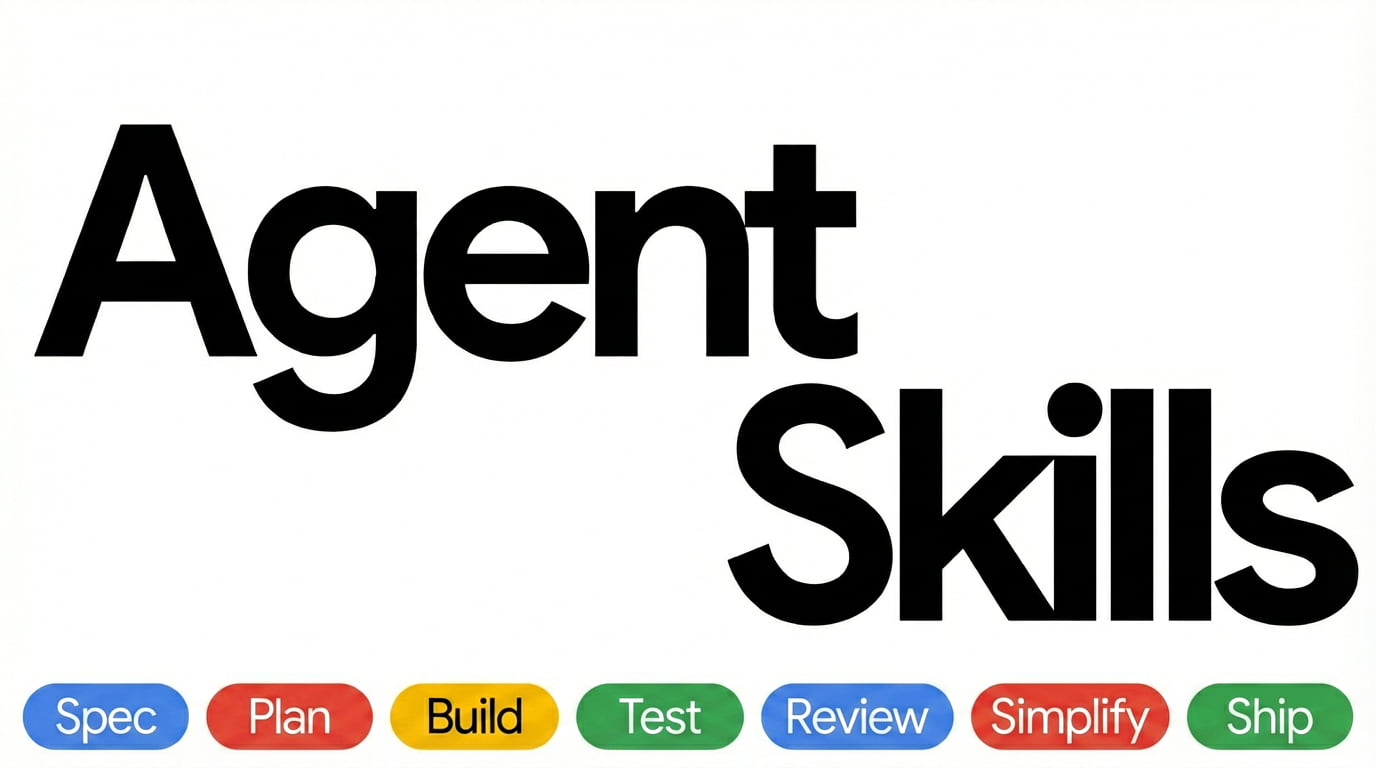
Production-grade engineering skills for AI coding agents.