
affaan-m/
ECC

affaan-m/ECCHarnesses
The agent harness performance optimization system. Skills, instincts, memory, security, and research-first development for Claude Code, Codex, Opencode, Cursor and beyond.
258k
Munder Difflin turns terminal agent CLIs into a local office of agents that you can brief through one orchestrator. It runs on Electron and TypeScript, with per-agent terminals, memory, routing, approvals, and a visual floor so you can watch work move between agents.
Builders who want their agent sessions to share memory, route work, and keep going while they step away.
You can run several agent sessions in parallel with shared memory and a single coordinator instead of re-explaining work each time.
Runs each agent as a real terminal process and shows them as avatars on a shared 2D office floor.
Uses a GOD agent to assign work, route messages, and escalate only critical actions back to you.
Keeps markdown memory plus semantic recall so agents can remember across sessions.
Moves messages through local inbox and outbox files with a shared task and event log.
Can give each agent its own worktree, identity, and provider-specific lifecycle.
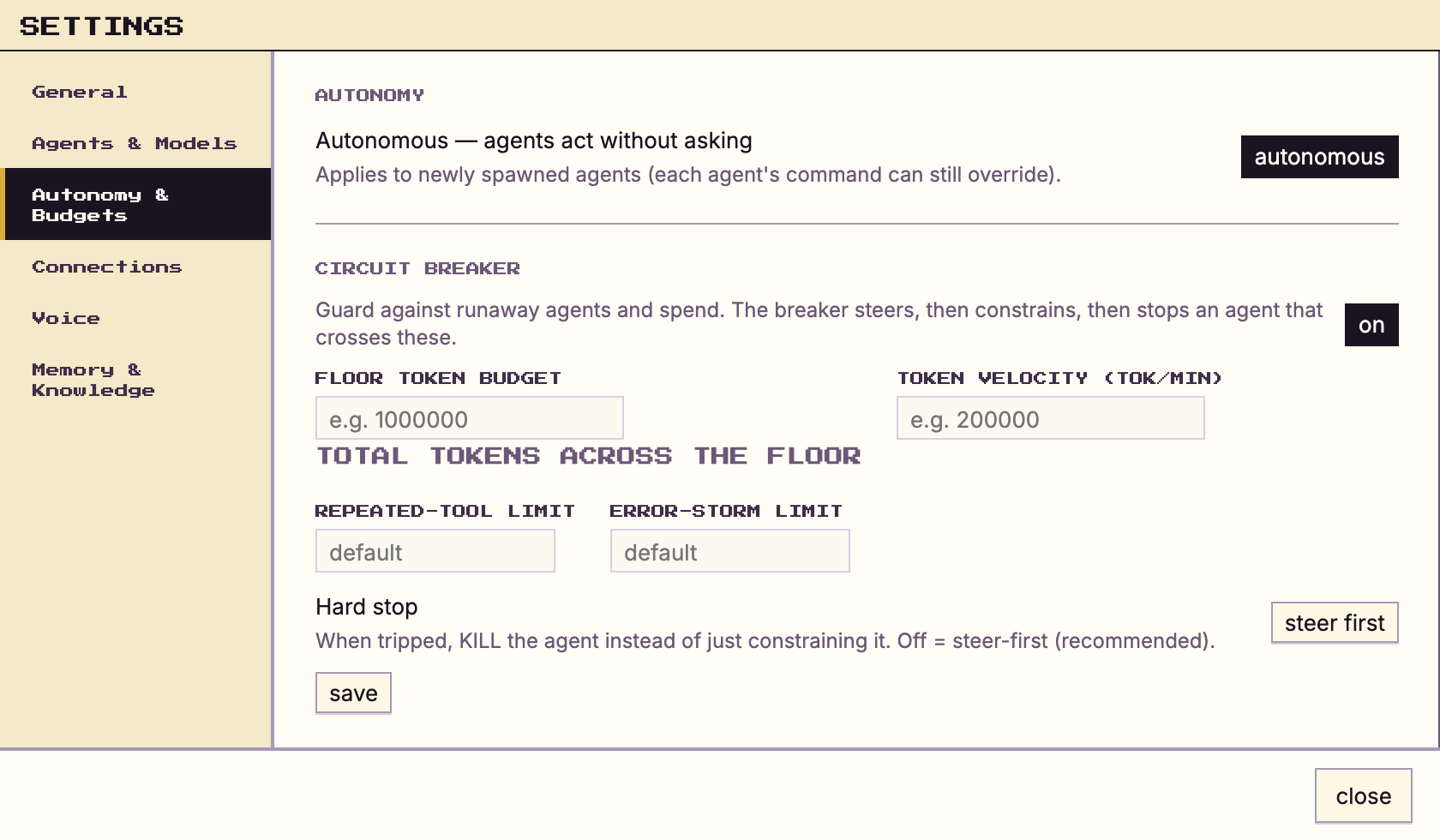
Lets you control spend, scope, and destructive actions, with a breaker for loops and runaway agents.
Wraps Claude Code, Codex, Gemini CLI, Copilot CLI, Cursor, OpenCode, Grok, Qwen, Crush, Pi, and custom commands.
Supports BYOK and local models through Ollama, LM Studio, and vLLM.
xcode-select --install
git clone https://github.com/chaitanyagiri/munder-difflin.git
cd munder-difflin
npm install        # postinstall rebuilds node-pty against Electron's ABI
npm run dev        # launches the Electron app with hot reload
npm run build      # production build via electron-vite
npm run preview    # preview the production build
npm run typecheck  # type-check the node (main/preload) and web (renderer) projects


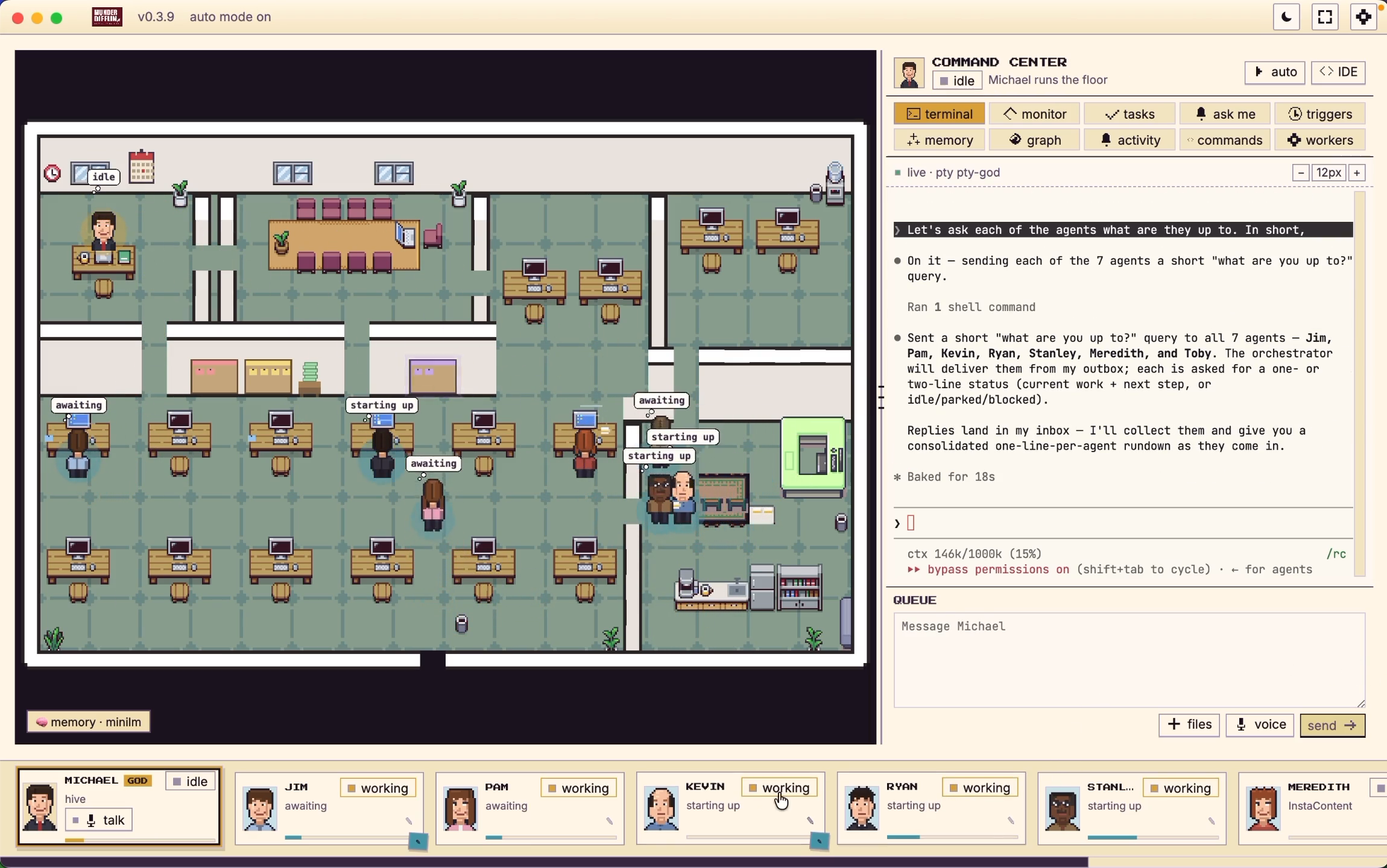
Free, open source and performant — a multi-agent harness that works with the subscriptions you already pay for, on their hourly limits. It turns the terminal coding CLI you already run into a clone of you, one that keeps working while you're away and coordinates a whole office of agents on your own machine.
Wraps Claude Code, Antigravity (Gemini), OpenAI Codex, xAI Grok, Kimi Code, Gemini CLI, Qwen, OpenCode, Crush, pi.dev, GitHub Copilot CLI, and Cursor — with bring-your-own keys and local LLMs. Agents that message, route, and remember, coordinated by your clone (Michael) and visualized as avatars at work on a shared office floor.
Electron · React · TypeScript · Pixi.js · xterm.js · node-pty







⬇ Download for macOS, Windows or Linux
macOS builds are signed and notarized. You do not need to build from source to use it.
[!NOTE] The world's best agents. The world's worst paper company. Munder Difflin takes the terminal-agent CLIs you already run —
claude,agy,codex,grok,kimi,qwen,opencode,crush,pi, andcopilot— and turns them into a self-coordinating team: each agent gets long-term memory, a mailbox, and a desk on a 2D office floor — and your clone (Michael) routes work between them while you watch. He's the boss of the floor; you're still the boss of him.
Bring the CLI you already pay for. Every one of these runs as a real process in its own terminal, with your existing subscription and its hourly limits. If it runs in a terminal, it can run here.
Claude Code Codex · GPT Grok · xAI Kimi Code Gemini CLI Antigravity · Gemini Qwen OpenCode Crush · Charm Pi GitHub Copilot Cursor + any custom command
Plus bring your own keys and local models through Ollama, LM Studio or vLLM.
Munder Difflin is a desktop app that wraps real terminal-agent CLIs as fully-capable agents, wires them into a hive mind, and puts your clone in charge — Michael, the one agent you talk to in order to get things done. Under the hood it runs the fastest memory layer in the world so every agent remembers what it learns and recalls it instantly.
claude, agy, codex, grok, kimi, qwen, opencode, crush, pi, copilot, or custom session runs as a real
process in a pseudo-terminal (node-pty), byte-for-byte authentic, rendered with xterm.js. you ── talk to ──► ┌─────────────┐
│ GOD agent │ orchestrator / supervisor
│ (Michael's │ roster · routing · adjudication
│ office) │ blackboard · task ledger
└──────┬──────┘
│ assigns · routes · escalates
┌────────────────────────┼────────────────────────┐
▼ ▼ ▼
┌───────────┐ ┌───────────┐ ┌───────────┐
│ agent A │ message │ agent B │ message │ agent C │
│ provider │ ─────────► │ provider │ ─────────► │ provider │
│ + memory │ │ + memory │ │ + memory │
└───────────┘ └───────────┘ └───────────┘
└──────── shared hive: memory · mailbox · blackboard · log ───────┘
claude, agy, codex, or custom)
with its own working directory, identity, and provider-specific lifecycle.outbox/; the harness's router delivers into recipients' inbox/. No agent ever touches git
(single-committer design avoids index.lock corruption).See HIVE.md for the full multi-agent design, SPEC.md for the
terminal/event plane, and DESIGN.md for the visual system.
Talk to one agent, not twelveMichael is your clone and the only agent you brief. He assigns the work, routes the traffic, and escalates the few things that actually need you. |

|
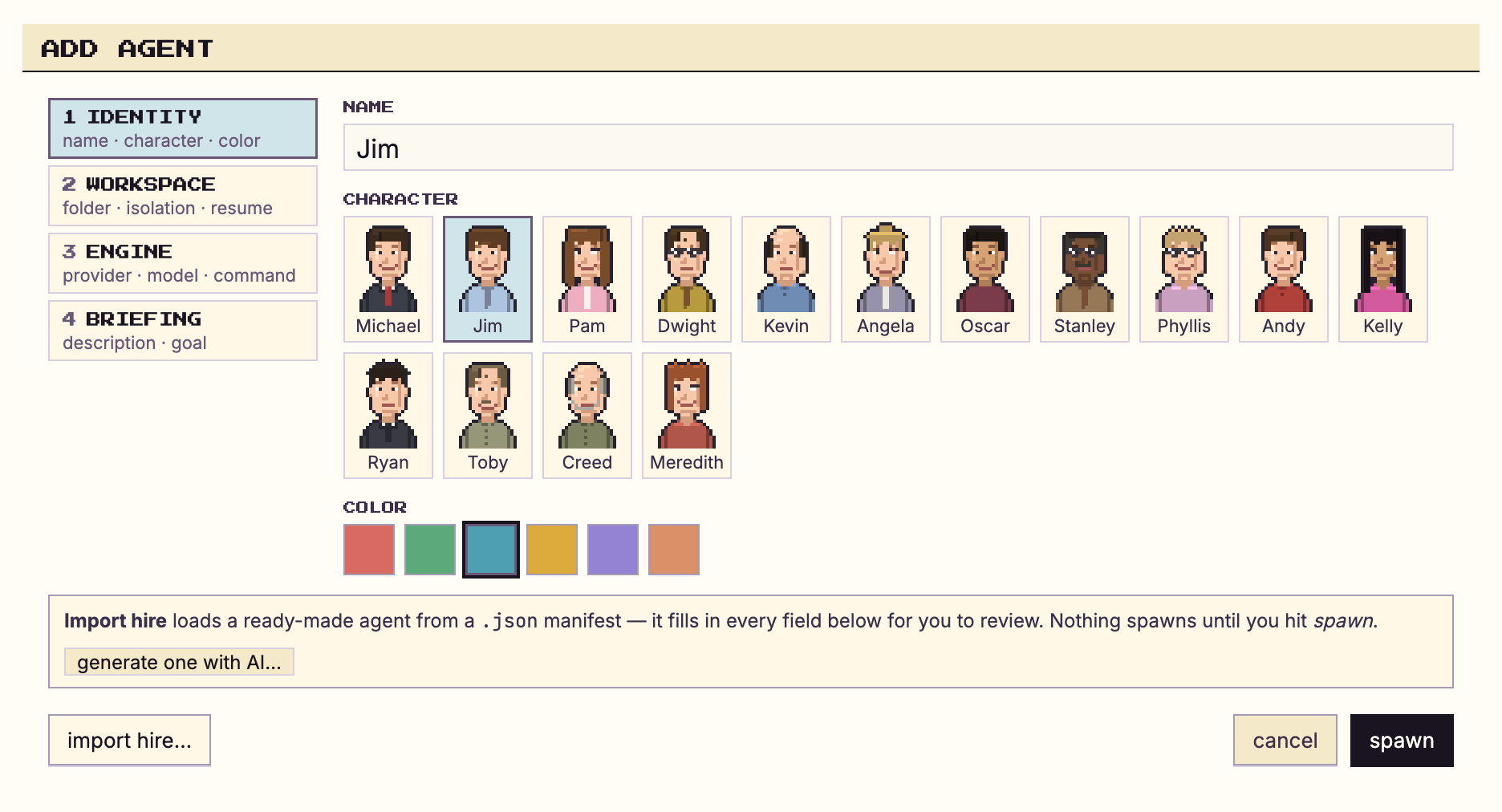
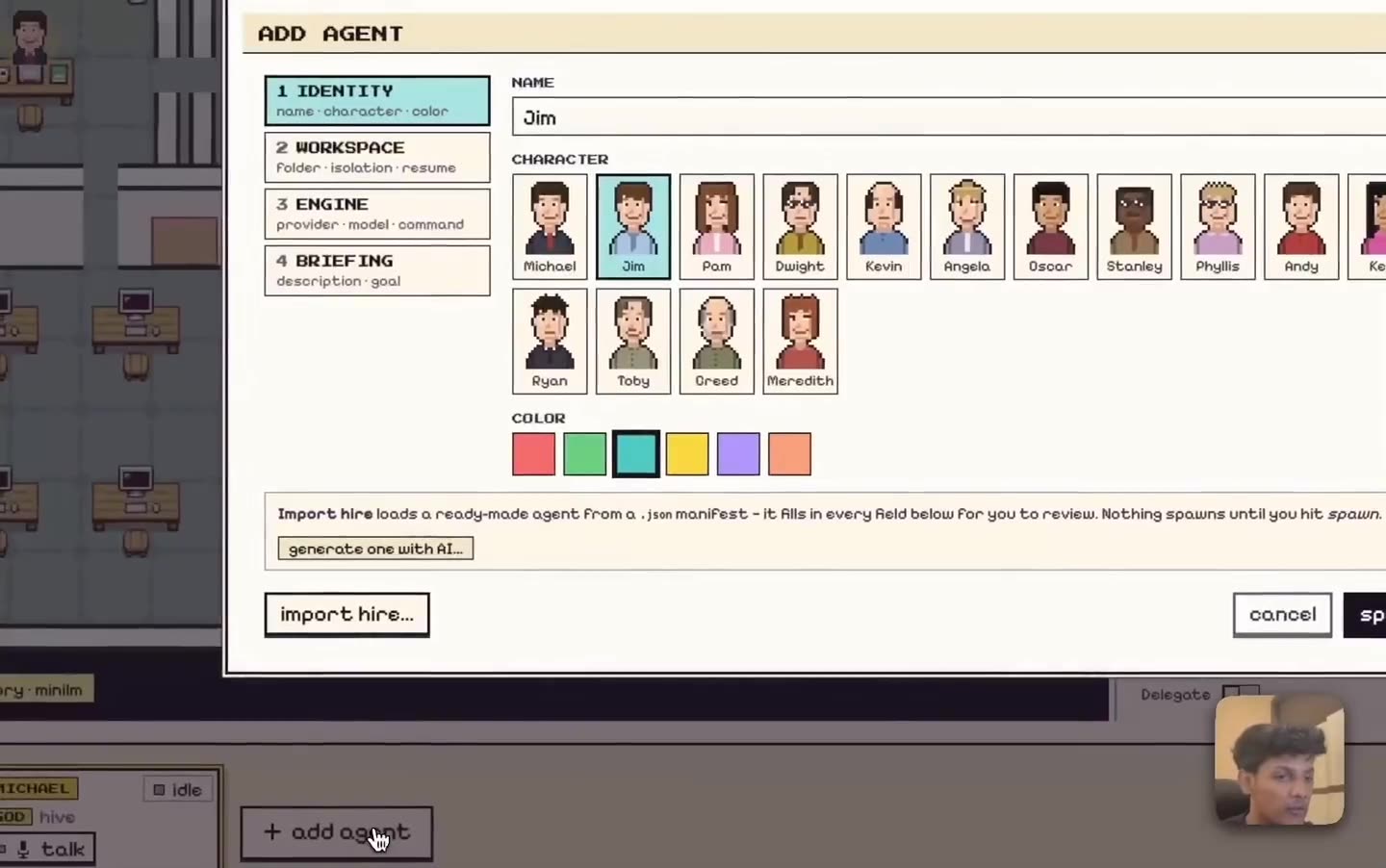
Hire an agent in a few clicksPick the CLI, the model and the autonomy, give it a desk, and it starts working. Import a ready made role from the Agent Gallery if you would rather not start from scratch. |
|
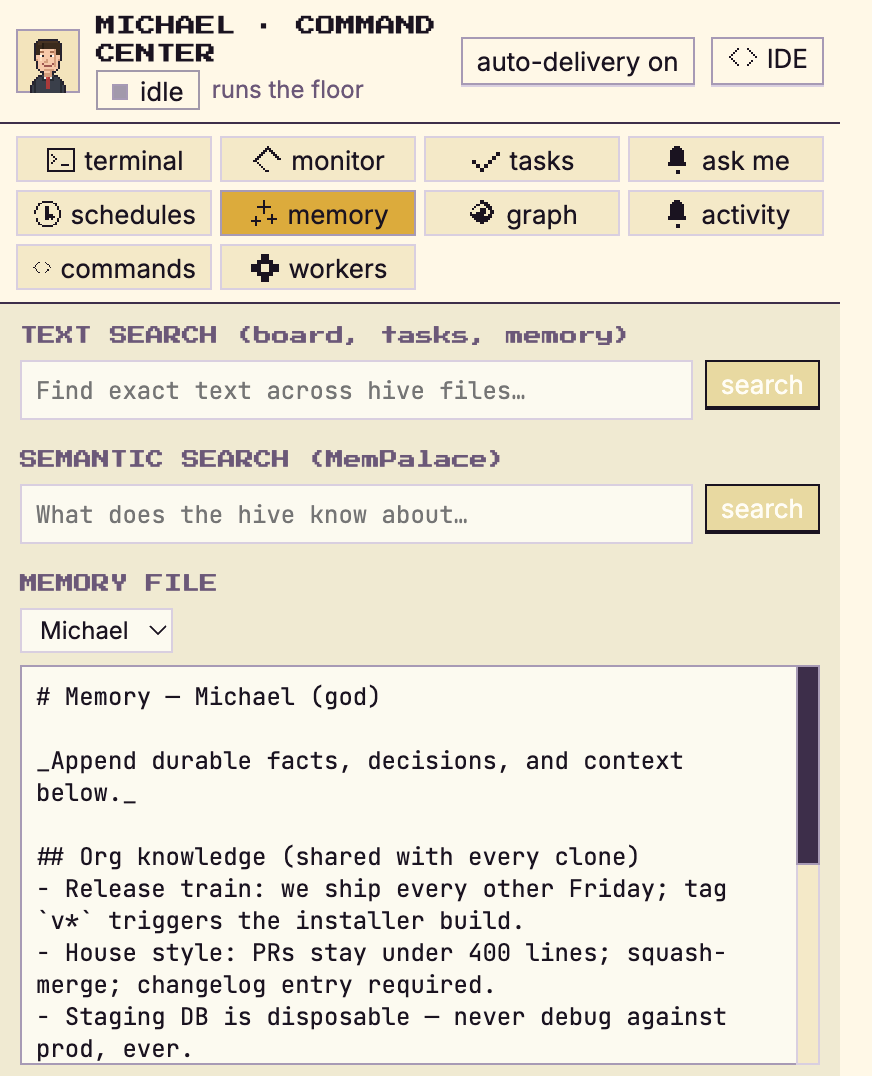
Memory that survives the sessionEvery agent keeps markdown memory that is mined into a shared, searchable palace. Close the app, come back tomorrow, and they still know what they learned. |
|
Autonomy with a leashSet how far each agent may go on its own. Spend, scope and destructive operations come back to you, and a circuit breaker steers, constrains, then stops anything that loops or runs away. |
|
Watch the whole floor workAgents walk to stations as they work and envelopes fly desk to desk when they message each other. Click any desk to read that terminal live, and type straight back into it. |
|
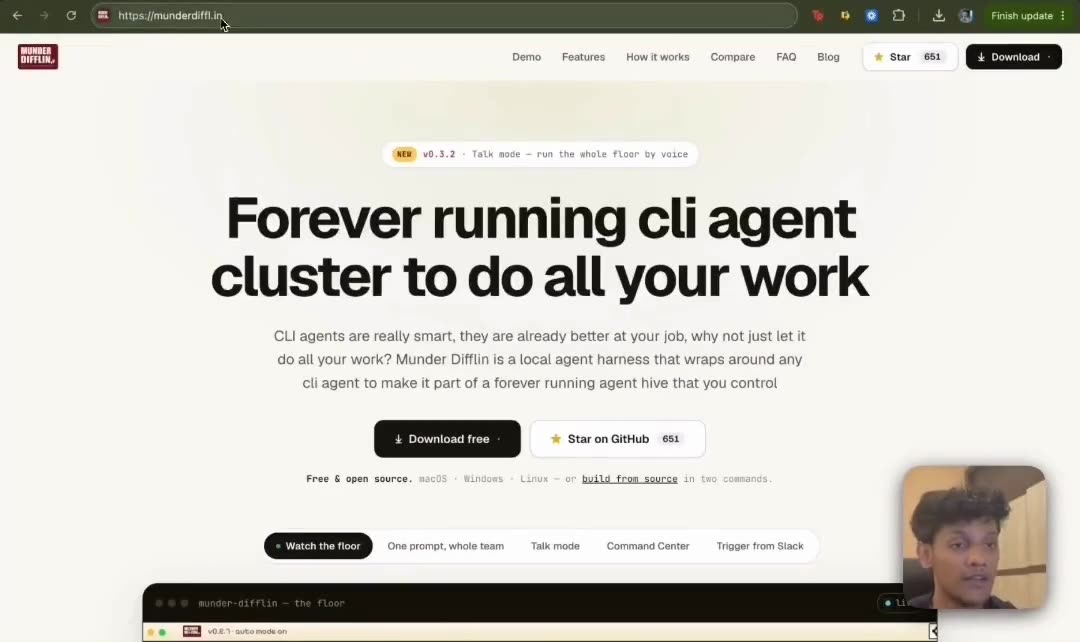
Set up onceThe onboarding wizard checks what you already have, and offers to install what is missing rather than sending you to a docs page. |
|
The floor
node-pty PTY, rendered with xterm.js.Memory & coordination
Control & safety
Command Center
Getting work in and out
munderdifflin://hire link; import only pre-fills the form, a human still spawns it. Browse roles at the Agent Gallery.latest once a check confirms you are current. A manual download is the fallback for when the updater cannot fetch the build itself. The first run afterwards opens that release's notes as a designed page rather than a version number.[!NOTE] Status: v0.4.6, the release where the app stops assuming everyone reads English left to right. The interface now runs in Simplified Chinese and Arabic, with right to left support. English stays the default and nothing changes until you pick a language in Settings, under General; the app never reads your operating system locale. All three app fonts now ship inside the bundle instead of loading from Google, which is blocked in mainland China and was breaking the interface for exactly the people the Chinese translation was for. An input method Enter no longer fires a send, a search or a rename while a candidate word is still being composed. Every string is translated, with nothing falling back to English, and the terminals read right to left. Some screens still need their padding and icons mirrored, and that is the next piece of work. No Arabic reader has reviewed the wording yet. Also in this release: the update badge runs the real download and restart instead of handing you a disk image, the update check can no longer spin forever, Settings persists through one Save button, the model lists moved into a checked in catalog, and the ASK ME card renders markdown. On the security side: the name of the CLI an agent launches is validated before it is resolved against your PATH, the OS sandbox stays on in auto mode, and analytics stopped sending IP and derived location. Telemetry now counts the messages you send to an agent, a count and nothing else, with no text, length or hash of the body in any shape. 16 community pull requests from 13 contributors landed in this release, one of them (#213) re-implemented rather than merged. If you're on 0.3.8, update: that build's usage-limit guard never released the agents it held, and it has been removed entirely. macOS (signed & notarized), Windows, and Linux builds are on the releases page.
Most people want this one. Signed and notarized macOS builds, plus Windows and Linux, are on the latest release. Install it, open it, and the wizard takes you the rest of the way. You do not need Node, a toolchain, or this repository.
You do still need at least one agent CLI on your machine, and the app can install missing ones for you from Settings → Prerequisites.
Everything below is for contributors and for people who want to run an unreleased build.
node-pty's native addon — on macOS, install Xcode Command Line Tools:
xcode-select --install
PATH — Claude Code
(claude, the default), Antigravity (agy), OpenAI Codex (codex), xAI Grok (grok),
Kimi Code (kimi), Gemini CLI (gemini), Qwen (qwen), OpenCode (opencode),
Crush (crush), pi.dev (pi), GitHub Copilot (copilot), or Cursor (cursor-agent).
Most missing CLIs self-heal: the harness runs the installer in the
terminal and continues into the new binary.git clone https://github.com/chaitanyagiri/munder-difflin.git
cd munder-difflin
npm install # postinstall rebuilds node-pty against Electron's ABI
npm run dev # launches the Electron app with hot reload
On first launch you'll go through the onboarding wizard, then land on the floor. Use Add agent to spawn your first session — the GOD agent seats itself in Michael's office automatically.
npm run build      # production build via electron-vite
npm run preview    # preview the production build
npm run typecheck  # type-check the node (main/preload) and web (renderer) projects
If
node-ptyfails to load after an Electron upgrade, re-runnpm install(thepostinstallhook runselectron-rebuildagainst the current Electron ABI).
Two data planes feed one renderer: a terminal plane that owns the PTYs, the filesystem and git, and an event plane that runs the hive, the hook server and the router. The renderer talks to both only through a typed bridge.
The full diagrams, the module by module project structure, and the design system live in
docs/ARCHITECTURE.md. They moved out of this file so it can explain
the product rather than the codebase. Also see HIVE.md for the multi-agent design,
SPEC.md for the terminal and event plane, and DESIGN.md for the
visual system.
Shipped through v0.4.6: a Simplified Chinese and Arabic interface with right to left support
and self-hosted fonts, twelve agent engines with BYOK keys and local LLMs, voice orchestration,
the hive (memory · mailboxes · blackboard · event log), Command Center with kanban and weekday
schedules, a built-in Monaco IDE with git rails, integrations registry + secret broker,
Slack-spawned workers, shareable hires and the Agent Gallery, observability and the circuit
breaker, durable persistence, session resume, multi-window floors, one click updates, a Skills
browser, a live Prerequisites check, cost reporting folded from the ledger, semantic memory
that works on Apple Silicon, and an updater that installs the build instead of pointing at it.
Full history in CHANGELOG.md.
Next up:
Contributions are welcome — this is pre-release software with a lot of surface area. Start with
CONTRIBUTING.md. The short version: fork, npm install && npm run dev, keep
npm run typecheck green, and derive any new UI from DESIGN.md tokens. Good
first areas: wiring real hook events, the add-agent flow, the config drawer, and cross-platform work.
[!IMPORTANT] Every pull request must show a before and an after — screenshots, or a recording when the thing moves — under the
### Beforeand### Afterheadings in the PR template. This is checked automatically and a PR without it does not merge. "My change has no UI" is not an exemption; it just changes what the evidence looks like. See Evidence is mandatory.
Questions, bugs, or want to show off your office? Join the Discord: https://discord.gg/SEDzP5ZPk5. Add your Discord handle to a PR and you'll get the employee of the month role when it merges.
Looking for somewhere to start? The
good first issue
list is kept stocked with small, self contained work that has a clear finish line.
Everyone whose code is in Munder Difflin is listed in CONTRIBUTORS.md.
If that is you, it is yours to point at. The list is generated from the pull requests themselves and
updates on its own, so you appear without having to ask. It also names the contributions that are in
main but that GitHub shows as closed rather than merged, because that was our mistake to record
and not theirs to explain.
Official builds send a small set of anonymous usage events (app opened, agent spawned, feature used) — never prompts, code, file paths, or agent output. The complete event list, the anonymity guarantees, and
Sign in to join the discussion.
No comments yet. Be the first to say what this is good for.
The agent harness performance optimization system. Skills, instincts, memory, security, and research-first development for Claude Code, Codex, Opencode, Cursor and beyond.
from vibe coding to agentic engineering - practice makes claude perfect
🌊 The original agent meta-harness. Deploy intelligent multi-player swarms, coordinate autonomous workflows, and build conversational AI systems. Features adaptive memory, self-learning intelligence, RAG integration, and native Claude Code / Codex / Hermes and many more Integrated
Practical patterns, starters & CLI tools for loop engineering with AI coding agents. Design systems that prompt and orchestrate agents (inspired by Addy Osmani and Boris Cherny). Includes loop-audit, loop-init, loop-cost.

Git. Ship. Done - Core

The most RAM efficient harness