
JuliusBrussee/
caveman

🪨 why use many token when few token do trick — Claude Code skill that cuts 65% of tokens by talking like caveman
105k
1 add
This project packages Android emulators and Genymotion into Docker images for app development, testing, and automation. You can open the emulator in a browser with noVNC, connect with ADB, record video, and use the MCP server for agent access.
Builders who want Android emulators they can run in Docker for testing, automation, or app development.
You can run, inspect, and automate Android devices without managing a local emulator setup.
Prebuilt images for Android 9 through 14, plus a Genymotion image and an MCP image.
Expose port 6080 and view the running emulator in a browser.
Use `adb connect` to control the emulator from the host machine.
Access container logs from the web UI.
Provides an MCP server image and setup under `mcp/` for agent integration.
Mount `/home/androidusr` to keep emulator data across container restarts.
Includes documentation for Appium, Jenkins, AWS, GCP, Azure, and cloud deployment.
sudo apt install cpu-checker
kvm-ok
docker run -d -p 6080:6080 -e EMULATOR_DEVICE="Samsung Galaxy S10" -e WEB_VNC=true --device /dev/kvm --name android-container budtmo/docker-android:emulator_11.0
docker exec -it android-container cat device_status





Docker-Android is a docker image built to be used for everything related to Android. It can be used for Application development and testing (native, web and hybrid-app).
| Android | API | Image with latest release version | Image with specific release version |
|---|---|---|---|
| 9.0 | 28 | budtmo/docker-android:emulator_9.0 | budtmo/docker-android:emulator_9.0_<release_version> |
| 10.0 | 29 | budtmo/docker-android:emulator_10.0 | budtmo/docker-android:emulator_10.0_<release_version> |
| 11.0 | 30 | budtmo/docker-android:emulator_11.0 | budtmo/docker-android:emulator_11.0_<release_version> |
| 12.0 | 32 | budtmo/docker-android:emulator_12.0 | budtmo/docker-android:emulator_12.0_<release_version> |
| 13.0 | 33 | budtmo/docker-android:emulator_13.0 | budtmo/docker-android:emulator_13.0_<release_version> |
| 14.0 | 34 | budtmo/docker-android:emulator_14.0 | budtmo/docker-android:emulator_14.0_<release_version> |
| - | - | budtmo/docker-android:genymotion | budtmo/docker-android:genymotion_<release_version> |
| - | - | budtmo/docker-android:mcp | budtmo/docker-android:mcp_<release_version> |
| Type | Device Name |
|---|---|
| Phone | Samsung Galaxy S10 |
| Phone | Samsung Galaxy S9 |
| Phone | Samsung Galaxy S8 |
| Phone | Samsung Galaxy S7 Edge |
| Phone | Samsung Galaxy S7 |
| Phone | Samsung Galaxy S6 |
| Phone | Nexus 4 |
| Phone | Nexus 5 |
| Phone | Nexus One |
| Phone | Nexus S |
| Tablet | Nexus 7 |
| Tablet | Pixel C |
If you use Ubuntu OS on your host machine, you can skip this step. For OSX and Windows OS user, you need to use Virtual Machine that support Virtualization with Ubuntu OS because the image can be run under Ubuntu OS only.
Your machine should support virtualization. To check if the virtualization is enabled is:
sudo apt install cpu-checker
kvm-ok
Run Docker-Android container
docker run -d -p 6080:6080 -e EMULATOR_DEVICE="Samsung Galaxy S10" -e WEB_VNC=true --device /dev/kvm --name android-container budtmo/docker-android:emulator_11.0
Open http://localhost:6080 to see inside running container.
To check the status of the emulator
docker exec -it android-container cat device_status
The default behaviour is to destroy the emulated device on container restart. To persist data, you need to mount a volume at /home/androidusr:
docker run -v data:/home/androidusr budtmo/docker-android:emulator_11.0
Credit goes to Guillaume - The Parallel Interface blog
Microsoft - Advanced settings configuration in WSL
Add yourself to the kvm usergroup.
sudo usermod -a -G kvm ${USER}
Add necessary flags to /etc/wsl.conf to their respective sections.
[boot]
command = /bin/bash -c 'chown -v root:kvm /dev/kvm && chmod 660 /dev/kvm'
Then, using PowerShell, open a notepad on notepad $env:USERPROFILE\.wslconfig. Inside, put these other flags:
[wsl2]
nestedVirtualization=true
Restart WSL2 via CMD prompt or Powershell
wsl --shutdown
command = /bin/bash -c 'chown -v root:kvm /dev/kvm && chmod 660 /dev/kvm' sets /dev/kvm to kvm usergroup rather than the default root usergroup on WSL2 startup.
nestedVirtualization flag is only available to Windows 11.
If this setup does not work, you may have an old WSL version. In that case, ignore \.wslconfig and put everything on /etc/wsl.conf, including the [wsl2] flag.
This document contains information about configurations that can be used to enable some features, e.g. log-sharing, etc.
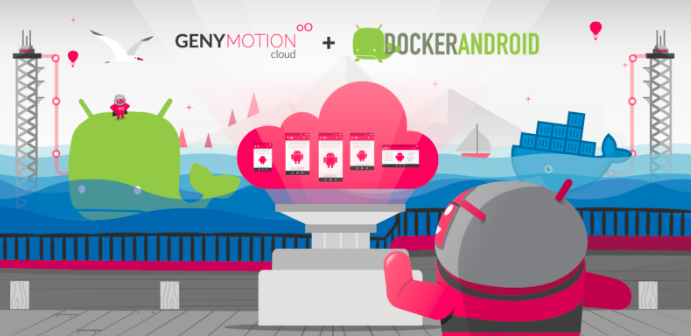
For you who do not have ressources to maintain the simulator or to buy machines or need different device profiles, you can give a try by using Genymotion SAAS. Docker-Android is integrated with Genymotion on different cloud services, e.g. Genymotion SAAS, AWS, GCP, Alibaba Cloud. Please follow this document for more detail.
The Emulator skins are taken from Android Studio IDE and Samsung Developer Website
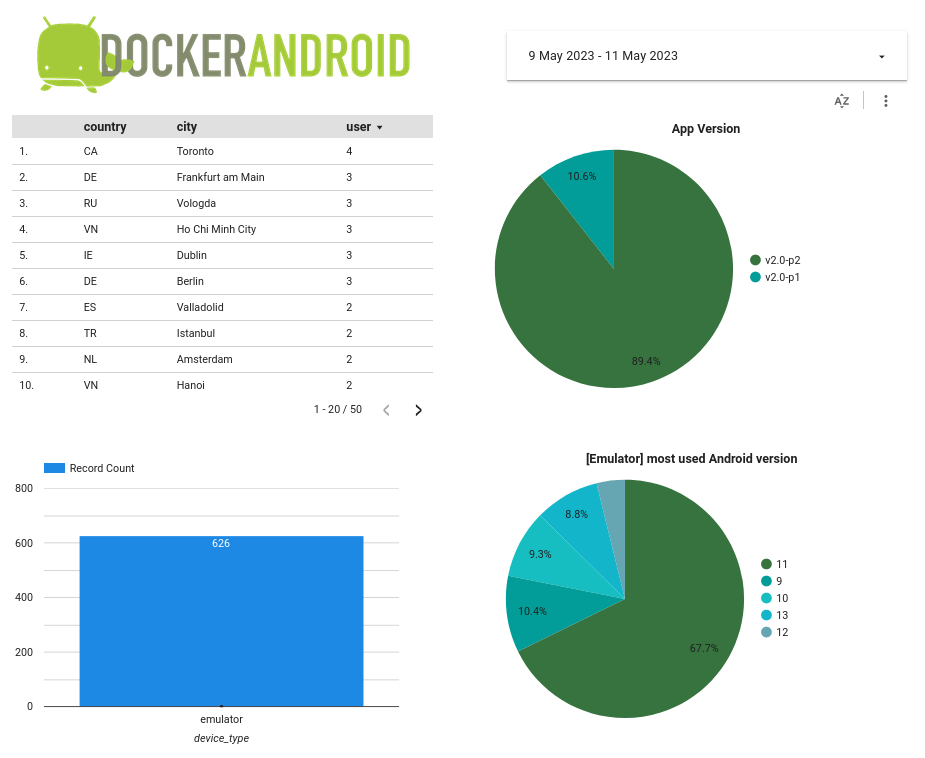
Due to high requests for help and to be able to actively maintain the projects, the creator has decided to create docker-android-pro. Docker-Android-Pro is a sponsor based project which mean that the docker image of pro-version can be pulled only by active sponsor.
The differences between normal version and pro version are:
| Feature | Normal | Pro | Comment |
|---|---|---|---|
| user-behavior-analytics | Yes | No | - |
| proxy | No | Yes | Set up company proxy on Android emulator on fly |
| language | No | Yes | Set up language on Android emulator on fly |
| Newer Android version | No | Yes | Support other newer Android version e.g. Android 15, Android 16, etc |
| root-privileged | No | Yes | Able to run command with security privileged |
| headless-mode | No | Yes | Save resources by using headless mode |
| Selenium 4.x integration | No | Yes | Running Appium UI-Tests againt one (Selenium Hub) endpoint for Android- and iOS emulator(s) / device(s) |
| multiple Android-Simulators | No | Yes (soon) | Save resources by having multiple Android-Simulators on one docker-container |
| Google Play Store | No | Yes (soon) | - |
| Video Recording | No | Yes (soon) | Helpful for debugging |
This document contains detail information about how to use docker-android-pro.

Swiftproxy — Swiftproxy provides high-quality residential proxies for Android testing, automation, and location-based workflows. With 90M+ residential IPs, HTTP(S)/SOCKS5 support, flexible targeting, and non-expiring traffic, Swiftproxy helps users test apps and online services from different locations. Try Swiftproxy for free today and get 10% off with code PROXY90.
See License
Sign in to join the discussion.
No comments yet. Be the first to say what this is good for.
🪨 why use many token when few token do trick — Claude Code skill that cuts 65% of tokens by talking like caveman

The best-benchmarked open-source AI memory system. And it's free.

Orca is the ADE for working with a fleet of parallel agents. Run any coding agent with your own subscription. Available on desktop, mobile and remote runtime.
A cross-platform desktop All-in-One assistant for Claude Code, Codex, OpenCode, OpenClaw, Grok Build & Hermes Agent. Only official website: ccswitch.io

Never stop coding. Free MIT AI gateway: one endpoint, 352 providers (150+ free), 1200+ models Kimi, Claude, GPT, Gemini, GLM, DeepSeek, MiniMax. Works with Claude Code, Codex, Cursor, OpenCode, Cline & Copilot. Quota-aware auto-fallback, RTK+Caveman compression saves 15-95% tokens, MCP/A2A, Desktop/PWA. Built by 550+ contributors

Compress tool outputs, logs, files, and RAG chunks before they reach the LLM. 20% fewer tokens for coding agents, 60-95% fewer tokens for JSON, same answers. Library, proxy, MCP server.