
JuliusBrussee/
caveman

🪨 why use many token when few token do trick — Claude Code skill that cuts 65% of tokens by talking like caveman
105k
1 add
stata-cli is a terminal interface for Stata built for agent use. It uses PyStata to run code, read data, fetch econometric results as JSON, and keep Stata alive in a daemon for faster repeat runs.
Builders who want their coding agent to run Stata commands, inspect datasets, and collect regression output in a structured way.
You can have an agent run Stata analyses and return results it can parse instead of scraping console output.
Execute inline commands, multi-line blocks, or stdin input with `run`.
Execute `.do` files with line continuation handling and auto-named graph output with `do`.
Read `r()`, `e()`, `s()`, and matrices like `e(b)` and `e(V)` as JSON with `return` and `matrix`.
View the current dataset, variable details, labels, frames, and macros from the terminal.
Keep PyStata running in the background for faster repeated commands and separate sessions.
Use JSON mode, compact output, token limits, exit codes, and log files for reliable tool use.
Look up built-in help topics and a 57-topic skill library for econometrics, causal inference, and packages.
pip install stata-cli
# One-shot usage
npx stata-cli run "display 1+1"

# Global install
npm install -g stata-cli
git clone https://github.com/ashuiGordon/stata-cli.git
cd stata-cli
pip install -e ".[data]"
pip install stata-cli
stata-cli detect
stata-cli daemon start
The agent-native Stata CLI for empirical research
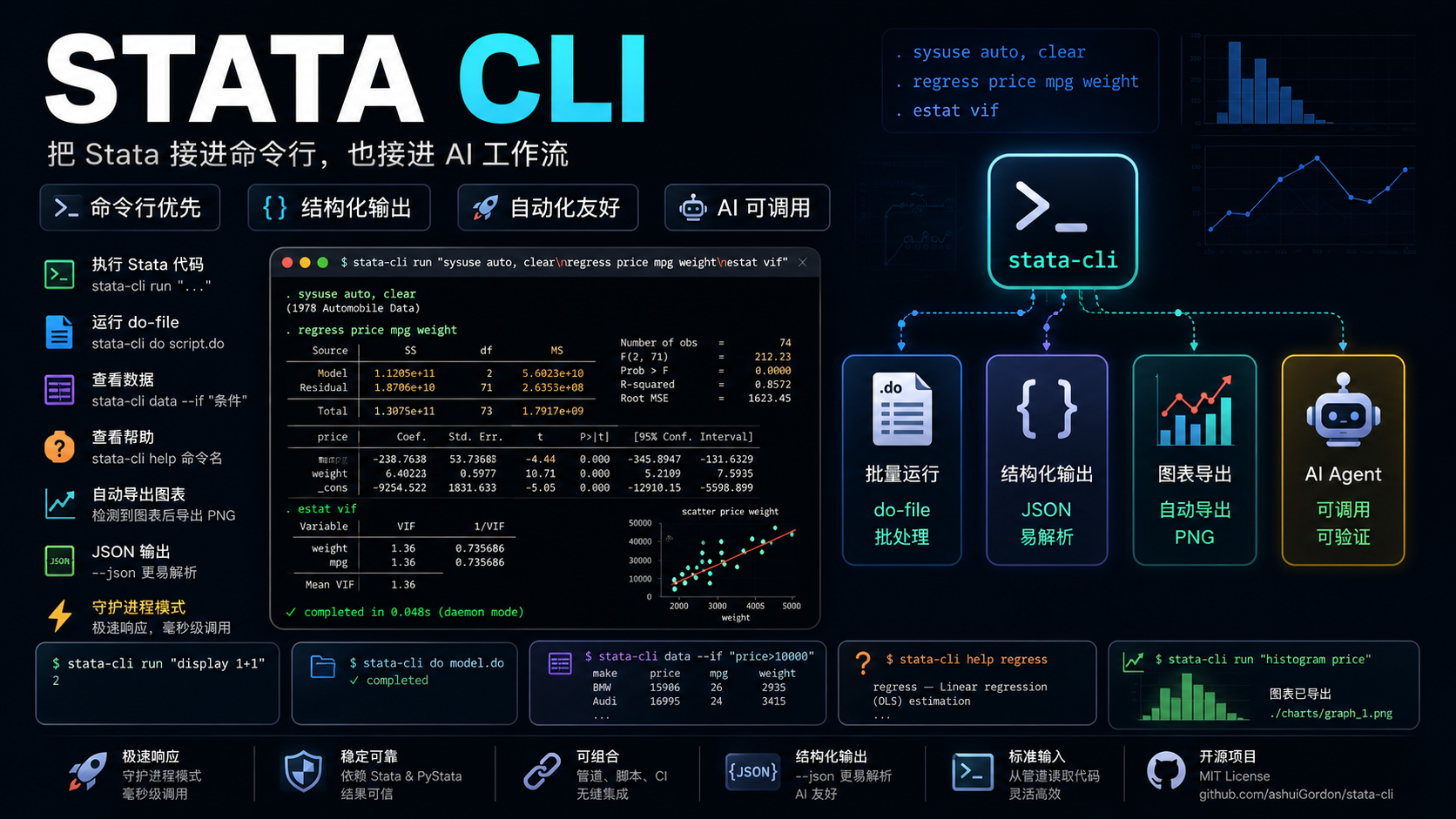


An agent-native command-line interface for Stata via PyStata. Let Codex, Claude Code, Cursor, and other AI coding agents run .do files, inspect datasets, retrieve econometric results as JSON, and export graphs from the terminal. A persistent daemon keeps repeated analyses fast.
Install · AI Agent · Commands · Daemon · Advanced · Contributing
.do files, view data, browse help, export graphs, interrupt execution — everything you need from one binarypip install| Category | Capabilities |
|---|---|
| Run Code | Execute inline Stata code, multi-line blocks, or pipe from stdin |
| Do Files | Run .do files with /// line continuation support and graph auto-naming |
| Data Viewer | View current dataset as JSON with if-condition filtering and row limits |
| Variable Metadata | Inspect variable names, types, formats, and labels via vars |
| Stored Results | Retrieve r(), e(), s() results as structured JSON via return |
| Matrix Access | Read Stata matrices (e.g. e(b), e(V)) as JSON via matrix |
| Value Labels | List and inspect value labels via labels |
| Macro Access | Get/set Stata macros including c(), e(), r() system macros |
| Frame Management | List Stata frames and current working frame via frame |
| Help System | Browse Stata help topics with SMCL-to-plain-text conversion |
| Graph Export | Auto-detect and export graphs as PNG/SVG/PDF to ~/.stata-cli/graphs/ |
| Daemon Mode | Persistent background process for sub-second execution; parallel sessions via --session |
| Output Control | Compact mode, JSON output, token limit management, log file output |
| Interruption | Send break signal to stop long-running commands |
| Skill Library | Built-in Stata reference with 57 topics: syntax, econometrics, causal inference, packages |
Choose one of the following methods:
Option 1 — From pip (recommended):
pip install stata-cli
Option 2 — From npm / npx (zero Python setup):
# One-shot usage
npx stata-cli run "display 1+1"

# Global install
npm install -g stata-cli
The npm package is a thin wrapper that delegates to uvx, pipx, or python3.
Option 3 — From source:
git clone https://github.com/ashuiGordon/stata-cli.git
cd stata-cli
pip install -e ".[data]"
# 1. Verify Stata is detected
stata-cli detect

# 2. Run your first command
stata-cli run "display 1+1"

# 3. Start daemon for fast execution
stata-cli daemon start
stata-cli run "sysuse auto, clear"    # ~85ms!
The following steps are for AI Agents calling
stata-clivia the Bash tool.
Step 1 — Install
pip install stata-cli
Step 2 — Verify Stata path
stata-cli detect
Step 3 — Start daemon (recommended)
stata-cli daemon start
Step 4 — Run commands
# Inline code
stata-cli run "sysuse auto, clear
regress price mpg weight
predict yhat"

# Structured JSON output
stata-cli --json run "summarize price"

# View data
stata-cli data --if "price>10000" --rows 50

# Lookup command syntax
stata-cli help regress
run — Execute Stata Codestata-cli run "sysuse auto, clear"
# Multi-line
stata-cli run "sysuse auto, clear
summarize price mpg
regress price mpg weight"
# Pipe from stdin
echo "display 42" | stata-cli run -
do — Execute a .do Filestata-cli do analysis.do
stata-cli --compact do long_script.do
Do files are preprocessed: /// line continuations are joined, and unnamed graph commands are auto-named for reliable export.
data — View Current Datasetstata-cli data
stata-cli data --if "price>5000" --rows 50
Returns the current dataset as JSON with columns, data, types, and row counts.
help — Browse Stata Helpstata-cli help regress
stata-cli help summarize
Displays help as plain text (SMCL markup is automatically converted).
stop — Interrupt Executionstata-cli stop
Sends a break signal to the running Stata command (daemon mode).
detect — Find Stata Installationstata-cli detect
Prints the auto-detected Stata installation path.
return — Retrieve Stored Resultsstata-cli return r # r() results (after summarize, etc.)
stata-cli return e # e() results (after regress, etc.)
stata-cli return s # s() results
Returns r(), e(), or s() stored results as structured JSON — scalars, macros, and matrix references.
vars — Variable Metadatastata-cli vars # all variables
stata-cli vars price mpg # specific variables
Returns variable names, types, formats, and labels as JSON. More structured than describe.
matrix — Read Stata Matricesstata-cli matrix e(b) # coefficient vector
stata-cli matrix e(V) # variance-covariance matrix
Returns matrix data, dimensions, and row/column names as JSON.
labels — Value Labelsstata-cli labels # list all value label names
stata-cli labels origin # show value-label mapping
stata-cli labels --var foreign # show label attached to a variable
macro — Get/Set Macrosstata-cli macro get "c(current_date)"
stata-cli macro get "e(cmd)"
stata-cli macro set myvar "hello"
Access Stata macros including system macros (c(), e(), r()).
frame — List Framesstata-cli frame
Shows all Stata frames and the current working frame.
skill — Stata Reference Librarystata-cli skill # overview: gotchas, patterns, topic routing table
stata-cli skill --list # list all 57 topics with descriptions
stata-cli skill regression # linear regression reference
stata-cli skill did # modern DiD packages (csdid, did_multiplegt)
stata-cli skill reghdfe # reghdfe package guide
Built-in reference library covering data management, econometrics, causal inference, graphics, Mata programming, and 20+ community packages. Aliases supported (e.g. did for difference-in-differences, panel for panel-data).
The daemon keeps PyStata alive in the background — reduces execution time from ~2-3s to ~85ms (35x speedup).
stata-cli daemon start       # Start background daemon
stata-cli run "display 1"    # Fast — auto-routes through daemon
stata-cli daemon status      # Check daemon state (PID, uptime, idle)
stata-cli daemon restart     # Clean restart (reset Stata state)
stata-cli daemon stop        # Shut down
| Command | Description |
|---|---|
daemon start | Start the background daemon process |
daemon stop | Graceful shutdown |
daemon stop --all | Stop all running sessions |
daemon status | Show all running sessions (PID, uptime, idle) |
daemon restart | Stop + start (clean Stata state) |
Commands auto-route through the daemon when it is running. Use --no-daemon to force direct execution.
The daemon auto-shuts down after 1 hour of inactivity (configurable with --idle-timeout).
Run multiple independent Stata instances — like opening multiple Stata windows:
# Start named sessions
stata-cli --session proj_a daemon start
stata-cli --session proj_b daemon start

# Each session has its own data, estimates, and macros
stata-cli --session proj_a run "use project_a.dta, clear"
stata-cli --session proj_b run "use project_b.dta, clear"

# Route any command to a specific session
stata-cli --session proj_a run "regress price mpg weight"
stata-cli --session proj_b return e
| Option | Description | Default |
|---|---|---|
--stata-path PATH | Stata installation directory | auto-detected |
--edition [mp|se|be] | Stata edition | mp |
--session NAME | Daemon session name (for parallel sessions) | default |
--compact | Strip verbose output noise | off |
--json | Structured JSON output | off |
--timeout SECONDS | Execution timeout | 600 |
--max-tokens N | Max output tokens (0=unlimited) | 0 |
--no-daemon | Force direct execution | off |
--graphs-dir PATH | Graph export directory | ~/.stata-cli/graphs/ |
--graph-format [png|svg|pdf] | Graph export format | png |
--log PATH | Save output to a log file | off |
stata-cli --json run "display 1+1"
{
  "success": true,
  "output": ". display 1+1\n2",
  "error": "",
  "execution_time": 0.04,
  "return_code": 0,
  "extra": {}
}
| Field | Type | Description |
|---|---|---|
success | bool | Whether the command succeeded |
output | string | Stata output text |
error | string | Error message (if any) |
execution_time | float | Seconds elapsed |
return_code | int | Stata r-code (0 = ok) |
extra | dict | May contain graphs list with exported file paths |
When Stata code creates graphs, they are automatically detected and exported as PNG:
stata-cli run "sysuse auto, clear
scatter price mpg"
[graph] graph1: /Users/you/.stata-cli/graphs/exec-.../graph1.png
In JSON mode, graph paths appear under extra.graphs.
For long outputs, use --max-tokens to truncate and save the full output to a file:
stata-cli --max-tokens 500 run "sysuse auto, clear
describe"
When output exceeds the limit, a preview is shown with a path to the full saved output.
| Variable | Description |
|---|---|
STATA_PATH | Override Stata installation path |
STATA_CLI_GRAPHS_DIR | Override graph export directory |
| Code | Meaning |
|---|---|
| 0 | Success |
| 1 | Stata command error |
| 2 | CLI usage error |
| 3 | Stata not found / init failure |
# Full analysis workflow
stata-cli run "sysuse auto, clear
summarize price mpg
regress price mpg weight
predict yhat
list make price yhat in 1/5"

# Retrieve regression results as structured JSON
stata-cli return e

# Get coefficient matrix
stata-cli matrix e(b)

# Inspect variable metadata
stata-cli vars price mpg weight

# Check value labels
stata-cli labels --var foreign

# Read system macros
stata-cli macro get "c(N)"

# Check data after loading
stata-cli data --if "price>10000"

# Lookup command syntax
stata-cli help anova

# Compact mode for less noise
stata-cli --compact run "sysuse auto, clear
describe"

# JSON mode for structured parsing
stata-cli --json run "display 1+1"

# Export graph as SVG
stata-cli --graph-format svg run "scatter price mpg"
Community contributions are welcome! If you find a bug or have feature suggestions, please submit an Issue or Pull Request.
For major changes, we recommend discussing with us first via an Issue.
This project is licensed under the MIT License.
Sign in to join the discussion.
No comments yet. Be the first to say what this is good for.
🪨 why use many token when few token do trick — Claude Code skill that cuts 65% of tokens by talking like caveman

The best-benchmarked open-source AI memory system. And it's free.

Orca is the ADE for working with a fleet of parallel agents. Run any coding agent with your own subscription. Available on desktop, mobile and remote runtime.
A cross-platform desktop All-in-One assistant for Claude Code, Codex, OpenCode, OpenClaw, Grok Build & Hermes Agent. Only official website: ccswitch.io

Never stop coding. Free MIT AI gateway: one endpoint, 352 providers (150+ free), 1200+ models Kimi, Claude, GPT, Gemini, GLM, DeepSeek, MiniMax. Works with Claude Code, Codex, Cursor, OpenCode, Cline & Copilot. Quota-aware auto-fallback, RTK+Caveman compression saves 15-95% tokens, MCP/A2A, Desktop/PWA. Built by 550+ contributors

Compress tool outputs, logs, files, and RAG chunks before they reach the LLM. 20% fewer tokens for coding agents, 60-95% fewer tokens for JSON, same answers. Library, proxy, MCP server.