
affaan-m/
ECC

affaan-m/ECCHarnesses
The agent harness performance optimization system. Skills, instincts, memory, security, and research-first development for Claude Code, Codex, Opencode, Cursor and beyond.
258k
Claude Capsule Kit extends Claude Code through its hook system, so it can remember sessions, track file and agent activity, and restore context later. It also adds dependency tools, a progressive reader for large files, specialist agents, and crew mode for worktree-based parallel branches.
Builders who use Claude Code on larger repositories and want their agent to keep context, inspect dependencies, and coordinate multi-branch work.
You can keep context across sessions, understand code relationships faster, and run coordinated agent teams on separate branches.
Logs file reads, edits, and agent activity into a local SQLite database and restores context on the next session.
Provides `query-deps`, `impact-analysis`, `find-circular`, and `find-dead-code` for answering import and change-impact questions.
Uses `progressive-reader` to split large files into navigable chunks by structure instead of truncating them.
Includes 18 read-only agents for debugging, review, architecture, security, database work, Git workflows, and session summaries.
Adds skills like `/crew`, `/workflow`, `/debug`, `/deep-context`, and `/code-review`, plus commands for setup, sync, and status.
Supports parallel multi-branch work with git worktrees, merge previews, health checks, discovery sharing, and worktree cleanup.
npm install -g claude-capsule-kit
cck setup
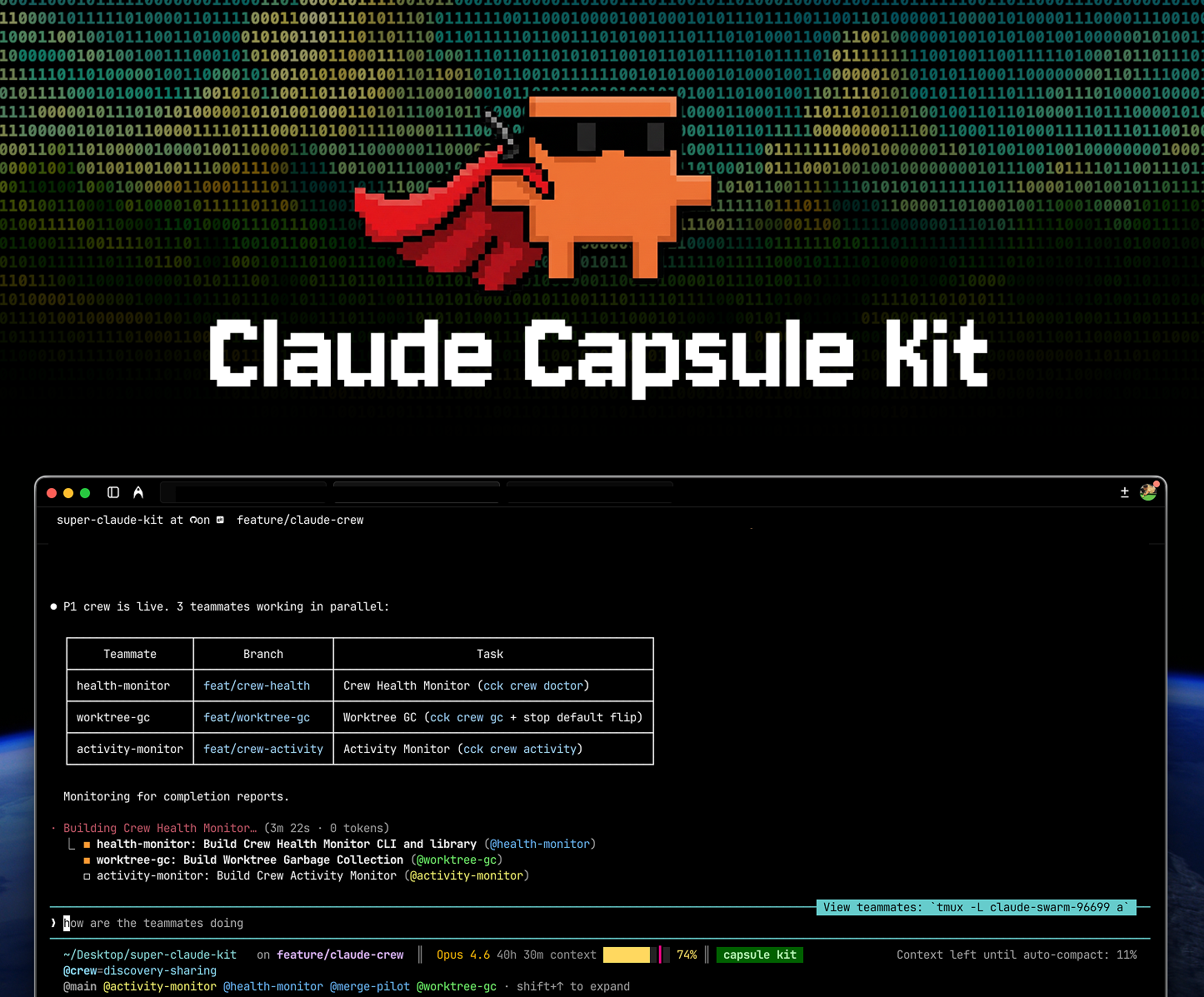



Session memory. Dependency analysis. Large file navigation. 18 specialist agents.
Crew teams for parallel multi-branch work. All automatic, zero configuration.
npm install -g claude-capsule-kit
cck setup
Restart Claude Code. Everything activates automatically via hooks.
Claude Code is powerful out of the box. But on real codebases, you run into limits:
CCK fills these gaps with a set of tools, hooks, and agents that plug into Claude Code's extension system. Nothing is patched or hacked — it's all built on official hooks, skills, commands, and agent routing.
Hooks capture every file read, edit, and agent invocation into a local SQLite database powered by blink-query — a DNS-inspired knowledge resolution layer built for AI agents.
| Event | What happens |
|---|---|
| You read/edit a file | Operation logged to capsule.db |
| Session ends | Summary saved with branch context |
| Next session starts | Previous context restored automatically |
| Context window fills up | Continuity doc saved before compaction |
| You switch branches | Context switches with you |
No manual logging. No /save commands. It just works.
cck stats overview # See what's been captured
Claude Code doesn't know your import graph. CCK builds one.
| Tool | What it answers |
|---|---|
query-deps | What does this file import? Who imports it? |
impact-analysis | What breaks if I change this file? |
find-circular | Are there circular dependencies? |
find-dead-code | What code is never imported? |
These use a pre-built dependency graph (via the Go-based dependency-scanner) — instant results instead of Claude scanning files one by one. The Pre-Tool-Use hook automatically suggests the right tool when Claude reaches for a file.
cck build # Build Go binaries (dependency-scanner, progressive-reader)
Files over 50KB hit Claude Code's token limit. CCK's progressive-reader parses the AST and splits files into navigable chunks — functions, classes, sections.
# Claude uses this automatically when it hits a large file
progressive-reader --path src/huge-file.ts --list     # See structure
progressive-reader --path src/huge-file.ts --chunk 3   # Read specific section
Supports TypeScript, JavaScript, Python, and Go. 75-97% token savings on large files.
Fresh-context agents routed by task type. All read-only — they investigate and report, never modify code.
| Agent | What it does |
|---|---|
error-detective | Root cause analysis of errors with structured RCA reports |
debugger | Step-through debugging, stack trace analysis, breakpoint strategies |
code-reviewer | Pre-commit review for bugs, security, performance, code quality |
architecture-explorer | Codebase architecture, service boundaries, integration points |
refactoring-specialist | Safe refactoring plans that preserve existing behavior |
security-engineer | Threat modeling, cryptographic systems, compliance review |
database-navigator | Schema exploration, data models, database relationships |
database-architect | Schema design, query performance, indexing strategies |
git-workflow-manager | Branching strategies, merge conflicts, git best practices |
system-architect | Technical architecture, algorithms, scalability analysis |
devops-sre | Production readiness, monitoring, deployment strategies |
brainstorm-coordinator | Multi-perspective design decisions with parallel specialists |
product-dx-specialist | API design, developer workflows, developer experience |
context-librarian | Context retrieval from capsule records and codebase patterns |
context-manager | Context optimization, conversation summarization, handoff prep |
github-issue-tracker | Create and manage GitHub issues with proper formatting |
session-summarizer | Session summaries for cross-device continuation |
agent-developer | Debug and develop custom agents and MCP integrations |
Auto-trigger on keywords. No need to remember commands.
| Skill | Triggers on | What it does |
|---|---|---|
/crew | "team", "parallel", "multi-branch" | Launch and coordinate crew teams |
/crew-setup | manual | Check prerequisites for crew teams |
/workflow | "complex task", "multi-step" | 5-phase systematic task execution |
/debug | "error", "bug", "failing" | RCA-first debugging with specialist agents |
/deep-context | "understand codebase", "need background" | Progressive context building |
/code-review | manual | Pre-commit quality review |
/statusline | manual | Configure statusline sections |
Parallel agent teams where each teammate works on their own git branch via worktrees.
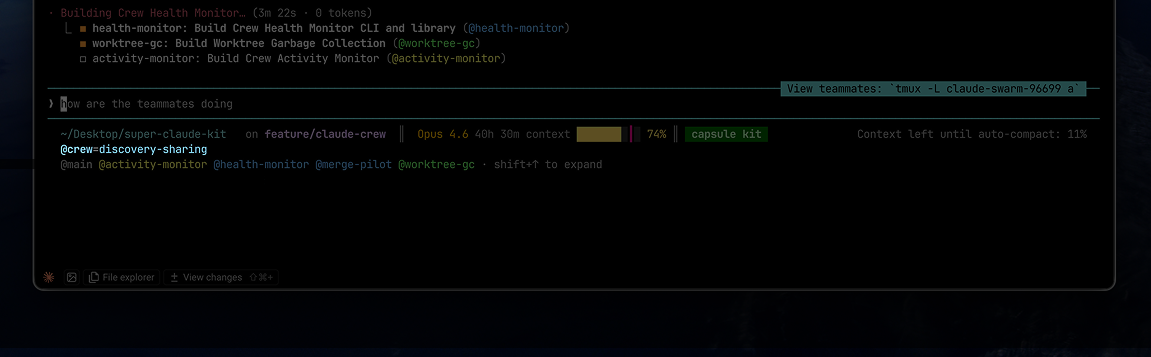
/crew-setup    # Check readiness
/crew          # Launch and coordinate a team
Define teams in .crew-config.json:
{
  "team": {
    "name": "my-feature",
    "teammates": [
      { "name": "backend", "branch": "feat/api", "role": "developer", "focus": "Build REST API" },
      { "name": "frontend", "branch": "feat/ui", "role": "developer", "focus": "Build React UI" }
    ]
  },
  "project": { "main_branch": "main" }
}
For larger teams, group teammates into crews:
{
  "team": {
    "name": "v2-release",
    "crews": [
      {
        "name": "frontend",
        "teammates": [
          { "name": "ui-dev", "branch": "feat/ui", "role": "developer", "focus": "React components" }
        ]
      },
      {
        "name": "backend",
        "teammates": [
          { "name": "api-dev", "branch": "feat/api", "role": "developer", "focus": "REST endpoints" }
        ]
      }
    ]
  }
}
Use --crew <name> to scope commands to a crew group (e.g. cck crew merge --crew frontend).
Roles: developer (sonnet, auto-commit) | reviewer (sonnet, read-only) | tester (haiku, auto-commit) | architect (opus, read-only)
What crew teams give you:
CCK extends Claude Code through its official hook system. Twelve hooks run at key moments:
SessionStart   → Restore previous context, inject discoveries, detect crew membership
PostToolUse    → Capture file ops and agent results to capsule.db
PreToolUse     → Enforce dependency tools, block large file reads, suggest right tool
PreCompact     → Save session continuity doc before context window compacts
PostCompact    → Re-inject saved context after compaction
SessionEnd     → Save session summary with branch, file count, agent count
SubagentStart  → Inject crew context and discoveries into subagent sessions
TeammateIdle   → Save teammate state and capture handoff on idle
WorktreeLifecycle → Register/deregister worktrees, update crew state
StopFailure    → Capture failure context and diagnostics for next session
Stop           → Quality check after responses
All data lives in ~/.claude/capsule.db — a SQLite database managed by blink-query, a resolution engine that organizes knowledge into namespaces with types, tags, and relationships. One global install, automatic project scoping.
Wikilink graph: prose summaries (handoffs, decisions, agent findings) are scanned for [[refs]] on save. Resolved references auto-create project-scoped ALIAS records, traversable via context-query backlinks <title-or-path> — returning hard links and FTS soft mentions. Resolution is eager-only.
cck setup              Install hooks, tools, and context system
cck teardown           Remove CCK (keeps your data)
cck update             Re-install if version changed
cck status             Show what's installed
cck build              Build Go binaries (dependency-scanner, progressive-reader)
cck stats <cmd>        Usage analytics (overview|files|agents|sessions|branch)
cck prune [days]       Clean old records (default: 30 days)

cck crew init          Create .crew-config.json
cck crew start         Launch team (setup worktrees, generate lead prompt)
cck crew stop          Stop team (removes worktrees by default)
cck crew status        Show team state
cck crew doctor        Check teammate health
cck crew activity      Show recent file ops and overlaps
cck crew merge-preview Preview branch merges (conflict detection)
cck crew merge         Execute branch merges
cck crew decompose     Analyze deps and suggest crew config
cck crew discoveries   List shared team discoveries
cck crew gc            Clean up orphaned worktrees
cck build)For crew teams, enable Agent Teams in Claude Code settings.
CCK is built on top of Anthropic's Claude Code extension system — hooks, skills, commands, and sub-agents. None of this would work without their platform.
cck teardown
npm uninstall -g claude-capsule-kit
Your data (~/.claude/capsule.db) is preserved.
MIT - Arpit Nath
Sign in to join the discussion.
No comments yet. Be the first to say what this is good for.
The agent harness performance optimization system. Skills, instincts, memory, security, and research-first development for Claude Code, Codex, Opencode, Cursor and beyond.
from vibe coding to agentic engineering - practice makes claude perfect
🌊 The original agent meta-harness. Deploy intelligent multi-player swarms, coordinate autonomous workflows, and build conversational AI systems. Features adaptive memory, self-learning intelligence, RAG integration, and native Claude Code / Codex / Hermes and many more Integrated
Practical patterns, starters & CLI tools for loop engineering with AI coding agents. Design systems that prompt and orchestrate agents (inspired by Addy Osmani and Boris Cherny). Includes loop-audit, loop-init, loop-cost.

Git. Ship. Done - Core

The most RAM efficient harness