
DietrichGebert/ponytailPlugins
Makes your AI agent think like the laziest senior dev in the room. The best code is the code you never wrote.
138k
1 add
Archcore Plugin gives coding agents a Git-backed project context layer, then exposes it through skills, commands, agents, and hooks. It works across Claude Code, Cursor, Codex CLI, and GitHub Copilot CLI so the same repo rules and specs can follow the work as it moves between tools.
Builders who want their coding agents to remember repo context, apply specs, and follow project rules across multiple tools.
You can make agent-led work land in the right place, follow existing decisions, and keep new decisions available for future changes.
Provides `/archcore:init`, `/archcore:plan`, `/archcore:document`, and `/archcore:review` for setup, planning, documentation, and review.
Computes which rules, specs, and documents apply to the current change instead of making you repeat them.
Stores specs, decisions, plans, and rules in Git so the agent can read them during later sessions.
Ships for Claude Code, Cursor, Codex CLI, and GitHub Copilot CLI with host-specific install paths.
Injects applicable rules and specs when the agent edits files and starts sessions with a recap of what is decided and in progress.
Pairs with Archcore CLI for the MCP server and project context layer, while the plugin adds host-facing skills, commands, and routing.
# macOS / Linux / WSL
curl -fsSL https://archcore.ai/install.sh | bash

# Windows (PowerShell 5.1+)
irm https://archcore.ai/install.ps1 | iex
/plugin marketplace add archcore-ai/plugin
/plugin install archcore@archcore-plugins
codex plugin marketplace add archcore-ai/plugin
codex
# then run /plugins, open Archcore, select Install plugin
# 1. Install the plugin (from this repo's plugin subdirectory)
copilot plugin install archcore-ai/plugin:plugins/archcore

# 2. Wire your project (registers the MCP server; run once per repo, commit the result)
archcore init --agent copilot --project "$PWD"
claude --plugin-dir /path/to/plugin
ln -s /path/to/plugin ~/.cursor/plugins/local/archcore
# then in Cursor: Cmd/Ctrl+Shift+P → "Developer: Reload Window"

Make your AI coding agent work like it already knows your repo.
Archcore brings spec-driven development and automatic project context to Claude Code, Cursor, Codex CLI, and GitHub Copilot CLI. Specs, architecture, decisions, rules, and plans live in Git and are applied as the agent works.
The plugin pairs with Archcore CLI: the CLI provides the git-native context layer and MCP tools; the plugin adds skills, slash commands, computed routing over gated instruments, and guardrails.
Spec-driven development defines intent. Context engineering supplies the broader project understanding needed to execute that intent correctly — a spec is one part of context, not the whole context.
The agent pulls in the rules and decisions that apply — no command needed — and still gives you the four commands below for anything explicit.
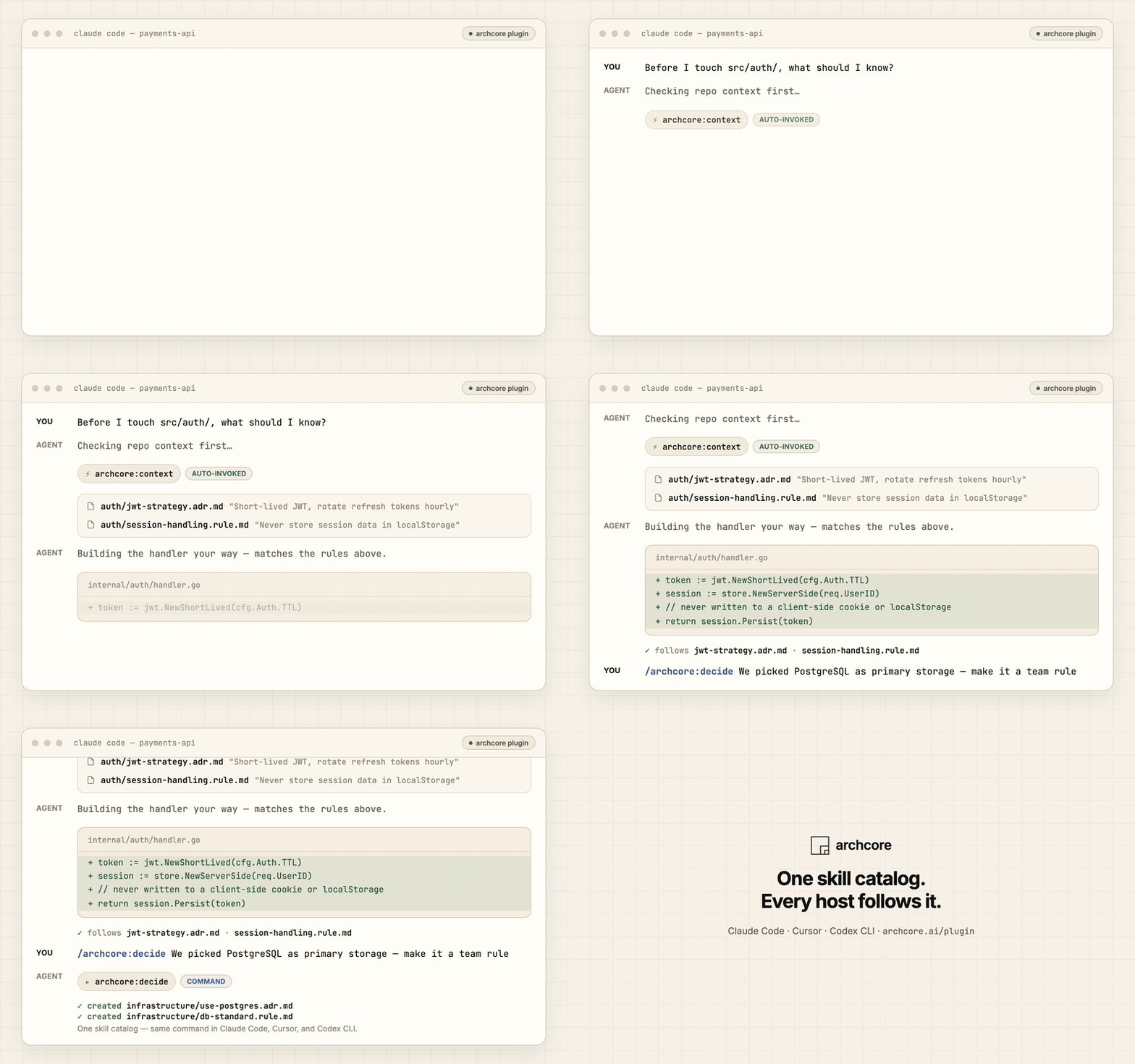
Describe what you want in plain English — Archcore computes the route. The slash commands below are shortcuts to the same instruments.
| Command | Outcome | When to use |
|---|---|---|
/archcore:init | Make your repo legible to AI agents | First-time setup — detects your repo's scale, seeds a first-day pack (stack rule, run guide, architecture overview, specs for hotspot modules) in one preview, wires host configs, and imports your CLAUDE.md / AGENTS.md / .cursorrules if present |
/archcore:plan | Turn an idea into a scoped implementation plan | New feature, refactor, or initiative — the route is computed from what the work changes: a small fix exits with no documents, one capability gets a spec and a plan, a large initiative gets an umbrella PRD with one spec per capability |
/archcore:document | Record a decision or document what lives in code | A decision was made (ADR/RFC, optionally codified as a team rule), or a module, API, or integration has tribal knowledge but no doc yet |
/archcore:review | Check your changes and your docs against each other | Before merge — reviews the branch against recorded rules and decisions; add --drift for code/doc staleness, --deep for a full documentation audit |
Everyday context needs no command at all: hooks inject the applicable rules and specs when the agent edits a file, and the session starts with a recap of what's decided and in progress.
/archcore:plan computes its route instead of running one fixed flow. Grounding derives what the request changes in the recorded canon (the delta), where the missing information lives, how hardened the touched zone is, and which risk flags apply — then the conductor assembles the matching document package and announces it in one line. A layout fix takes the null route and produces no documents; one new capability gets a spec and a plan; a large initiative gets an umbrella PRD with one spec per capability. /archcore:document and /archcore:review route by wording into the same instrument set — decision, describe, actualize, closeout, experience:
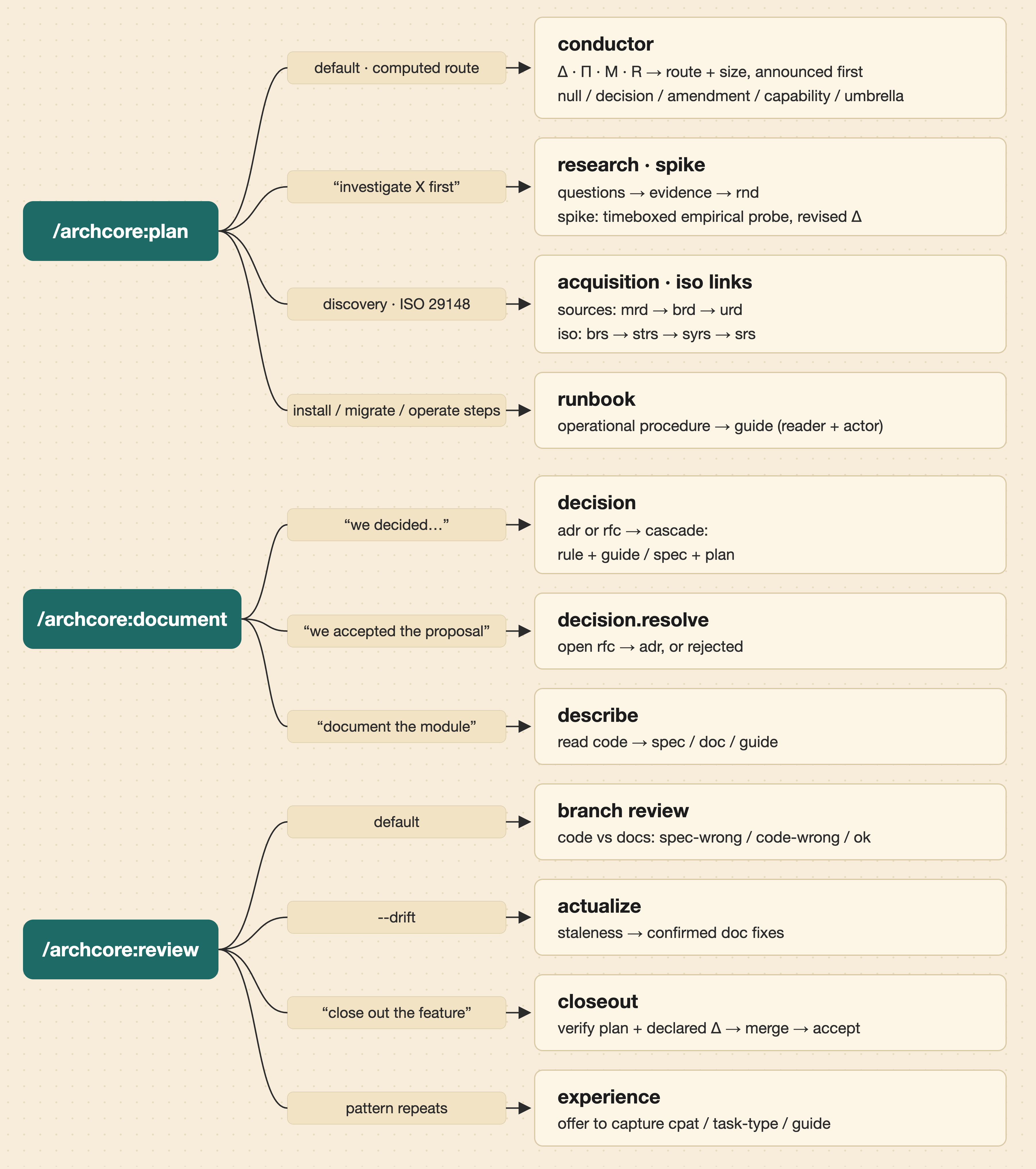
You never pick a route or a size — the announcement names both before any document is created (naming an expert path still works: plan research, plan iso, review closeout). Every gate skips itself when an existing document already covers it, so a fully-specified request runs question-free; a vague one stays within 5 questions. An interrupted flow resumes in a later session — the draft document carries the route state.
plan research <topic> runs the research instrument, which produces either a research document (a territory survey closed by scope coverage) or an rnd (an investigation closed by a recommendation, selected when the request names a pending decision or a set of candidates); document research <report> files a ready report the same way; document evidence <material> files one external material as an evidence document. The research and evidence types and the supports, contradicts, and supersedes relations require Archcore CLI ≥ v0.8.3; on an older CLI, plan research falls back to an rnd and reports the required version.
Archcore plugins require the Archcore CLI on PATH — it serves the MCP server the plugin talks to.
# macOS / Linux / WSL
curl -fsSL https://archcore.ai/install.sh | bash

# Windows (PowerShell 5.1+)
irm https://archcore.ai/install.ps1 | iex
Verify: archcore --version · Update: archcore update · Docs: docs.archcore.ai/cli/install
Then add the plugin in your host:
Claude Code
/plugin marketplace add archcore-ai/plugin
/plugin install archcore@archcore-plugins
Cursor — requires Cursor 2.5+. Open Plugins, paste https://github.com/archcore-ai/plugin into Search or paste link, click Add Plugin. One-time MCP setup: copy docs/cursor.mcp.example.json into ~/.cursor/mcp.json (user-scoped) or .cursor/mcp.json (project-scoped).
Codex CLI — requires Codex CLI v0.117.0+.
codex plugin marketplace add archcore-ai/plugin
codex
# then run /plugins, open Archcore, select Install plugin
GitHub Copilot CLI — two steps, both required. The plugin brings skills, commands, agents and hooks — but on Copilot it cannot bring the MCP server, so a project that skips step 2 has no document tools at all.
# 1. Install the plugin (from this repo's plugin subdirectory)
copilot plugin install archcore-ai/plugin:plugins/archcore

# 2. Wire your project (registers the MCP server; run once per repo, commit the result)
archcore init --agent copilot --project "$PWD"
Copilot CLI only: VS Code agent mode has no self-serve plugin install, and cloud-agent sandboxes do not load plugin hooks.
Why step 2 is not optional: a plugin's MCP server is launched in the plugin install directory with no project path (github/copilot-cli#4234), so it would serve the plugin cache rather than your repo. The plugin therefore ships no MCP server to Copilot at all, and the project-level one from step 2 is the only source of document tools. Archcore CLI ≥ v0.6.7 refuses to serve from a plugin cache by design, so the failure mode is loud rather than silent.
Claude Code — load the plugin for the current session:
claude --plugin-dir /path/to/plugin
Cursor — symlink the repo into Cursor's local plugins directory and reload the window:
ln -s /path/to/plugin ~/.cursor/plugins/local/archcore
# then in Cursor: Cmd/Ctrl+Shift+P → "Developer: Reload Window"
Codex CLI — point a local marketplace at the checkout:
codex plugin marketplace add /path/to/plugin
codex plugin add archcore@archcore-plugins
GitHub Copilot CLI — load the plugin directory directly:
copilot --plugin-dir /path/to/plugin/plugins/archcore
Cursor team rollouts — Dashboard → Settings → Plugins → Team Marketplaces → Import (paste the GitHub URL).
Open your project and try these three prompts. Each shows a different side of what your agent can now do.
Empty repo? Run
/archcore:initfirst — it seeds a stack rule, a run-the-app guide, and optionally imports your existingCLAUDE.md/AGENTS.md/.cursorrules.
1. "Before I change anything in src/auth/, what should I know?"
Your agent sees what's already decided for that path — before it touches the code.
2. "Add a new API handler and follow this repo's conventions." Your agent places the handler where your architecture says it belongs, instead of guessing.
3. "We picked PostgreSQL — record it as a team standard." The decision is captured, codified as a rule, and auto-applied to every future change in the same area. Decisions stop dying in chat scrollback.
The agent stops guessing and starts following the system.
CLAUDE.md / .cursorrules / AGENTS.md keeps growing and driftingNot for — chat memory, a prompt library, or a one-shot spec-to-code generator. Archcore is a git-native context layer for AI coding agents, not a methodology kit.
| Host | Status | Install |
|---|---|---|
| Claude Code | Production | Plugin marketplace |
| Cursor | Implemented | Plugin marketplace |
| Codex CLI | Implemented | Plugin marketplace |
| GitHub Copilot CLI | Implemented | copilot plugin install (subdir spec) |
Built on open standards (Agent Skills, MCP) — skills and MCP tools are shared across hosts; only manifests are host-specific.
| Tool | Category | How Archcore differs |
|---|---|---|
| BMAD / Spec Kit / Agent OS | Methodology | Methodology tools define a development process. Archcore keeps the resulting project knowledge alive, connected, versioned, and available to agents throughout implementation. |
| Superpowers | Methodology | Shapes agent behavior; Archcore provides canonical project knowledge any agent can read. |
AGENTS.md / CLAUDE.md / .cursorrules | Instruction files | Instruction files are useful entry points. Archcore adds typed documents, relations, lifecycle, selective retrieval, and cross-agent portability. |
| claude-mem / Mem0 / agentmemory | Memory | Memory remembers what happened in previous sessions. Archcore stores what the project says is true. |
| Cline Memory Bank | Docs | Same spirit, lower ceremony. Archcore adds typed relations and validated multi-step cascades. |
Pick a methodology tool for an opinionated dev flow. Pick a memory tool for session continuity. Pick Archcore when you want typed, queryable project truth that your coding agent respects on every request.
Claude Code: /plugin uninstall archcore@archcore-plugins
Cursor: remove from plugin settings.
Codex CLI: codex plugin uninstall archcore
GitHub Copilot CLI: copilot plugin uninstall archcore
Apache-2.0 · Issues and ideas: GitHub Issues
Sign in to join the discussion.
No comments yet. Be the first to say what this is good for.
Makes your AI agent think like the laziest senior dev in the room. The best code is the code you never wrote.
Graphs that teach > graphs that impress. Turn any code into an interactive knowledge graph you can explore, search, and ask questions about. Works with Claude Code, Codex, Cursor, Copilot, Gemini CLI, and more.

OmO: Just type "mass ulw" keyword with your prompt. Now you are the master of graph engineering.
Persistent Context Across Sessions for Every Agent – Captures everything your agent does during sessions, compresses it with AI, and injects relevant context back into future sessions. Works with Claude Code, OpenClaw, Codex, Gemini, Hermes, Copilot, OpenCode + More
Opinionated Oxlint rules for rejecting low-evidence TypeScript and JavaScript patterns
Teams-first Multi-agent orchestration for Claude Code