

rtk-ai/rtkHooks
CLI proxy that reduces LLM token consumption by 60-90% on common dev commands. Single Rust binary, zero dependencies
80k
Enso is a discipline plugin that sits around an existing agent instead of replacing it. It captures tool errors, turns them into lessons, injects that memory into later sessions, and uses PAC to ask about patterns you have not raised yourself. The system is local and works through shell hooks and template files under `~/.enso/`.
Builders who use Claude Code, Gemini CLI, or another agent with lifecycle hooks and want consistent learning between sessions.
You can stop re-explaining past mistakes and get a session that remembers lessons, forgets stale ones, and calls out recurring blind spots.
Hooks record tool failures, distill them into lessons, and inject them in the next session.
Stale lessons are pruned with decay, LRU eviction, trace rotation, and archive handling.
The PAC layer watches logs and memory, then writes Socratic challenges when it sees self-limiting patterns.
Pre-tool hooks block unsafe memory writes, secret leaks, and self-modification of core rules where supported.
`enso-lint.sh` checks for orphaned, duplicate, weak, or oversized memory entries.
Session 1:  You hit an error -> Enso captures it automatically
            Session ends -> Enso distills 1-3 lessons from the error

Session 2:  Enso injects the lessons -> Agent avoids the same mistake
            You didn't do anything. The system learned by itself.




Quickstart • PAC 🪞 • What Enso Adds • Works With • How It Works • 中文
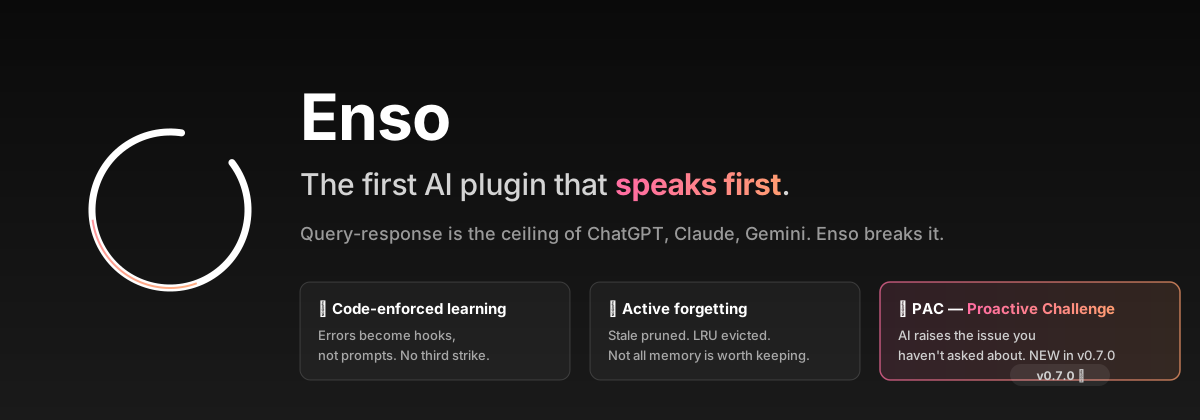
Enso is the first AI plugin that speaks first.
Every LLM product today — ChatGPT, Claude, Gemini, Perplexity — is built on the same anti-pattern: AI responds, AI never initiates. It observes your mistakes and stays silent. It sees your self-limiting patterns and waits for you to ask.
Enso breaks that silence. It is a discipline plugin that adds three things no mainstream AI product has by default:
Install in 30 seconds. Just bash + python3 (pre-installed on macOS/Linux). Wraps around Claude Code, Hermes, OpenClaw, Gemini CLI. Your data stays local.
# Claude Code (default)
git clone https://github.com/amazinglvxw/enso-os.git
cd enso-os && bash install.sh

# Gemini CLI
bash install.sh --target gemini-cli

# Hermes Agent
bash install.sh --target hermes

# OpenClaw
bash install.sh --target openclaw

# Any agent with lifecycle hooks
bash install.sh --target generic
That's it. Start a new session. Enso is active:
Session 1:  You hit an error -> Enso captures it automatically
            Session ends -> Enso distills 1-3 lessons from the error

Session 2:  Enso injects the lessons -> Agent avoids the same mistake
            You didn't do anything. The system learned by itself.
"PAC is not a judge. It's a mirror."
Every mainstream LLM is query-response. You ask, AI answers. If you don't ask about the blindspot, AI doesn't raise it. This is polite. It is also — for serious users — expensive.
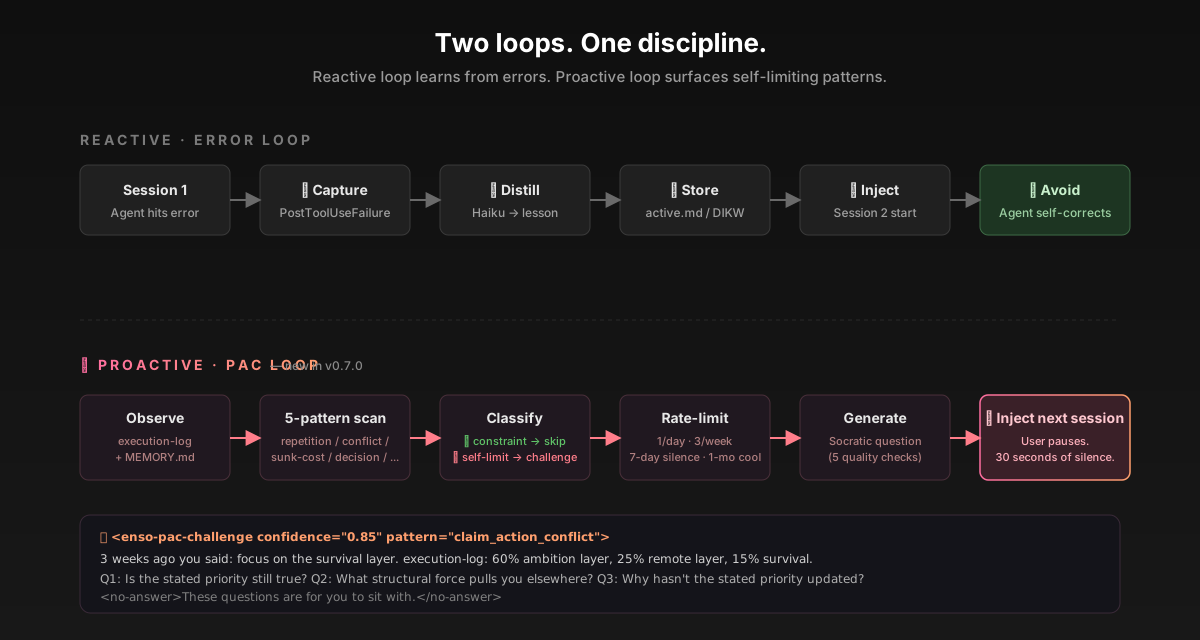
PAC adds the missing half: observation-initiated dialogue. Enso watches your session logs, memory files, and decision patterns. When it detects self-limiting behavior that you haven't asked about, it writes a Socratic challenge and delivers it at the start of your next session.
| # | Pattern | Example Trigger |
|---|---|---|
| 1 | Repetition — Starting new while old is incomplete | 5 new business lines in 30 days, each lasting 4 days |
| 2 | Claim-Action Conflict — Stated focus ≠ executed focus | MEMORY says "focus on X", logs show 70% on Y |
| 3 | Capability-Task Mismatch — Strategy delegated to executors | Supply-chain risk handed to an ops person with past failures |
| 4 | Sunk Cost — Long-running zero-growth with tactical churn | 47 days, 17 days zero growth, pricing changed twice, core assumption never questioned |
| 5 | Critical Decision Node — Irreversible action about to ship | "about to sign" on a $50k contract |
A naive challenger burns out the user. PAC's core innovation is classification:
When uncertain, PAC biases toward not challenging. Silence is the safe default.
Every PAC challenge must pass five checks before it ever reaches you:
| # | Rule | Bad | Good |
|---|---|---|---|
| 1 | Based on observation, not wisdom | "You should focus more" | "execution-log shows 9 active lines in 30 days" |
| 2 | Point to structure, not instance | "Why did you do X?" | "Why do you always do X-type things?" |
| 3 | Challenge premise, not options | "A or B?" | "Why do you need this at all?" |
| 4 | Time dimension | "This is wrong" | "In Q1 you did X, Q2 also X — why?" |
| 5 | No answer given | "You should do Y" | "If you only had 3 options, what would they be?" |
PAC_ENABLED=false to disable entirely<enso-pac-challenge confidence="0.85" pattern="claim_action_conflict">
<observation>
You told me 3 weeks ago to focus on the survival layer.
execution-log shows 60% of your actual actions on the ambition layer
and 25% on the remote layer. Survival layer: 15%.
</observation>
<challenges>
<q id="1">Is the stated priority still true?</q>
<q id="2">If it is, what's the structural force pulling you elsewhere?</q>
<q id="3">If it isn't, why hasn't the stated priority been updated?</q>
</challenges>
<no-answer>These questions are for you to sit with.</no-answer>
</enso-pac-challenge>
道德经: 知人者智,自知者明。 Knowing others is intelligence. Knowing yourself is enlightenment.
PAC is the mirror for 自知 (self-knowing). Its goal is not to manage you. It is to help you see yourself clearly. Once a month, PAC should ask a question that makes you pause, silent for 30 seconds, unable to immediately answer.
That 30 seconds of silence is where growth begins.
Full spec: docs/PAC_SPEC.md
Enso is a plugin, not a platform. It adds discipline to your existing agent without replacing anything.
| What Enso adds | What your host agent handles |
|---|---|
| Code-enforced error learning | Context management |
| Active forgetting (stale decay, LRU) | Multi-model orchestration |
| Immutable self-protection (3 hooks) | Platform integrations |
| Knowledge quality checks (weekly lint) | Tool execution |
| 🪞 PAC — AI that initiates, not just responds | Query-response dialogue |
| What Enso enforces (blocks violations) | What Enso audits (logs + warns) |
|---|---|
| Self-protection: agent can't modify its own hooks | Write verification: tracks unverified writes |
| Safety scan: blocks secrets/injection in memory files | Memory budget: warns when MEMORY.md is too large |
Enso doesn't replace your agent. It makes it more disciplined. Like SELinux for your AI — invisible when things go right, invaluable when they go wrong. Your agent keeps doing what it does best (context, tools, models). Enso adds the layer it's missing: learning from failure, forgetting what's stale, and protecting its own rules from itself.
| Capability | Claude Code | Gemini CLI | Hermes | OpenClaw | Generic |
|---|---|---|---|---|---|
| Error capture + distillation | ✅ | ✅ | ✅ | ✅ | ✅ |
| Lesson injection (SessionStart) | ✅ | ✅ | ✅ | ✅ | ✅ |
| Tool call tracing | ✅ | ✅ | ✅ | ✅ | ✅ |
| Active forgetting + maintenance | ✅ | ✅ | ✅ | ✅ | ✅ |
| Self-protection (core-readonly) | ✅ | ✅ | — | — | — |
| Memory safety scan | ✅ | ✅ | — | — | — |
| Memory budget guard | ✅ | ✅ | — | — | — |
| Write verification audit | ✅ | ✅ | — | — | — |
Pre-tool-use hooks (self-protection, safety scan, budget guard, write verification) require the framework to support a "before tool execution" lifecycle event. Hermes, OpenClaw, and generic targets get the full learning + forgetting loop but not the guard layer.
Your Agent (Claude Code / Hermes / OpenClaw / Gemini CLI / ...)
       ↕ every tool call passes through
┌──────────────────────────────────────┐
│         Enso Discipline Layer        │
│  🔒 Can't skip  🧠 Learns  🗑️ Forgets │
└──────────────────────────────────────┘
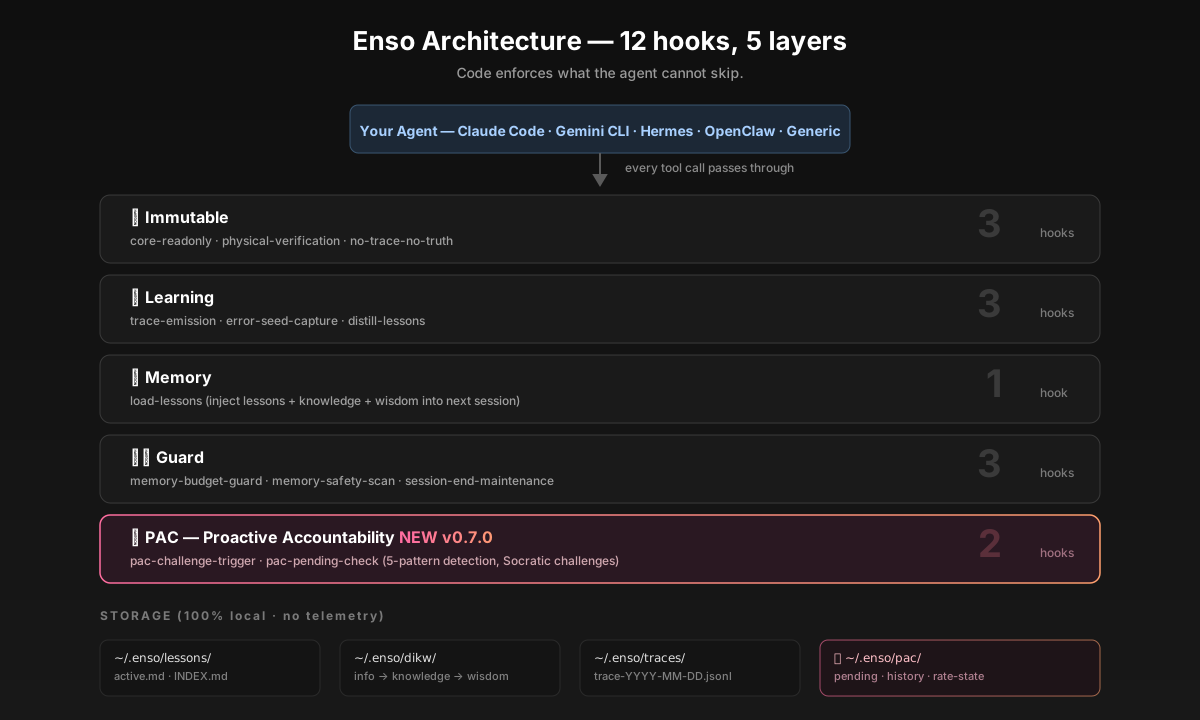
12 hooks, 5 layers. The agent can't skip what code enforces.
| Layer | Hooks | What they do |
|---|---|---|
| Immutable | 3 | Write must verify. Can't modify own rules. Session-end audit. |
| Learning | 3 | Log every tool call. Capture errors. Distill lessons via LLM. |
| Memory | 1 | Inject lessons + knowledge + wisdom into next session. |
| Guard | 3 | Memory budget cap. Block secrets/injection. Auto-maintenance. |
| 🪞 PAC | 2 | Scan for self-limiting patterns. Inject pending challenges. |
The two loops:
Error loop:     Error -> Capture -> Distill -> Store -> Inject -> Avoid (reactive)
PAC loop:       Pattern -> Classify -> Challenge -> Silence -> Observe answer (proactive)
Most memory systems only grow. Enso actively forgets — because not forgetting is more dangerous.
| Mechanism | What it does |
|---|---|
| Stale decay | Lessons unused >37 days deleted |
| LRU eviction | Over 50 lessons, oldest evicted |
| MEMORY.md downsink | Completed items archived |
| Trace rotation | >14 days deleted (daily cron) |
| Recovery safety net | Deleted lesson reappears as error, flagged |
enso-lint.sh runs weekly — like CI for your knowledge base:
| Check | What it finds |
|---|---|
| Orphans | Lessons never used (hits:0, >7 days) |
| Duplicates | >60% keyword overlap between lessons |
| Weak lessons | No actionable verb — not useful |
| Budget | MEMORY.md capacity status |
Every distillation auto-rebuilds lessons/INDEX.md for fast routing.
~/.enso/
├── core/                          # Shared modules
│   ├── env.sh                     # Paths, enso_parse(), enso_find_memory_file()
│   ├── parse-hook-input.py        # JSON parser for all hooks
│   ├── dikw-utils.py              # DIKW operations (7 subcommands)
│   ├── enso-lint.sh               # Weekly health check
│   ├── rebuild-index.py           # Auto-rebuild INDEX.md
│   ├── deleted-lessons-tracker.py # Recovery safety net
│   ├── pac-analyzer.py            # 🪞 5-pattern self-limiting detection
│   └── pac-question-generator.py  # 🪞 Socratic challenge generation
├── hooks/                         # 12 lifecycle hooks
│   ├── pre-tool-use/              # core-readonly, budget-guard, safety-scan
│   ├── post-tool-use/             # physical-verification, trace-emission
│   ├── post-tool-use-failure/     # error-seed-capture
│   ├── stop/                      # audit, distill, maintenance, pac-challenge
│   └── session-start/             # load-lessons, pac-pending-check
├── dikw/                          # DIKW distillation (Info -> Knowledge -> Wisdom)
├── pac/                           # 🪞 Pending challenges + history + rate state
├── traces/                        # Tool call logs + lint reports
└── lessons/                       # active.md + INDEX.md
Like biological evolution: DNA provides immutable constraints (protein folding physics), but within those constraints, life finds infinite creative solutions.
Built from 100+ papers analyzed over 5 months:
| Source | Key Insight |
|---|---|
| OpenAI Harness Engineering | Rules in code, not prompts |
| Agent Lightning (Microsoft) | Trace/Span + Hook/Emission dual layer |
| fireworks-skill-memory | 200 lines of hooks > 800 lines of prompt |
| SWE-agent (NeurIPS 2024) | Constrained interfaces reduce errors |
This project's GitHub metrics are its evolutionary fitness signal:
The agent maintaining this repo monitors these signals. If the system works, it thrives. If not, it dies.
Q: What agents does this work with? Five targets out of the box: Claude Code (default, fully tested), Gemini CLI, Hermes Agent, OpenClaw, and a generic target for any agent with lifecycle hooks.
Q: Does Enso compete with Mem0, Hermes memory, or OpenClaw Dreaming? No. Those are memory systems — they store facts and context. Enso is a discipline system — it enforces error learning, active forgetting, and self-protection. They are complementary.
Q: Can I use Hermes memory + Enso together? Yes, that's exactly the point. Hermes handles context and skill creation. Enso adds code-enforced error capture, stale decay, and immutable self-protection on top. Same with Claude Code's Auto Memory or OpenClaw's Dreaming.
Q: Where is my data stored?
100% local. ~/.enso/ on your machine. No cloud, no Docker, no database.
Q: What are the prerequisites?
bash and python3 (3.6+). Both are pre-installed on macOS and most Linux distros. No pip install, no npm, no Docker.
Q: Do I need to configure anything after install?
No. bash install.sh registers all hooks. Next session, it starts learning.
Q: Why not just use my agent's built-in memory? Built-in memory stores facts. Enso adds what's missing: code-enforced error learning, active forgetting with quality checks, and immutable self-protection hooks that the agent cannot bypass.
Q: Is PAC just another nagging notification system? No. PAC has five anti-fatigue layers: max 1/day, max 3/week, 7-day same-topic silence, 1-month cooldown after 3 rejections, and a confidence threshold that defaults to 0.70. Most sessions trigger zero PAC challenges. When one does trigger, it's because five independent checks all agreed.
Q: What if PAC challenges something I already thought through? PAC distinguishes constraint-optimal choices (don't challenge) from self-limiting ones (must challenge). When uncertain, it stays silent. If it ever misfires, you can dismiss and it enters cooldown on that pattern for 30 days.
Q: Does PAC send my data anywhere?
No. Everything is local in ~/.enso/pac/. Pattern detection runs in Python on your machine. The Socratic question generator uses your existing LLM adapter chain (claude → llm → openai CLI). No telemetry.
Q: How do I disable PAC?
export PAC_ENABLED=false in your shell rc. Or delete the two PAC hooks from ~/.claude/settings.json. The rest of Enso keeps working.
See CONTRIBUTING.md. Most impactful:
MIT. See LICENSE.
The enso is drawn in a single stroke — imperfect, incomplete, beautiful.
This system will never be perfect. But it will always be evolving.
Sign in to join the discussion.
No comments yet. Be the first to say what this is good for.
CLI proxy that reduces LLM token consumption by 60-90% on common dev commands. Single Rust binary, zero dependencies
Warcraft III Peon voice notifications (+ more!) for Claude Code, Codex, IDEs, and any AI agent. Stop babysitting your terminal. Employ a Peon today.

Read the Qur'an while Claude Code works. Start a session with 'claude --cwq' and a reader beside it walks forward through the Qur'an one ayah per prompt, resuming where you left off — in a terminal pane or a browser tab. Zero dependencies, fully offline.

Clean up Claude's token vomit with a separate LLM. Save your tokens, Opus is hopeless
A pre-execution guard for AI coding agents. It blocks destructive Git and file system commands, plus common attempts to access sensitive files, before a tool call runs. Supports Amp Code, Antigravity CLI, Claude Code, Codex, Cursor, Gemini CLI, GitHub Copilot CLI, Grok Build, Hermes Agent, Kimi Code, OpenClaw, OpenCode, and Pi.
Automated TDD enforcement for Claude Code