
JuliusBrussee/
caveman

🪨 why use many token when few token do trick — Claude Code skill that cuts 65% of tokens by talking like caveman
105k
1 add
Wit sits between your agents and git. Agents declare intents, lock symbols, and check for conflicts over a Unix socket, while git still handles version control.
Builders who want multiple coding agents to work in one repository without colliding on the same files or symbols.
You can see and avoid work overlap before code is written, instead of cleaning up merge conflicts later.
Agents announce what they plan to work on with `wit declare` so others can see the scope.
Agents reserve specific functions, classes, types, or exports with `wit lock` instead of locking whole files.
The daemon warns when intents overlap, when a lock is already held, or when one change depends on another locked symbol.
Accepted function-signature contracts are checked by a Git pre-commit hook and can block invalid commits.
The plugin adds a `wit:coordinate` skill and a session hook that loads shared state at startup.
`wit hook install` sets up commit-message and pre-commit hooks for intent tracking and contract checks.
curl -fsSL https://bun.sh/install | bash
bun install -g wit-protocol
git clone https://github.com/amaar-mc/wit.git
cd wit
bun install
bun link
cd your-project
wit init

Agent coordination protocol for shared codebases
Declare intents. Lock symbols. Detect conflicts. Before code is written.


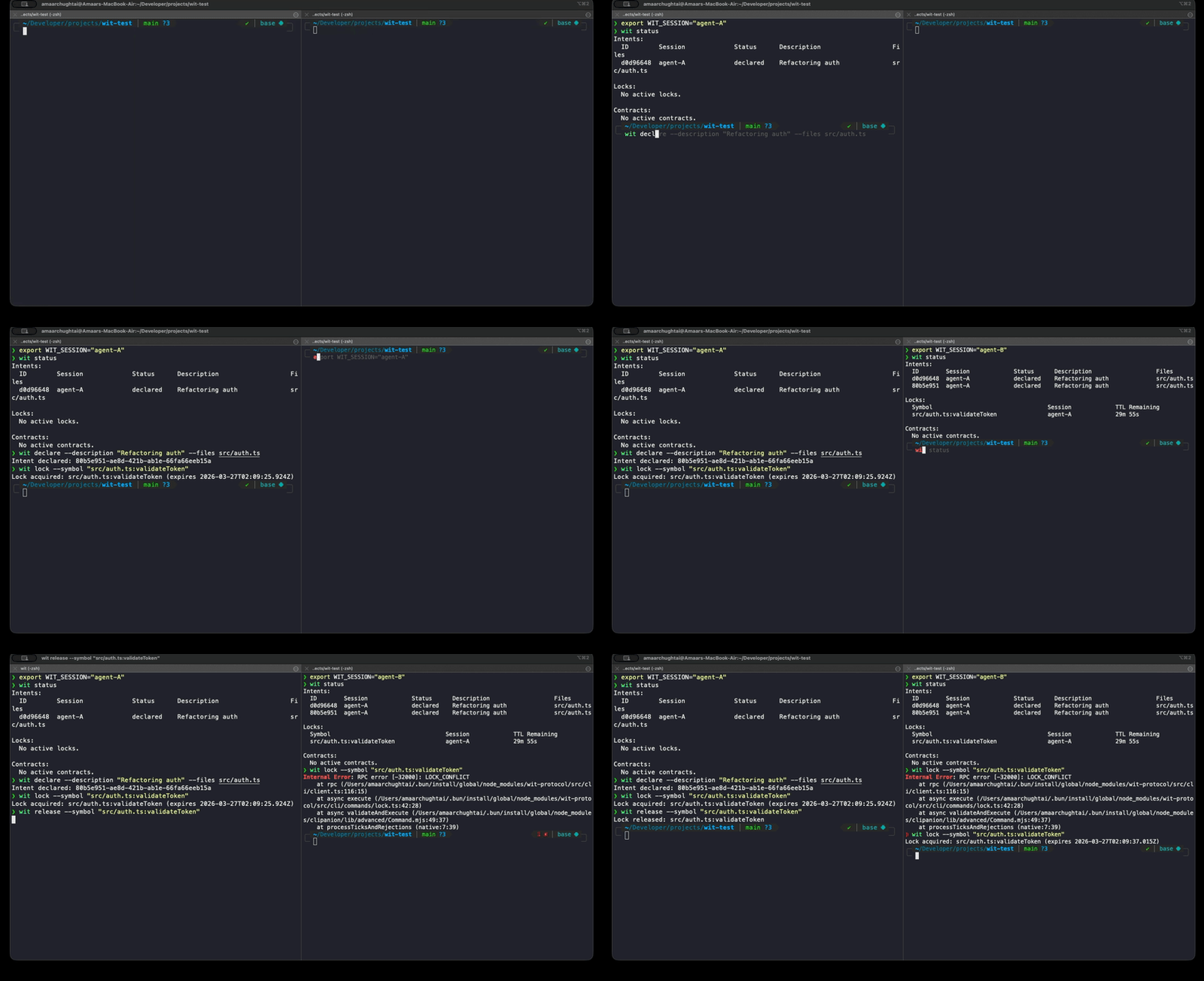
Wit coordinates multiple AI coding agents working on the same repository simultaneously. It sits between your agents and git — git handles version control, Wit prevents the conflicts.
The name comes from the word itself: the intelligence to coordinate before colliding. It also stands for Workspace Intent Tracker.
You have three Claude Code instances (or Cursor, Copilot, Devin — any combination) working on the same repo. Without coordination, they each write code independently and produce merge conflicts that waste time and break work.
Git detects conflicts after they happen. Wit prevents them before code is written.
Wit runs a lightweight daemon in the background. Agents communicate with it over a Unix socket using JSON-RPC. The daemon tracks four things:
| Primitive | What it does | Example |
|---|---|---|
| Intents | Agent announces planned work scope | "I'm refactoring the auth module" |
| Locks | Agent reserves a specific function/type/class | Lock src/auth.ts:validateToken |
| Conflicts | Daemon warns when intents or locks overlap | "Agent B also declared intent on auth.ts" |
| Contracts | Agents agree on function signatures | "validateToken accepts string, returns boolean" |
Intents and locks are warnings, not blocks. Agents always get to decide what to do. The only hard enforcement is contracts — a git pre-commit hook blocks commits that violate an accepted contract signature.
Wit requires Bun (v1.0+). It uses Bun-native APIs for the daemon, SQLite, and process management. Install Bun if you don't have it:
curl -fsSL https://bun.sh/install | bash
From npm:
bun install -g wit-protocol
From source:
git clone https://github.com/amaar-mc/wit.git
cd wit
bun install
bun link
After either method, the wit command is available globally.
cd your-project
wit init
This creates a .wit/ directory, starts the daemon, and generates a CLAUDE.md with coordination instructions. You only run this once per project — the daemon auto-starts on subsequent commands.
Every Claude Code session in this project will now automatically read the CLAUDE.md and follow the coordination protocol. Agents declare intents, lock symbols, and respect conflicts without any manual setup.
# See what's happening
wit status

# Declare intent before working
wit declare --description "Adding rate limiting to API" --files src/api.ts --files src/middleware.ts

# Lock a specific function you're about to modify
wit lock --symbol "src/api.ts:handleRequest"

# Check status — your intent and lock are visible to all agents
wit status

# Release when done
wit release --symbol "src/api.ts:handleRequest"

# Watch live updates (like htop for coordination)
wit watch
When Agent B tries to work in an area Agent A has claimed:
# Agent B declares intent on the same file
$ wit declare --description "Fixing auth bug" --files src/api.ts

# Response includes conflict warning:
# {
#   "intentId": "abc-123",
#   "conflicts": {
#     "hasConflicts": true,
#     "items": [{
#       "type": "INTENT_OVERLAP",
#       "message": "Agent A has active intent on src/api.ts"
#     }]
#   }
# }
Agent B sees the warning, checks what Agent A is doing, and chooses to work on a different part of the codebase.
Wit ships as a Claude Code plugin. Once installed, agents automatically declare intents and lock symbols before editing — no manual configuration.
Step 1: Add the Wit marketplace (one-time)
/plugin marketplace add amaar-mc/wit
Step 2: Install the plugin
/plugin install wit@amaar-mc-wit
Step 3: Make sure the CLI is installed (see Install the CLI above)
Step 4: Initialize Wit in your project
wit init
That's it. Every Claude Code instance in the project now coordinates automatically.
What the plugin provides:
wit:coordinate skill — Instructs agents to declare intents and acquire locks before editing code. Activates automatically when .wit/ exists.Without Claude Code: Wit works with any AI agent that can run shell commands. Add instructions to your agent's system prompt to call wit declare, wit lock, wit status, and wit release. See the Protocol Specification for the raw JSON-RPC API.
| Command | What it does |
|---|---|
wit init | Create .wit/, start daemon, generate session ID |
wit status | Show all active intents, locks, contracts, and conflicts |
wit declare | Announce intent to work on files/symbols |
wit lock | Acquire a semantic lock on a specific symbol |
wit release | Release a held lock |
wit watch | Live dashboard of coordination state |
wit hook install | Install git hooks for contract enforcement and intent tracking |
All commands support --json for machine-readable output.
Wit doesn't lock files — it locks symbols. A symbol is a function, class, type, or export identified by its path:
src/auth.ts:validateToken      # a function
src/models.ts:User             # a type/class
src/utils.py:calculate_score   # a Python function
src/utils.py:RateLimiter       # a Python class
Wit uses Tree-sitter WASM grammars to parse your code and identify symbol boundaries — the exact byte range of each function, class, and type. Two agents can safely work on different functions in the same file.
Supported languages: TypeScript, JavaScript, Python.
When an agent declares an intent, Wit runs three checks:
| Check | What it catches |
|---|---|
| Intent Overlap | Two agents targeting the same code region |
| Lock Intersection | Intent targets a symbol locked by another agent |
| Dependency Chain | Intent targets a caller of a locked symbol |
All conflicts are warnings. The intent still succeeds. The agent decides what to do.
Agents can agree on function signatures. Once accepted, a git pre-commit hook enforces the contract — commits that change the agreed signature are blocked.
# Install enforcement hooks
wit hook install

# Now if an accepted contract's signature changes, the commit is rejected
git commit -m "changed params"
# ERROR: Contract violation — src/auth.ts:validateToken signature changed
Contracts are propose/accept/reject. No counter-proposals in v1.
wit hook install also installs a prepare-commit-msg hook. Active intents are linked to commits via git trailers:
feat: add rate limiting

Wit-Intent: abc-123-def-456
+-----------+    +-----------+    +-----------+
| Claude A  |    | Cursor B  |    | Copilot C |
+-----+-----+    +-----+-----+    +-----+-----+
      |                |                |
      |   JSON-RPC over Unix socket    |
      |                |                |
      +--------+-------+----------------+
               |
         +-----+------+
         | Wit Daemon  |
         |             |
         |  Hono HTTP  |
         |  SQLite WAL |
         |  Tree-sitter|
         +-----+------+
               |
         .wit/daemon.sock
         .wit/state.db
witVersion field for version negotiationWit exposes 12 JSON-RPC methods for agent coordination. Full spec in two formats:
docs/PROTOCOL.md — Human-readable with request/response examples for every methoddocs/openrpc.json — Machine-readable OpenRPC 1.4.0 schemaAny AI coding tool that can POST JSON to a Unix socket or run a shell command can participate in the coordination protocol. Build your own integration using the spec.
.wit/ Directory| File | Purpose |
|---|---|
daemon.sock | Unix domain socket for JSON-RPC communication |
daemon.pid | Daemon PID for lifecycle management and crash recovery |
state.db | SQLite database with WAL mode for concurrent access |
session.id | Stable session identifier for agent tracking |
Add .wit/ to your .gitignore.
Wit uses Tree-sitter WASM grammars to parse source code at the AST level. Currently supported:
Adding a new language is straightforward. See issue #1 (Go), #2 (Rust), or #4 (Java/Kotlin) for examples of what's involved.
wit watch)Wit is open source and contributions are welcome. Good places to start:
git clone https://github.com/amaar-mc/wit.git
cd wit
bun install
bun test
MIT
Star this repo if you find it useful.
Sign in to join the discussion.
No comments yet. Be the first to say what this is good for.
🪨 why use many token when few token do trick — Claude Code skill that cuts 65% of tokens by talking like caveman

The best-benchmarked open-source AI memory system. And it's free.

Orca is the ADE for working with a fleet of parallel agents. Run any coding agent with your own subscription. Available on desktop, mobile and remote runtime.
A cross-platform desktop All-in-One assistant for Claude Code, Codex, OpenCode, OpenClaw, Grok Build & Hermes Agent. Only official website: ccswitch.io

Never stop coding. Free MIT AI gateway: one endpoint, 352 providers (150+ free), 1200+ models Kimi, Claude, GPT, Gemini, GLM, DeepSeek, MiniMax. Works with Claude Code, Codex, Cursor, OpenCode, Cline & Copilot. Quota-aware auto-fallback, RTK+Caveman compression saves 15-95% tokens, MCP/A2A, Desktop/PWA. Built by 550+ contributors

Compress tool outputs, logs, files, and RAG chunks before they reach the LLM. 20% fewer tokens for coding agents, 60-95% fewer tokens for JSON, same answers. Library, proxy, MCP server.