







JuliusBrussee/
caveman

🪨 why use many token when few token do trick — Claude Code skill that cuts 65% of tokens by talking like caveman
105k
1 add
skill-up runs skill evaluations from YAML config and case files, then grades the results with rule-based, script, or agent judges. It supports Claude Code, Codex, and custom engines, and can export reports like JSON, JUnit, HTML, and benchmark files.
Builders who want a repeatable way to evaluate and improve Skills in Claude Code, Codex, or custom agent engines.
You can measure Skill behavior, spot failures, and feed those results into the next edit or regression case.
Defines evaluation setup in `eval.yaml` plus `cases/*.yaml`, so runs are repeatable instead of ad hoc.
Works with built-in engines like Claude Code and Codex, plus user-defined custom engines.
Supports `rule_based`, `script`, and `agent_judge` evaluation strategies.
Writes `grading.json`, `benchmark.json`, `benchmark.md`, `result.json`, JUnit XML, and HTML reports.
Imports Anthropic-compatible `evals.json` into the repo's YAML layout with `skill-up import`.
Ships a GitHub Action so you can run the same skill evals in pull requests.
Includes a distributable Skill that can create evals, inspect failures, and iterate on fixes through conversation.
# Codex, global install
npx skills add https://github.com/alibaba/skill-up/tree/main/skills/skill-upper -g -a codex -y

# Claude Code, global install
npx skills add https://github.com/alibaba/skill-up/tree/main/skills/skill-upper -g -a claude-code -y
curl -fsSL https://raw.githubusercontent.com/alibaba/skill-up/main/install.sh | bash
skill-up is an evaluation and evolution tool for Agent Skills.
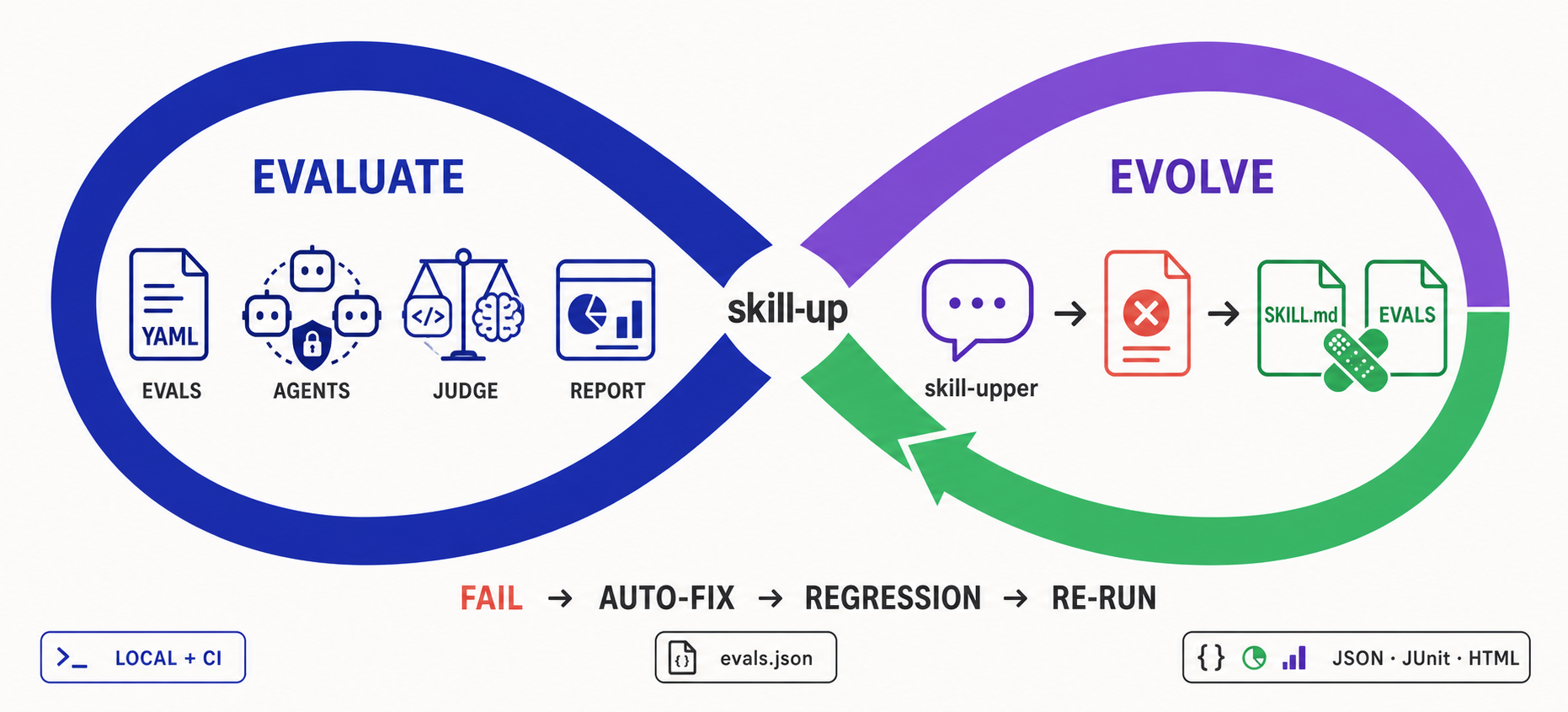
eval.yaml + cases/*.yaml).engine.custom (local transport — see docs/design/custom-engine.md).rule_based, script, and agent_judge evaluation strategies.grading.json, benchmark.json, benchmark.md, plus result.json, JUnit XML, and HTML reports.evals.json via skill-up import, or auto-detect with --auto.The official Agent Skills evaluation guide describes the right evaluation loop: write realistic cases, run with and without the Skill, grade outputs, aggregate results, and iterate. skill-up turns that workflow into a reusable CLI:
eval.yaml + cases/*.yaml format.claude_code, codex, qodercli, qwen_code) instead of tying the workflow to one client.evals.json while adding richer judges, CI-friendly commands, and structured reports.The recommended way to use skill-up is through skill-upper, the Agent Skill shipped in this repository. It lets your AI agent create evals, run skill-up, understand failures, fix the Skill or its evals, add regression coverage, and repeat the loop through conversation.
# Codex, global install
npx skills add https://github.com/alibaba/skill-up/tree/main/skills/skill-upper -g -a codex -y

# Claude Code, global install
npx skills add https://github.com/alibaba/skill-up/tree/main/skills/skill-upper -g -a claude-code -y
You normally do not need to install skill-up first. skill-upper checks for the CLI when it runs and guides the agent through installation if needed.
Open a project that contains your Skill's SKILL.md in Codex, Claude Code, or
another compatible Agent, then ask:
Use skill-upper to evaluate this Skill.
Read SKILL.md, identify its most important behaviors, create realistic eval
cases with appropriate judges, validate the configuration, and run skill-up.
Summarize the results and the highest-impact failures.
skill-upper creates the declarative eval suite and drives the CLI for you:
my-skill/
  SKILL.md
  evals/
    eval.yaml
    cases/
      <case-id>.yaml
my-skill-workspace/
  iteration-1/
    result.json
Continue in the same conversation:
Review the latest skill-up results. For each failure, determine whether the
Skill or the eval is wrong. Fix SKILL.md and supporting files, or repair the
eval case and judge as appropriate. Add regression cases for the bugs you
found, rerun skill-up, and continue until the important behaviors pass.
This is the evolution loop: reports become fixes, fixes become regression cases, and every iteration makes the Skill and its eval suite stronger.
You can still install the CLI directly and hand-write eval.yaml and case
files:
curl -fsSL https://raw.githubusercontent.com/alibaba/skill-up/main/install.sh | bash
See the official documentation for Getting Started, Writing Evals, CLI Reference, and User Configuration. Windows-specific setup and limitations are covered in the Windows guide.
skill-up auto-loads an optional user-level config that supplies default OpenTelemetry env vars and per-environment runtime kwargs. The embedded defaults are empty; downstream consumers maintain their own config file.
embed (empty) < user (~/.config/skill-up/config.yaml) < project ($PWD/.skill-up.yaml) < explicit (--config)
| Source | Path |
|---|---|
embed | empty Config{} — no vendor defaults baked in |
user | $SKILL_UP_CONFIG, else $XDG_CONFIG_HOME/skill-up/config.yaml, else ~/.config/skill-up/config.yaml |
project | $PWD/.skill-up.yaml |
explicit | --config <path> (must exist) |
Missing files at the user and project layers are silently skipped; a missing --config path is a hard error. A corrupt config at any layer also fails the run.
skill-up init                            # writes a template to ~/.config/skill-up/config.yaml (XDG-aware)
skill-up init --local                    # writes a template to $PWD/.skill-up.yaml
skill-up init --print                    # prints the template to stdout
skill-up init --force                    # overwrite an existing file
skill-up init --config foo.yaml          # reads foo.yaml, writes it to ~/.config/skill-up/config.yaml
skill-up init --config foo.yaml --local  # reads foo.yaml, writes it to $PWD/.skill-up.yaml
With --config <path>, init reads that file (validating it as a skill-up
config) and writes its raw bytes to the target — comments and formatting are
preserved. Without --config, init writes a commented YAML template.
schema_version: v1alpha1
kind: SkillUpConfig

telemetry:
  service_name: skill-up                              # OTEL_SERVICE_NAME
  traces_exporter: otlp                                 # OTEL_TRACES_EXPORTER
  traces:
    endpoint: http://localhost:4317                     # OTEL_EXPORTER_OTLP_TRACES_ENDPOINT (4317 for grpc, 4318/v1/traces for http/protobuf)
    protocol: grpc                                      # OTEL_EXPORTER_OTLP_TRACES_PROTOCOL (grpc | http/protobuf); skill-up defaults to grpc
  resource_attributes:                                  # serialized into OTEL_RESOURCE_ATTRIBUTES
    deployment.environment: local
  verbose: false                                        # if true, also enables OTEL_LOG_* payload capture

env:                                                    # arbitrary defaults, applied only-if-unset
  OTEL_EXPORTER_OTLP_HEADERS: authorization=${OTLP_TOKEN}

runtime_kwargs:                                         # keyed by environment.type
  opensandbox:
    base_url: http://localhost:8080
    # extensions: '{}'
For environment variables: any value already set in the process environment wins; the config only fills in missing keys.
For runtime_kwargs: explicit --runtime-kwarg on run > eval.yaml environment.kwargs > user-config runtime_kwargs[environment.type].
Prefer ${ENV_VAR} references inside the config file rather than baking secret literals. The redaction mechanism (userconfig.Redact) masks fields tagged secret:"true" when printing; currently no Config field carries the tag, but the mechanism is in place for future fields.
evals.jsonUse skill-up import to migrate an Anthropic-compatible evals.json into the YAML layout used by this repo:
skill-up import ./evals/evals.json --output ./evals
| Command | Description |
|---|---|
skill-up run [path] | Run evaluation cases and produce reports |
skill-up validate [path] | Validate eval.yaml and case files |
skill-up list-cases [path] | List all cases referenced by the config |
skill-up report <result.json> | Generate reports from a previous run |
skill-up import <evals.json> | Import Anthropic evals.json to YAML cases |
skill-up debug judge <input.json> | Debug judge module with a JSON input |
skill-up debug report <input.json> | Debug report module with a JSON input |
Run your Agent Skill evals in CI on every pull request — and check the same skill
across engines (claude_code / codex / qodercli / qwen_code) in one step. This repo
ships an action at its root (action.yml):
# .github/workflows/skill-eval.yml
name: Skill Eval
on:
  pull_request:
    paths: ['skills/**', 'evals/**', '**/SKILL.md']
jobs:
  eval:
    runs-on: ubuntu-latest          # Docker container action — Linux only
    steps:
      - uses: actions/checkout@v4
      - uses: alibaba/skill-up@main  # see "Versioning" below
        with:
          engine: claude_code        # or codex / qodercli / qwen_code; empty = let eval.yaml decide
          api-key: ${{ secrets.ANTHROPIC_API_KEY }}
          base-url: https://api.anthropic.com   # your model endpoint
          skill-target: evals/eval.yaml
Requirements for the caller: a Linux runner (it's a Docker container action), and your model credential stored as a repo secret. The runner image is public, so no extra registry auth is needed.
Key inputs: engine, model, provider, api-key, base-url, skill-target,
parallelism. The action prebuilds skill-up + the three engine CLIs into its
runner image, so a run is just "pull image, eval". See action.yml
for the full input/output reference.
The container image includes a deliberately pinned skill-up CLI version. The
version is not resolved from latest when a workflow starts, so a given image
digest always runs the same CLI.
The skill-up-version input is only a fallback for a custom image that does not
already contain the skill-up binary. The official image contains the binary,
so this input cannot override its bundled version. To find the effective
version, check the skill-up --version line in the Action log.
Publishing a new skill-up CLI release does not automatically update the GitHub
Action image. Maintainers must synchronize the pinned version, publish and test
a new runner image, and update the image digest in action.yml. The complete
maintainer procedure is documented in the
CI maintenance runbook.
The production Action must use an immutable sha256: image digest. Do not
replace it with skill-up-runner:latest; a mutable tag would allow existing
Action references to change behavior without a repository commit.
uses: points at any git ref that contains action.yml. Pin a release tag
(the first release that includes the action onward) or a commit SHA for stability;
@main always tracks the latest. Release tags published before the action was
added do not contain action.yml and cannot be used as the ref.
A CLI release tag captures the action.yml and runner-image digest that existed
when that tag was created. Because the current runner image is refreshed
manually after CLI release assets become available, do not assume that a CLI tag
automatically contains an Action image with the same CLI version. Until a
separate Action release tag process is introduced, use a post-refresh commit SHA
for an immutable reference or @main when intentionally following Action
updates.
skill-up/
├── cmd/skill-up/          # CLI entry point
├── internal/              # Private implementation packages
│   ├── cli/               # Commands and flags
│   ├── evaluator/         # Case execution and judging orchestration
│   ├── evalevent/         # Evaluation event model, lifecycle, publisher, and JSONL sink
│   ├── runner/            # End-to-end run orchestration
│   └── report/            # JSON, JUnit, HTML, and benchmark reports
├── pkg/                   # Publicly importable APIs
├── schemas/evalevent/     # Versioned evaluation event JSON Schemas
├── skills/skill-upper/    # Distributable workflow Skill
├── docs/                  # VitePress documentation
├── e2e/                   # End-to-end tests and fixtures
└── examples/              # Example evaluations and fixtures
See CONTRIBUTING.md for the complete directory map and architectural responsibilities.
Apache License 2.0 — see LICENSE.
Sign in to join the discussion.
No comments yet. Be the first to say what this is good for.
🪨 why use many token when few token do trick — Claude Code skill that cuts 65% of tokens by talking like caveman

The best-benchmarked open-source AI memory system. And it's free.

Orca is the ADE for working with a fleet of parallel agents. Run any coding agent with your own subscription. Available on desktop, mobile and remote runtime.
A cross-platform desktop All-in-One assistant for Claude Code, Codex, OpenCode, OpenClaw, Grok Build & Hermes Agent. Only official website: ccswitch.io

Never stop coding. Free MIT AI gateway: one endpoint, 352 providers (150+ free), 1200+ models Kimi, Claude, GPT, Gemini, GLM, DeepSeek, MiniMax. Works with Claude Code, Codex, Cursor, OpenCode, Cline & Copilot. Quota-aware auto-fallback, RTK+Caveman compression saves 15-95% tokens, MCP/A2A, Desktop/PWA. Built by 550+ contributors

Compress tool outputs, logs, files, and RAG chunks before they reach the LLM. 20% fewer tokens for coding agents, 60-95% fewer tokens for JSON, same answers. Library, proxy, MCP server.