
JuliusBrussee/
caveman

🪨 why use many token when few token do trick — Claude Code skill that cuts 65% of tokens by talking like caveman
105k
1 add
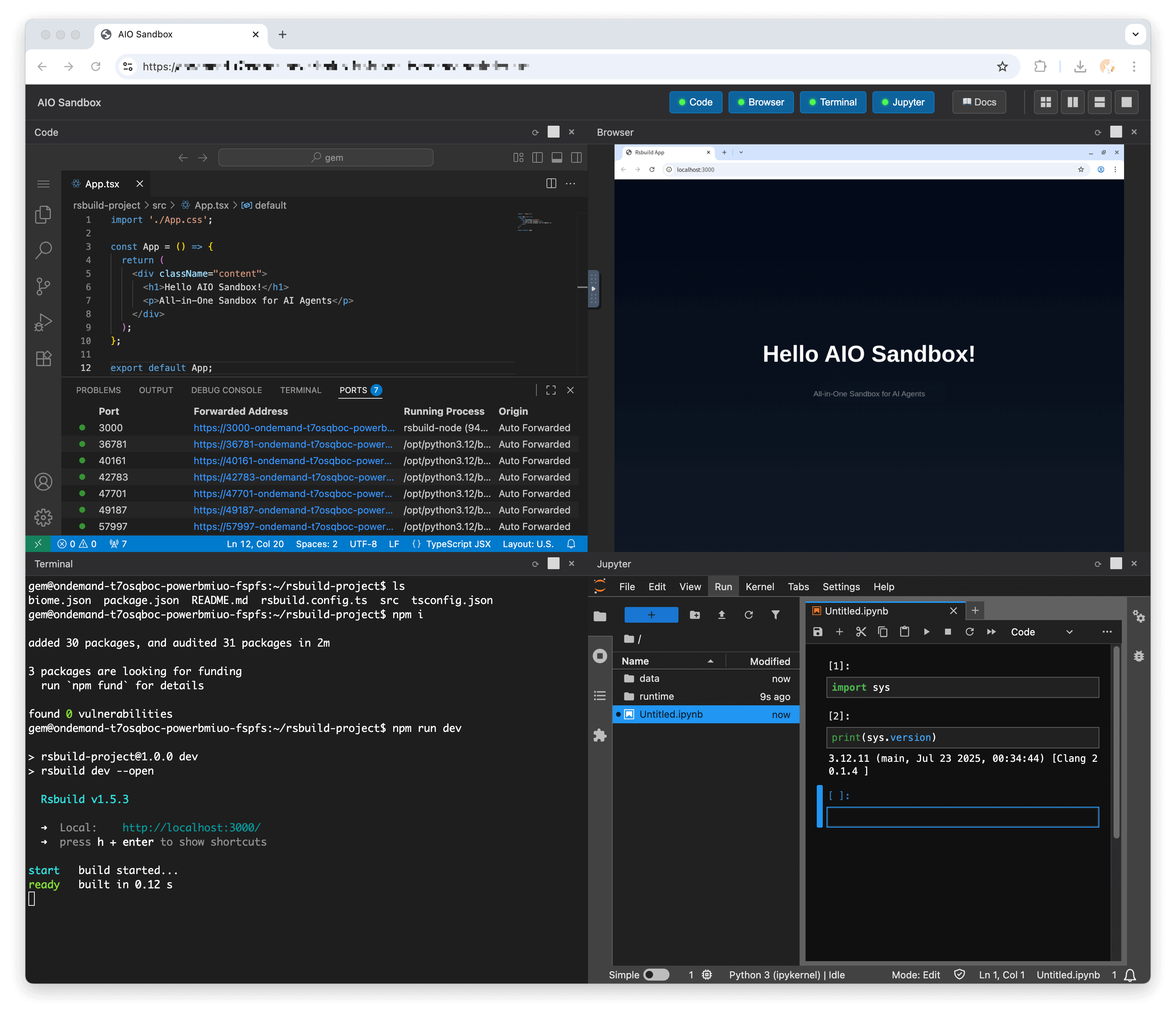
AIO Sandbox combines browser, shell, file, VS Code, Jupyter, and MCP access in a single Docker container. Agents can use the shared filesystem and the built-in APIs to move between browsing, code execution, and file editing without switching environments.
Builders who want one local or containerized workspace for agent browsing, command running, file edits, and tool use.
You can give an agent one shared environment for browsing, coding, and file handling instead of stitching tools together.
Runs browser, shell, file, MCP, and VS Code Server in one container with a shared filesystem.
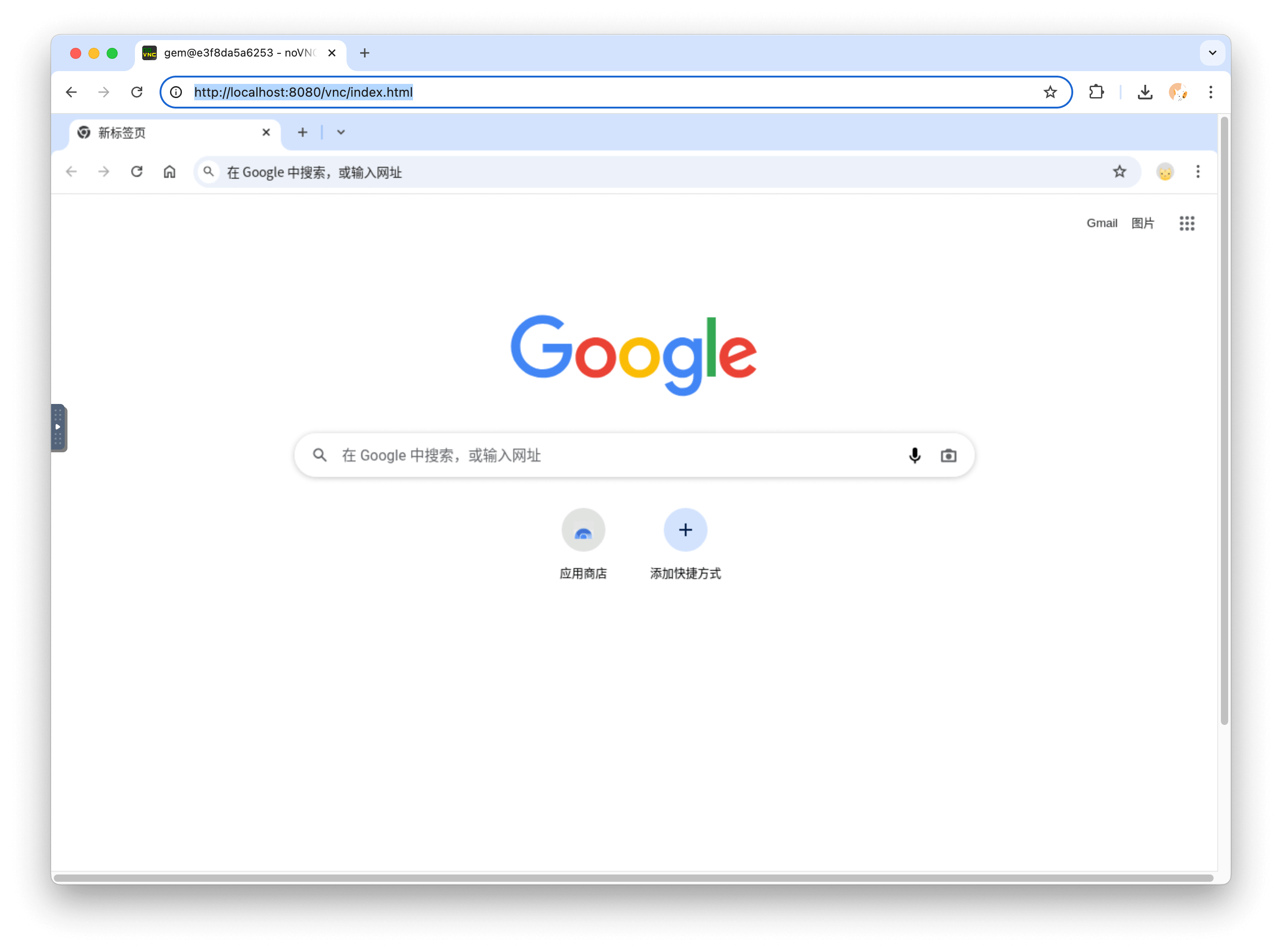
Supports browser work through VNC, CDP, and MCP tools for navigation, clicking, typing, scrolling, and screenshots.
Includes VS Code Server, Jupyter Notebook, a terminal, and port forwarding for web app previews.
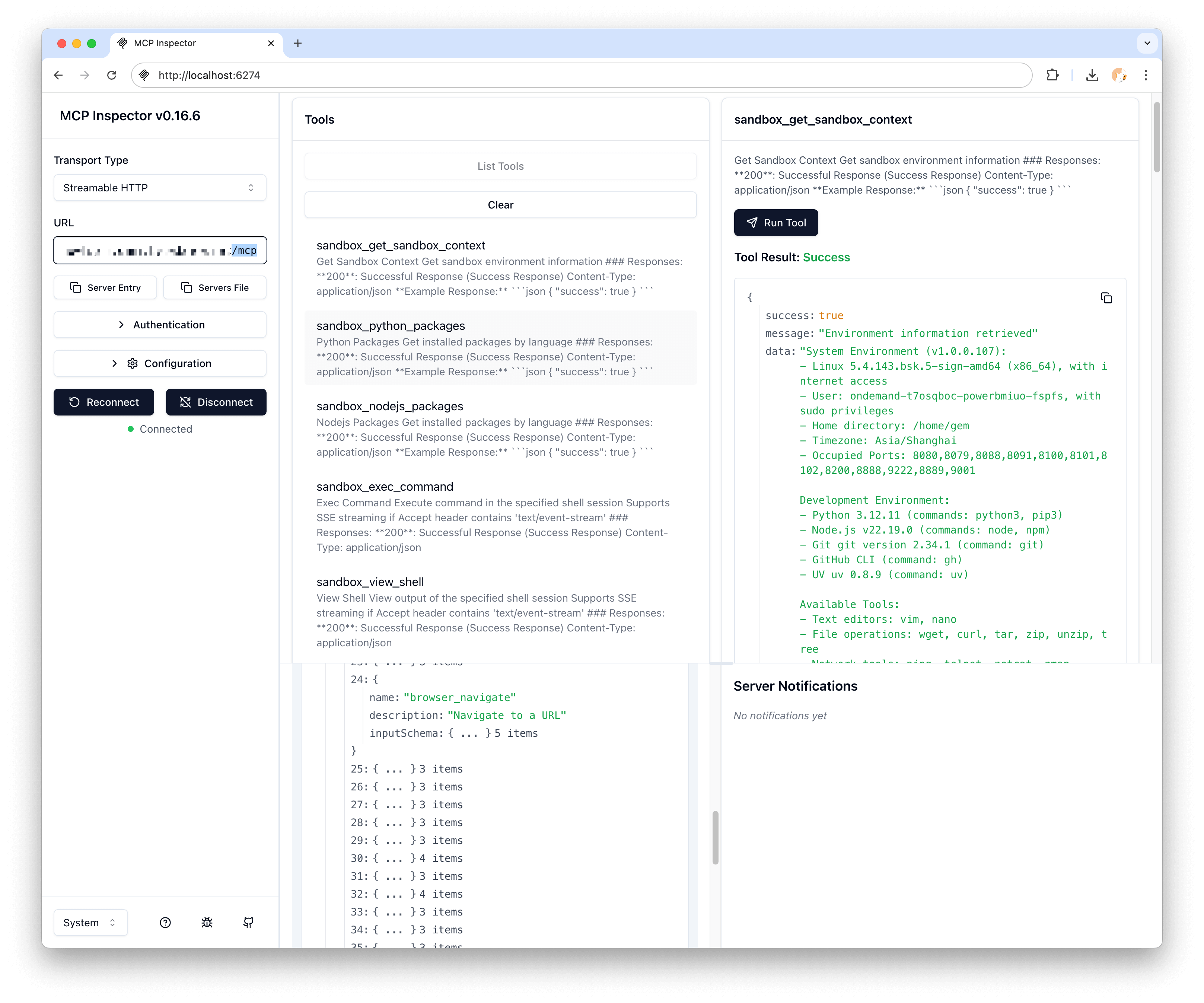
Provides browser, file, shell, and markitdown MCP servers ready to connect to an agent.
Offers Python, JavaScript, and Go SDKs plus example integrations for browser-use, LangChain, OpenAI, and others.
docker run --security-opt seccomp=unconfined --rm -it \
  -e SANDBOX_API_KEY=your-secret-key \
  -p 127.0.0.1:8080:8080 enterprise-public-cn-beijing.cr.volces.com/vefaas-public/all-in-one-sandbox:1.11.0
docker run --security-opt seccomp=unconfined --rm -it \
  -p 127.0.0.1:8080:8080 ghcr.io/agent-infra/sandbox:1.11.0
# or use the pinned mainland China mirror
docker run --security-opt seccomp=unconfined --rm -it \
  -p 127.0.0.1:8080:8080 enterprise-public-cn-beijing.cr.volces.com/vefaas-public/all-in-one-sandbox:1.11.0
pip install agent-sandbox
npm install @agent-infra/sandbox
go get github.com/agent-infra/sandbox-sdk-go
🌐 Browser | 💻 Terminal | 📁 File | 🔧 VSCode | 📊 Jupyter | 🤖 MCP
🌐 Website | 🔌 API | 📑 Paper | 🌟 Examples | 📊 Evaluation




Get up and running in 30 seconds:
# Recommended: Enable API Key authentication (protects all services: API, JupyterLab, VNC)
# - Supports three methods: X-AIO-API-Key header, Authorization: Bearer header, ?api_key= query parameter
# - Without SANDBOX_API_KEY, services remain open (backward compatible)
docker run --security-opt seccomp=unconfined --rm -it \
  -e SANDBOX_API_KEY=your-secret-key \
  -p 127.0.0.1:8080:8080 ghcr.io/agent-infra/sandbox:latest
For users in mainland China:
docker run --security-opt seccomp=unconfined --rm -it \
  -e SANDBOX_API_KEY=your-secret-key \
  -p 127.0.0.1:8080:8080 enterprise-public-cn-beijing.cr.volces.com/vefaas-public/all-in-one-sandbox:1.11.0
For reproducible deployments, pin a release tag. Replace 1.11.0 with the release you want:
docker run --security-opt seccomp=unconfined --rm -it \
  -p 127.0.0.1:8080:8080 ghcr.io/agent-infra/sandbox:1.11.0
# or use the pinned mainland China mirror
docker run --security-opt seccomp=unconfined --rm -it \
  -p 127.0.0.1:8080:8080 enterprise-public-cn-beijing.cr.volces.com/vefaas-public/all-in-one-sandbox:1.11.0
These examples intentionally bind the host side to 127.0.0.1 because the sandbox listens on 0.0.0.0 inside the container. For cloud deployment, keep port 8080 private and publish it through a reverse proxy or Ingress: Cloud Deployment Guide.
Once running, access the environment at:
AIO Sandbox is an all-in-one agent sandbox environment that combines Browser, Shell, File, MCP operations, and VSCode Server in a single Docker container. Built on cloud-native lightweight sandbox technology, it provides a unified, secure execution environment for AI agents and developers.
Traditional sandboxes are single-purpose (browser, code, or shell), making file sharing and functional coordination extremely challenging. AIO Sandbox solves this by providing:
|
Python |
TypeScript/JavaScript |
Golang |
|
Python Example |
TypeScript Example |
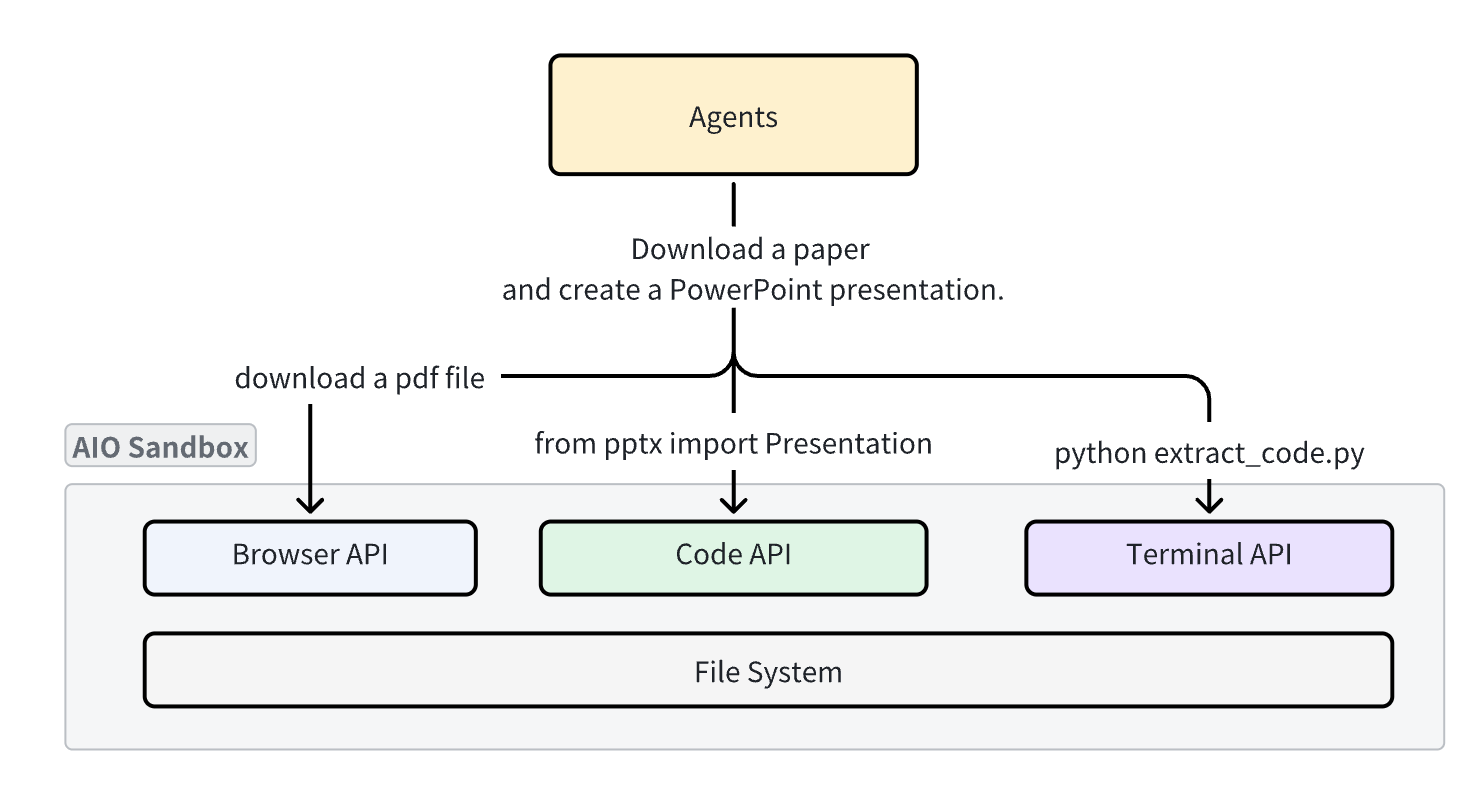
All components run in the same container with a shared filesystem, enabling seamless workflows:
Full browser control through multiple interfaces:
Integrated development environment with:
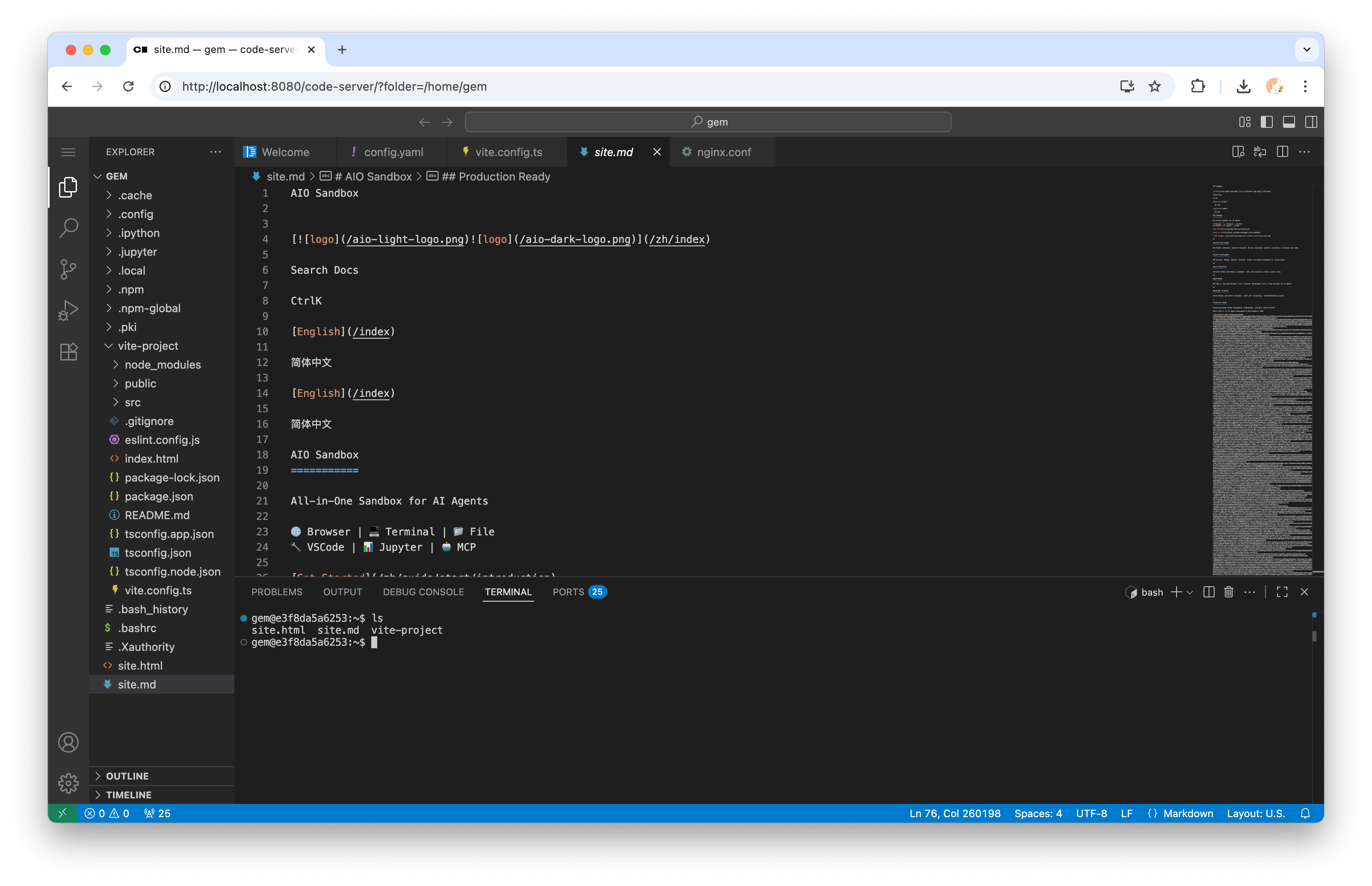
Pre-configured Model Context Protocol servers:
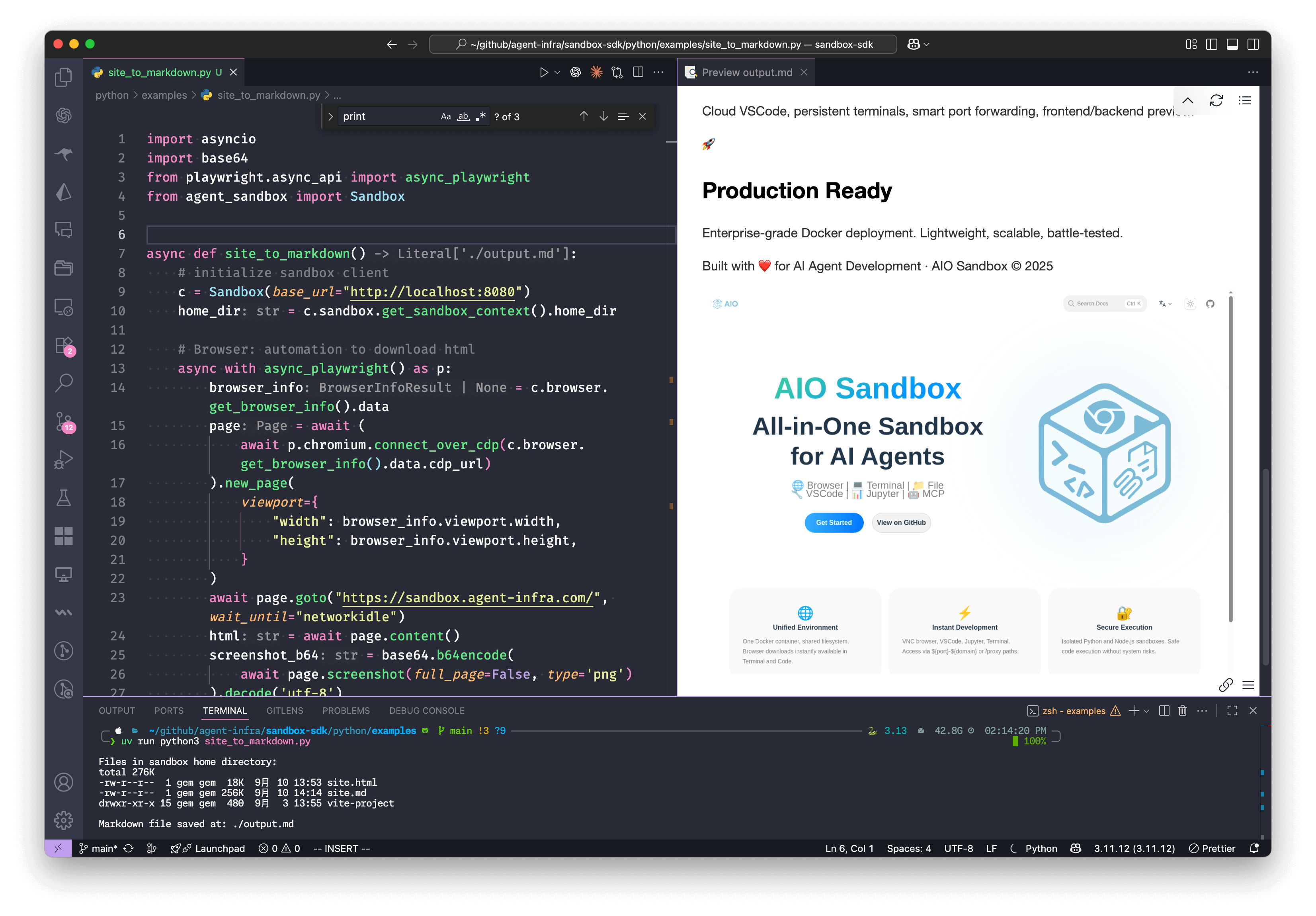
Convert a webpage to Markdown with embedded screenshot:
import asyncio
import base64
from playwright.async_api import async_playwright
from agent_sandbox import Sandbox
async def site_to_markdown():
# Initialize sandbox client
c = Sandbox(base_url="http://localhost:8080")
home_dir = c.sandbox.get_context().home_dir
# Browser: Automation to download HTML
async with async_playwright() as p:
browser_info = c.browser.get_info().data
page = await (await p.chromium.connect_over_cdp(browser_info.cdp_url)).new_page()
await page.goto("https://example.com", wait_until="networkidle")
html = await page.content()
screenshot_b64 = base64.b64encode(await page.screenshot()).decode('utf-8')
# Jupyter: Convert HTML to markdown in sandbox
c.jupyter.execute_code(code=f"""
from markdownify import markdownify
html = '''{html}'''
screenshot_b64 = "{screenshot_b64}"
md = f"{{markdownify(html)}}\\n\\n"
with open('{home_dir}/site.md', 'w') as f:
f.write(md)
print("Done!")
""")
# Shell: List files in sandbox
list_result = c.shell.exec_command(command=f"ls -lh {home_dir}")
print(f"Files in sandbox: {list_result.data.output}")
# File: Read the generated markdown
return c.file.read_file(file=f"{home_dir}/site.md").data.content
if __name__ == "__main__":
result = asyncio.run(site_to_markdown())
print(f"Markdown saved successfully!")
┌─────────────────────────────────────────────────────────────┐
│                    🌐 Browser + VNC                        │
├─────────────────────────────────────────────────────────────┤
│  💻 VSCode Server  │  🐚 Shell Terminal  │  📁 File Ops   │
├─────────────────────────────────────────────────────────────┤
│              🔗 MCP Hub + 🔒 Sandbox Fusion               │
├─────────────────────────────────────────────────────────────┤
│         🚀 Preview Proxy + 📊 Service Monitoring          │
└─────────────────────────────────────────────────────────────┘
| Endpoint | Description |
|---|---|
/v1/sandbox | Get sandbox environment information |
/v1/shell/exec | Execute shell commands |
/v1/file/read | Read file contents |
/v1/file/write | Write file contents |
/v1/browser/screenshot | Take browser screenshot |
/v1/jupyter/execute | Execute Jupyter code |
| Server | Tools Available |
|---|---|
browser | navigate, screenshot, click, type, scroll |
file | read, write, list, search, replace |
shell | exec, create_session, kill |
markitdown | convert, extract_text, extract_images |
services:
  sandbox:
    container_name: aio-sandbox
    image: ghcr.io/agent-infra/sandbox:latest
    security_opt:
      - seccomp:unconfined
    ports:
      - "127.0.0.1:${HOST_PORT:-8080}:8080"
    volumes:
      - sandbox_data:/home/gem/workspace
    extra_hosts:
      - "host.docker.internal:host-gateway"
    restart: "unless-stopped"
    shm_size: "2gb"
    environment:
      SANDBOX_API_KEY: ${SANDBOX_API_KEY:-}
      PROXY_SERVER: ${PROXY_SERVER:-}
      WORKSPACE: ${WORKSPACE:-/home/gem/workspace}
      TZ: ${TZ:-Asia/Singapore}

volumes:
  sandbox_data:
apiVersion: apps/v1
kind: Deployment
metadata:
  name: aio-sandbox
spec:
  replicas: 2
  selector:
    matchLabels:
      app: aio-sandbox
  template:
    metadata:
      labels:
        app: aio-sandbox
    spec:
      containers:
      - name: aio-sandbox
        image: ghcr.io/agent-infra/sandbox:latest
        ports:
        - containerPort: 8080
        resources:
          limits:
            memory: "2Gi"
            cpu: "1000m"
import asyncio

from agent_sandbox import Sandbox
from browser_use import Agent, Tools
from browser_use.browser import BrowserProfile, BrowserSession
from browser_use.llm import ChatOpenAI

sandbox = Sandbox(base_url="http://localhost:8080")
print("sandbox", sandbox.browser)
cdp_url = sandbox.browser.get_info().data.cdp_url

browser_session = BrowserSession(
    browser_profile=BrowserProfile(cdp_url=cdp_url, is_local=True)
)
tools = Tools()


async def main():
    agent = Agent(
        task='Visit https://duckduckgo.com and search for "browser-use founders"',
        llm=ChatOpenAI(model="gcp-claude4.1-opus"),
        tools=tools,
        browser_session=browser_session,
    )

    await agent.run()
    await browser_session.kill()

    input("Press Enter to close...")


if __name__ == "__main__":
    asyncio.run(main())
from langchain.tools import BaseTool
from agent_sandbox import Sandbox

class SandboxTool(BaseTool):
    name = "sandbox_execute"
    description = "Execute commands in AIO Sandbox"

    def _run(self, command: str) -> str:
        client = Sandbox(base_url="http://localhost:8080")
        result = client.shell.exec_command(command=command)
        return result.data.output
from openai import OpenAI
from agent_sandbox import Sandbox
import json

client = OpenAI(
    api_key="your_api_key",
)
sandbox = Sandbox(base_url="http://localhost:8080")


# define a tool to run code in the sandbox
def run_code(code, lang="python"):
    if lang == "python":
        return sandbox.jupyter.execute_code(code=code).data
    return sandbox.nodejs.execute_nodejs_code(code=code).data


# Use OpenAI
response = client.chat.completions.create(
    model="gpt-4",
    messages=[{"role": "user", "content": "calculate 1+1"}],
    tools=[
        {
            "type": "function",
            "function": {
                "name": "run_code",
                "parameters": {
                    "type": "object",
                    "properties": {
                        "code": {"type": "string"},
                        "lang": {"type": "string"},
                    },
                },
            },
        }
    ],
)


if response.choices[0].message.tool_calls:
    args = json.loads(response.choices[0].message.tool_calls[0].function.arguments)
    print("args", args)
    result = run_code(**args)
    print(result['outputs'][0]['text'])
MiniMax provides an OpenAI-compatible API, so you can use the same openai SDK with a different base_url:
from openai import OpenAI
from agent_sandbox import Sandbox
import json

client = OpenAI(
    api_key="your_minimax_api_key",
    base_url="https://api.minimax.io/v1",
)
sandbox = Sandbox(base_url="http://localhost:8080")


def run_code(code, lang="python"):
    if lang == "python":
        return sandbox.jupyter.execute_code(code=code).data
    return sandbox.nodejs.execute_code(code=code).data


response = client.chat.completions.create(
    model="MiniMax-M2.7",
    messages=[{"role": "user", "content": "calculate 1+1"}],
    tools=[
        {
            "type": "function",
            "function": {
                "name": "run_code",
                "parameters": {
                    "type": "object",
                    "properties": {
                        "code": {"type": "string"},
                        "lang": {"type": "string"},
                    },
                },
            },
        }
    ],
    temperature=0.01,  # MiniMax requires temperature > 0
)


if response.choices[0].message.tool_calls:
    args = json.loads(response.choices[0].message.tool_calls[0].function.arguments)
    result = run_code(**args)
    print(result.outputs[0].text)
See the full minimax-integration example for more details.
We welcome contributions! Please see our Contributing Guide for details.
AIO Sandbox is released under the Apache License 2.0.
Built with ❤️ by the Agent Infra team. Special thanks to all contributors and the open-source community.
Ready to revolutionize your AI development workflow?
⭐ Star us on GitHub •
📚 Read the Docs •
🐛 Report Issues
Sign in to join the discussion.
No comments yet. Be the first to say what this is good for.
🪨 why use many token when few token do trick — Claude Code skill that cuts 65% of tokens by talking like caveman

The best-benchmarked open-source AI memory system. And it's free.

Orca is the ADE for working with a fleet of parallel agents. Run any coding agent with your own subscription. Available on desktop, mobile and remote runtime.
A cross-platform desktop All-in-One assistant for Claude Code, Codex, OpenCode, OpenClaw, Grok Build & Hermes Agent. Only official website: ccswitch.io

Never stop coding. Free MIT AI gateway: one endpoint, 352 providers (150+ free), 1200+ models Kimi, Claude, GPT, Gemini, GLM, DeepSeek, MiniMax. Works with Claude Code, Codex, Cursor, OpenCode, Cline & Copilot. Quota-aware auto-fallback, RTK+Caveman compression saves 15-95% tokens, MCP/A2A, Desktop/PWA. Built by 550+ contributors

Compress tool outputs, logs, files, and RAG chunks before they reach the LLM. 20% fewer tokens for coding agents, 60-95% fewer tokens for JSON, same answers. Library, proxy, MCP server.