
affaan-m/
ECC

affaan-m/ECCHarnesses
The agent harness performance optimization system. Skills, instincts, memory, security, and research-first development for Claude Code, Codex, Opencode, Cursor and beyond.
258k
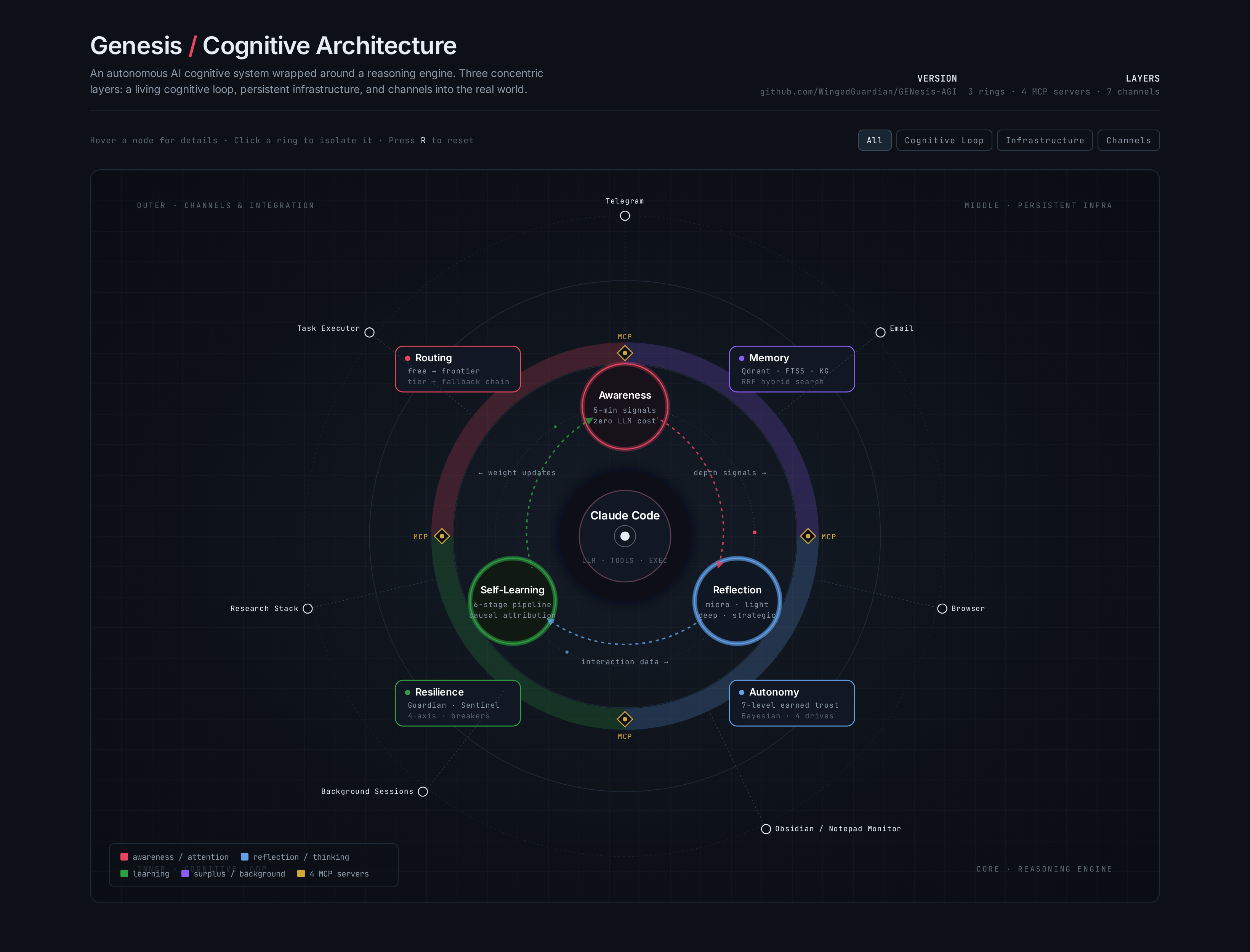
GENesis-AGI is a Claude Code-centered system that layers memory, reflection, self-learning, and earned autonomy on top of agent sessions. It runs as a larger operating setup with hooks, MCP servers, background monitors, and config files that shape how the agent thinks and acts.
Builders who want Claude Code to run with persistent memory, autonomous follow-up, and project rules.
You can let your agent keep working, remember past context, and propose actions without re-explaining the project every time.
A dual-ego loop wakes up, gathers signals, decides what needs attention, and proposes or executes work.
Essential knowledge, proactive recall, deep search, and a knowledge pipeline keep context available across sessions.
Trust is granted per action category based on outcomes, with failures causing demotion and later recovery through performance.
Claude Code hooks and MCP servers connect the system to memory, health, outreach, and other runtime tools.
The system classifies outcomes, extracts reusable procedures, and updates confidence from experience.
Guardian and Sentinel services monitor the host and container to keep the system running.
git clone https://github.com/WingedGuardian/GENesis-AGI.git ~/genesis-setup
cd ~/genesis-setup
./scripts/host-setup.sh
genesis # alias the installer adds; drops you into the container at ~/genesis
claude # onboarding collects your API keys, profile and channels

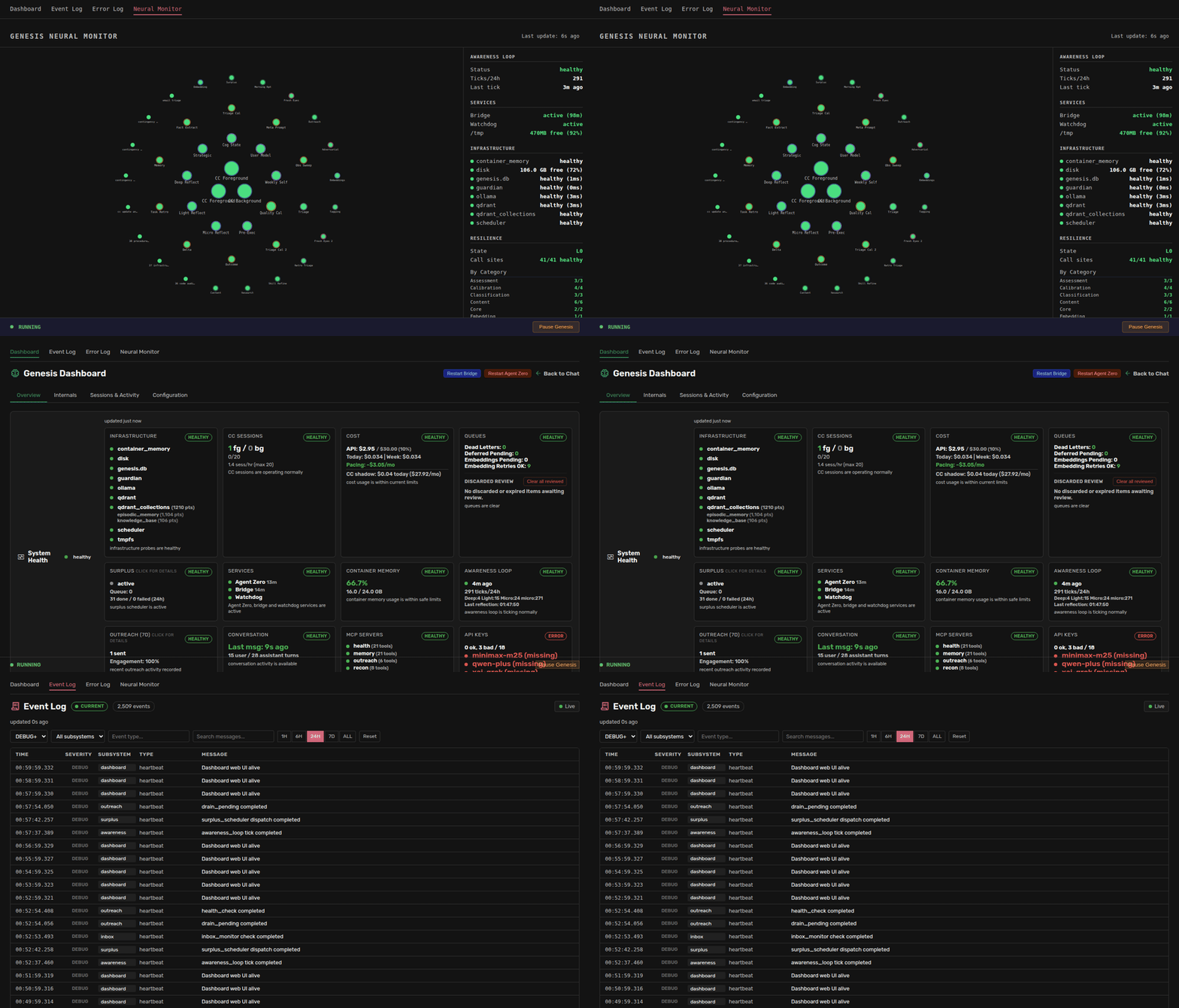





Run your own personal AGI. Genesis is a complete, open cognitive architecture—clone it, run your own instance, and extend the core. What follows is the case for why that's worth doing.
We have the most capable AI models ever created, and we're using them like search bars with better grammar.
Every other AI agent puts you in the driver's seat—and keeps you there. YOU figure out what you need. YOU debug the failures. YOU manage the infrastructure. YOU supervise every step.
But now? This is my run at personal AGI—the most complete open-source cognitive architecture for a persistent personal agent.
Not the sci-fi version. The real one: a system that remembers everything, learns from every interaction, thinks while you sleep, earns autonomy through demonstrated competence, and gets fundamentally better every day it runs. Clone it, run it; tell me I'm wrong!
Truthfully, no, I do not genuinely consider this to be "true" AGI. In order to get to something resembling "true" AGI, it would need to be built from first principles, which would require the orchestration (that IS Genesis) to be built into the LLM layer, the most foundational part of Genesis' compute layer itself. Nor am I of any particular belief that LLMs are necessarily the right architecture for this pursuit in the first place. But because I cannot change the LLM layer, and no better technology currently exists, this is the best I can do today. Call it "proto-AGI;" "pseudo-AGI" even.
But what I can tell you is this: Genesis is far closer to AGI than anything else I've seen, and even if it's not AGI from first principles, it mimics a lot of the same outcomes and behaviours and capabilities that AGI would presumably need to exhibit. If AGI sounds like something you'd like to help contribute to, come build with us →
Personal AI does what you tell it. Personal AGI does what you need.
Your current AI—however capable—is reactive, stateless, and session-scoped. You direct it. You re-explain context every time. It's equally ignorant about you on day 100 as day 1. It's a tool: smart in the moment, dumb about you.
Genesis is different:
With personal AI, you are the intelligence directing the tool. With personal AGI, it is an intelligence working alongside you—and the amount you need to manage shrinks over time.
How it does this:
Day 1 — a strong generalist with full cognitive infrastructure. Day 30 — a personalized specialist in every domain you've touched. Day 90 — anticipating needs you haven't articulated yet. Day 180 — evolving its own architecture to serve you better.
Genesis is a cognitive architecture that makes the AGI claim explicitly—and backs it up with open-source code you can read, run, and challenge.
Not a chatbot. Not an API wrapper. Not another prompt chain with a for loop.
It uses Claude Code as its reasoning engine. Genesis is what it's been missing: the mind that remembers, reflects, learns, and decides.

"Claude Code already had the brain. We gave it the heart."
50+ subsystems. 4 MCP servers. 2 vector databases. Every design decision made by one engineer working full-stack across infrastructure, cognition, and integration layers. That's the point. If one developer with the right cognitive infrastructure can build and run a system this complex, imagine what a team becomes capable of.
Genesis is a full system, not a pip package. It runs best on a dedicated Linux machine.
| Resource | Minimum | Recommended | Notes |
|---|---|---|---|
| OS | Ubuntu 22.04+ | Ubuntu 24.04 LTS | Debian-based required for auto-install. Other Linux works with manual setup. |
| RAM | 8 GB | 16 GB+ | Genesis + Qdrant + Claude Code + background tasks. 8 GB is tight under load. Service memory caps are percentage-based, so Genesis right-sizes itself to the box — scaling down on an 8 GB host and up on a 32 GB+ one. |
| Disk | 15 GB | 40 GB+ | The installer's pre-flight check requires 15 GB free and stops below it. Fresh install ~400 MB; memory, logs, and caches grow steadily with use. |
| CPU | 2 cores | 4-8 cores | Concurrent background tasks benefit from parallelism. |
| Network | Internet access | Always-on | Cloud LLM APIs required. Offline not supported. |
These are the requirements for the host VM. Genesis runs inside a container the installer creates.
| What you need | Why | Where |
|---|---|---|
| Claude account | Powers the Claude Code agentic sessions — the reasoning Genesis does as an agent | claude.ai |
| At least one LLM provider key | Required. Genesis's own cognitive layer — routing, reflection, triage, memory extraction — calls these directly and does not run on your Claude subscription. Several have free tiers | see secrets.env.example |
| Telegram bot token (optional) | Only if you want the Telegram channel: proactive messages, approvals, voice | @BotFather |
| Tailscale (free) | Remote dashboard access from any device — no port-forwarding | tailscale.com |
One script sets up the entire infrastructure: Incus container, Guardian health monitor, bidirectional SSH, all dependencies.
git clone https://github.com/WingedGuardian/GENesis-AGI.git ~/genesis-setup
cd ~/genesis-setup
./scripts/host-setup.sh
Genesis is installed inside a container the script creates — the clone on your host is only the installer. Everything below happens in the container.
Step 1 — go in:
genesis # alias the installer adds; drops you into the container at ~/genesis
If the alias isn't recognised yet, open a new terminal or source ~/.bashrc.
Step 2 — start your first session and let it set you up:
claude # onboarding collects your API keys, profile and channels
Onboarding is interactive and covers the credentials Genesis needs. If it doesn't
start on its own, run /setup. You can also edit ~/genesis/secrets.env directly
inside the container — the installer creates it from the template but leaves it to
you to fill in.
At minimum, set one LLM provider key. Without it the cognitive layer — routing,
reflection, triage, memory extraction — has nothing to call, and those are the parts
described above. Telegram is optional and configured in the same file
(TELEGRAM_BOT_TOKEN from @BotFather, plus
TELEGRAM_ALLOWED_USERS — message @userinfobot for your
numeric id); leave both blank to run without that channel.
What you get:
| Component | What it does |
|---|---|
| Full cognitive stack | Memory (4-layer hybrid retrieval + knowledge graph), self-learning loop, reflection engine, earned autonomy, dual-ego decision layer—all running continuously |
| Genesis server | Dashboard, API, and all subsystems at http://<container-ip>:5000 |
| Qdrant | Vector database powering semantic memory (2 collections: episodic + knowledge) |
| Channel integration | Telegram (proactive outreach, approvals, voice), email triage, browser automation, inbox monitoring |
| Background cognition | Autonomous sessions that think, research, and audit while you're away—surplus compute, reflection cycles, goal tracking |
| Self-healing infrastructure | Guardian (host VM) + Sentinel (container)—two independent systems monitoring each other in a closed loop |
| Claude Code | CLI with Genesis hooks + 4 MCP servers auto-activated per session |
| Component | Install |
|---|---|
| Ollama | curl -fsSL https://ollama.com/install.sh | sh |
| LM Studio | Download from lmstudio.ai |
Without these, Genesis uses cloud embedding APIs. With them: private, faster, free.
Your Genesis install is one operational system: the public GENesis-AGI codebase, your private fork for customizations, and your private encrypted backups repo. See .claude/docs/your-genesis.md for the full model.
git clone <your-fork> → scripts/bootstrap.sh → scripts/restore.sh. Back in minutes.Four cognitive layers, running continuously:
graph TB
    subgraph "Cognitive architecture"
        EGO["Ego<br/><i>Two egos: signal-driven focus,<br/>goal tracking, autonomous action</i>"]
        AL["Awareness loop<br/><i>5-min tick, 18+ signals,<br/>zero LLM cost</i>"]
        RE["Reflection engine<br/><i>Micro / Light / Deep / Strategic<br/>with relevance tagging</i>"]
        SL["Self-learning loop<br/><i>Dopaminergic feedback</i>"]
    end

    subgraph "Infrastructure"
        RT["Operational runtime<br/><i>Dashboard, API, extensions</i>"]
        CC["Claude Code<br/><i>Reasoning, tools, sessions</i>"]
    end

    subgraph "Memory and data"
        QD["Qdrant<br/><i>2 vector collections</i>"]
        SQ["SQLite + FTS5"]
        MCP["4 MCP servers<br/><i>memory / recon / health / outreach</i>"]
    end

    EGO -->|"dispatches work"| CC
    AL -->|"depth signal"| RE
    RE -->|"observations"| EGO
    RE -->|"interaction data"| SL
    SL -->|"weight updates"| AL

    AL <--> RT
    RE <--> MCP
    MCP <--> QD
    MCP <--> SQ

    style EGO fill:#1a1a2e,stroke:#e94560,color:#fff
    style AL fill:#1a1a2e,stroke:#e94560,color:#fff
    style RE fill:#1a1a2e,stroke:#0f3460,color:#fff
    style SL fill:#1a1a2e,stroke:#533483,color:#fff
Every 5 minutes, the system collects 18+ signals across all its inputs—entirely programmatic, zero LLM cost. Signals get classified by how much thinking depth they warrant. Routine health checks get a quick pass. Novel patterns in user behavior get a deep analysis. Accumulated smaller reflections trigger strategic synthesis. The depth decision is automatic, and each cognitive layer feeds the next.
On top of this sits the ego layer: two autonomous decision-makers that read the system's observations and act on them. The User Ego (running Opus) focuses on user goals, activity patterns, and pending work. The Genesis Ego (running Sonnet) handles system health, infrastructure, and operational decisions. Each one assembles its own context from filtered observations, proposes actions via Telegram, and dispatches Claude Code sessions to execute approved work. They run on adaptive cadence—more frequently when things are active, backing off when they're not.
The ego doesn't just observe—it runs a unified cognitive loop. Signals (a stale goal, a conversation, a system event) enter a queue. A focus selector picks what matters most. Context gets assembled for that focus. The ego thinks, proposes, acts—cycle repeats. What you experience: Genesis notices when your goals go stale, reviews them with full context, tells you when subgoals complete a milestone, and adjusts its own review frequency per goal. It doesn't wait for you to ask "how's that project going?"—it already checked.
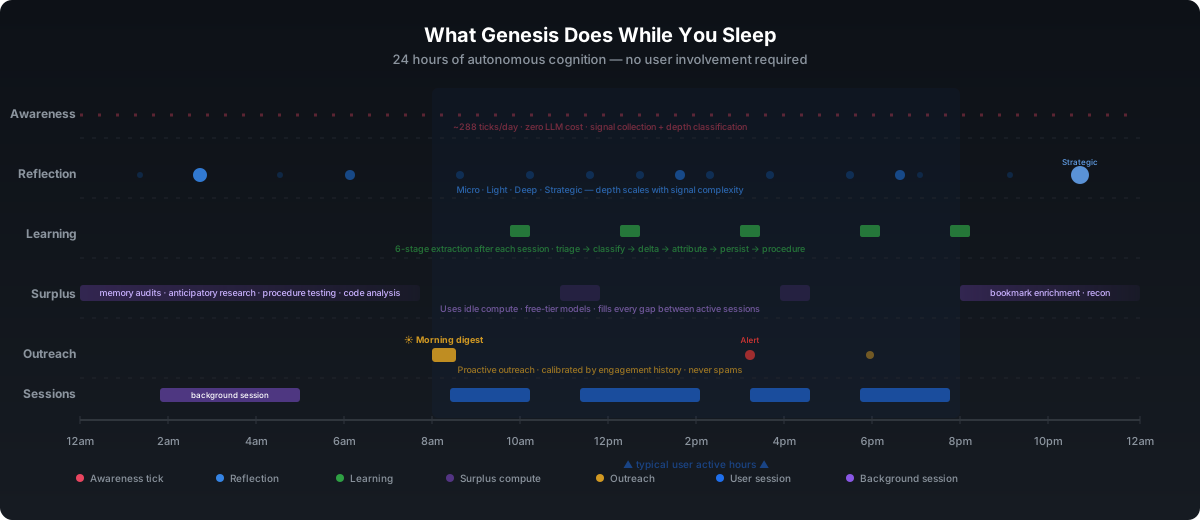
When Genesis isn't handling a user request, it doesn't sit idle. It researches topics you'll ask about tomorrow. It audits its own memory for contradictions and staleness. It tests whether its learned procedures still hold up. It works through problems it got stuck on earlier. The system you come back to on Monday is measurably sharper than the one you left on Friday.
Most AI memory is a vector database with a retrieval function. Genesis runs a four-layer architecture—because "what are we working on?", "what's relevant right now?", "find everything about X", and "what does the external documentation say?" are fundamentally different operations that need different retrieval strategies.
L1: Essential Knowledge (~300 tokens, injected at every session start)
    Pure DB queries. No LLM, no network, no latency.
    Content: active context, recent decisions, structural overview.
    → The forest view. Always available, even if everything else is down.

L2: Proactive Recall (fires on every user message, ~4.5s budget)
    Surfaces the most relevant memories automatically—before Genesis
    even starts thinking about your question. How many depends on what
    you asked: one for a bare command, three for general conversation,
    six for a question or a decision (a configurable ceiling caps it at eight).
    Hybrid: FTS5 keyword + Qdrant vector + activation scoring → RRF fusion.
    → You never have to ask "do you remember?"—it already checked.

L3: Deep Search (on-demand, ~1-2s)
    Full pipeline: two to five ranked signals fused via Reciprocal Rank
    Fusion — vector, keyword and activation, plus intent and event
    signals when they apply. Degrades to keyword+activation with no
    embedding provider.
    Wing/room filtering, intent classification, graph traversal.
    → When you need everything Genesis knows about a topic.

L4: Knowledge Pipeline (external, permanent)
    Ingests from text, PDF, audio, video, web pages, YouTube transcripts.
    Separate vector collection. Idempotent — re-ingesting updates, never duplicates.
    → Domain knowledge that doesn't decay with time.
LLMs lose the forest for the trees—that's a known weakness of large-context reasoning. The layer model is the architectural compensation: L1 maintains the forest (what are we doing, what have we decided, what matters), while L2-L3 drill into specific trees on demand. L4 provides the reference library.
What actually happens when you send a message:
Every prompt triggers L2 before Genesis starts reasoning about your question:
confidence × recency × (base + w₁·access_freq + w₂·connectivity) × class_weight — a weighted blend, not a bare sum. The base term is a floor (default 0.6) so a never-retrieved memory isn't buried by the cold-start problem; the weights are a tunable knob.If the embedding provider is down, vector search is skipped—FTS5 still works because it's compiled into SQLite with zero external dependencies. Memory degrades gracefully, never goes dark.
Not just documents in a vector space:
Memories aren't isolated documents—they're connected. The knowledge graph creates typed links between memories across 12 edge types: supports, contradicts, extends, elaborates, succeeded_by, preceded_by, and more. When a memory is stored, auto-linking finds its nearest neighbors and creates typed edges based on similarity. When you recall a fact, Genesis can walk the graph to find what supports it, what contradicts it, and what replaced it. As of September 2026, on the install this was measured from: ~86,000 memories, of which ~81,000 are embedded into the episodic vector collection (a second collection holds ~3,900 knowledge-base entries), wired together by ~264,000 typed connections.
An event calendar tracks time-anchored information—deadlines, scheduled tasks, recurring cycles—so Genesis knows not just what happened but when, and can anticipate what's coming. Procedural memory captures reusable multi-step workflows extracted from experience, each with a calibrated confidence score that promotes or demotes it based on outcomes.
Activation scoring ensures relevance isn't just cosine similarity—it's time-aware decay (configurable half-lives: 30-60 days by source type), access frequency (log scale, capping at 20 retrievals), graph connectivity, and class weighting. A steering rule from month one outranks a casual observation from yesterday.
Two collections, different lifecycles:
| Collection | What lives there | Lifecycle |
|---|---|---|
| Episodic | Conversations, decisions, reflections, evaluations | Decays over time. Subject to correction. |
| Knowledge | External domain data, ingested reference material | Permanent. Authoritative. Re-ingested, never duplicated. |
Session extraction: After conversations end, a pipeline extracts what mattered—entities, decisions, evaluations, action items, relationships—each tagged with provenance back to the source conversation and line range. The system doesn't just remember what you said. It identifies what's worth keeping.
Wing taxonomy: Memory is classified into 12 structural domains (autonomy, career, channels, dev_workflow, employment, general, infrastructure, integrations, learning, memory, research, routing) with subtopics. Querying within a specific domain cuts noise from the full store. Classification uses tiered confidence signals: file path patterns (strongest) → keywords → tags → source pipeline → fallback.
Volume is the least interesting thing about this, and it is what a vector database with a lot of rows in it also has. The question worth asking is whether retrieval still works once the store is large — so Genesis grades its own recall weekly with an LLM judge and keeps the series:
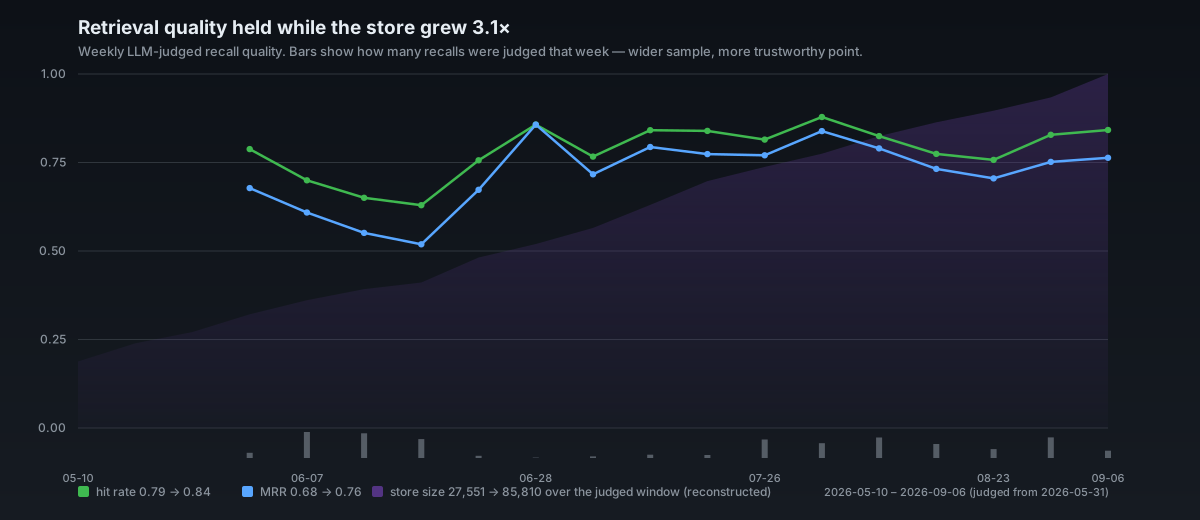
Weekly snapshots from eval_snapshots, 2026-05-10 to 2026-09-06, on a single
install. An LLM judge scores each recall; hit rate is whether a relevant
memory came back at all, MRR is how near the top it landed.
Regenerate with python3 scripts/gen_memory_quality_chart.py.
Most AI systems log what happened. Genesis classifies why it happened, extracts a reusable principle, and verifies that principle works next time. The pipeline runs automatically after every meaningful interaction:
1. Triage        → Should we learn from this at all? (5 depth levels)
2. Outcome       → What happened vs. what was expected? (5 outcome classes)
3. Delta
Sign in to join the discussion.
No comments yet. Be the first to say what this is good for.
The agent harness performance optimization system. Skills, instincts, memory, security, and research-first development for Claude Code, Codex, Opencode, Cursor and beyond.
The job search that runs on your machine. AI job application framework built on Claude Code: evaluate postings, tailor CVs, write cover letters, prep interviews. Fork it and own it.
from vibe coding to agentic engineering - practice makes claude perfect
🌊 The original agent meta-harness. Deploy intelligent multi-player swarms, coordinate autonomous workflows, and build conversational AI systems. Features adaptive memory, self-learning intelligence, RAG integration, and native Claude Code / Codex / Hermes and many more Integrated
Practical patterns, starters & CLI tools for loop engineering with AI coding agents. Design systems that prompt and orchestrate agents (inspired by Addy Osmani and Boris Cherny). Includes loop-audit, loop-init, loop-cost.

Git. Ship. Done - Core