


VoltAgent/awesome-openclaw-skillsCollections
The awesome collection of OpenClaw skills. 5,400+ skills filtered and categorized from the official OpenClaw Skills Registry.🦞
52k
This repo collects examples of AutoResearch in practice, from model training and GPU kernels to prompt tuning and software speedups. Each entry links to the underlying repo or trace so you can inspect the agent’s attempts, not only the final result.
Builders who want to study real agent loops, traces, and reusable AutoResearch setups.
You can browse proven AutoResearch examples and inspect how the optimization loop behaved in real projects.
A table of AutoResearch examples across LLM training, kernel optimization, software speedups, and research tasks.
Each entry points to a progress chart, blog, PR, or dashboard so you can see the full optimization trajectory.
Includes research benchmarks like ResearchClawBench and FML-bench with links to traces and evaluations.
Lists related repos and forks such as autoresearch, pi-autoresearch, autoresearch-mlx, and CORAL.

A curated list of AutoResearch use cases with optimization traces and open source implementations. Every entry includes a link to the actual optimization trajectory so you can see what the agent tried, not just the final result.
AutoResearch is, at its core, a prompt. Karpathy released it as a single markdown file - program.md, that instructs a coding agent (Claude Code, Codex, or similar) to follow an optimization workflow. The agent edits one file (train.py, that trains a language model), runs for a fixed 5 minutes on a GPU, checks whether the metric improved, and either commits the change or reverts it. Then it loops forever.
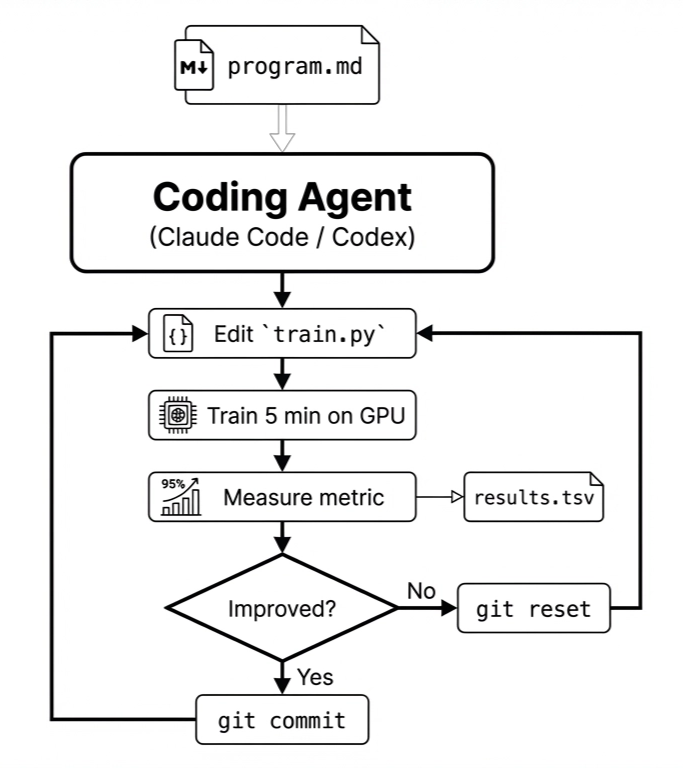
The specific program.md that ships with AutoResearch is written for one task: training a GPT model. But the structure - iteratively optimizing a file against an evaluation metric, with a discard/keep loop - turns out to be portable. In the weeks since release, the community has adapted it to GPU kernel optimization, template engine optimization, tabular ML engineering, and more. The program.md for each of these looks different, but the loop is the same.
| Use Case | Description | Author | Links | Traces |
|---|---|---|---|---|
| LLM training optimization | The original - optimize nanoGPT training code. 20 improvements found overnight on hand-tuned code | Andrej Karpathy | GitHub · Tweet | progress chart |
| Speed up Shopify's template engine | 53% faster parse+render, 61% fewer allocations from 93 automated commits on Shopify's Liquid engine | Tobi Lutke (Shopify CEO) | GitHub · Tweet | PR |
| GPU kernel optimization | Autoresearch applied to CUDA kernel optimization (18 → 187 TFLOPS) | RightNow AI | GitHub · Tweet | progress chart |
| Voice agent prompt engineering | Optimize voice agent prompts with automated evaluation (score 0.728 → 0.969) | Archie Sengupta | GitHub · Tweet | progress chart |
| Predict baseball pitch speed | Build predictive model for pitch velocity from biomechanics data (R² 0.44 → 0.78) | Kyle Boddy (Driveline Baseball) | Tweet | progress chart |
| XGBoost for tennis match prediction | Predict ATP/WTA match outcomes - encountered and documented reward hacking | Nick Oak | Blog · GitHub | blog |
| RL post-training optimization | Autoresearch for RL hyperparameters on Qwen 0.5B + GSM8K (eval 0.475 → 0.550 in fewer steps) | Vivek Kashyap | GitHub · Tweet | progress chart |
| Ancient scroll ink detection | Vesuvius Challenge autoresearch agent swarm for ink detection models. 4 agents 24/7, cross-scroll generalization nearly doubled | Vesuvius Challenge | Blog | blog |
| Earth system model optimization | Hybrid: LLM proposes formula structures, TPE optimizes parameters. Fire correlation 0.09→0.65 | Dev Paragiri (UMD CS) | Tweet · Blog | blog |
| Bitcoin price formula discovery | Autonomous search for best time-based formula predicting Bitcoin price. 328 experiments, 50.5% RMSE improvement over power law. Walk-forward OOS evaluation with bootstrap significance testing | Carlos Baquero | GitHub | progress chart |
| Protein folding architecture search | Codex /goal iterating SimplexFold (AlphaFold2-style model) on NanoFold benchmark for 150+ hours, searching topologically inspired architectures. 127 scored runs, best val C-alpha lDDT 0.4311 | Chris Hayduk (OpenAI) | GitHub · Tweet | progress chart |
| Flappy Bird game AI | Evolved a Flappy Bird agent from scratch over 100 iterations — mean score 2.76 → 20.9 (6.6×) for ~$12, no human guidance beyond initial setup | Weco AI | Blog | progress chart · search tree |
| Autoresearch on autoresearch | Autoresearch harness optimizing its own code: 100 outer-loop steps over 8 days. Improved agents generalize to held-out benchmarks; reward hacking cut 63% → 34% on KernelBench | Weco AI | Blog | progress chart · blog |
| TPU model performance optimization | Autoresearch loop applied to TPU training MFU / tokens-per-sec on v6e-8. Llama3-8B and Qwen3-8B optimized across JAX and torchax lanes, profiling each run via an XProf MCP and keeping one model-code change per experiment; several agent+harness stacks surpassed the MaxText reference (Google's repo of state-of-the-art TPU-optimized models) | Aleksey Vlasenko | GitHub · Blog | interactive trace |
| Bioinformatics software speedup | AutoZyme: autonomous agentic framework that accelerates bioinformatics software. 45 tasks across 9 scientific domains, 16.7x median and up to 1482x (single-cell), with output concordance and peak memory verified against frozen upstream baselines | Elliot Xie et al. (UW-Madison) | GitHub · Paper | benchmarks |
| OpenAI Parameter Golf hiring challenge | Weco's Aiden agent in OpenAI's LM-training challenge (16 MB artifact, 10 min on 8×H100). 7 of 47 merged leaderboard records (best human: 3), h-index 10 (next: 7), 1,243 experiments in 22 days | Weco AI | Blog | blog |
| Benchmark | Description | Maintainer | Links | Traces |
|---|---|---|---|---|
| ResearchClawBench | End-to-end scientific research benchmark for AI agents: agents read raw data and papers, write code, generate figures, and produce publication-style reports scored against expert checklists | InternScience | GitHub · Dataset · Leaderboard | run traces |
| FML-bench | Controlled study of AI research agent strategies across 18 ML research tasks (10 domains), separating search strategy from execution infrastructure. Finds a simple greedy hill-climber nearly matches the best tree-search agent; performance tracks early convergence and focused exploration, not diversity or compute | NUS | Paper · GitHub | search dynamics |
| Project | Description | Links |
|---|---|---|
| autoresearch | The original - single GPU, 630 lines of Python | GitHub |
| pi-autoresearch | Generalized as a Pi extension. Works for any optimization target - test speed, bundle size, build times, Lighthouse scores | GitHub |
| autoresearch-mlx | Apple Silicon (MLX) port. No PyTorch required, uses unified memory | GitHub |
| autoresearch-win-rtx | Windows + consumer RTX GPU port (RTX 2060 through 4090) | GitHub |
| autoresearch-at-home | Distributed autoresearch - SETI@home style. Multi-agent swarm coordination | GitHub |
| autoresearch (Claude Skill) | Generalized as a Claude Code skill for any domain | GitHub |
| agent-digivolve-harness | A control layer for long-running CLI agent work. Generalizes the autoresearch keep/revert loop with persistent run state, explicit eval packages, baseline and holdout cases, and one bounded mutation per iteration | GitHub |
| auto-agent | Autoresearch, but for AI agents. Given a golden dataset, it autonomously improves a target agent through an iterative hypothesis-driven loop: analyze failures, spawn a coding agent to implement fixes, evaluate, and accept or rollback | GitHub |
| CORAL | Multi-agent autoresearch with shared evolution. Spawns parallel Claude Code agents in isolated git worktrees that share a hub of attempts, notes, and reusable skills. Each agent reads a task guide, commits changes, triggers eval-on-commit, and loops — with cross-agent knowledge sharing as the core mechanism for open-ended discovery | GitHub · Paper |
| evo | A Claude Code plugin for autoresearch | GitHub |
| Agon | Research orchestrator as a Claude Code plugin: a topic → idea → proposal → experiment loop with scientist/coder/auditor roles, deployed across 10+ disciplines | GitHub · Paper |
| AutoNumerics | Autonomous multi-agent pipeline that writes, debugs, and validates classical PDE numerical solvers from a plain-language problem description, picking the right numerical method automatically | GitHub · Paper |
Want to add a use case? Open a PR or file an issue.
To make our work easier, please make submissions as verifiable as possible:
Sign in to join the discussion.
No comments yet. Be the first to say what this is good for.
The awesome collection of OpenClaw skills. 5,400+ skills filtered and categorized from the official OpenClaw Skills Registry.🦞
A curated list of awesome Claude Skills, resources, and tools for customizing Claude AI workflows

PM Skills Marketplace: 100+ agentic skills, commands, and plugins — from discovery to strategy, execution, launch, and growth.

A collection of MCP servers.

Model Context Protocol Servers
Extracted system prompts from Anthropic - Claude Fable 5.1, Opus 5, Claude Design, Claude Code. OpenAI - ChatGPT GPT-6-Astra, Codex. Google - Gemini 3.8 Flash, 3.1 Pro, Antigravity. xAI - Grok, Grok Bot, Cursor, Kimi and more! Updated regularly.