


affaan-m/
ECC

affaan-m/ECCHarnesses
The agent harness performance optimization system. Skills, instincts, memory, security, and research-first development for Claude Code, Codex, Opencode, Cursor and beyond.
258k
Foreman keeps a roadmap in the project so your agent can decide what comes next without losing the reason, constraints, or open blockers. It checks the roadmap against the code, then turns finished work into evidence that can inform later tasks.
Builders who use Claude Code or Codex and want each session to pick up from the last one with project context intact.
You can resume work with a clear next task, its reason, and its checked context instead of re-explaining the project.
Stores the plan in the repository so task order and context travel with the project.
Answers "what's next?" with a suggested task and the reason behind it.
Checks stale plans against the current code before the agent acts.
Shows status, blockers, and work waiting for acceptance.
Creates a prompt for the next step without requiring a roadmap entry.
Keeps acceptance of finished work distinct from a passing run.


Your plan stays next to your code. The next task arrives with its context checked.
Available on
Get started · What is this? · How it works · What you can do · Evidence
You finish a session with a fix, a side request and an issue still waiting. Next time, you need to know which one comes first and why. Foreman keeps that context in a roadmap beside your code.
Ask "what’s next?" and it recommends a task with its reason and a prompt checked against the project’s files. Completed work brings evidence back into the plan; acceptance stays a separate decision.

The roadmap lives in your project. Foreman reads it, checks the relevant context and helps you choose what to do next. Optional lessons let later tasks learn from earlier work without creating a separate knowledge base.
| You say | You get |
|---|---|
| Add this to the roadmap | Requested work recorded with its reason and boundaries |
| Where are we? | Status, blockers and work waiting for acceptance |
| What's next? | A recommended task and a choice of where to run it |
| Check whether the plan still matches the code | A grounded review before choosing work |
| Craft a prompt for this | A checked handoff without requiring a roadmap entry |
Choose the assistant you use. Its edition page has the installation steps, commands and compatibility notes for your setup.
| Your assistant | Status | Next step |
|---|---|---|
| Claude Code | Available | Install and get started |
| Codex | Available | Install and get started |
Foreman is for a solo developer. It does not become a team tracker, code-review service, unattended scheduler or workflow server. Your project keeps its own data. The optional ledger is off until requested; disabling it deletes no existing notes.
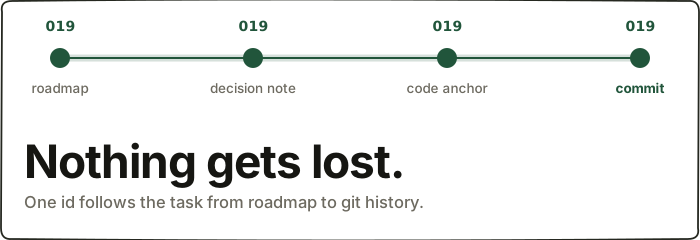
The task trail above illustrates the workflow. The recorded demo below comes from Claude Code; it is not a Codex measurement. Evidence and methodology.
Measurements belong to the model and setup that produced them. Each edition keeps its own results, limitations and any measurements still missing:
Research and validation · Benchmark instruments and retained evidence · Foundry
MIT — see LICENSE.
Sign in to join the discussion.
No comments yet. Be the first to say what this is good for.
The agent harness performance optimization system. Skills, instincts, memory, security, and research-first development for Claude Code, Codex, Opencode, Cursor and beyond.
from vibe coding to agentic engineering - practice makes claude perfect
🌊 The original agent meta-harness. Deploy intelligent multi-player swarms, coordinate autonomous workflows, and build conversational AI systems. Features adaptive memory, self-learning intelligence, RAG integration, and native Claude Code / Codex / Hermes and many more Integrated
Practical patterns, starters & CLI tools for loop engineering with AI coding agents. Design systems that prompt and orchestrate agents (inspired by Addy Osmani and Boris Cherny). Includes loop-audit, loop-init, loop-cost.

Git. Ship. Done - Core

The most RAM efficient harness