
affaan-m/
ECC

affaan-m/ECCHarnesses
The agent harness performance optimization system. Skills, instincts, memory, security, and research-first development for Claude Code, Codex, Opencode, Cursor and beyond.
258k
Coder Eval runs a real coding agent in a sandbox against declarative YAML tasks, then scores files, commands, and other criteria from the run. It supports agent comparison, skill-trigger checks, A/B experiments, telemetry, and CI gates, while keeping the same tasks and scoring across Claude Code, Codex, Gemini, OpenCode, and other harnesses.
Builders who want to benchmark agent runs, verify skills trigger, and gate changes in CI.
You can compare agents on your own tasks and fail CI when agent quality regresses.
Define a prompt, agent config, sandbox, and success criteria in one task file.
Run tasks in isolated environments with resource limits and Docker-based isolation.
Score runs with continuous 0.0–1.0 criteria, thresholds, and partial credit.
Verify that a target skill actually activates during an agent run.
Compare models, tools, or prompts side by side on the same task set.
Run the evaluator in GitHub Actions and fail the build on regressions.
Install slash commands like `/coder-eval:init` and `/coder-eval:analyze` inside Claude Code.
Collect tool calls, token counts, costs, and export JUnit and markdown reports.
uv tool install coder-eval    # puts the `coder-eval` CLI on your PATH,
                              # in its own isolated environment

uv tool install "coder-eval[codex,antigravity]"   # same, with agent extras
coder-eval --version                              # verify the install






Playwright for coding agents — one declarative test file, any agent runtime, a real sandbox, and a pass/fail gate in CI.
Coder Eval (pip install coder-eval / uv tool install coder-eval) is an
open-source, agent-agnostic framework for evaluating and benchmarking AI coding
agents and their skills — built for benchmark authors, CLI builders, and skill
builders — with sandboxing, reproducibility, and data-driven analysis. It runs a real
agent — Claude Code, OpenAI Codex, Google Antigravity (Gemini),
OpenCode, or Pi — in a sandbox against declarative YAML tasks, then scores the files and
commands it actually produced. Changing harness is one field (agent.type); the
tasks, criteria, scoring, telemetry, and reports stay the same.
Reach for it when you want to benchmark agents on your own domain tasks,
test whether a skill triggers in the agent you ship for, A/B-test Claude Code
vs. Codex vs. Gemini vs. OpenCode vs. Pi (or model vs. model, prompt vs. prompt), or
gate CI on coding-agent quality. It is not a fixed leaderboard: unlike
SWE-bench or SkillsBench, which rank models on a shared task set, you bring the tasks
and you bring the scoring — weighted 0.0–1.0 criteria, a skill_triggered activation
check, an A/B experiment layer, and per-tool cost telemetry, over whatever work you
care about. See How it compares.
📚 Full docs: coder-eval.com/docs.
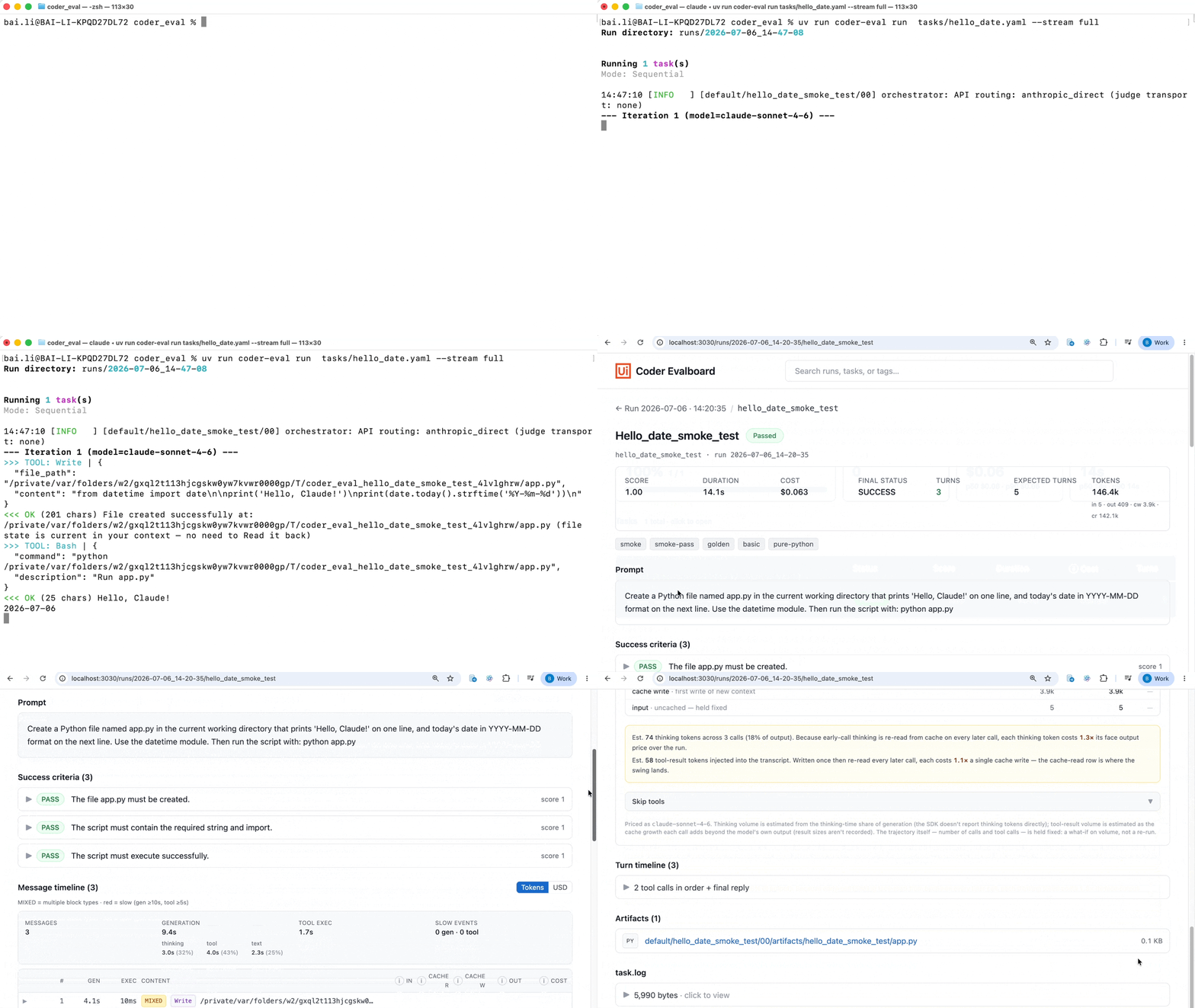
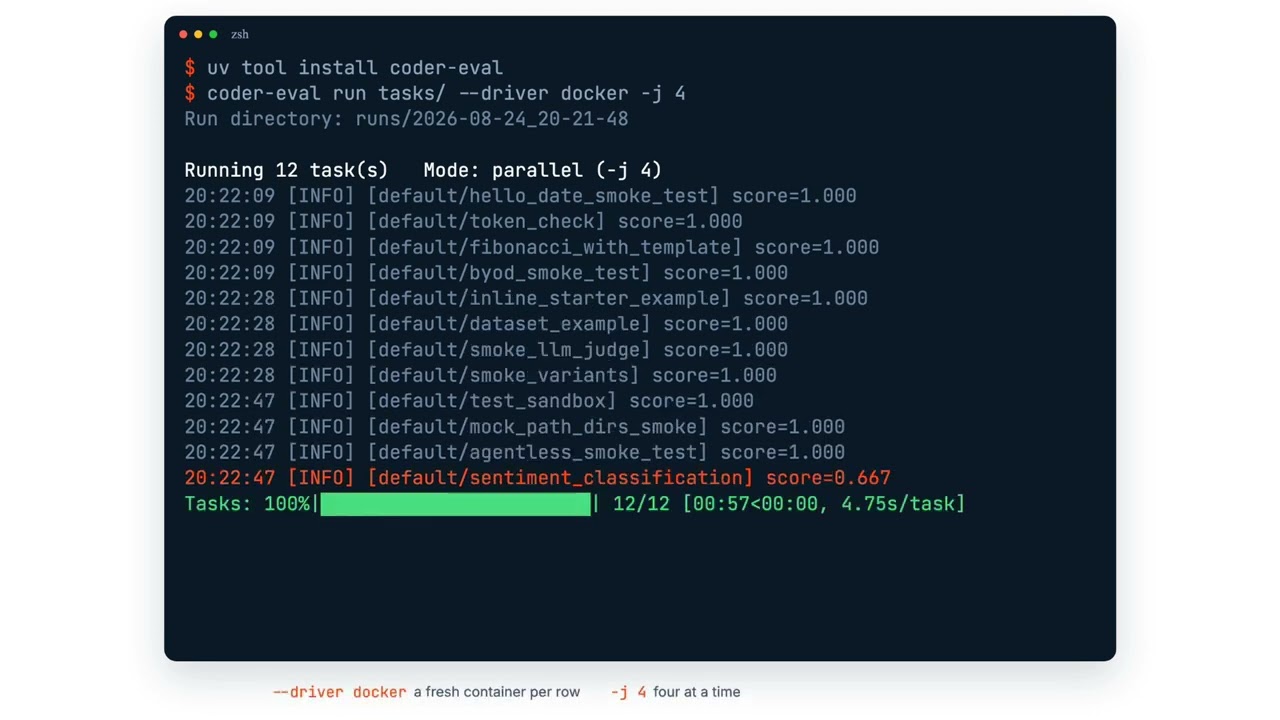
🔊 Turn the sound on — GitHub's inline player always starts muted.
▶ Also on YouTube: Coder Eval: UiPath open-source framework to test AI Coding Agents — what the framework does, and how a run works end to end.
skill_triggered) and score skill-driven suites (SkillsBench-style), on whichever harness your users runKeeping skills fresh? Run Coder Eval as a scheduled GitHub Actions job so your skills are continuously re-evaluated against the latest model — a skill that quietly stops triggering surfaces as a failing criterion before your users hit it. See Tutorial 02 — Running Coder Eval in CI.
Prerequisites: Python 3.13+, uv 0.8+, and the runtime of at least one coding agent — plus that agent's own model credentials. Pick the agent you want to evaluate; two of the four ship with a Coder Eval extra, the other two are separate CLIs you install yourself:
| Agent | agent.type | Runtime | Guide |
|---|---|---|---|
| Claude Code (default) | claude-code | brew install claude — separate CLI | Claude Code |
| OpenAI Codex | codex | uv sync --extra codex — the extra ships the Codex SDK + CLI | Codex |
| Google Antigravity (Gemini) | antigravity | uv sync --extra antigravity — the extra ships the harness binary | Antigravity |
| OpenCode (open-weight models) | opencode | npm install -g opencode-ai — separate CLI | OpenCode |
The examples below use the default claude-code agent. Developed on macOS; CI runs on
Linux.
git clone https://github.com/UiPath/coder_eval.git
cd coder_eval

uv sync                      # install the framework (add --extra codex /
                             # --extra antigravity for those runtimes)
cp .env.example .env         # then set ANTHROPIC_API_KEY — or skip that: an
                             # existing Claude Code login (`claude login`) is
                             # picked up automatically

uv run coder-eval plan tasks/hello_date.yaml   # validate (no tokens spent)
uv run coder-eval run  tasks/hello_date.yaml   # run your first evaluation
uv run coder-eval report runs/latest           # view the result
New here? Follow Tutorial 01 — Your First Evaluation.
Two more extras you only need on purpose: --extra dev adds the contributor
toolchain (pytest, ruff, pyright, pre-commit — see
CONTRIBUTING.md), and --extra uipath adds the in-host uipath
SDK for local sandbox parity (public PyPI, no credentials). Without either, the
framework still runs end-to-end.
Just want the CLI, without cloning? Install the published package — this is also what a CI job or another repo does:
uv tool install coder-eval    # puts the `coder-eval` CLI on your PATH,
                              # in its own isolated environment

uv tool install "coder-eval[codex,antigravity]"   # same, with agent extras
coder-eval --version                              # verify the install
To add it as a project dependency instead: uv add coder-eval or
pip install coder-eval. In a real CI gate, pin to a specific released version
so a harness upgrade can't silently move your results. (The example tasks/
live in this repo — clone it or point the CLI at your own task files.) See
Tutorial 02 — Running Coder Eval in CI for
the full setup.
Coder Eval evaluates any of the supported agents, and it also ships an authoring front-end for one of them: this repo is a Claude Code plugin marketplace, so the whole loop — scaffold a suite, author a task, check whether a skill triggers, read the results — runs inside Claude Code. The suites you author this way run on every harness:
/plugin marketplace add UiPath/coder_eval
/plugin install coder-eval@coder-eval
That adds six slash commands: /coder-eval:init, /coder-eval:check-skill,
/coder-eval:task, /coder-eval:lint-tasks, /coder-eval:analyze and
/coder-eval:ci. They drive the coder-eval CLI, so install it too
(uv tool install coder-eval). See Claude Code Plugin.
A composite action — on the Marketplace as
coder_eval — runs
coder-eval as a CI gate. It installs the pinned CLI, runs your tasks, writes a
JUnit XML report, reports where its artifacts landed, and fails the step on any
task failure:
- uses: actions/setup-node@v4      # the claude-code agent needs the Claude CLI…
  with: { node-version: '20' }
- run: npm install -g @anthropic-ai/claude-code

- uses: UiPath/coder_eval@v0       # …then run the gate (@v1 once 1.0.0 ships; @vX.Y.Z pins exactly)
  id: eval
  with:
    args: |
      tests/tasks/**/*.yaml
      --model
      claude-sonnet-5
    env: |
      ANTHROPIC_API_KEY=${{ secrets.ANTHROPIC_API_KEY }}
Eight inputs, and none of them is a coder-eval run flag. The CLI has 21;
GitHub silently ignores an input the referenced tag does not define, so a
forwarding input that is mistyped or newer than your pin yields a run that
measured something else and still exits 0. A wrong CLI flag is a hard error. So
flags and task globs all go through args, and an input exists only where the
action does something with the value besides pass it along.
| Input | Default | Purpose |
|---|---|---|
args | — | Task paths/globs and every flag for coder-eval run, one argument per line, verbatim |
version | pinned release | PyPI version, or local to install from the checkout |
extras | — | coder-eval extras, composed into the install requirement (codex, antigravity,litellm) |
extra-packages | — | Extra requirements installed into coder-eval's environment (--with), one per line |
install-flags | — | Flags for uv tool install, one per line (--prerelease=allow, --extra-index-url …) |
env | — | Credentials/backend passthrough: newline-separated NAME=VALUE pairs, exported for the run step only |
working-directory | . | Directory every step of the action runs in |
run-dir | runs/ci | Run directory; also where the reports are written |
Outputs: run-dir, junit-path (<run-dir>/junit.xml) and run-md-path
(<run-dir>/run.md). The action writes nothing to the job summary — a consumer
that has to redact the report first cannot undo a write that already happened:
- if: always()
  run: cat "${{ steps.eval.outputs.run-md-path }}" >> "$GITHUB_STEP_SUMMARY"
- uses: mikepenz/action-junit-report@v5
  if: always()
  with:
    report_paths: ${{ steps.eval.outputs.junit-path }}
Credentials and backend config are the sole responsibility of env — a
passthrough exported for the run step only (never written to $GITHUB_ENV, so
it can't leak into later steps). Set whatever the run needs, Anthropic or not:
- uses: UiPath/coder_eval@v0
  with:
    args: tests/tasks/**/*.yaml
    env: |
      API_BACKEND=bedrock
      AWS_BEARER_TOKEN_BEDROCK=${{ secrets.BEDROCK_TOKEN }}
The step's exit code is coder-eval's own: non-zero on any failed task.
Agent runtime is the caller's responsibility. The action is agent-agnostic — it installs
coder-evalbut no coding-agent runtime, which is why the example above starts withactions/setup-node+npm install -g @anthropic-ai/claude-code: the defaultclaude-codeagent needs theclaudeCLI onPATHbefore the action runs. Swap those steps for your own agent's runtime as needed.
Security. Evaluated tasks execute agent-generated code. Do not run this action under
pull_request_targetwith secrets exposed to untrusted fork PRs — usepull_requestand gate on the same-repo condition, as this repo's own dogfood job does.
📊 Usage telemetry is on by default.
coder-evalsends anonymous usage telemetry (command names, outcomes, counts, durations, an anonymous install id, platform info) to help improve the tool. It never captures prompts, file contents, or repo paths, and prints a one-time notice on first run. To disable it, setTELEMETRY_ENABLED=falsein your.envor environment. See Usage Telemetry for details and how to route it to your own resource.
| Guide | What's in it |
|---|---|
| Tutorials | Step-by-step walkthroughs — start here |
| User Guide | Full CLI, configuration, output, and environment-variable reference |
| Task Definition Guide | The task-file schema — all criterion types, scoring, templates |
| Claude Code | Configuring and running the default Claude Code agent |
| Codex | Running the OpenAI Codex agent |
| Antigravity (Gemini) | Running the Google Antigravity / Gemini agent |
| OpenCode | Running the OpenCode agent on open-weight models |
| Pi | Running the Pi agent on open-weight models |
| Run-Limit Parity | What each run_limits field means on every harness |
| A/B Experiments | Compare models / tools / prompts across the same tasks |
| Bring Your Own Dataset | Fan a single task out over a dataset |
| Dialog Mode | Evaluate agents in multi-turn conversation via a simulated user |
| Docker Isolation | The container sandbox driver, with custom images |
| CI Gate & GitHub Action | Run Coder Eval as a CI gate — the Marketplace Action, JUnit output, run reports |
| Claude Code Plugin | Install the Claude Code plugin — author, run, and analyze suites from inside the agent |
| Extending Coder Eval | Author a custom agent, criterion, or model pricing via the plugin SPI |
| Report Schema | Field-level reference for run.json / variant.json / task.json |
| How It Compares | vs. SWE-bench, SkillsBench, Harbor, OpenAI Evals, hand-rolled scripts |
| Repo doc | What's in it |
|---|---|
| CLAUDE.md | Architecture, key patterns, and extension points |
| CONTRIBUTING.md | Dev setup, quality bar, and how to contribute |
See the full comparison — with sources.
A task is a YAML file: a prompt, the agent config, a sandbox, and success criteria.
task_id: "hello_world"
description: "Create a Python script that prints Hello, World!"
initial_prompt: "Create hello.py that prints 'Hello, World!'"

agent:
  type: "claude-code"
  permission_mode: "acceptEdits"
  allowed_tools: ["Read", "Write", "Bash"]

sandbox:
  driver: "tempdir"
  python: {}

success_criteria:
  - type: "file_exists"
    path: "hello.py"
    description: "hello.py must be created"
  - type: "run_command"
    command: "python hello.py"
    timeout: 10
    description: "Script must execute successfully"
agent.type is the only harness-specific line: swap it for codex, antigravity, or
opencode — or override it per run with coder-eval run … -D agent.type=opencode — and
the same criteria score the same way. Tasks can omit the agent section entirely —
defaults resolve from the experiment layer (experiments/default.yaml). For the full
schema and every criterion type, see the
Task Definition Guide; for what each run_limits field
means on each harness, see Run-Limit Parity.
Tip: With the Claude Code plugin installed, use
/coder-eval:taskto scaffold a task from a natural-language description, and/coder-eval:analyze runs/latestto get improvement suggestions from a completed run.
make install    # package + dev + [uipath] deps + pre-commit hooks
make verify     # format + lint + typecheck + test + coverage (CI equivalent)
Run make verify before pushing — it mirrors CI (80% coverage threshold). See
CONTRIBUTING.md for the full workflow, commit conventions, and
extension points (new criteria, new agents).
tempdir driver is not a
security boundary.codex,
antigravity); Claude Code and OpenCode are separate CLIs. Supply the runtime (see
Quick Start) and the keys it needs — Anthropic, Bedrock, OpenAI,
Gemini, or an OpenRouter key for open-weight models via OpenCode.© 2026 UiPath. Licensed under the Apache License, Version 2.0 — see LICENSE and NOTICE.
Built with Pydantic, Typer, and Rich, on top of the harnesses it drives — the Claude Agent SDK, the Codex SDK, Google Antigravity, and OpenCode.
Sign in to join the discussion.
No comments yet. Be the first to say what this is good for.
The agent harness performance optimization system. Skills, instincts, memory, security, and research-first development for Claude Code, Codex, Opencode, Cursor and beyond.
from vibe coding to agentic engineering - practice makes claude perfect
🌊 The original agent meta-harness. Deploy intelligent multi-player swarms, coordinate autonomous workflows, and build conversational AI systems. Features adaptive memory, self-learning intelligence, RAG integration, and native Claude Code / Codex / Hermes and many more Integrated
Practical patterns, starters & CLI tools for loop engineering with AI coding agents. Design systems that prompt and orchestrate agents (inspired by Addy Osmani and Boris Cherny). Includes loop-audit, loop-init, loop-cost.

Git. Ship. Done - Core

The most RAM efficient harness