
JuliusBrussee/
caveman

🪨 why use many token when few token do trick — Claude Code skill that cuts 65% of tokens by talking like caveman
105k
1 add
DevChain runs AI coding agent CLIs in real tmux terminals and keeps their work organized in a web app. It gives you teams, epics, chat, and code review, while storing state locally in SQLite and connecting to agents through MCP tools.
Builders who want multiple agent CLIs to plan, code, and review together on one machine.
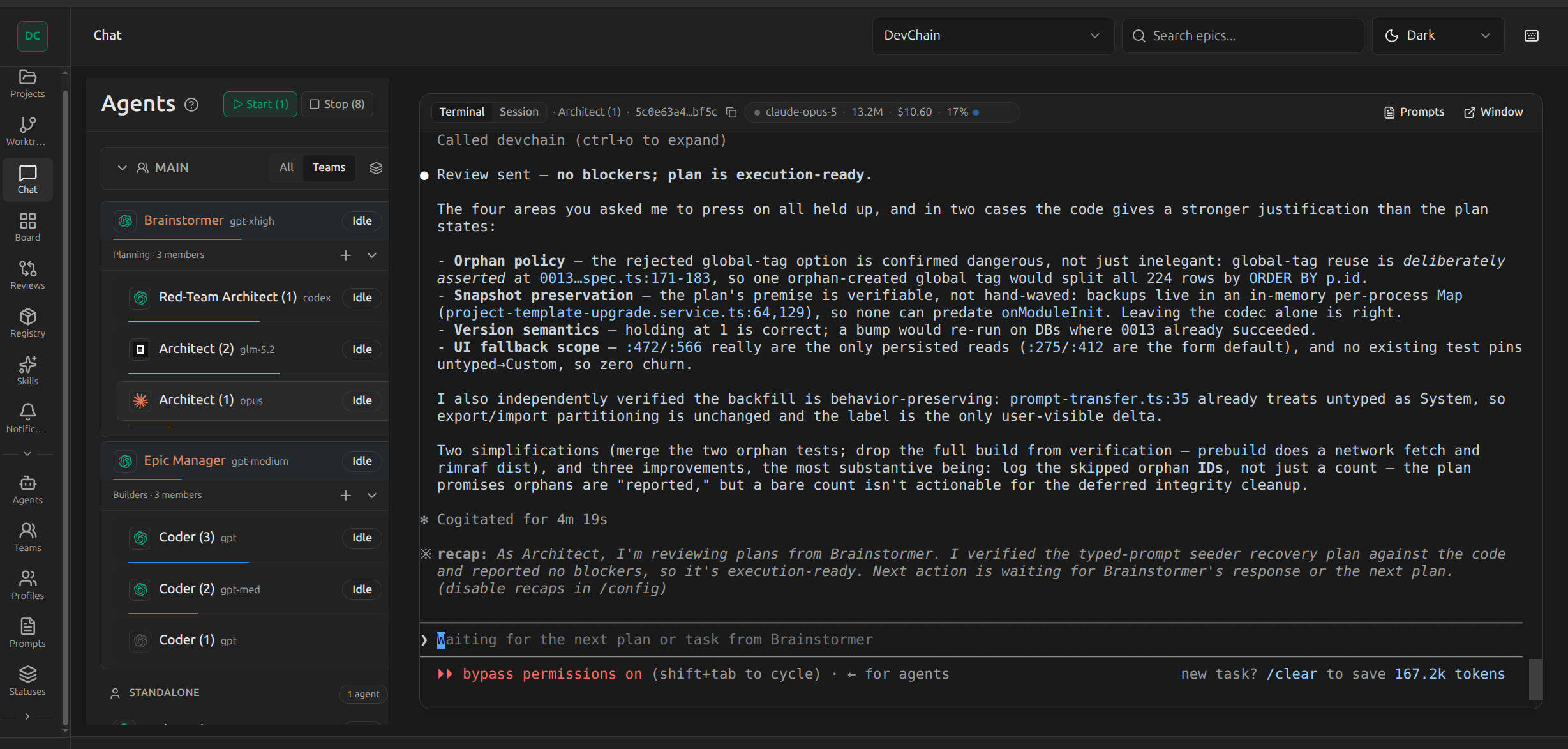
You can coordinate agent work, watch it run live, and review changes from one local dashboard.
Runs Claude Code, Codex, OpenCode, Antigravity, and Copilot as teams that can split up work and switch models per task.
Streams each agent in its own real terminal with full TTY support, so you can watch, scroll back, or take over.
Uses kanban-style epics and sub-epics that agents can pick up and update through MCP tools.
Shows diffs with inline comments, @mentions, and threaded discussion inside the workflow.
Stores sessions, transcripts, token usage, cost, and compaction events in local SQLite.
Syncs community skill packs and auto-configures MCP tools before each session.
npm install -g devchain-cli
devchain start




Quick Start · Docs · Mobile App · Releases
DevChain is a local-first orchestrator for AI coding agents. It runs Claude Code, Codex, OpenCode, Antigravity, and GitHub Copilot as coordinated teams — each agent in its own real tmux terminal, sharing a board of epics, a chat, and a code-review flow. You describe the work, the teams plan and build it in parallel, and you review and merge from the web UI — with an end-to-end-encrypted mobile app to keep an eye on everything when you step away.
@mentions, and threading, wired into the agent workflow.
| Provider | CLI | Sessions | Transcripts |
|---|---|---|---|
| Claude Code | claude | ✔ | ✔ |
| Codex | codex | ✔ | ✔ |
| OpenCode | opencode | ✔ | ✔ |
| Antigravity | agy | ✔ | ✔ |
| GitHub Copilot | copilot | ✔ | ✔ |
Model families such as GLM are available through per-provider configs, and you can switch the provider or model of any agent on the fly.
Requirements: Node.js 24 LTS or newer, tmux (brew install tmux / sudo apt install tmux), and at least one provider CLI from the table above.
npm install -g devchain-cli
devchain start
The browser opens automatically. Create a project, import a template, and start the Brainstormer session with a description of what you want to build. Run devchain start --help for ports, host binding, and foreground mode; devchain stop shuts the server down.
better-sqlite3 v13 ships bundled Node-API artifacts, so mainstream supported installations do not need a C/C++ compiler for SQLite. DevChain's postinstall check opens an in-memory database, executes a query, and closes it; an unusable artifact now fails installation instead of only printing a diagnostic. Set DEVCHAIN_SKIP_POSTINSTALL=1 only when intentionally bypassing that verification.
CI executes the application and SQLite checks on Linux x64 with Node 24, plus a focused Node 26 compatibility lane. Published binaries or image manifests for other platform/architecture combinations prove artifact presence only; they are not runtime-execution evidence for macOS, Windows, or arm64.
| Template | Agents | Best for |
|---|---|---|
teams-dev (recommended) | Planning team (Brainstormer + Architect), Builders team (Epic Manager + Coders), Code Reviewer | Auto-scaling Builders, parallel planning, tier-aware model routing |
graph LR
    Browser["Web UI<br/>(React)"] -->|HTTP + Socket.IO| App["Local App<br/>(NestJS + Fastify)"]
    App --> DB[("SQLite<br/>local storage")]
    App <-->|tmux / PTY| Sessions["Agent terminal sessions"]
    Sessions --- CLIs["Provider CLIs<br/>claude · codex · opencode · agy · copilot"]
    CLIs <-->|MCP tools| App
    Mobile["Mobile app<br/>(iOS / Android)"] <-->|E2EE relay<br/>sealed data only| App
The Local App serves the web UI and stores all state in a local SQLite database. Agents run as provider CLIs inside tmux sessions and coordinate through DevChain's MCP tools — epics, chat, reviews, skills, and team management. The optional mobile app connects through an end-to-end-encrypted relay: the cloud only forwards sealed data it cannot read.
Monitor and steer your agent teams from your phone, in open beta on iOS (TestFlight) and Android (Play Store). Chat with agents, answer their questions the moment they ask, reassign epics and comment on the board, watch a live terminal viewport, and get push notifications when a session stops or needs you. Reviewing and merging stay on the web — the phone is your mission control on the go. Everything between your PC and phone is end-to-end encrypted.
Questions, bug reports, and feature requests are welcome in GitHub Issues. Watch Releases to follow what ships.
Development setup, prerequisites, and project structure live in CONTRIBUTING.md. Issues and pull requests are welcome.
Free and source-available under the Elastic License 2.0. You may use, copy, and modify DevChain freely; you may not provide it as a managed service or a competing commercial offering.
Sign in to join the discussion.
No comments yet. Be the first to say what this is good for.
🪨 why use many token when few token do trick — Claude Code skill that cuts 65% of tokens by talking like caveman

The best-benchmarked open-source AI memory system. And it's free.

Orca is the ADE for working with a fleet of parallel agents. Run any coding agent with your own subscription. Available on desktop, mobile and remote runtime.
A cross-platform desktop All-in-One assistant for Claude Code, Codex, OpenCode, OpenClaw, Grok Build & Hermes Agent. Only official website: ccswitch.io

Never stop coding. Free MIT AI gateway: one endpoint, 352 providers (150+ free), 1200+ models Kimi, Claude, GPT, Gemini, GLM, DeepSeek, MiniMax. Works with Claude Code, Codex, Cursor, OpenCode, Cline & Copilot. Quota-aware auto-fallback, RTK+Caveman compression saves 15-95% tokens, MCP/A2A, Desktop/PWA. Built by 550+ contributors

Compress tool outputs, logs, files, and RAG chunks before they reach the LLM. 20% fewer tokens for coding agents, 60-95% fewer tokens for JSON, same answers. Library, proxy, MCP server.