
obra/
superpowers

obra/superpowersSkills
An agentic skills framework & software development methodology that works.
285k
1 add
SkillHone packages the harness from the paper into standard agent skills that run on skill-capable runtimes. It manages optimisation, evaluation, PRD setup, synthesis, and Forgejo-backed history as separate skills inside one bundle.
Builders who want their agent to revise a skill folder over time with tracked decisions and repeatable evaluations.
You can improve a skill through tracked, reviewable Git changes instead of editing a single prompt string.
Updates `SKILL.md`, helper scripts, references, and assets together in one atomic change.
Records each step as a Git issue, branch, pull request, commit, or wiki entry.
Keeps probe data separate from skill instructions using code paths and filesystem permissions.
Runs on Claude Code, Codex, OpenClaw, Hermes, and other agentskills.io runtimes.
Includes separate skills for running evaluations, drafting a PRD, and generating benchmark data.
Uses Forgejo as the default local Git backend for issues, PRs, and wiki pages.
 SkillHone-Skills


English • 简体中文
Paper • News • Why SkillHone • Compare • Install • Usage • Whole-Skill Optimisation • Observability • Runtimes • Eval / Skill Split • Bundle • Configure
|
Overview Video |
Demo Video |
provider/model configuration across Anthropic, DeepSeek, OpenAI, Gemini,
and other LiteLLM providers—no external Anthropic-compatible endpoint or
transport switch required. Improver, executor, and synthesis can each use
independent credentials and endpoints.The unit of change is a skill folder, not a prompt string. Every decision is a Git artifact.
SkillHone-Skills abstracts the SkillHone harness described in the paper
into a bundle of standard agent skills — install it into any
skill-supporting runtime to run the full optimisation loop. Two things
set it apart from "let an LLM rewrite the SKILL.md string" projects:
SKILL.md, add a new helper under scripts/, and drop a
reference page under references/ — in one atomic change,
gated by the regression suite. Detail and a real PR-diff table
in the Whole-Skill Optimisation
section below.Supporting properties that make the above viable in practice:
| Capability | microsoft/SkillOpt | NousResearch/hermes-agent-self-evolution | SkillHone |
|---|---|---|---|
| Evolves agent skills automatically | ✅ | ✅ | ✅ |
| Open source, Python implementation | ✅ | ✅ | ✅ |
| Held-out validation before adopting a change | ✅ | ✅ | ✅ |
Patches the entire skill folder — SKILL.md + scripts/ + references/ | ❌ | ❌ | ✅ |
| GitHub-style audit trail — every step is a git issue / PR / commit / wiki | ❌ | ❌ | ✅ |
Copy the prompt below and send it to any skill-capable AI assistant — Claude Code, Codex, OpenClaw, Lighthouse, Kimi, and so on. The assistant fetches the install guide, detects your runtime, and puts SkillHone in the right place.
Please install SkillHone by following the instructions at
https://raw.githubusercontent.com/Tencent/SkillHone/main/docs/install/skillhone.md. Detect my agent runtime, install theskillhoneskill into its skills directory, and then ask me for the model credentials needed to finish configuration.
To update later, re-send the same prompt and ask the assistant to refresh the install.
Execution notice. Some SkillHone-Skills workflows may use Claude Code bypass mode and local command execution, such as
exec/ subprocess calls, for validation or optimization. Run them only in an isolated workspace, sandbox, container, virtual machine, or disposable clean clone. Avoid directories containing secrets, credentials, production data, private files, or unrelated repositories.
Once installed, invoke skills the way your runtime invokes any
agentskills.io skill — by slash command
(/skillhone) or by intent. The top-level skillhone skill is the
recommended entry; it dispatches to the right sub-skill (see
Skills in this Bundle below).
Paste any of these into your agent:
/skillhoneoptimize mytravel-qaskill for 5 iterations.
Use skillhone to evaluate my
travel-qaskill against the latest probe split.
Use skillhone-prd to draft a PRD for a new "code-review" skill, then use skillhone to seed and run a first optimisation pass.
Each sub-skill's SKILL.md lists its full trigger surface.
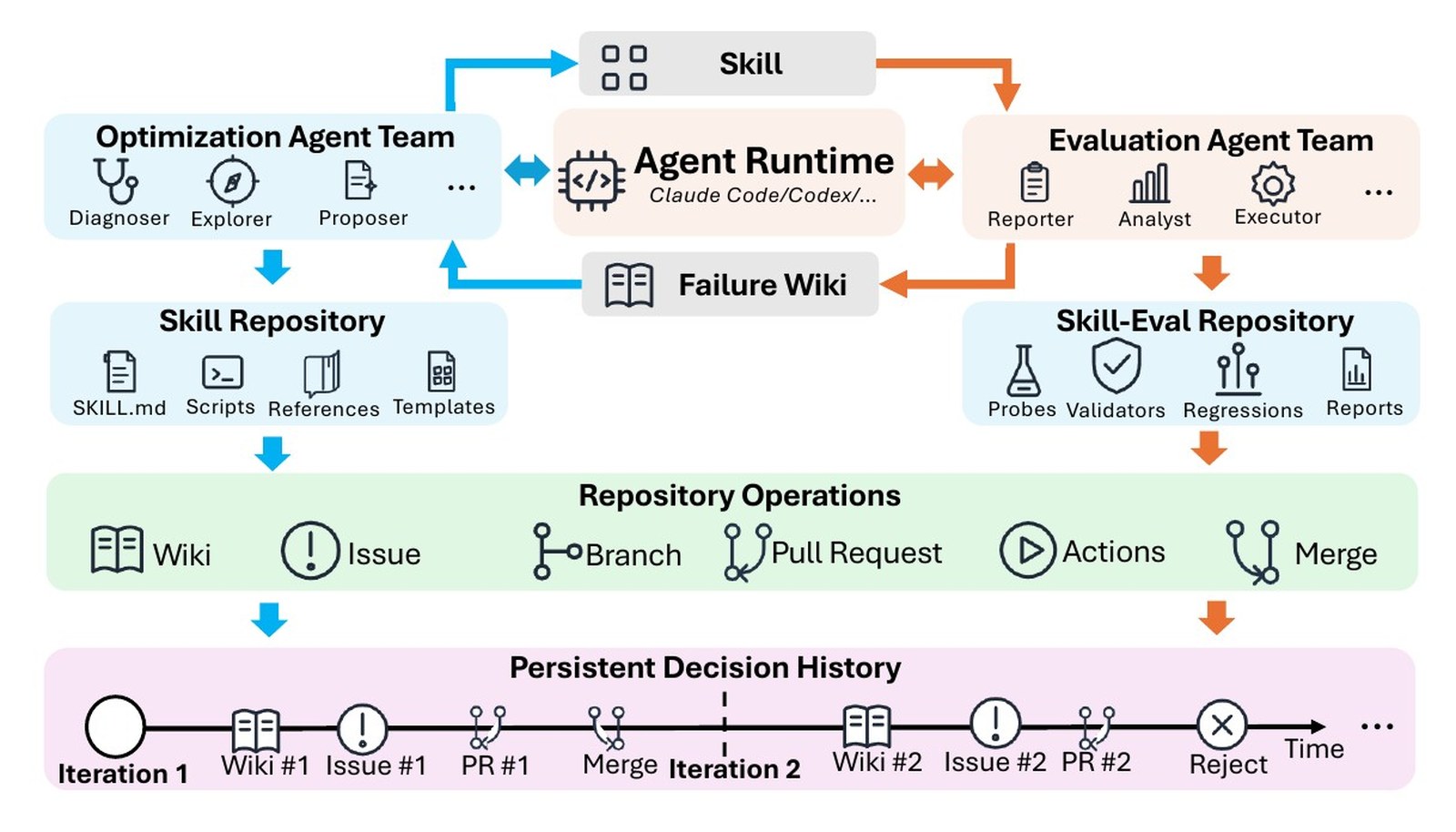
A skill is not a single file — it is a folder, containing SKILL.md,
scripts/, references/, and assets/. Mainstream skill-evolution
work today only edits one of those files, SKILL.md. Editing one
file out of many cannot fix failures that live in the helper scripts
or the reference pages, and a non-trivial fraction of real failures
live exactly there. The optimisation is structurally incomplete —
the surface available to it is one file, the surface where the
failures actually live is the whole folder.
A genuine skill is a folder. Alongside SKILL.md it carries
scripts/ (executable helpers the agent calls — Python, shell,
anything), references/ (schemas, lookup tables, format cheat-sheets
the agent reads on demand), and assets/ (fixtures and templates).
SkillHone's optimisation loop reaches into all of these: diagnose a
probe failure → decide whether the fix belongs in the prose, in a new
helper script, in a reference page, or in any combination of those —
and land it as a single atomic PR gated by a regression eval. The
whole-folder edit is the practical-value differentiator — it is
where SkillHone stops being theoretical and starts paying for itself.
The table below lists the merged PRs from one travel-qa smoke run.
Each row is one merge; each diff column shows what that single PR
changed across the skill folder.
| PR | Issue it closes | Skill-folder diff (one merge) |
|---|---|---|
| #2 | #1 matrix-routing 404 — 36 failures across 5 executors | SKILL.md +116 / −19 · scripts/tomtom_api.py ➕ 243 (new file) · scripts/tsp_solver.py ➕ 184 (new file) |
| #4 | #3 wrong statistic — used mean where the question asked for median | SKILL.md +62 / −5 |
| #6 | #5 model invented tool syntax + tomtom_api.py HTTP 403 | SKILL.md +27 · scripts/tomtom_api.py +27 / −4 ⚠ |
| #7 | regression caught after #6 merged | SKILL.md 0 / −27 · scripts/tomtom_api.py +4 / −27 (revert) |
A prompt-only optimiser could not land PR #2: even with the prose
saying "use matrix routing", the agent still has no
tomtom_api.py and reproduces the same 404 in a different shape.
Full per-PR walkthrough lives in the
travel-qa example.
Other skill-evolution projects typically persist optimisation
trajectories as flat text files on disk. SkillHone instead writes every
decision into the standard artifacts of a self-hosted Git server —
Issues, branches, pull requests, wiki pages — so the entire optimisation
process is presented in a UI any reviewer already understands. The
server (Forgejo by default) runs locally — a single docker compose up -d
is sufficient.
The screenshots below are taken from our own Forgejo on the
travel-qa skill. Each diagnosis corresponds to an Issue, each
revision to a Pull Request, and each iteration's observations to a
Wiki page.
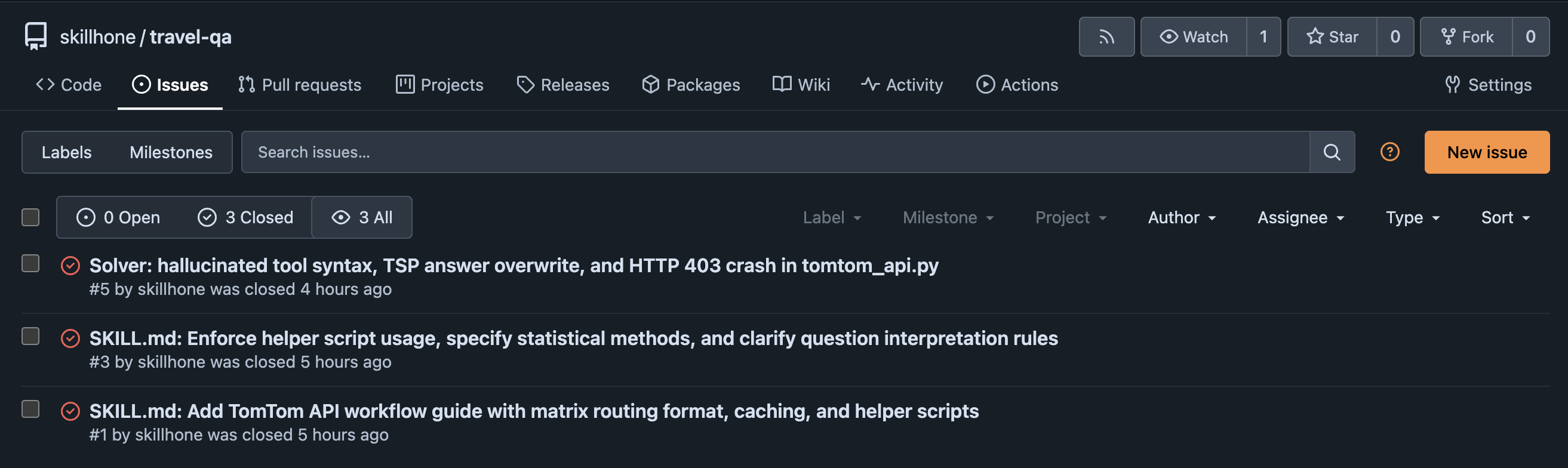
Issues — the failures that drove each revision.
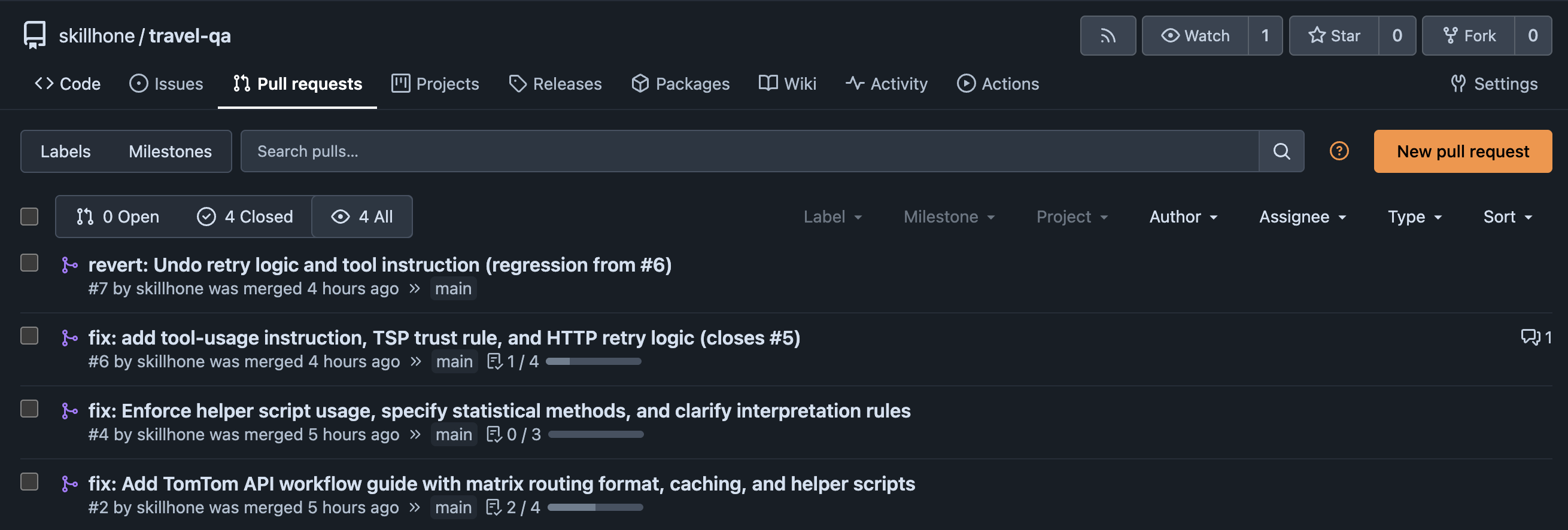
Pull requests — the skill changes themselves.
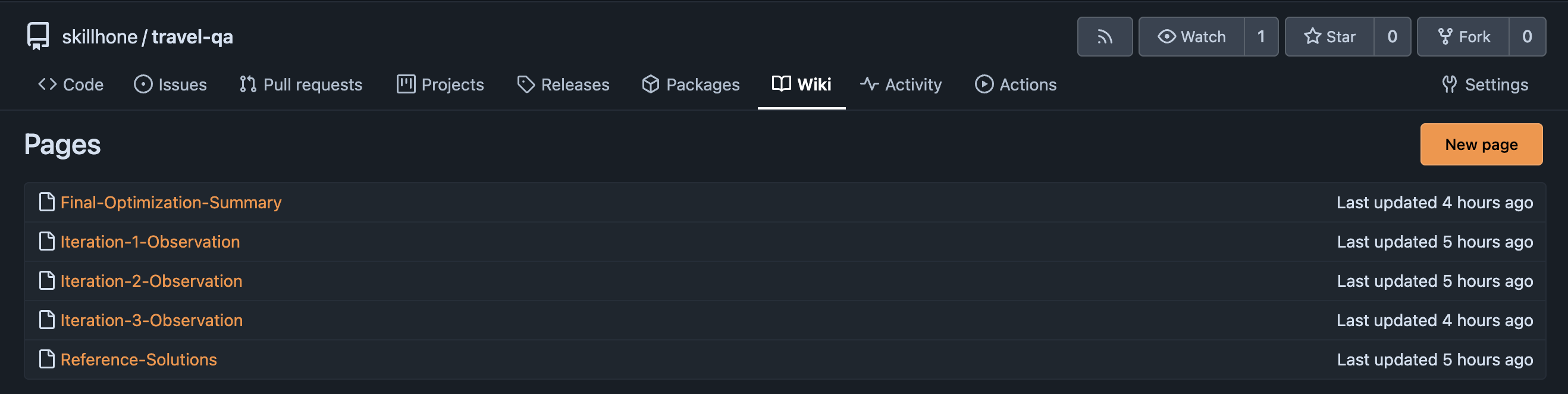
Wiki — per-iteration observations that later runs read.
Drop the same bundle into any skill-supporting runtime —
~/.claude/skills/, ~/.codex/skills/, and so on — and SkillHone is live.
For example: Claude Code, Codex, OpenClaw, Hermes, …
The public skill repo and the private eval repo are isolated by code and filesystem permissions, not by prompts. By default the engine reads probes without copying them into skill instructions, and gold labels stay in the eval repo.
| Skill | What it does |
|---|---|
skillhone | Top-level entry — wraps the CLI (status, eval, optim, new, seed, synth, serve). |
skillhone-optimization | Optimisation orchestrator — diagnoses failures, plans changes, lands focused PRs on the skill repo. |
skillhone-evaluation | Runs and interprets evaluations — eval / probe / PR-validation, regression checks, trajectory diagnosis. |
skillhone-prd | Interactive PRD builder — pins down a new skill's goal, tools, and scoring rubric before optimisation begins. |
skillhone-synthesis (experimental — data-synthesis skill) | Experimental skill for synthesising closed-form, automatically verifiable benchmark Q/A by exploring tool environments. Used to bootstrap eval datasets; not part of the core measurement / optimisation loop and may change without notice. |
forgejo | REST-API toolkit for the default Git backend — issues, PRs, wikis, repos, branches. |
All SkillHone really needs from you is model credentials. Give the
assistant these values when you install — it will write the right
~/.skillhone/settings.json for you.
| Role | Required? | What it does |
|---|---|---|
| Improver | required | Drives the optimisation loop — proposes patches to the skill. |
| Executor | optional, defaults to Improver | Runs the skill being tested on each probe. |
| Synthesis | optional, defaults to Improver | Generates evaluation data when using the synthesis workflow. |
For each role, provide an api_key and a LiteLLM provider/model name. Add
api_base only when the provider needs a non-default upstream endpoint. Each
role can use independent credentials and endpoints; omitted optional roles
reuse the Improver profile.
SkillHone starts a loopback-only LiteLLM bridge and supplies its Anthropic Messages endpoint to Claude Agent SDK automatically. You do not need to run a proxy or find an Anthropic-compatible endpoint. The same configuration covers DeepSeek, Anthropic, OpenAI, Gemini, and other LiteLLM providers:
{
  "improver": {
    "model": "deepseek/deepseek-chat",
    "api_key": "sk-xxx"
  }
}
Full schema, multi-identity Forgejo tokens, and the ~/.skillhone/
directory layout live in
skills/skillhone/references/configuration.md.
SkillHone-Skills is a bundle of standard agent skills built around the ideas in the paper "SkillHone: A Harness for Continual Agent Skill Evolution Through Persistent Decision History" (arXiv:2606.08671, 2026).
The SkillHone harness in the paper is built on an enterprise-internal
agent framework with no current plans for open-source release. For
the convenience of community adoption, we packaged its ideas as a
bundle of standard agent skills following the
agentskills.io protocol, with
claude-agent-sdk as the default agent backend and Forgejo as the
default Git server. The bundle runs on any agent runtime supporting
the protocol — Claude Code, Codex, OpenClaw, Hermes, …
The core methodology remains identical: each development step is
recorded as a (diagnosis, candidate revision, redacted evidence, outcome) tuple — the persistent decision history;
role-separated optimisation and evaluation subagents prevent
practice feedback from leaking into skill instructions; and the
eval / skill split is enforced by code paths and filesystem
permissions. Due to differences between agent frameworks, there are
some implementation-level distinctions (e.g., role separation is
enforced through skill mount boundaries and code paths instead of
framework-native subagent policies).
@misc{li2026skillhoneharnesscontinualagent,
  title         = {SkillHone: A Harness for Continual Agent Skill Evolution Through Persistent Decision History},
  author        = {Zhiwei Li and Yong Hu},
  year          = {2026},
  eprint        = {2606.08671},
  archivePrefix = {arXiv},
  primaryClass  = {cs.LG},
  url           = {https://arxiv.org/abs/2606.08671},
}
SkillHone is released under the MIT License.
Open-source agent skills built on the ideas of the SkillHone harness.
Demo video rendered with HyperFrames.
Sign in to join the discussion.
No comments yet. Be the first to say what this is good for.
An agentic skills framework & software development methodology that works.
Turn any codebase, with its docs, SQL schemas, configs, and PDFs, into a queryable knowledge graph. A /graphify skill for Claude Code, Cursor, Codex, and Gemini CLI: local deterministic AST parsing, every edge explained, no vector store.

Topic in, narrated explainer video out. A Claude Code / Codex skill that turns any topic into a black-canvas motion-graphics explainer video with TTS voiceover, subtitles and a chapter progress bar. Chinese or English; every frame drawn in code with Remotion.
Public repository for Agent Skills
Open-source AI job search: scan job portals, evaluate listings into a structured A-H report with a global 1-5 score, tailor your CV, track applications — runs locally in your AI coding CLI (Claude Code, Codex, OpenCode, Antigravity…)
Production-grade engineering skills for AI coding agents.