

rtk-ai/rtkHooks
CLI proxy that reduces LLM token consumption by 60-90% on common dev commands. Single Rust binary, zero dependencies
80k
why-was-fable-banned installs a hard gate around agent edits. The gate requires a passing `.wfb/spec.json`, blocks forbidden paths, and keeps work from landing until the acceptance commands produce live output.
Builders who want Claude Code or Codex to write a spec first and prove the work before editing their repo.
You can keep agent-led changes scoped, verified, and blocked until there is live evidence they work.
A `PreToolUse` hook blocks edits until `.wfb/spec.json` validates against the required fields.
The gate does not allow completion until the acceptance commands run and produce live output.
Protected paths are blocked by the gate instead of being left to prompt discipline.
Works with Claude Code hooks and Codex worktree-based acceptance flow.
`gates/wfb_judge.py` adds a rubric-based meaning check on top of the deterministic form gate.
`bench/` and `tests/` measure overhead, quality, and gate behavior with reproducible scripts.
git clone https://github.com/SihyeonJeon/why-was-fable-banned
cd why-was-fable-banned && sh install.sh
English · 한국어
Gate for AI coding agents: blocks edits until a spec passes.





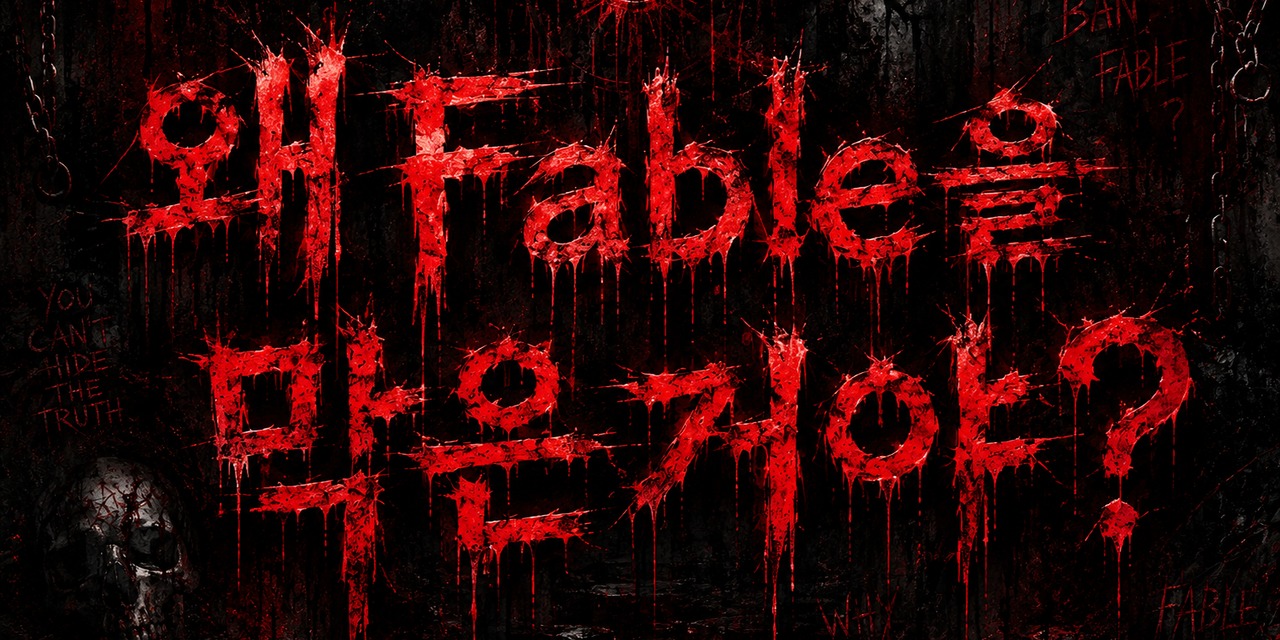
The agent can't edit code until it writes .wfb/spec.json and a deterministic
gate accepts it: restated goal, non-goals, context chosen by authority, ≥2 rejected
alternatives with the boundary each breaks, risks, and runnable acceptance. One
shared gate, installed as hooks. Works in Claude Code and Codex.
Same prompt, same model — gate off vs on. "Implement a water-current + fish simulation," Opus 4.8, identical prompt both runs:
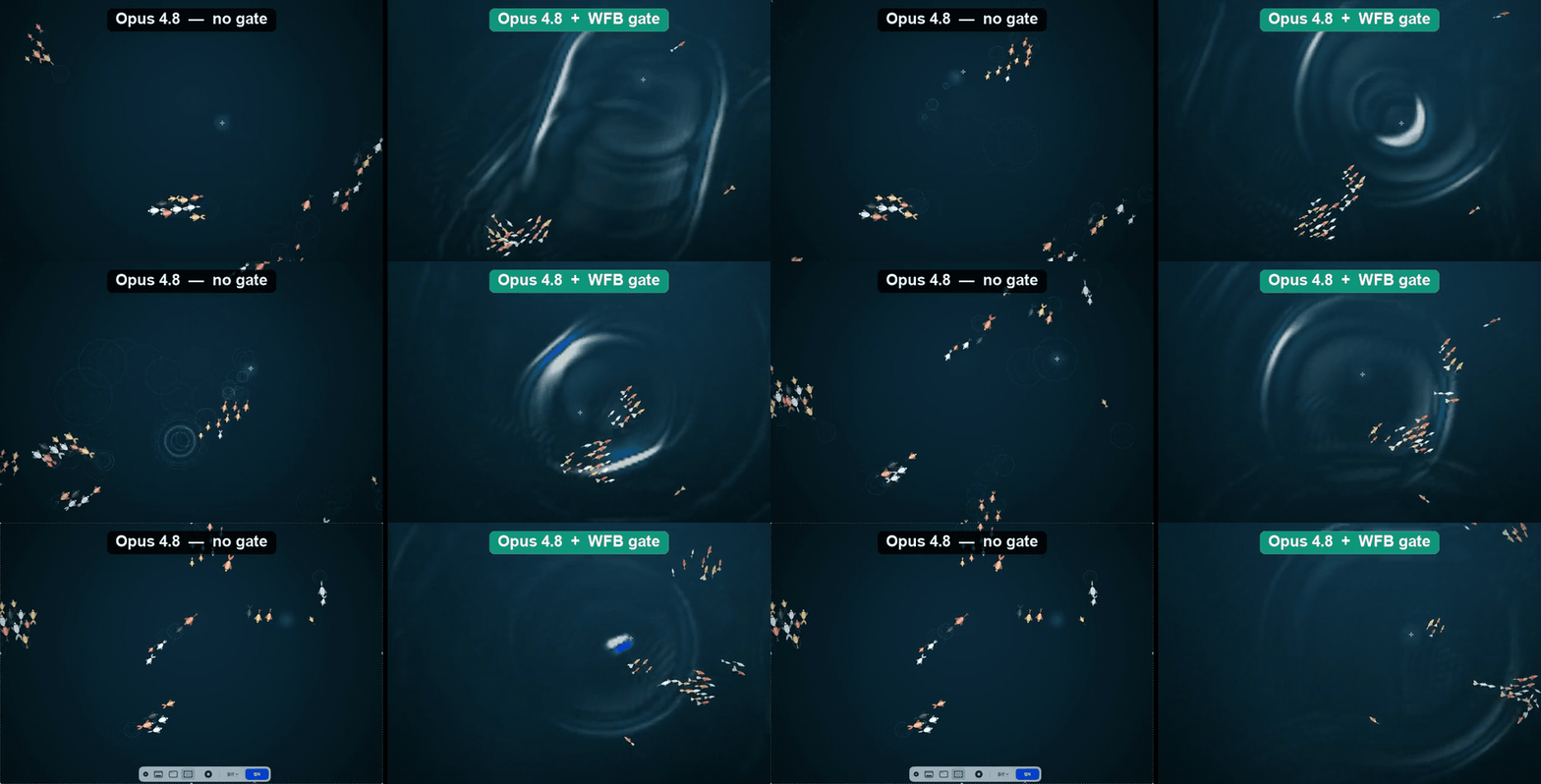
Left (naked) stops at thin ripples. Right, the gate makes the model keep working until its own acceptance criteria pass — a volumetric vortex with schooling fish. One anecdote (n=1), not a capability benchmark; measured numbers are below.
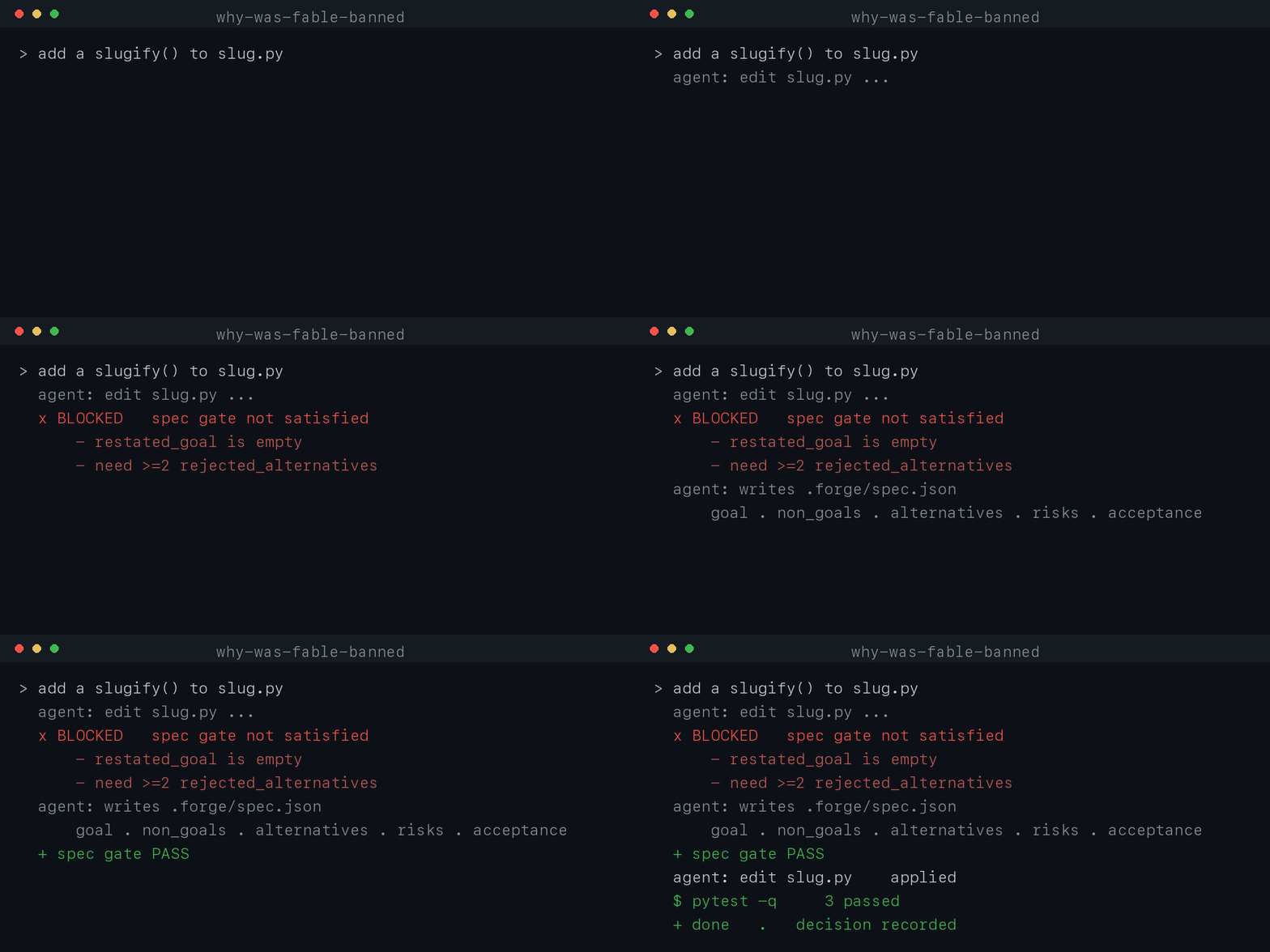
[!NOTE] A spec must exist and pass before edits land, and unspeced or forbidden-path work never reaches your repo. Every change ships with an auditable decision record.
Fable-style discipline means spec before code, scoped execution, and verification you can re-run — long-horizon work that doesn't drift. WFB doesn't make the model that disciplined; it externalizes the discipline as a hard gate the model can't skip:
PreToolUse hook exits 2 until the spec validates.It enforces process, not capability — see the honest benchmark.
git clone https://github.com/SihyeonJeon/why-was-fable-banned
cd why-was-fable-banned && sh install.sh
python3 only, stdlib. Remove: sh install.sh --uninstall.
sh install.sh installs machine-wide: every Claude Code project on this computer (and every subagent / orchestrated worker) inherits the gate
sh install.sh --here installs for this repo only (Claude Code project-level .claude/settings.json)
Toggle in-session at three scopes by typing (the hook handles it, never sent to the model):
| type | scope | persists |
|---|---|---|
wfb off / wfb on | this project dir | across sessions in this repo |
wfb off here / wfb on here | this session only | this chat |
wfb off all / wfb on all | the whole machine | everywhere |
Most-specific wins (session > project > machine > default on), so you can turn the project off and force one hard session on. State is a file, so it survives reboots until you flip it back. wfb status shows all three. One-off env bypass: WFB_BYPASS=1.
Status line: when the gate is on, [why-was-fable-banned] shows in the Claude Code status line (installed only if you don't already have one; otherwise the installer prints how to add the segment)
Works wherever Claude Code runs: terminal, the VS Code and JetBrains extensions, desktop (they share the same hooks), plus Codex. It does not apply to non-Claude-Code/Codex agents (e.g. Cursor's own agent)
PreToolUse hook intercepts every edit and exits 2 until the spec passessh install.sh: wires the hooks at user level (every project + subagent inherits it).wfb/spec.json (it's told exactly what to fill); edits stay blocked until it passesGrade auto-scales the depth: typos (LIGHT) require only a restated goal + one acceptance check; auth/payments/migration (HEAVY) pay the full gate.
wfb-codex-accept "<goal>" --repo <dir> (worktree-accept; headless)Recorded real engineering sessions with hooks (42 traces), extracted them as a structured decision schema, generalized 19 into 8 decision axes, and cross-checked the generalization with a second model. Observable artifacts only: no chain-of-thought, local, secrets masked.
| layer | checks | how |
|---|---|---|
gates/wfb_gate.py | form: fields, real paths, forbidden, fail-closed | deterministic, free |
gates/wfb_judge.py | meaning: 0–2 rubric, gaming detection | optional LLM judge |
bench/ | correctness: hidden grader | runs the tests |
Measured in this repo, reproducible (bash bench/run_quality.sh, bash tests/run_all.sh):
| measure | gate OFF | gate ON |
|---|---|---|
| Decision record per change | none | enforced |
| Unspeced or forbidden-path edits reaching the repo | possible | blocked |
| Adversarial / edge gate tests (downgrade, bypass, malformed, no-brick) | n/a | 35/35 pass |
| benchmark | naked (gate OFF) | gated (gate ON) |
|---|---|---|
| SWE-bench Verified (light-repo slice, N=28) | 22/28 | 23/28 |
| SWE-bench Pro (qutebrowser, N=10) | 7/10 | 8/10 |
| combined (N=38) | 29/38 | 31/38 |
+2 across 38 tasks, zero regressions (the gate never lost a task naked solved; it
won the ones it won by matching the exact test contract instead of a plausible-but-wrong
shortcut) — at ~2–3× the tokens. This is small and within noise: the gate enforces
process, not capability. On toy tasks with a hidden grader it shows no lift at
all (both arms 10/10) — see bench/BENCHMARK.md. Raw per-instance
results: bench/results/verified/, bench/results/pro/.
Validated live: a Codex run left a protected file untouched and applied only the gate-passing diff; if verification is incomplete it retries, then rejects rather than apply. Details: bench/BENCHMARK.md · TOKEN_BUDGET.md.
What is why-was-fable-banned (WFB)? A spec-first, evidence-gated edit boundary for AI coding agents. It blocks an agent (Claude Code or Codex) from editing code until it writes a spec a deterministic gate accepts, and blocks "done" until live acceptance output proves the work.
Does it make Opus or Codex smarter? No. It enforces process, not capability. On SWE-bench it lifts the same Opus model by +2/38 at ~2–3× tokens (within noise); on toy tasks, no lift. Its value is enforcement, evidence, and an auditable decision record — not injecting intelligence.
Is it a Fable 5 plugin? No. It's a model-agnostic gate installed as hooks. It runs the same discipline Fable-style autonomy implies — spec, scope, re-runnable verification — as an external boundary, so Opus 4.8 or Codex must follow it whether or not the model would on its own.
How is it different from a prompt, CLAUDE.md, or a behavior plugin? Those are
suggestions the model can ignore. WFB is hard enforcement: a PreToolUse hook exits 2
and the edit never happens until the spec passes. Forbidden paths and fail-closed
verification are enforced, not requested.
Works with: Claude Code (terminal, VS Code / JetBrains extensions, desktop) and Codex. Not other agents (e.g. Cursor's own agent).
PRs welcome. MIT.
Sign in to join the discussion.
No comments yet. Be the first to say what this is good for.
CLI proxy that reduces LLM token consumption by 60-90% on common dev commands. Single Rust binary, zero dependencies
Warcraft III Peon voice notifications (+ more!) for Claude Code, Codex, IDEs, and any AI agent. Stop babysitting your terminal. Employ a Peon today.

Read the Qur'an while Claude Code works. Start a session with 'claude --cwq' and a reader beside it walks forward through the Qur'an one ayah per prompt, resuming where you left off — in a terminal pane or a browser tab. Zero dependencies, fully offline.

Clean up Claude's token vomit with a separate LLM. Save your tokens, Opus is hopeless
A pre-execution guard for AI coding agents. It blocks destructive Git and file system commands, plus common attempts to access sensitive files, before a tool call runs. Supports Amp Code, Antigravity CLI, Claude Code, Codex, Cursor, Gemini CLI, GitHub Copilot CLI, Grok Build, Hermes Agent, Kimi Code, OpenClaw, OpenCode, and Pi.
Automated TDD enforcement for Claude Code