

affaan-m/
ECC

affaan-m/ECCHarnesses
The agent harness performance optimization system. Skills, instincts, memory, security, and research-first development for Claude Code, Codex, Opencode, Cursor and beyond.
258k
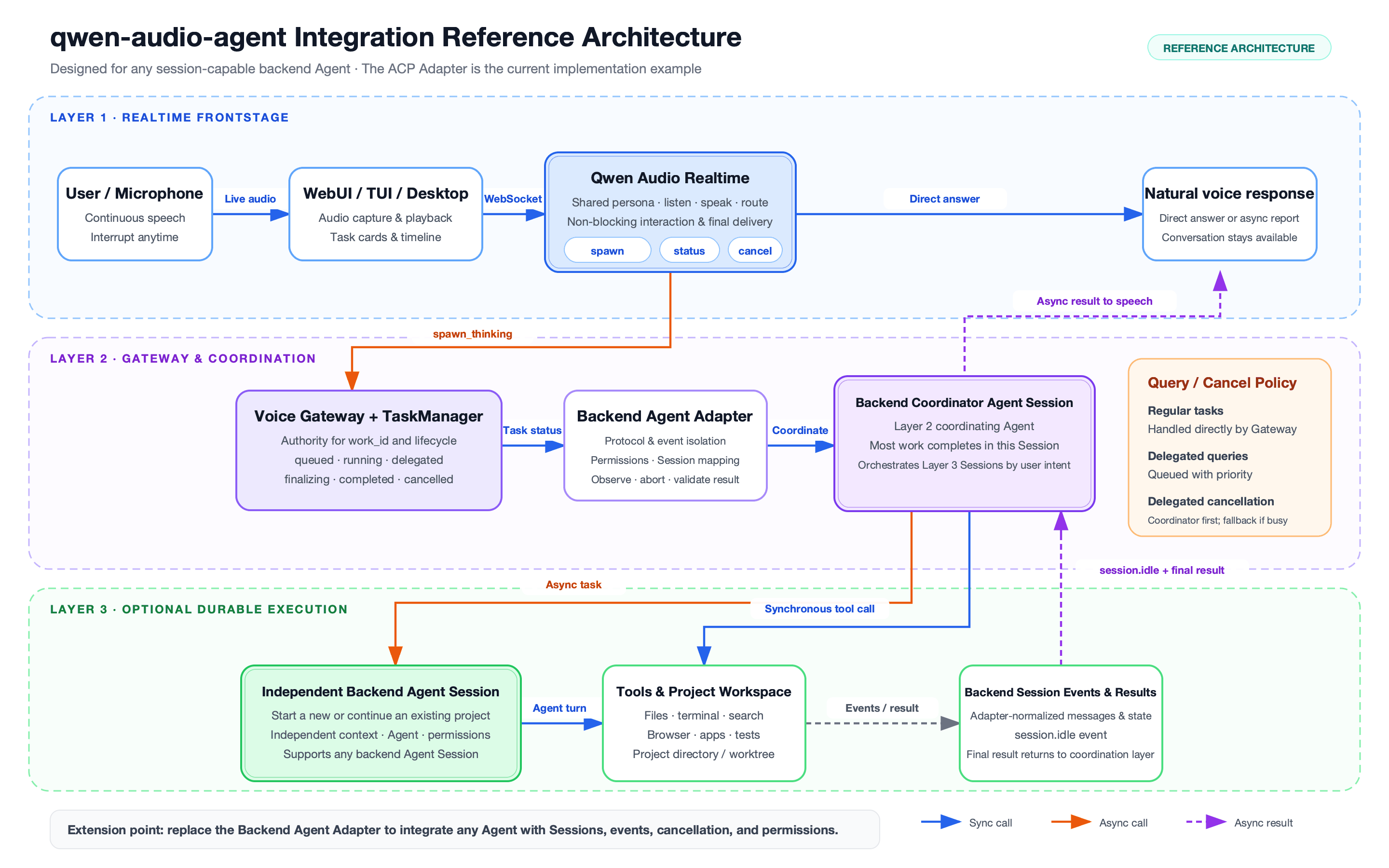
Qwen Audio Agent is a realtime voice runtime for keeping an agent in the loop while it talks, uses tools, and works on longer tasks. It routes quick questions directly and sends heavier work to a backend agent, then brings the result back into the same conversation. The runtime comes with a CLI, TUI, web UI, and desktop app.
Builders who want their agent to keep talking while it handles tools, file work, and long-running tasks.
You can keep one live conversation going instead of switching between chat, tool runs, and task updates.
Supports realtime voice interaction, interruption, and multi-turn conversation without stopping after one response.
Runs frontend conversation and backend tasks in parallel, with progress tracking and cancellation.
Reuses an agent’s model config, tools, MCP, skills, and auth through native or adapter-based ACP support.
Provides a web UI, terminal TUI, and desktop floating orb for macOS, Windows, and Linux.
Keeps per-user memory, with an optional VoiceMem connector for richer session continuity.
Includes example setups for smart cockpit, AI Passport, VoiceMem, and LightRAG integrations.
npm install -g qwen-audio-agent
qwenaudio config
qwenaudio        # Terminal 1: Gateway
qwenaudio tui    # Terminal 2: TUI
中文 | English | User Guide | Quickstart



Real conversation should not leave you waiting after a single sentence, nor should it grind to a halt just because the Agent is looking something up, calling a tool, or working on a task.
Conversation should keep flowing, and the Agent should always be present.
That is why we built qwen-audio-agent—a realtime voice runtime that keeps Agents talking, working, and present. Whether chatting with you, thinking through a problem, or working on a task, your Agent remains in the conversation. It listens, responds, and when the task is complete, naturally tells you:
"It's ready."
Conversation doesn't stop for background tasks; when a task completes, the result naturally returns to the current conversation:
https://github.com/user-attachments/assets/ab570531-8da9-4af4-93fa-244bb6614c05
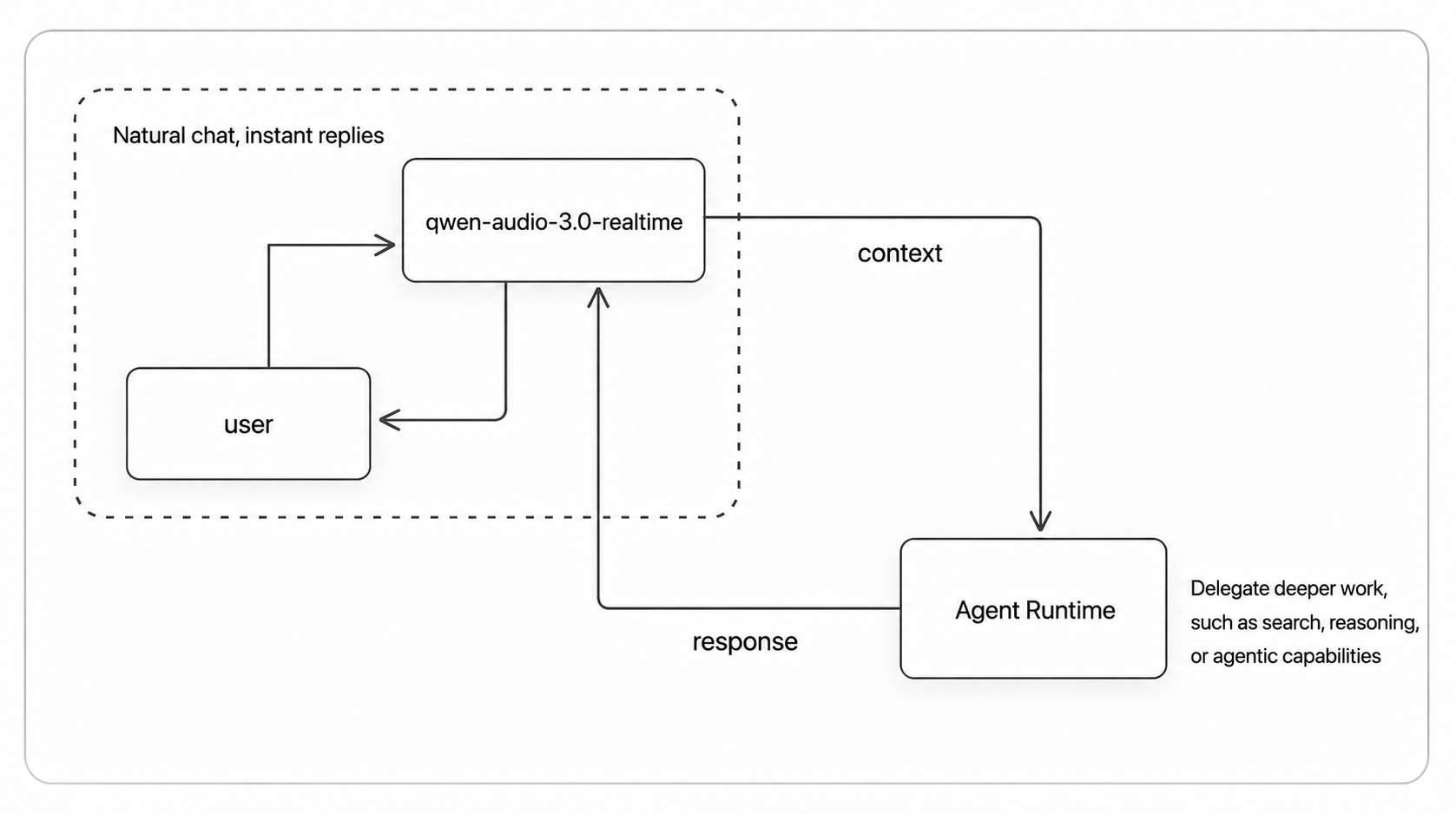
Questions that can be answered directly are answered immediately; when tools or sustained processing are needed, the task is delegated to the backend Agent. Throughout, the user always faces the same assistant.
| Backend Agent | Integration | Setup | Rating |
|---|---|---|---|
| None | N/A | Frontend-only mode, no config needed | ★★★★★ |
| Qwen Code | Native ACP | One-click install, user config required | ★★★★★ |
| OpenCode | Native ACP | One-click install + Bailian config | ★★★★★ |
| OpenClaw | Built-in ACP bridge | One-click install + Bailian config | ★★★★★ |
| Qoder | Native ACP | One-click install, user config required | ★★★★★ |
| MiniMax Code | Native ACP | One-click install, user config required | ★★★★☆ |
| Kimi Code | Native ACP | One-click install, user config required | ★★★★★ |
| Hermes | Native ACP | One-click install, user config required | ★★★★☆ |
| CodeBuddy | Native ACP | One-click install, user config required | ★★★★☆ |
| Codex | External ACP adapter | One-click install (base + adapter), user config required | ★★★★☆ |
| Claude Code | External ACP adapter | One-click install (base + adapter), user config required | ★★★★☆ |
| DeepSeek | Native ACP | One-click install, DeepSeek API key required | ★★★★☆ |
| Pi | External ACP adapter | One-click install (base + adapter), user config required | ★★★★☆ |
Ratings reflect current integration completeness, compatibility, and verification level: five stars indicate a thoroughly tested recommended integration; four stars indicate active development or not yet fully verified. For detailed configuration and capability boundaries, see the backend Agent documentation and configuration guide.
Requires Node.js 22.22.2+ or 24.15.0+, npm 10+. One-click install (recommended):
npm install -g qwen-audio-agent
For building from source, installing from GitHub, and obtaining a DashScope API Key, see the installation guide.
qwenaudio config
DASHSCOPE_API_KEY=your-key
# Voice frontend model: Audio Flash/Plus or Omni Flash/Plus (Audio Plus is default)
QWEN_AUDIO_REALTIME_MODEL=qwen-audio-3.0-realtime-plus
# Backend Agent: optional, leave empty or set to none for frontend-only mode
AGENT_PROTOCOL=openclaw
# Backend model: optional; explicit values use standard ACP, empty reuses Agent config
QWEN_AUDIO_AGENT_BACKEND_MODEL=qwen3.7-max
Before starting, create a key from the Bailian API Key page. Eligible new users can review the new-user free quota and check remaining usage on the model usage page. Quota and billing rules are subject to the current official Bailian documentation.
Uses DashScope realtime voice by default. Alternatives include Speech-to-Speech and ModelBest MiniCPM-o 4.5, with local or hosted endpoints selected through their service URL.
With a visual-capable Realtime frontend, WebUI can explicitly stream bounded camera frames alongside live audio. See Realtime frontend configuration.
qwenaudio webui for the browser UI):qwenaudio # Terminal 1: Gateway
qwenaudio tui # Terminal 2: TUI
For full configuration options, local voice frontend setup, and TUI platform notes, see quick start, voice frontends, and TUI notes.
The desktop app provides a persistent floating voice orb with a built-in Gateway, automatic idle sleep, local voice wake, and customizable appearance. Download the installer for your platform from the releases page, or build from source:
npm run desktop:build:local      # macOS
npm run desktop:build:win        # Windows
npm run desktop:build:linux      # Linux (AppImage + deb, no signing)
For visuals, orb behavior, and build instructions, see the desktop documentation.
The current qwen-audio-agent framework focuses on desktop productivity: users can keep talking with the Agent in realtime while delegating tool use, file work, code changes, and long-running tasks to the backend Agent.
This "foreground conversation + background task" design is not limited to desktop use. It can also expand to more scenarios where the Agent can both chat naturally and get real work done.
| Scenario | Description | Link | Status |
|---|---|---|---|
| Desktop | Voice chat, progress follow-up, tools, and background tasks. | Docs | Available |
| Smart cockpit | Vehicle control, navigation, music, weather, and services. | Example | Available |
| AI Passport | Qwen Voice Bean on a hardware card; voice conversation and backend tasks through a LAN relay. Currently half-duplex only. | Example | Experimental |
| VoiceMem | Optional semantic memory with transcript or native-audio input. | Setup example | Available |
| LightRAG | Replaceable knowledge base with semantic retrieval, document indexing, and management. | Integration example | Available |
| Customer support | Issue clarification, order lookup, tickets, and human handoff. | TBD | Planned |
| Embodied intelligence | Voice commands, action execution, inspection, and exception feedback. | TBD | Planned |
| Livestream assistant | Audience interaction, product explanation, coupons, and risk reminders. | TBD | Exploratory |
This repository includes a smart-cockpit reference scenario built on the foreground-conversation and backend-execution boundary. Its cockpit UI, small A2A Agent, and cockpit service are customer-replaceable examples:
cp examples/smart-cockpit/.env.example examples/smart-cockpit/.env.local
npm run example:smart-cockpit:install
npm run example:smart-cockpit          # service + agent + gateway + client
See examples/smart-cockpit for details.
The VoiceMem setup example shows how to install VoiceMem outside the framework, configure the connector, and switch between Realtime transcripts and VoiceMem-native audio. Lightweight Markdown memory remains the default; the core npm package contains no VoiceMem Python code or dependencies.
The LightRAG integration example
connects an independently deployed knowledge base through the generic KnowledgeProvider.
LightRAG keeps control of its LLM, embeddings, documents, and indexes; the core npm package does
not include LightRAG or Python dependencies.
You can start discussions directly in GitHub Issues.
For users in China, scan the QR codes below to join the WeChat group. If the group QR code is full or expired, scan either maintainer's personal QR code to be invited.
| WeChat Group | Personal | Personal |
|---|---|---|
 |  |  |
Sign in to join the discussion.
No comments yet. Be the first to say what this is good for.
The agent harness performance optimization system. Skills, instincts, memory, security, and research-first development for Claude Code, Codex, Opencode, Cursor and beyond.
The job search that runs on your machine. AI job application framework built on Claude Code: evaluate postings, tailor CVs, write cover letters, prep interviews. Fork it and own it.
from vibe coding to agentic engineering - practice makes claude perfect
🌊 The original agent meta-harness. Deploy intelligent multi-player swarms, coordinate autonomous workflows, and build conversational AI systems. Features adaptive memory, self-learning intelligence, RAG integration, and native Claude Code / Codex / Hermes and many more Integrated
Practical patterns, starters & CLI tools for loop engineering with AI coding agents. Design systems that prompt and orchestrate agents (inspired by Addy Osmani and Boris Cherny). Includes loop-audit, loop-init, loop-cost.

Git. Ship. Done - Core