


JuliusBrussee/
caveman

🪨 why use many token when few token do trick — Claude Code skill that cuts 65% of tokens by talking like caveman
105k
1 add
Pinvou Agent gives you one desktop place to run agents on work, design, and coding tasks. It uses the app UI in `pinvou3-app/` and the CodeWhale engine to handle sessions, tools, knowledge, Skills, MCP servers, and workflow steps.
Builders who want their agents to work in a desktop app with files, tools, knowledge, and reusable workflows.
You can turn agent chats into edited files, working code, and other deliverables without bouncing between separate tools.
Keeps messages, tool calls, and artifacts with each session so you can return to past work.
Collects files the agent creates or edits, with preview, locate, and open actions in one place.
Lets you attach collections, search them, and store long-term preferences with review and confirmation.
Packages repeated methods into reusable capabilities for the agent.
Supports local and remote MCP servers, CLI tools, API connectors, and OAuth/SSO where available.
Lets you run Codex, Claude Code, or Kimi inside the workspace on a real project or temporary workspace.
Adds QR-code remote control plus system monitoring for GPU, memory, disk, model service, and context usage.
git clone --recursive https://github.com/Pinvou/pinvou-agent.git
cd pinvou-agent/pinvou3-app
npm ci
cd ..
./pinvou3-app/run-dev.sh
git submodule update --init --recursive
An open-source desktop AI agent workspace for work, design, and coding.



Download Preview · Website · QQ Group · Issues · Discussions · Security
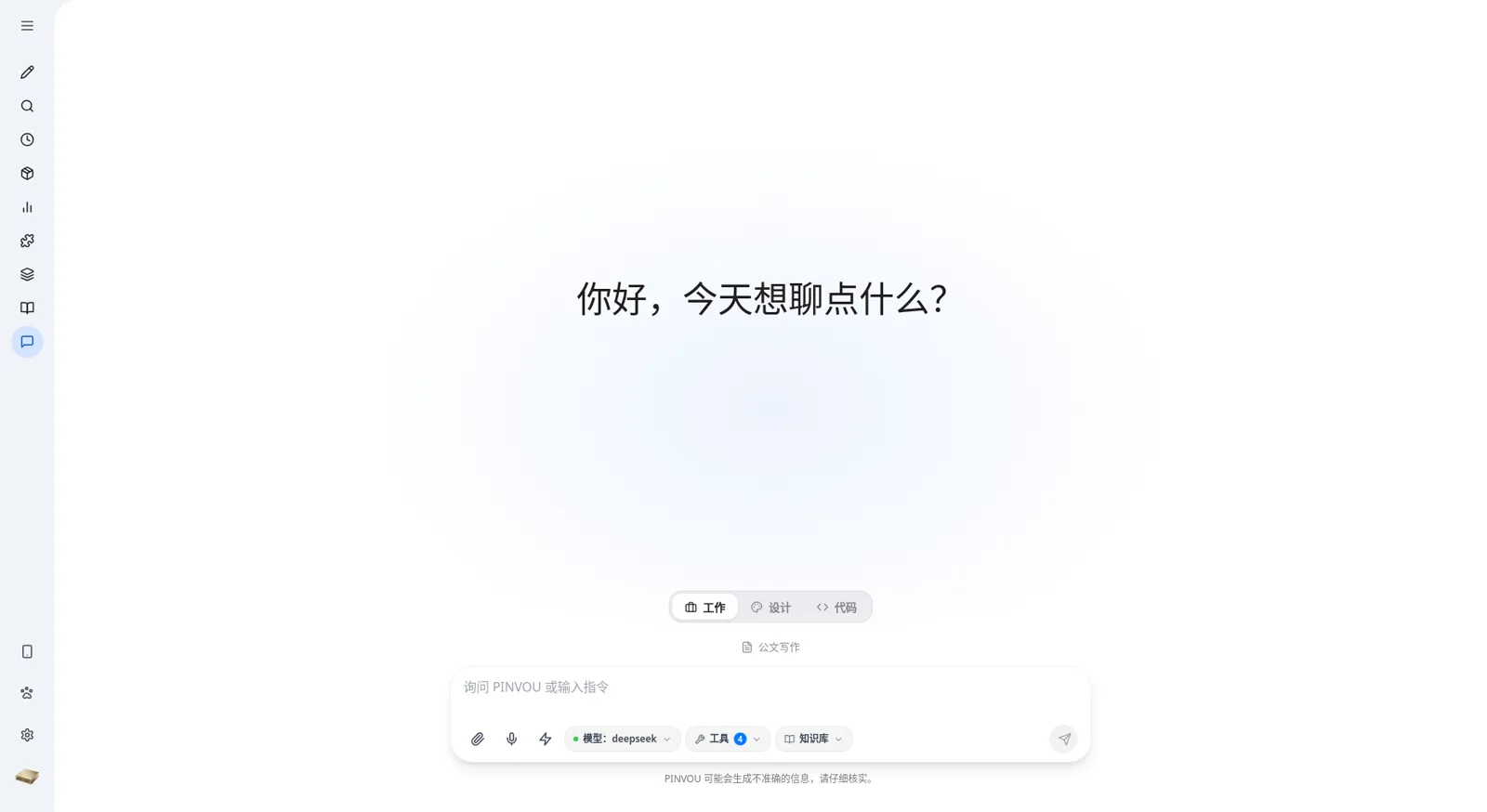
Pinvou Agent is more than a chat window. It brings everyday work, visual design, and software development into one desktop workspace — designed for tasks that should end with a result, not just another chat response. Use tools, work with files, and build personal knowledge; bring a dedicated coding agent into a real project over ACP; or turn a prompt into a visual artifact you can continue editing.
Use a local model for a fully private loop, connect any OpenAI-compatible endpoint, and extend the agent with MCP servers, CLI connectors, Skills, and workflows.
Combine attachments, personal knowledge, specialist personas, Skills, MCP tools, and workflows to research, analyze, write, and deliver reusable files — not just another block of chat text.
Create posters and data visualizations in natural language. Open the result in design mode, select elements directly, and adjust copy, fonts, colors, dimensions, and layout — or keep describing changes and let the agent iterate on the current design.
Use Codex, Claude Code, or Kimi through ACP in the same desktop workspace. The coding agent can read and edit a real project or an isolated temporary workspace, run commands, and surface plans, tool steps, permission requests, and file changes. Sessions stay bound to their workspace and can be continued after restarting the app.
~/.pinvou3/[!NOTE] Whether data leaves your machine depends on the model and tools you enable. A local model with local tools stays fully local. Cloud models, remote MCP servers, and third-party connectors send the relevant requests to their respective services.
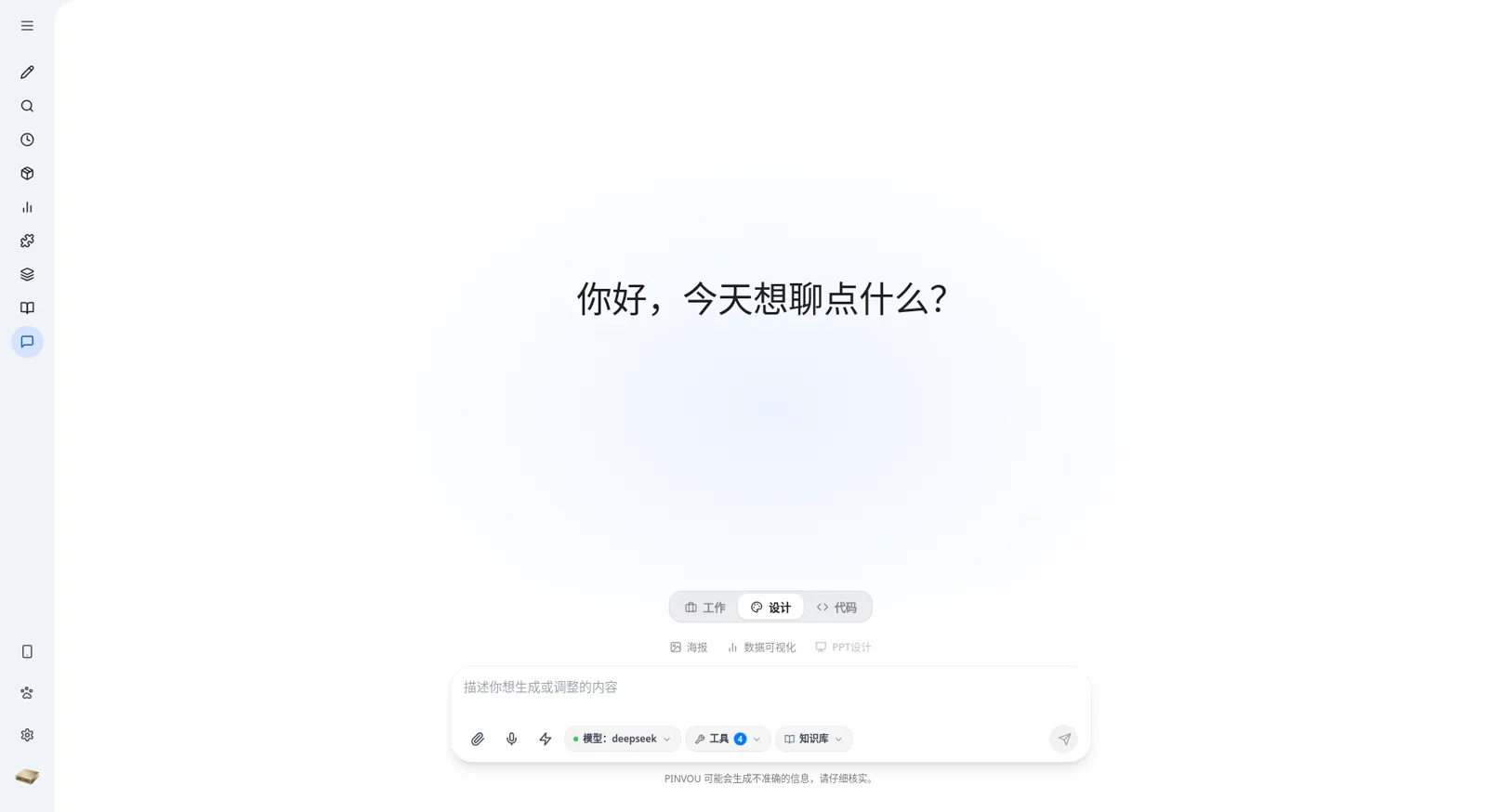 | 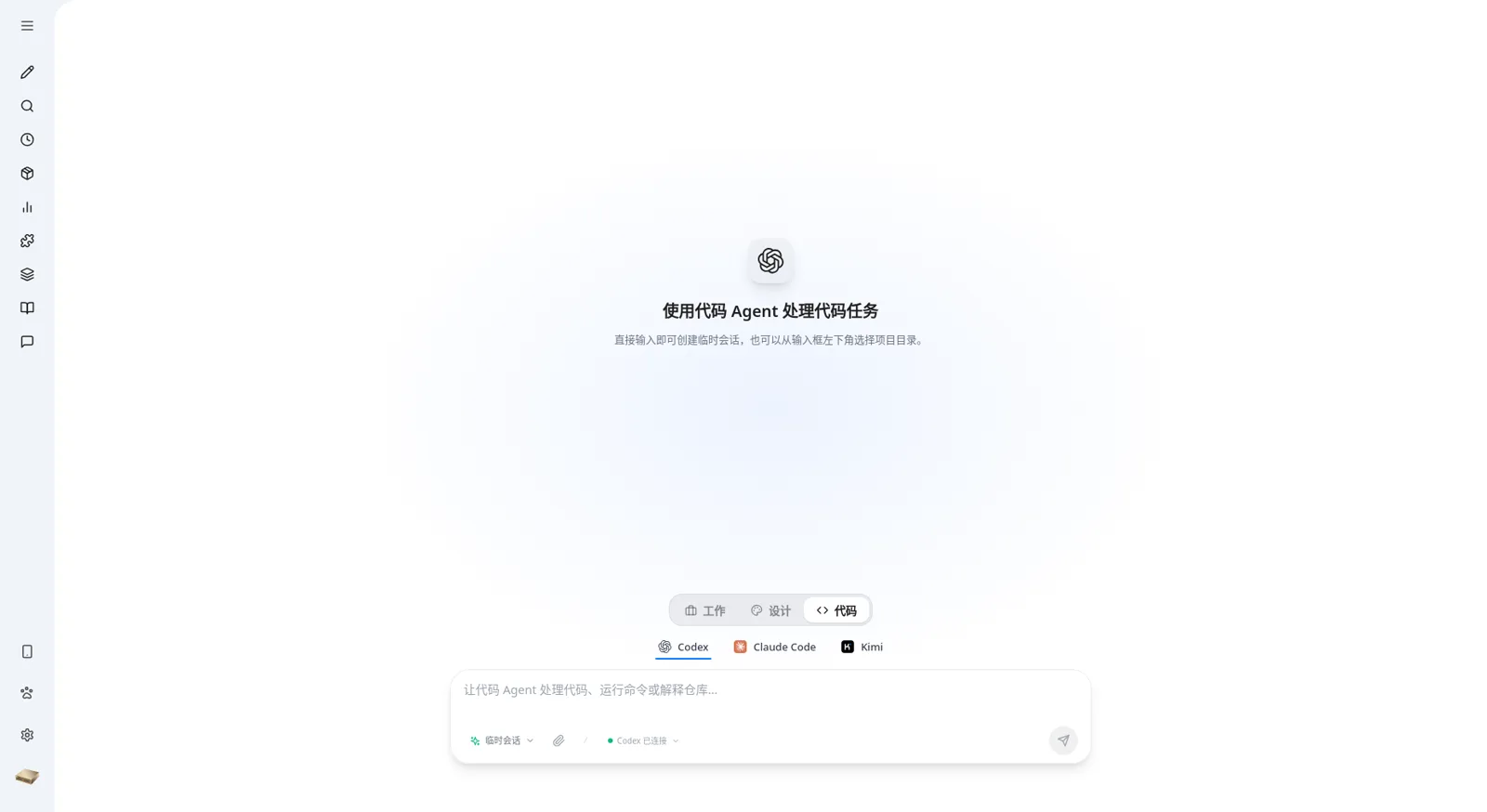 |
| Design mode for posters and data visualizations | Code mode with Codex, Claude Code, and Kimi |
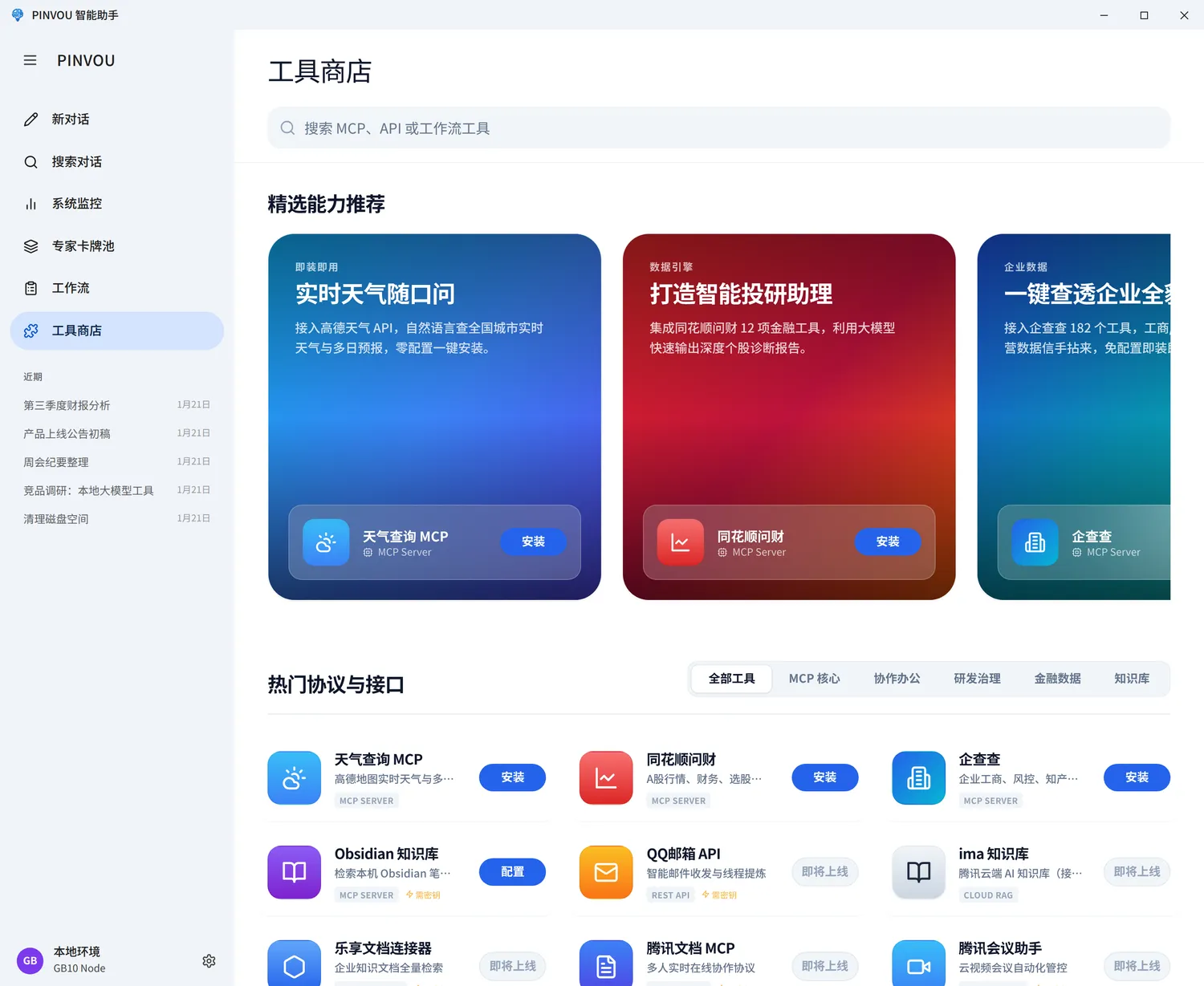 | 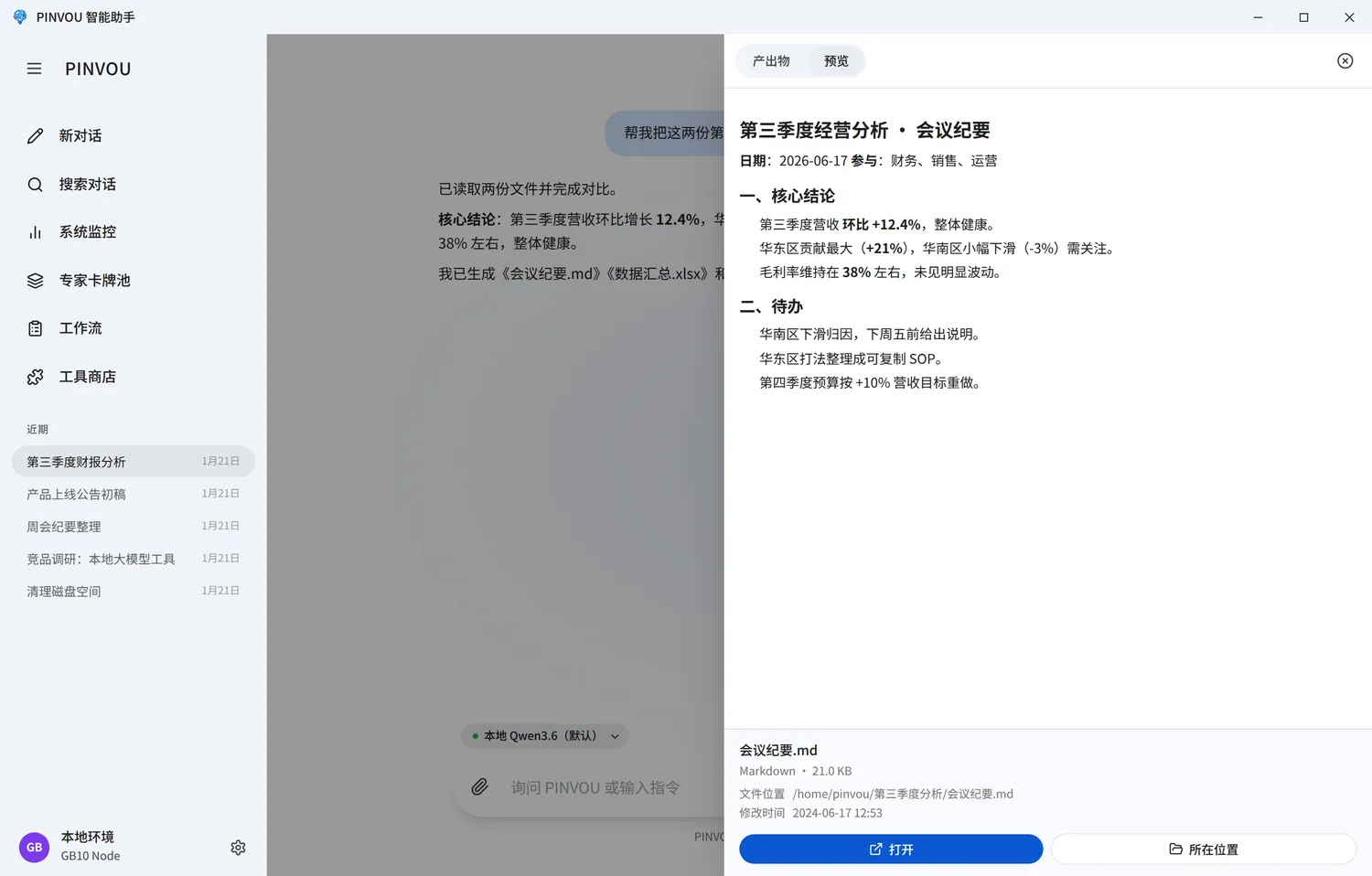 |
| Extend the agent with tools and connectors | Preview and deliver generated artifacts |
Pinvou Agent works with local vLLM and any OpenAI-compatible API. Save multiple model configurations in the app, give cloud configurations optional display aliases, and switch between them per session without changing the model identifier sent to the provider. Built-in templates cover local vLLM, DeepSeek, Kimi, Qwen, Doubao, MiniMax, Zhipu (GLM), MiMo, OpenAI, Anthropic, Gemini, and xAI — or fill in any custom compatible endpoint.
Local vLLM example:
export DEEPSEEK_BASE_URL="http://127.0.0.1:8000/v1"
export DEEPSEEK_API_KEY="local-no-auth"
export DEEPSEEK_MODEL="your-model-name"
Endpoints, model names, and API keys can also be managed directly in the application settings. For a non-loopback plain HTTP endpoint in a trusted development network, explicitly set DEEPSEEK_ALLOW_INSECURE_HTTP=1.
The source tree supports Linux, Windows, and macOS. Linux release packages target Ubuntu 22.04 or newer (glibc 2.35+) on x86_64 and arm64; the deb also requires WebKitGTK 2.40+ (any 22.04 system with the standard updates pocket applied satisfies this). macOS release packages are universal (Apple Silicon and Intel) builds for macOS 11 or later. Speech-recognition engines can be packaged per build configuration; file parsing (PDF / Office / OCR / archives) relies on optional external tools installable via your platform's package manager (see pinvou3-app/INSTALL.md).
git clone --recursive https://github.com/Pinvou/pinvou-agent.git
cd pinvou-agent/pinvou3-app
npm ci
cd ..
./pinvou3-app/run-dev.sh
If you cloned without submodules:
git submodule update --init --recursive


React + Vite UI
       ↕ Tauri commands / events
pinvou3-app (desktop orchestration)
       ↕ EngineHandle / AgentHarness
CodeWhale (agent engine submodule)
       ├─ OpenAI-compatible model services
       ├─ MCP servers and CLI connectors
       └─ Skills, Commands, Hooks, and Compaction
CodeWhale provides the agent engine: model calls, streaming, tool execution, sessions, MCP, Skills, hooks, and compaction. pinvou3-app/ owns the desktop UI, runtime configuration, orchestration, and operating-system integration — it never re-implements engine capabilities.
| Extension goal | Where it belongs |
|---|---|
| Add a domain agent or tool bundle | A SKILL.md package |
| Connect an external API | An independent MCP server or connector |
| Guide model behavior | Bundle instructions (instructions.md) |
| Change desktop UI or system integration | pinvou3-app/ |
| Fix a reusable engine issue | The CodeWhale fork, following the fork policy |
pinvou3-app/          Tauri 2 + React/Vite desktop application
CodeWhale/            Agent engine submodule
pinvou-knowledge/     Reusable knowledge core and self-contained server
remote-control-relay/ Optional self-hosted relay for QR-code remote control
pinvou3-app/resources/mcp-servers/
                      Independent local MCP servers
scripts/              Tests, guards, build, and release helpers
docs/                 Architecture and maintenance documentation
Run these commands from the repository root:
(cd pinvou3-app && npm run lint:ui)
(cd pinvou3-app && npm run build:ui)
(cd pinvou3-app && npm test)

(cd pinvou3-app/src-tauri && cargo test --lib -- --test-threads=1)

./scripts/fork-guard.sh --fast
Contributions are welcome! Please read CONTRIBUTING.md for the contribution workflow and CI gates, and docs/fork-policy.md with the current fork modification inventory for CodeWhale maintenance rules. By participating, you agree to our Code of Conduct.
security@pinvou.com
Licensing, third-party attribution, SBOM, brand-use boundaries, and the extension marketplace overview are documented in THIRD_PARTY_NOTICES.md, docs/sbom.md, TRADEMARKS.md, and docs/工具市场.md.
Pinvou Agent is under active development — the main branch and the latest release notes are the source of truth for current behavior.
MIT License · Made with ❤️ by the Pinvou team and contributors
Sign in to join the discussion.
No comments yet. Be the first to say what this is good for.
🪨 why use many token when few token do trick — Claude Code skill that cuts 65% of tokens by talking like caveman

The best-benchmarked open-source AI memory system. And it's free.

Orca is the ADE for working with a fleet of parallel agents. Run any coding agent with your own subscription. Available on desktop, mobile and remote runtime.
A cross-platform desktop All-in-One assistant for Claude Code, Codex, OpenCode, OpenClaw, Grok Build & Hermes Agent. Only official website: ccswitch.io

Never stop coding. Free MIT AI gateway: one endpoint, 352 providers (150+ free), 1200+ models Kimi, Claude, GPT, Gemini, GLM, DeepSeek, MiniMax. Works with Claude Code, Codex, Cursor, OpenCode, Cline & Copilot. Quota-aware auto-fallback, RTK+Caveman compression saves 15-95% tokens, MCP/A2A, Desktop/PWA. Built by 550+ contributors

Compress tool outputs, logs, files, and RAG chunks before they reach the LLM. 20% fewer tokens for coding agents, 60-95% fewer tokens for JSON, same answers. Library, proxy, MCP server.