
JuliusBrussee/
caveman

🪨 why use many token when few token do trick — Claude Code skill that cuts 65% of tokens by talking like caveman
105k
1 add
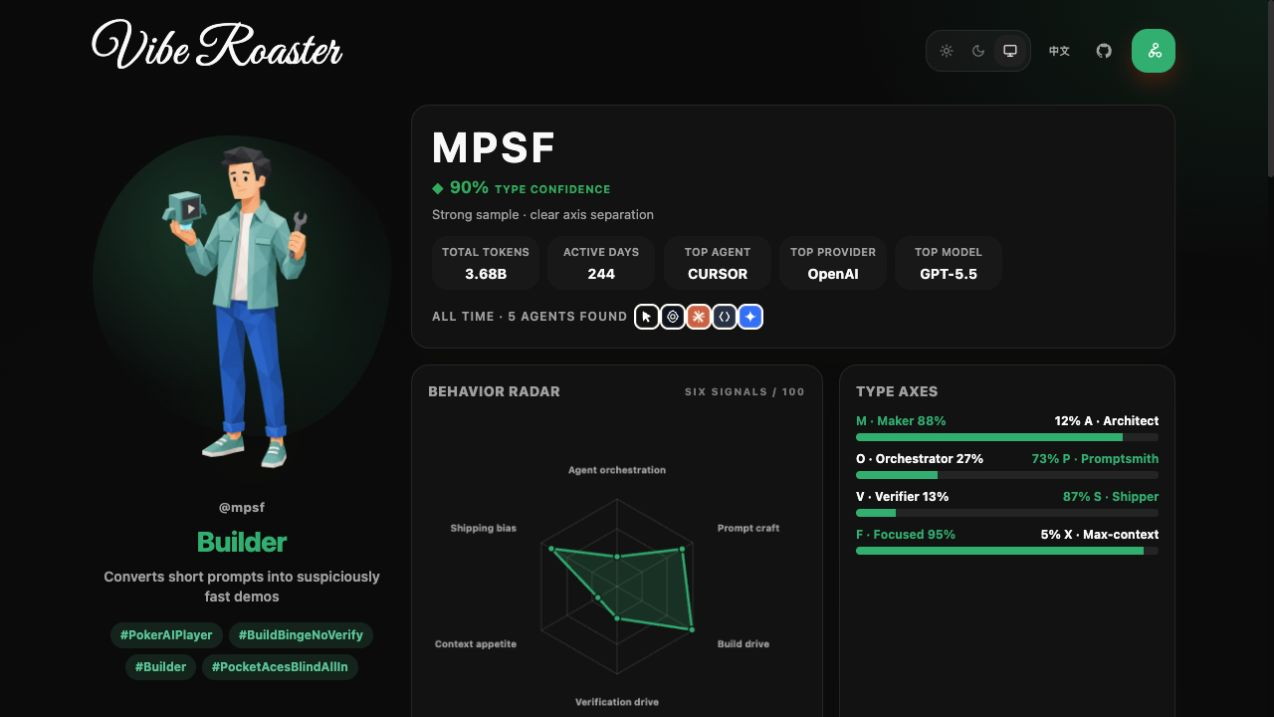
Vibe Roaster scans local coding-agent histories, classifies the work into four axes, and turns that into one of 16 characters plus an evidence-grounded roast. The same data powers a local dashboard, usage analytics, recurring theme discovery, and a shareable 3:4 card.
Builders who want their agent history turned into a profile, roast, and usage dashboard.
You can inspect how you actually use coding agents instead of guessing from memory.
Turns four observable behavior axes into one of 16 illustrated coding characters.
Generates a roast from aggregate profile signals instead of the raw prompts you typed.
Shows activity trends, agent share, provider and model usage, and token stats.
Finds repeated project nouns, frameworks, subsystems, and acronyms from your history.
Creates a 3:4 personality card with the character, roast, hashtags, and repo link.
Reads supported local stores for Claude Code, Codex, Cursor, Gemini CLI, Copilot, Windsurf, and others.
npx vibe-roast
http://localhost:7681
git clone https://github.com/PinkR1ver/vibe-roast.git
cd vibe-roast
npm install
npm run build
npm run serve

Turn your local AI coding history into a 16-type personality profile—and let it roast the evidence.



Quick start · What you get · How it works · Privacy · Development · 中文
Vibe Roaster reads local coding-agent histories and builds:
The personality calculation is deterministic and local. AI writing is optional.

Watch the 30-second demo · click for the 1080p version
Requires Node.js 20 or newer.
npx vibe-roast
Vibe Roaster scans the supported local stores it can find, starts the local dashboard server, and opens:
http://localhost:7681
tokentracker-cli ships as a runtime dependency. The first launch initializes its
local-only collectors and compatible hooks; later launches sync the queue before
opening the report. Activity is always measured in Tokens. If TokenTracker cannot
collect data for a source, the UI shows zero for that source.
Vibe Roaster invokes TokenTracker in local-only, no-auth mode. TokenTracker's account, OAuth, leaderboard, and cloud sync features are not used.
Interactive terminals show a short branded launch animation. Piped output, CI,
and NO_COLOR environments use plain text.
Missing agents are skipped. You don't need to configure every source, create an account, or provide an API key to see the local result.
The download badge reports npm Registry fetches per month. npx vibe-roast counts
when npm needs to download the package; cached runs may not.
On first launch, choose one of three paths:
| Mode | What happens | Account or key |
|---|---|---|
| Local roast | Uses deterministic bilingual copy | None |
| Hosted roast | GitHub identifies the profile; Cloudflare Workers AI writes and caches the roast | GitHub sign-in |
| Your provider | Sends aggregate roast evidence to your selected model | DeepSeek, OpenAI, Anthropic, Gemini, Groq, or OpenRouter key |
GitHub login is for identity only. It does not use GitHub Models.
|
16 coding personalities Four inspectable behavior axes resolve into one illustrated character—Builder, Debugger, Prompt Priest, Agent Commander, and twelve more. |
Evidence-grounded roast The type stays deterministic. Optional AI writing turns aggregate signals and contradictions into bilingual comedy without receiving the exact requests you typed. |
|
Usage analytics Explore activity heatmaps, trends, Agent share, provider/model usage, and available Codex or Claude context breakdowns. |
Recurring themes A time- and Agent-filtered cloud promotes repeated coding concepts, project nouns, frameworks, subsystems, and meaningful acronyms. |
|
Semantic Hashtags AI reads coherent concept clusters and turns them into shareable character labels instead of copying the highest-frequency token. |
Shareable by design Export a 1080 × 1440 personality card with the character, roast, axes, complete Hashtag set, repository URL, and one-command install path. |



flowchart LR
    A["Local agent histories"] --> B["Keep real user intent"]
    B --> C["Classify prompt behavior"]
    C --> D["Resolve four type axes"]
    D --> E["Choose one of 16 characters"]
    C --> F["Build aggregate roast evidence"]
    E --> G["Roast Result"]
    F --> G
    G --> H["3:4 share card"]
This is MBTI-like presentation for observed coding-agent behavior—not psychology, ability, or code quality.
| Axis | Left | Right | Main evidence |
|---|---|---|---|
| M / A | Maker · asks for runnable artifacts | Architect · asks for plans and explanations | implementation and repair vs planning and research |
| O / P | Orchestrator · delegates through workflows | Promptsmith · directs one agent precisely | workflow language vs direct prompt craft |
| V / S | Verifier · proves and repairs | Shipper · builds and releases | debugging, testing, refactor vs implementation and packaging |
| F / X | Focused · keeps requests compact | Max-context · supplies broad context | useful/reference balance and long-prompt ratio |
Every axis exposes its evidence split. The winning letters are concatenated—MPSF, for example—and mapped to a character.
| Type | Character | Type | Character |
|---|---|---|---|
| MOVF | Agent Engineer | AOVF | Systems Architect |
| MOVX | Systems Wrangler | AOVX | Context Cartographer |
| MOSF | YOLO Shipper | AOSF | Strategy Shipper |
| MOSX | Agent Commander | AOSX | Agent Believer |
| MPVF | Debugger | APVF | Architect |
| MPVX | Context Maxxer | APVX | Prompt Priest |
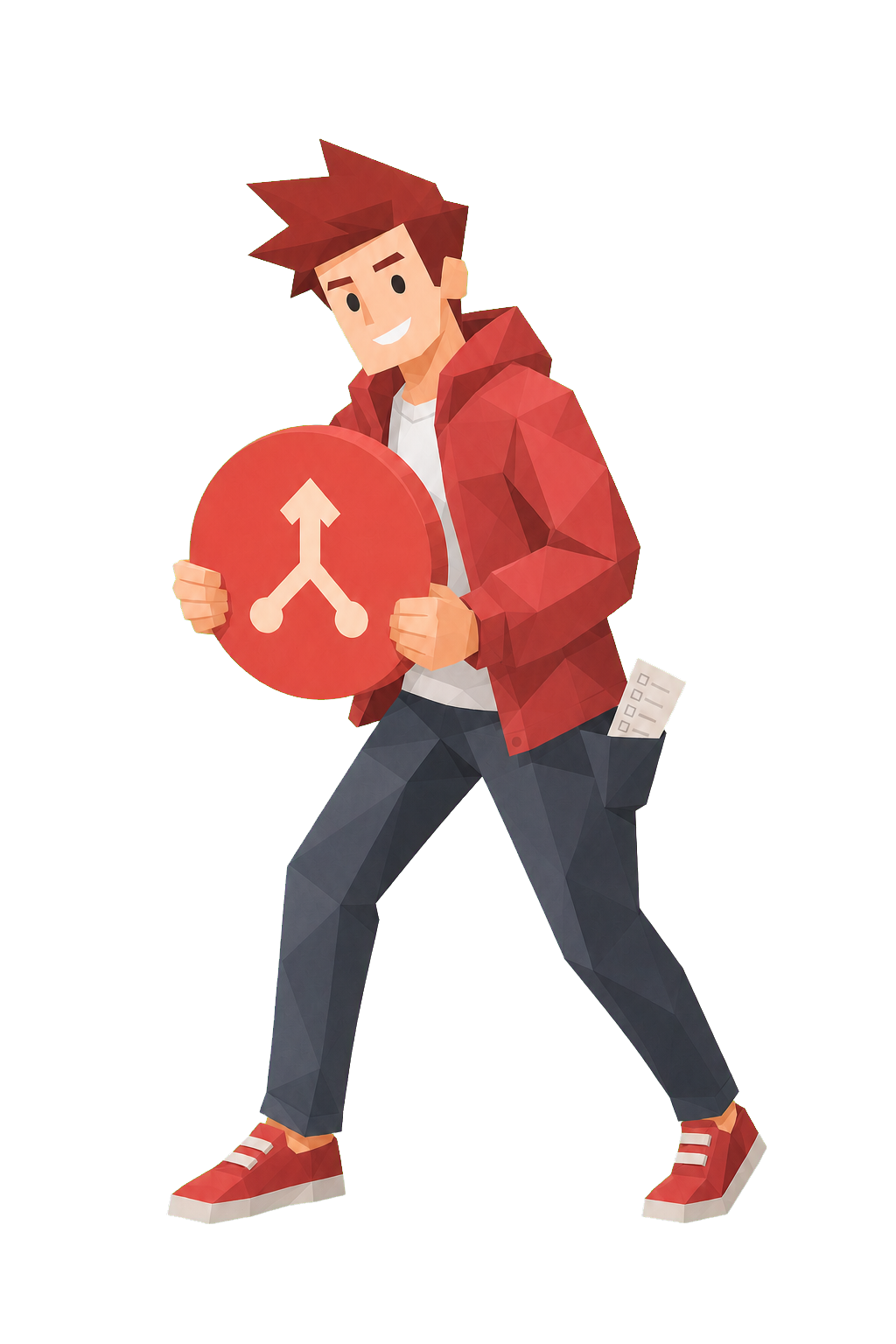
| MPSF | Builder | APSF | Diagram Sprinter |
| MPSX | Tab Hoarder | APSX | Infinite Planner |
There is no primary/secondary persona and no quality rank. Fewer than 20 useful prompts produces a provisional type; confidence grows with sample size and clearer axis separation.
Classification is multi-label. A request such as “fix this login bug and add a regression test” contributes half to Debugging and half to Testing, so one verbose prompt cannot count several times.
| Category | Typical evidence |
|---|---|
| Planning | plans, architecture, brainstorming |
| Debugging | failures, exceptions, root-cause work |
| Testing | tests, regression, assertions, coverage |
| Refactor | restructuring, extraction, cleanup |
| Packaging | build, release, publish, deployment |
| Explanation | explain, why, walkthrough |
| Research | search, documentation, investigation |
| UI design | pages, components, layout, CSS/UX |
| Workflow | agents, hooks, MCP, skills, automation |
| Implementation | useful requests without a more specific category |
| Reference | pasted code, logs, stack traces, system/tool noise |
Reference material is excluded from useful-intent counts.
The word cloud is not a raw token dump. It removes pasted code, paths, markup fragments, provider boilerplate, conversational filler, and stop words. English identifiers are split into readable terms; Chinese text uses Intl.Segmenter plus a compact developer vocabulary.
Ranking favors the number of distinct prompts containing a concept, with a smaller logarithmic repetition bonus. Common bilingual variants are merged, lexical/category duplicates are collapsed, and recurring acronyms preserve their observed casing.
Project-domain entities do not need to be hardcoded. A candidate can be promoted when it:
The same Day / Week / Month / Total / Custom and Agent filters apply to the cloud, token totals, usage trend, and model breakdown.
Only a compact roast_evidence object is ever sent over the network. It contains
aggregate type, axis, category, dimension, concept, and activity signals—never
the text you typed into an Agent.
The writer cannot change the deterministic type. In one model call it produces:
en, zh, semantic kind, and a short shared meaning.Hashtags are semantic interpretations, not frequency labels. Chinese is localized from the intended joke rather than translated literally. Proper names, framework names, and meaningful acronyms may stay unchanged.
Vibe Roaster is local-first. The AI roast and hosted profile cache are optional network features.
| Data | Local profile | Optional AI roast | Hosted profile cache |
|---|---|---|---|
| Prompt text you typed | Used locally | Never sent | Never stored |
| Local paths and configuration | Local only | Never sent | Never stored |
| Aggregate categories and scores | Computed locally | Sent when explicitly enabled | Stored as a compact snapshot |
| Generated roast and Hashtags | Local result | Returned by selected model | Stored for stable signed-in profiles |
| API key | Not required | Used for that request only | Never stored by the local app |
The UI runs on localhost. The Node server is not hardened for public exposure—don't
expose port 7681 to untrusted networks.
GitHub sessions are stored under ~/.vibe-roast/ with owner-only permissions. A
cached roast is reused until the profile changes materially.
Vibe Roaster inspects the sources it can find and treats missing roots as empty.
| Source | ID | Default store |
|---|---|---|
| Codex | codex | ~/.codex/sessions |
| Claude Code | claude | ~/.claude/projects |
| Cursor | cursor | platform state.vscdb |
| Cline | cline | VS Code/Cursor global storage |
| Roo Code | roo | VS Code/Cursor global storage |
| Continue | continue | ~/.continue/sessions |
| Gemini CLI | gemini | ~/.gemini/tmp/*/chats |
| Aider | aider | .aider.chat.history.md |
| Windsurf | windsurf | ~/.codeium/windsurf plaintext exports |
| Copilot Chat | copilot | VS Code/Cursor global storage |
| Amazon Q | amazonq | ~/.aws/amazonq/history |
| Antigravity | antigravity | ~/.gemini/antigravity(-ide)/conversations |
| OpenCode | opencode | ~/.local/share/opencode/opencode.db |
| TokenTracker (bundled) | activity only | ~/.tokentracker/tracker/queue.jsonl |
| Vibe tracker | vibe-tracker | ~/.vibe-roast/sessions.jsonl |
Cursor and OpenCode are best-effort and require the local sqlite3 command. Encrypted or binary histories are skipped.
npx vibe-roast inspect \
  --from 2026-06-01 \
  --to 2026-06-08 \
  --sources codex,claude,cursor
The JSON report includes source summaries, activity, word frequencies, prompt analysis, the four-axis profile, aggregate roast evidence, and normalized prompt records.
npx vibe-roast inspect \
  --codex-root /path/to/codex/sessions \
  --claude-root /path/to/claude/projects \
  --cursor-db /path/to/state.vscdb
Additional overrides:
--home
--cline-root
--roo-root
--continue-root
--gemini-root
--aider-root
--windsurf-root
--copilot-root
--amazonq-root
--antigravity-root
--opencode-root
--token-tracker-queue
npx tokentracker-cli status
npx tokentracker-cli doctor
Installing the npm package does not modify Agent configuration. The first
vibe-roast run initializes TokenTracker; TokenTracker manages its own hooks and
local queue from that point on.
Most users need no environment variables.
| Variable | Purpose |
|---|---|
PORT | Change the local server port from 7681 |
VIBE_ROAST_NO_OPEN=1 | Start without opening the browser |
VIBE_ROAST_PLAIN_OUTPUT=1 | Disable terminal color and launch animation |
VIBE_ROAST_AUTH_BROKER_URL | Override the hosted OAuth/AI broker for development or self-hosting |
DEEPSEEK_BASE_URL | Override the default DeepSeek-compatible endpoint |
DEEPSEEK_MODEL | Override the default DeepSeek model |
For local development, place ignored values in .env.local. Explicit shell environment variables take precedence.
Never commit API keys, client secrets, session secrets, .env.local, or worker/.dev.vars.
git clone https://github.com/PinkR1ver/vibe-roast.git
cd vibe-roast
npm install
npm run build
npm run serve
# terminal 1: API and local assets
VIBE_ROAST_NO_OPEN=1 npm run serve

# terminal 2: Vite HMR
npm run dev
Vite runs at http://localhost:5173 and proxies /api plus /assests to the local Node server.
npm test
npm run build
Tests cover adapters, fixture parsing, prompt hygiene, activity aggregation, type scoring, word-cloud entities, AI schema validation, OAuth/broker behavior, caching, Hashtags, and frontend helpers.
bin/                    CLI entrypoints
src/sources/            local Agent adapters
src/extract/            prompt and concept extraction
src/lib/                scoring, activity, roast, cache snapshots
dashboard/src/          React Roast Result UI
worker/                 Cloudflare OAuth + hosted AI broker
assests/                published visual pack (spelling is intentional)
test/                   Node fixtures and tests
.agents/                architecture, decisions, and feature specs
For architecture details, see the project architecture. For the hosted OAuth and free-AI flow, see the hosted-roast architecture.
The public npm package defaults to https://auth.pinktalk.online. End users do not need a GitHub Client Secret.
The included Cloudflare Worker uses:
Deployment and secret configuration live in worker/README.md.
Issues and pull requests are welcome. Read CONTRIBUTING.md for development setup, test requirements, privacy rules, AI-assisted contribution disclosure, and the review process.
Report vulnerabilities privately according to SECURITY.md. Never commit private session dumps, user histories, tokens, or credentials.
Sign in to join the discussion.
No comments yet. Be the first to say what this is good for.
🪨 why use many token when few token do trick — Claude Code skill that cuts 65% of tokens by talking like caveman

The best-benchmarked open-source AI memory system. And it's free.

Orca is the ADE for working with a fleet of parallel agents. Run any coding agent with your own subscription. Available on desktop, mobile and remote runtime.
A cross-platform desktop All-in-One assistant for Claude Code, Codex, OpenCode, OpenClaw, Grok Build & Hermes Agent. Only official website: ccswitch.io

Never stop coding. Free MIT AI gateway: one endpoint, 352 providers (150+ free), 1200+ models Kimi, Claude, GPT, Gemini, GLM, DeepSeek, MiniMax. Works with Claude Code, Codex, Cursor, OpenCode, Cline & Copilot. Quota-aware auto-fallback, RTK+Caveman compression saves 15-95% tokens, MCP/A2A, Desktop/PWA. Built by 550+ contributors

Compress tool outputs, logs, files, and RAG chunks before they reach the LLM. 20% fewer tokens for coding agents, 60-95% fewer tokens for JSON, same answers. Library, proxy, MCP server.