

obra/
superpowers

obra/superpowersSkills
An agentic skills framework & software development methodology that works.
285k
1 add
Ultracode adds a small skill layer that guides the agent through planning, delegation, integration, and final verification. For non-trivial tasks, it writes inspectable workflow files and can use native agents when the host supports them.
Builders who want their agent to handle bigger coding tasks with clearer steps and safer handoffs.
You can run multi-step coding work with more structure, delegation, and final checks without building a separate tool.
Decides whether a task should use direct edits, workflow files, or delegated agents.
Writes plain Markdown and JSON files such as `plan.md`, `orchestration.md`, `state.json`, `integration.md`, and `final-report.md`.
Uses Codex native `spawn_agent` when it helps, with bounded sidecar agents for independent packets.
Checks the result before answering and can add a final audit for higher-risk runs.
Falls back to workflow mode when native agents are unavailable or not useful.
mkdir -p "${CODEX_HOME:-$HOME/.codex}/skills"
cp -R ultracode "${CODEX_HOME:-$HOME/.codex}/skills/"mkdir -p "$HOME/.claude/skills" cp -R ultracode "$HOME/.claude/skills/"
mkdir -p .agents/skills cp -R /path/to/ultracode .agents/skills/
mkdir -p "$HOME/.gemini/antigravity/skills" cp -R ultracode "$HOME/.gemini/antigravity/skills/"
Use $ultracode to build this feature end to end.
Use $ultracode. Split this across agents where it is safe, keep integration in the parent session, and verify the final patch.




Ultracode Skill gives Codex a dynamic workflow layer for serious coding tasks: planning, native agents, integration, and final verification without turning the repo into a separate runner.
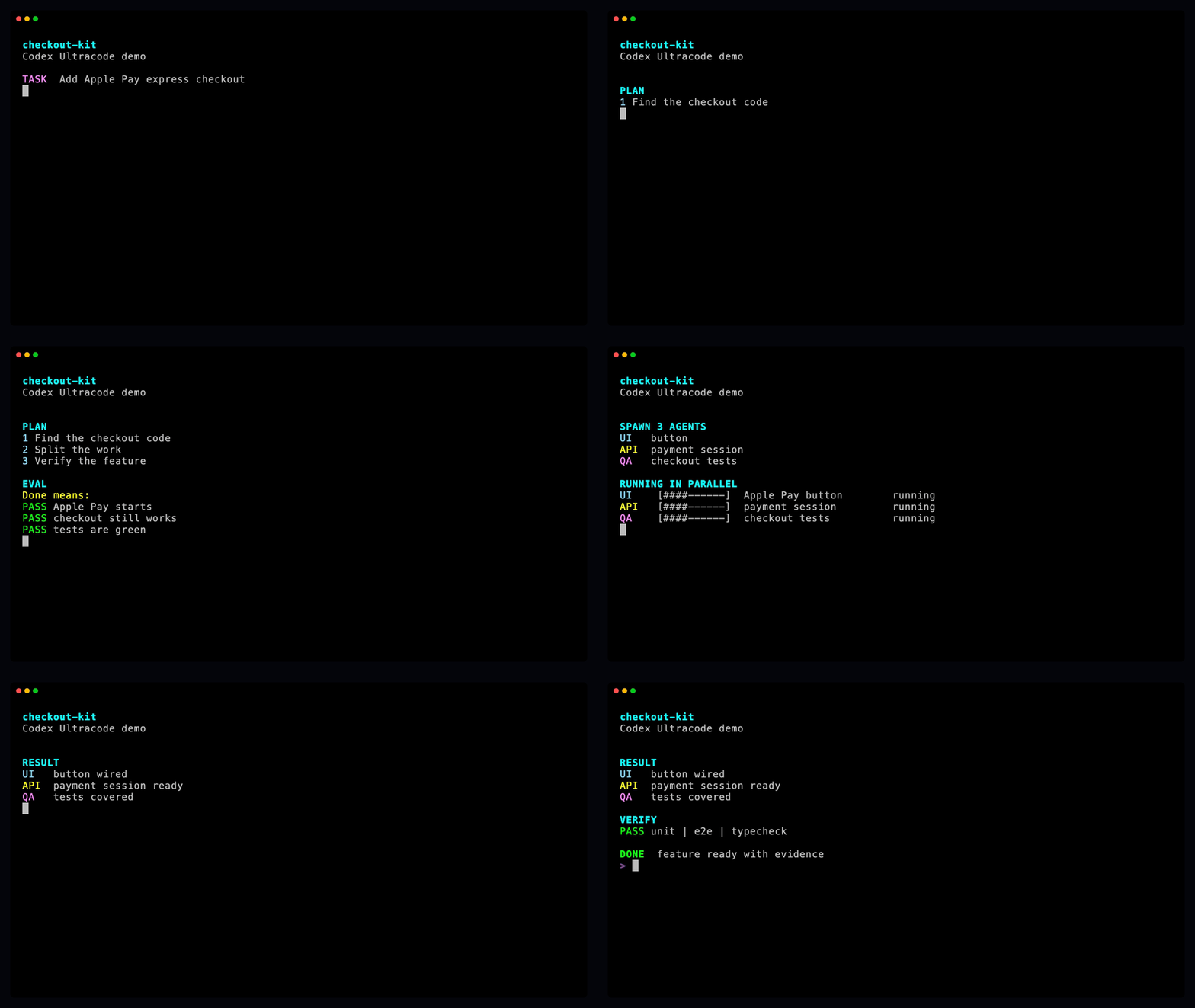
Use it when a task needs more than one pass: discovery, implementation, review, tests, and a final integration step. The skill tells the agent how to decide between a direct edit, a packetized workflow, or native agent delegation.
Codex is the main target. Claude Code already has first-class workflow concepts; Codex has native multi-agent tools, but users still need a clean operating pattern around them. Ultracode fills that gap with one small SKILL.md folder.
Ultracode asks the agent to:
For Codex, that means the skill can use native spawn_agent for independent packets, then integrate the results in the parent session.
The installable skill folder is ultracode/.
mkdir -p "${CODEX_HOME:-$HOME/.codex}/skills"
cp -R ultracode "${CODEX_HOME:-$HOME/.codex}/skills/"
Restart Codex after installing.
mkdir -p "$HOME/.claude/skills"
cp -R ultracode "$HOME/.claude/skills/"
Workspace install:
mkdir -p .agents/skills
cp -R /path/to/ultracode .agents/skills/
User install:
mkdir -p "$HOME/.gemini/antigravity/skills"
cp -R ultracode "$HOME/.gemini/antigravity/skills/"
Start with the short form:
Use $ultracode to build this feature end to end.
You do not have to manually design the workflow or ask for subagents. Ultracode decides whether the task needs a direct edit, a workflow, or native agents.
For non-trivial Codex tasks, $ultracode is delegated-workflow intent: when useful native agents are available, Ultracode should prefer a small bounded fan-out instead of doing every independent packet in one session.
If you want to force a delegated run, you can still say it directly:
Use $ultracode. Split this across agents where it is safe, keep integration in the parent session, and verify the final patch.
| Mode | Use it for | Behavior |
|---|---|---|
| Direct | Small, clear edits | No workflow files unless needed. Run the narrowest useful check. |
| Workflow | Multi-step work without useful delegation | Write plan, packet, result, integration, and final report files. |
| Delegated | Independent packets where native agents are available | Spawn bounded agents, keep the critical path local, integrate results, verify. |
For non-trivial tasks, Ultracode writes plain Markdown and JSON:
.workflow/ultracode/<run-slug>/
  plan.md
  orchestration.md
  state.json
  packets/
  results/
  integration.md
  final-report.md
High-risk or cross-surface runs may also include eval-contract.md, contracts/, handoffs/, or final-audit.md.
These files make the run inspectable. You can see what was delegated, what changed, what passed, and what risk remains.
When Codex exposes native agent tools, Ultracode prefers real delegation over fake packet simulation.
The parent session should:
explorer agents for read-only discoveryworker agents only with clear file ownershipagent_type with a full-history forkIf native agents are unavailable, blocked by policy, or not useful for the task, Ultracode falls back to workflow mode and records the concrete reason.
This skill was tested in Codex with a fresh demo repository.
Result:
$ultracode loaded the skill.workflow/ultracode/... artifacts were createdspawn_agentUltracode Skill does not ship a background service, hidden runner, or required scripts. It is a small skill folder that teaches the agent how to run high-effort coding workflows with the tools already available in the current host.
The repo is ultracode-skill.
The skill name is ultracode, so users can invoke it with:
$ultracode
MIT.
Sign in to join the discussion.
No comments yet. Be the first to say what this is good for.
An agentic skills framework & software development methodology that works.
Turn any codebase, with its docs, SQL schemas, configs, and PDFs, into a queryable knowledge graph. A /graphify skill for Claude Code, Cursor, Codex, and Gemini CLI: local deterministic AST parsing, every edge explained, no vector store.

Topic in, narrated explainer video out. A Claude Code / Codex skill that turns any topic into a black-canvas motion-graphics explainer video with TTS voiceover, subtitles and a chapter progress bar. Chinese or English; every frame drawn in code with Remotion.
Public repository for Agent Skills
Open-source AI job search: scan job portals, evaluate listings into a structured A-H report with a global 1-5 score, tailor your CV, track applications — runs locally in your AI coding CLI (Claude Code, Codex, OpenCode, Antigravity…)
Production-grade engineering skills for AI coding agents.