

JuliusBrussee/
caveman

🪨 why use many token when few token do trick — Claude Code skill that cuts 65% of tokens by talking like caveman
105k
1 add
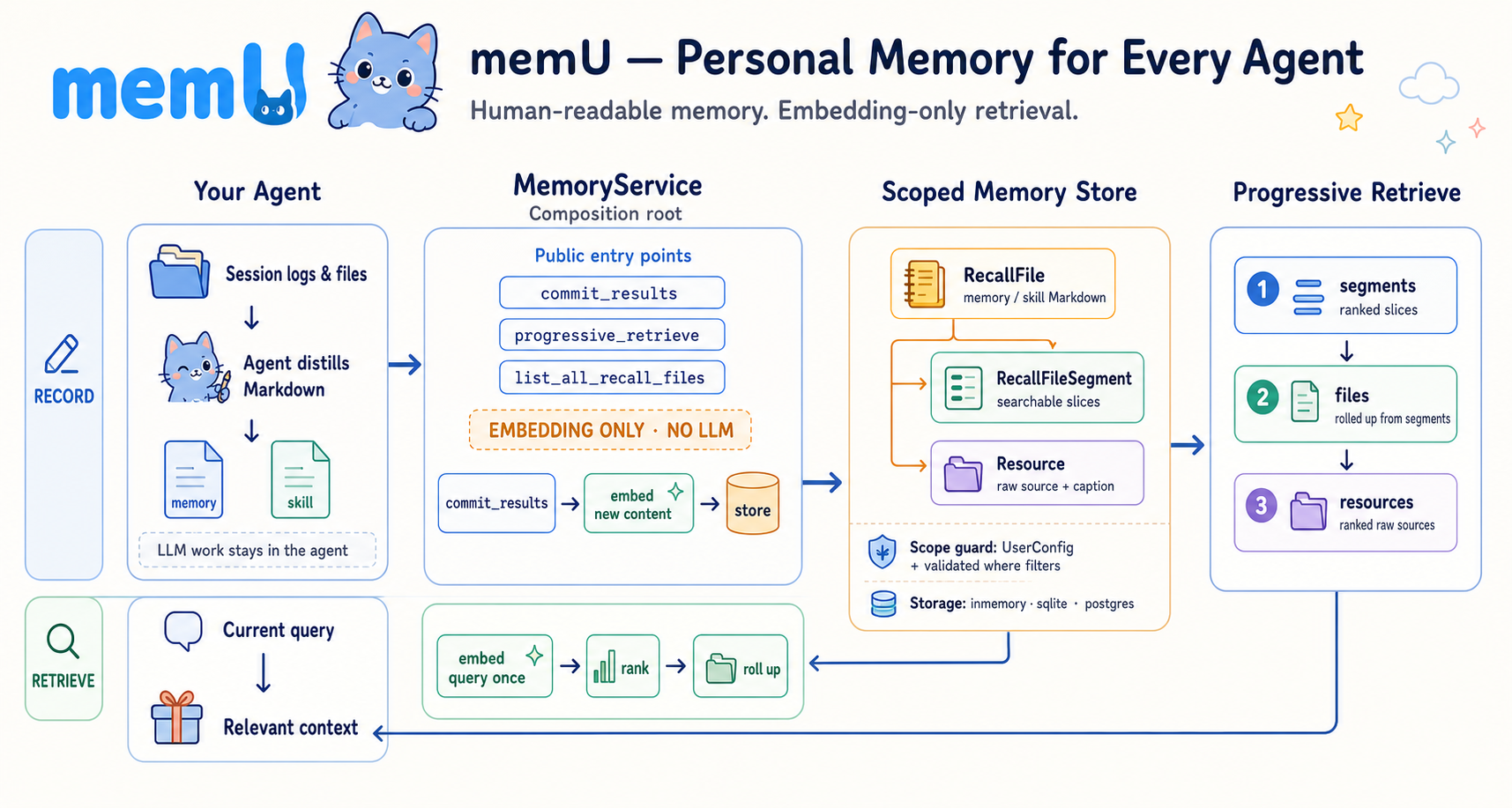
memU stores useful session knowledge as shared memory and retrieves it when a later task needs it. It works through host adapters that read agent session logs, patch the host’s instruction file, and run scheduled bridging jobs to turn past work into reusable memory or skills.
Builders who want their agent to remember past work across sessions, devices, and tools.
You can stop re-explaining project context and reuse learned workflows in later agent sessions.
Stores memory in a shared backend so one agent’s sessions can be retrieved by another.
Reads new session history and turns it into self-contained jobs for the agent to process into memory.
Converts useful agent history into Markdown skills that can be reused later.
Provides binaries like `memu-codex`, `memu-claude-code`, `memu-cursor`, and `memu-openclaw` for specific agent environments.
Lets you run `retrieve` from the host adapter to fetch relevant memory on demand.
Works with local SQLite, Postgres, or MemU Cloud through `MEMU_MEMORY_MODE` and related config.
memu-codex retrieve "What should I remember about this project?"
# or: memu-claude-code / memu-cursor / memu-openclaw / memu-hermes / memu-workbuddy / memu-cola / memu-pi / memu-agent
pip install memu-cli         # library + memu + memu-codex CLIs
npx memu-cli --help          # CLI via npm launcher (engine: PyPI package memu-cli)
uvx --from memu-cli memu     # CLI via uv, no install

Across Sessions. Across Agents. Across Devices.




memU is a lightweight, agent-driven memory system that gives users a shared LLM wiki across sessions, agents, and devices. It automatically distills your own reusable skills from your agent history. Its core memory logic is only 500 lines — compact enough to inspect, understand, and adapt.
memU works with Codex, Claude Code, Cursor, OpenClaw, Hermes, WorkBuddy, Cola, pi, and more. See Host adapters.
Cross-device · Free · Unlimited · View online
Get your API key from memu.so, then send this message to your agent:
Read https://memu.pro/SKILL.md, follow its instructions to install and configure memU, API Key is memu_•••••••••(get Api Key from memu.so).
This matrix lists the currently tested memU integrations by operating system.
| Agent | Mode | Memorize | Retrieve | User note |
|---|---|---|---|---|
| ChatGPT | ChatGPT(Work mode), codex and VS Code extension | ✅ | ✅ | |
| ChatGPT | Chat | ❌ | ❌ | Chat mode is not currently supported. Please use Work mode. |
| Claude Code | Desktop and CLI | ✅ | ✅ | If the selected model declines the setup steps, retry with Opus or another model. Sonnet 5 can occasionally do this. |
| Claude | Chat and Cowork | ❌ | ❌ | |
| Cursor | — | ✅ | ✅ | |
| OpenClaw | — | ✅ | ✅ | Retrieve support has not yet been verified. |
| Hermes Agent | — | ✅ | ✅ | |
| WorkBuddy | — | ✅ | ✅ |
| Agent | Mode | Memorize | Retrieve | User note |
|---|---|---|---|---|
| ChatGPT | ChatGPT(Work mode), codex and VS Code extension | ✅ | ✅ | |
| ChatGPT | Chat | ❌ | ❌ | Chat mode is not currently supported. Please use Work mode. |
| Claude Code | Desktop and CLI | ✅ | ✅ | If the selected model declines the setup steps, retry with Opus or another model. Sonnet 5 can occasionally do this. |
| Claude | Chat and Cowork | ❌ | ❌ | |
| Cursor | — | ✅ | ✅ | |
| OpenClaw | — | ✅ | ✅ | |
| Hermes Agent | — | ✅ | ⚠️ | Use a memU version with Windows HERMES_HOME support; older versions may retrieve from the wrong files. |
| WorkBuddy | — | ✅ | ✅ | With Hy3, retrieval may fail. Retry with another model if this happens. |
| Agent | Mode | Memorize | Retrieve | User note |
|---|---|---|---|---|
| Codex | VS Code extension | ❌ | ✅ | |
| Claude Code | CLI | ✅ | ✅ | |
| OpenClaw | 4.23 / 7.1 | ✅ | ✅ |
Support status reflects the current release and may change as host integrations evolve.
Once the scheduled bridging task is installed, memU can turn useful agent history into reusable Markdown skills automatically.
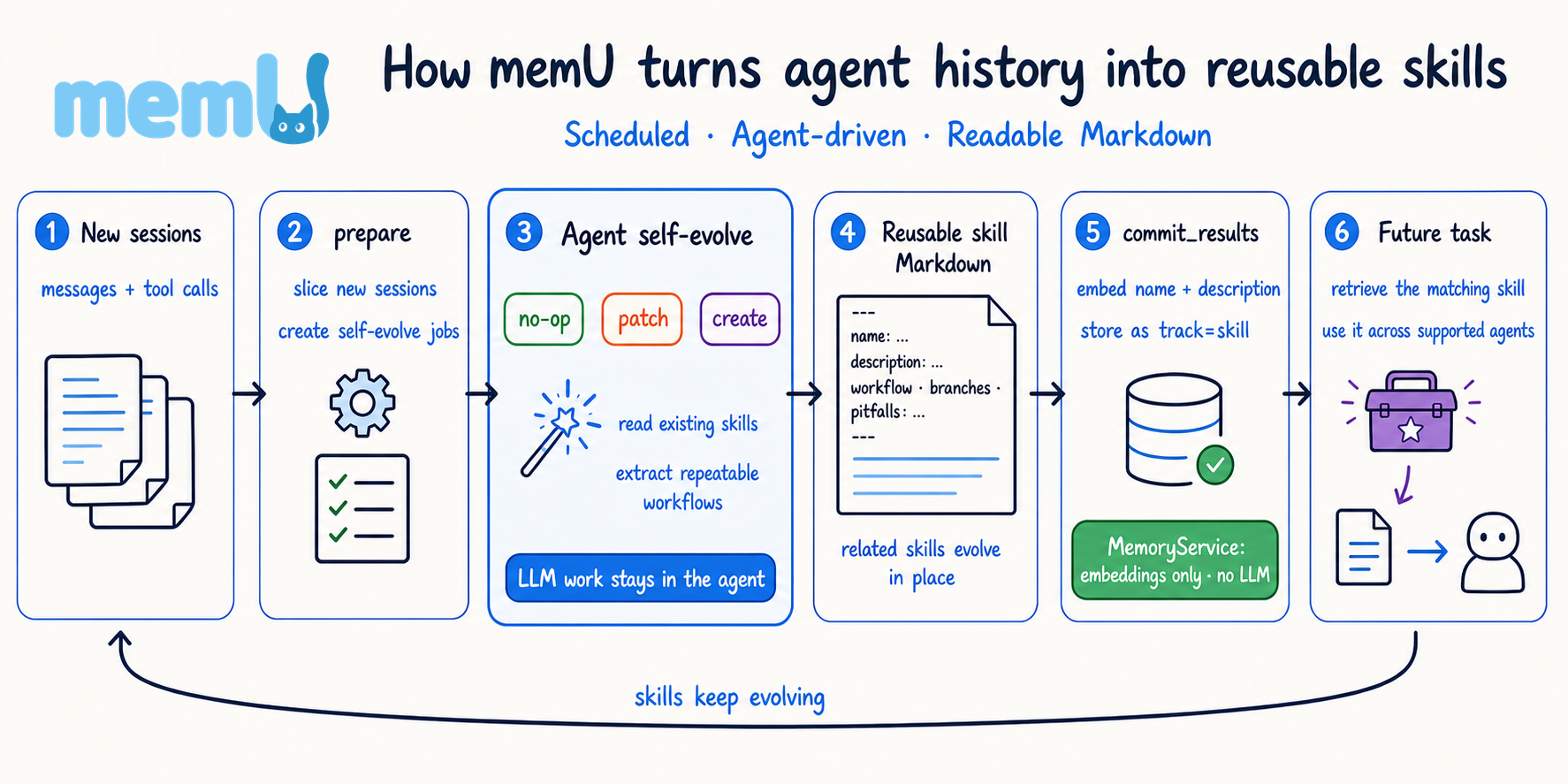
prepare slices each session into a self-contained job with the paths and context the agent needs.commit submits changed skill files through commit_results; memU embeds the skill name and description and stores it under the skill track.The judgment and synthesis stay inside the agent. MemoryService makes no LLM or chat calls; it stores, embeds, and retrieves the skill Markdown the agent prepared.
Private · Single-device · Embedding key required
To run memU locally with your own storage and embedding provider, send this message to your agent:
Read https://raw.githubusercontent.com/NevaMind-AI/MemU/main/SKILL.md and follow it to install memU.
To uninstall memU, send this message to your agent:
Read https://memu.pro/SKILL.md and follow its instructions to uninstall memU.
By default, uninstalling removes the host integration and tooling while keeping your memory store and ~/.memu/config.env, so a later reinstall can resume where you left off. Memory is erased only when you explicitly ask for it.
memU runs as a sidecar to a desktop agent, one binary per host. Each binds two seams:
commit submits whatever the agent left on disk back through commit_results.<binary> retrieve (→ progressive_retrieve) before answering.| Host | Binary | Session log it mines | Instruction file it patches |
|---|---|---|---|
| Codex | memu-codex | ~/.codex/sessions/**/*.jsonl | ~/.codex/AGENTS.md |
| Claude Code | memu-claude-code | ~/.claude/projects/<project>/<session>.jsonl | ~/.claude/CLAUDE.md |
| Cursor (Agent/CLI) | memu-cursor | ~/.cursor/projects/<project>/agent-transcripts/**.jsonl | ./AGENTS.md (per project) |
| OpenClaw | memu-openclaw | ~/.openclaw/agents/<agentId>/agent/openclaw-agent.sqlite (SQLite, read-only) + legacy <agentId>/sessions/*.jsonl | ~/.openclaw/workspace/AGENTS.md |
| Hermes Agent | memu-hermes | ~/.hermes/state.db (SQLite, read-only) | ~/.hermes/SOUL.md |
| WorkBuddy | memu-workbuddy | ~/.workbuddy/projects/<project>/<session>.jsonl | ~/.workbuddy/SOUL.md |
| Cola | memu-cola | ~/.cola/sessions/<scope>/<session>.jsonl | ~/.cola/memory-bank/MEMORY.md |
| pi | memu-pi | ~/.pi/agent/sessions/<encoded-cwd>/<session>.jsonl | ~/.pi/agent/AGENTS.md |
| any other agent | memu-agent | found by memu-agent detect (JSONL dialect sniffed) | found by detect (AGENTS.md / CLAUDE.md / SOUL.md / …) |
For agents without a dedicated binary, memu-agent detect probes the machine and reports per agent whether memorization works (a recognizable session log exists) and whether retrieval works (an instruction file exists to patch) — then the same verbs run against what it found.
All hosts share one configured memory backend via ~/.memu/config.env — local
or MemU Cloud. What one host's sessions taught memU, another host retrieves.
Installation is the one-message setup in Quick start or Self-hosted. SKILL.md is the routing skill it hands your agent: install the package, identify which host you are (falling back to memu-agent detect for anything without a dedicated adapter), print that host's packaged install guide (<binary> docs install), and follow it — configure the memory backend, register the scheduled bridging task, patch the instruction file, each step behind a verify gate — then report which seams (memorization / retrieval) are now active.
Afterwards <binary> doctor proves the whole loop resolves: config, selected
mode, and a live retrieval.
Adding another host means implementing one TranscriptSource (where its session logs live, how its records are shaped) plus a HostSpec-sized CLI — the pipeline, verbs, and instruction text are shared.
Applications that already own their conversation history can use memu memorize
to prepare self-evolve jobs from 1–10 completed sessions for one external agent and
commit the resulting memory, skill, and resource changes. See Developer integration for the
canonical input contract and the complete prepare → agent → commit workflow.
With memU Cloud, sign in at memu.so to view your memory files. With a local installation, memory lives in the shared store configured by MEMU_DB in ~/.memu/config.env — typically ~/.memu/memu.sqlite3 for local SQLite, or a Postgres DSN.
Once installed, your agent retrieves relevant memory automatically before answering. To retrieve manually, run the adapter for your host:
memu-codex retrieve "What should I remember about this project?"
# or: memu-claude-code / memu-cursor / memu-openclaw / memu-hermes / memu-workbuddy / memu-cola / memu-pi / memu-agent
Install or invoke the CLI directly:
pip install memu-cli         # library + memu + memu-codex CLIs
npx memu-cli --help          # CLI via npm launcher (engine: PyPI package memu-cli)
uvx --from memu-cli memu     # CLI via uv, no install
Values resolve in order: process env → ~/.memu/config.env → default. memU
supports Local and Cloud memory backends, selected by MEMU_MEMORY_MODE; an
unset mode remains Local for backward compatibility.
For Local / self-hosted installations, every CLI flag has a matching variable:
| Setting | Env var | Default |
|---|---|---|
| Store | MEMU_DB | ./data/memu.sqlite3 (CLI); required for host adapters |
| Embedding provider | MEMU_EMBED_PROVIDER | openai (also: jina, voyage, doubao, openrouter); legacy MEMU_LLM_PROVIDER still read |
| API key | MEMU_API_KEY | the provider's env var, e.g. OPENAI_API_KEY |
| Embedding model | MEMU_EMBED_MODEL | the provider's default |
| Base URL | MEMU_BASE_URL | the provider's default |
Run <binary> doctor to display the resolved mode and verify the same retrieval
path the host uses.
| Provider | DSN | Vector search | Use for |
|---|---|---|---|
inmemory | — | brute-force cosine | tests, throwaway sessions |
sqlite | sqlite:///path.sqlite3 | brute-force cosine | local/default, single writer |
postgres | postgresql://... | pgvector | concurrent access, large stores (pip install "memu-cli[postgres]") |
service = MemoryService(
    database_config={"metadata_store": {"provider": "postgres", "dsn": "postgresql://..."}},
    embedding_profiles={"default": {"provider": "jina"}},
)
Apache-2.0
Partnership Community: LINUX DO
Sign in to join the discussion.
No comments yet. Be the first to say what this is good for.
🪨 why use many token when few token do trick — Claude Code skill that cuts 65% of tokens by talking like caveman

The best-benchmarked open-source AI memory system. And it's free.

Orca is the ADE for working with a fleet of parallel agents. Run any coding agent with your own subscription. Available on desktop, mobile and remote runtime.
A cross-platform desktop All-in-One assistant for Claude Code, Codex, OpenCode, OpenClaw, Grok Build & Hermes Agent. Only official website: ccswitch.io

Never stop coding. Free MIT AI gateway: one endpoint, 352 providers (150+ free), 1200+ models Kimi, Claude, GPT, Gemini, GLM, DeepSeek, MiniMax. Works with Claude Code, Codex, Cursor, OpenCode, Cline & Copilot. Quota-aware auto-fallback, RTK+Caveman compression saves 15-95% tokens, MCP/A2A, Desktop/PWA. Built by 550+ contributors

Compress tool outputs, logs, files, and RAG chunks before they reach the LLM. 20% fewer tokens for coding agents, 60-95% fewer tokens for JSON, same answers. Library, proxy, MCP server.