
JuliusBrussee/
caveman

🪨 why use many token when few token do trick — Claude Code skill that cuts 65% of tokens by talking like caveman
105k
1 add
SkillEvaluator checks agent skills in three stages: validation, deduplication, and live evaluation. It uses deterministic checks, embeddings-based similarity checks, synthetic eval dataset generation, and sandboxed agent runs to show whether a skill helps or harms agent behavior.
Builders who want to validate, compare, and live-test agent skills before they ship them.
You can catch broken, redundant, or harmful skills before they change how your agent works.
Runs schema, PII, license, quality, Unicode, lint, and security checks on a skill folder.
Compares skills for semantic overlap with `context-optimization-check` and `similarity-check`.
Generates eval datasets and runs agent sessions to measure the skill's effect on behavior.
Works with NVIDIA Build, OpenAI, Anthropic, Bedrock, and OpenAI-compatible endpoints for chat and embeddings.
Supports Docker, local OS, or cloud sandboxes for live evaluation through the selected agent runtime.
uv tool install --python 3.13 "skillevaluator[all] @ git+https://github.com/NVIDIA/SkillEvaluator.git"
skillevaluator validate ./my-skill \
  --checks schema,pii,license,quality,unicode,lint \
  --no-dedup
export SKILL_EVAL_LLM_PROVIDER=nv_build
export NVIDIA_API_KEY='nvapi-...'
skillevaluator models --limit 10



SkillEvaluator is an open-source, multi-tier framework for evaluating AI agent artifacts, starting with agent skills: deterministic quality gates, semantic overlap detection, synthetic eval dataset generation, and live agent evaluation.
Agent skills are folders of instructions and supporting files that extend AI agents, as defined by the Agent Skills specification. SkillEvaluator is part of the NVIDIA Verified Skills pipeline.
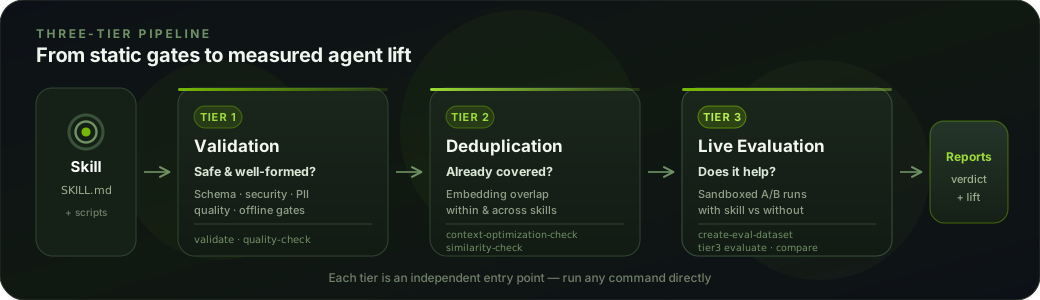
Tiers are independent entry points; nothing requires running earlier ones first.
| Tier | Purpose | Representative commands | Requires |
|---|---|---|---|
| Tier 1: Validation | Safe & well-formed? | validate, quality-check, security-scan, pii-scan, lint-scripts, rubric-eval | No API key for deterministic checks; the security extra plus external Semgrep, SkillSpector, and Gitleaks for full scanner coverage; a provider key for LLM checks |
| Tier 2: Deduplication | Overlap with what exists? | context-optimization-check, similarity-check | An embeddings provider; intra-skill analysis also needs a chat LLM — local OpenAI-compatible endpoints work |
| Tier 3: Live Evaluation | Does it help the agent? | create-eval-dataset, tier3 evaluate, compare | No credential for keyless templates and report inspection; a provider key for LLM generation and grading; live evaluation also needs the agent CLI with its credential and a Docker, local OS, or cloud sandbox |
SkillSpector provides specialized security scanning for Tier 1 validation. Harbor, the open-source agent evaluation framework, powers the sandboxed agent runs in Tier 3 live evaluation. Full tier guides live in the documentation.
Install all SkillEvaluator evaluation extras with uv, then run the built-in deterministic validation gates. This first result needs no API key, Docker daemon, or repository clone:
uv tool install --python 3.13 "skillevaluator[all] @ git+https://github.com/NVIDIA/SkillEvaluator.git"
skillevaluator validate ./my-skill \
  --checks schema,pii,license,quality,unicode,lint \
  --no-dedup
./my-skill is any directory containing a SKILL.md. The command checks its
schema, PII, license, quality, Unicode safety, and scripts. The scoped check
list keeps this first run keyless; the complete Tier 1 security scan also uses
external tools described in the
installation guide.
If your shell cannot find the command after installation, run
uv tool update-shell and open a new terminal.
No OpenAI or Anthropic key yet? Create a free API key at
build.nvidia.com — NVIDIA Build offers free
inferencing, and NVIDIA Build defaults to the open-source Nemotron model
nvidia/nemotron-3-nano-30b-a3b for a quick try. Prefer a different model?
Pick any free model on build.nvidia.com and set
SKILL_EVAL_LLM_MODEL. Once that key is set, the same provider works
seamlessly across Tier 1 LLM checks, Tier 2, and Tier 3 (chat plus embeddings
with one credential):
export SKILL_EVAL_LLM_PROVIDER=nv_build
export NVIDIA_API_KEY='nvapi-...'
skillevaluator models --limit 10
Other supported provider setups are:
SKILL_EVAL_LLM_PROVIDER=openai and OPENAI_API_KEY.SKILL_EVAL_LLM_PROVIDER=anthropic and ANTHROPIC_API_KEY.SKILL_EVAL_LLM_PROVIDER=bedrock plus the standard AWS
credential chain and region.SKILL_EVAL_LLM_PROVIDER=openai-compatible,
SKILL_EVAL_LLM_BASE_URL, SKILL_EVAL_LLM_MODEL, and
SKILL_EVAL_LLM_API_KEY.The pinned chat defaults are gpt-5.6-sol for OpenAI,
claude-opus-5 for Anthropic, and
us.anthropic.claude-opus-5 for Amazon Bedrock. Override any provider with
SKILL_EVAL_LLM_MODEL; gpt-5.4-mini is the documented lower-cost OpenAI
alternative.
When exactly one of NVIDIA_API_KEY, OPENAI_API_KEY, or ANTHROPIC_API_KEY
is present, SkillEvaluator can auto-select that provider. Anthropic and Bedrock
do not provide embeddings, so Tier 2 also needs a separate OpenAI, NVIDIA
Build, or OpenAI-compatible embedding provider. See
Providers & Credentials
for model defaults, endpoint overrides, and fully local setup.
similarity-check needs an embeddings provider. context-optimization-check
also needs a chat provider to check one skill for repeated guidance:
skillevaluator context-optimization-check ./my-skill
skillevaluator similarity-check ./skills
Install Semgrep, SkillSpector, and Gitleaks before a full run; missing Tier 1
scanner evidence makes validation incomplete. Then verify the selected agent
runtime and use validate --full:
skillevaluator doctor --agents codex --env-mode docker
skillevaluator validate ./my-skill \
  --full \
  --agents codex \
  --env-mode docker
--full runs Tiers 1, 2, and 3 and enables autopilot. If the skill has no
accepted evaluation source, autopilot creates one initial case at
evals/evals.json; if the file already exists, SkillEvaluator reuses it. For a
broader four-bucket dataset, generate and review it first:
skillevaluator create-eval-dataset ./my-skill --full
Tier 2 needs chat and embedding providers. Tier 3 also needs the evaluator
provider, the selected agent's credential, and a Docker, local, or cloud
sandbox. Live model calls and managed sandboxes can incur charges; local mode
avoids managed sandbox charges, not hosted model charges. It is experimental
and only for trusted skills and workspaces; use Docker or cloud for untrusted
code. Start with one agent and a small dataset.
See the Tier 3 guide
before scaling a run. Tier 1 always gates validate. Tier 2 gates by default;
--no-block-on-dedup keeps its scan and reports but makes its findings
advisory. Tier 3 is advisory by default; --block-on-agent-eval promotes its
findings, including invalid task-source evidence, into the exit gate.
Read the complete documentation at docs.nvidia.com/skills/skillevaluator for installation, the quickstart, provider configuration, tier guides, results and CI integration, the CLI reference, and contributor guidance.
Follow the installation guide to choose the full installation or a smaller per-tier setup.
This project will download and install additional third-party open source software projects. Review the license terms of these open source projects before use.
Contributions are welcome. Read CONTRIBUTING.md, include tests for behavior changes, and run the checks before opening a pull request:
make lint && make test && make build
Project governance is described in GOVERNANCE.md. Participation is governed by the Code of Conduct.
Support level: Experimental. SkillEvaluator is community-supported on a best-effort basis with no SLA or NVIDIA enterprise support entitlement. Report reproducible bugs and feature requests through GitHub Issues; see SUPPORT.md for details.
Report suspected vulnerabilities using the private process in SECURITY.md. Do not disclose security issues in a public GitHub issue.
Release changes are recorded in CHANGELOG.md and GitHub Releases.
Apache License 2.0 — see LICENSE, NOTICE, and THIRD_PARTY_NOTICES.md.
Copyright (c) 2026 NVIDIA CORPORATION & AFFILIATES. All rights reserved.
Sign in to join the discussion.
No comments yet. Be the first to say what this is good for.
🪨 why use many token when few token do trick — Claude Code skill that cuts 65% of tokens by talking like caveman

The best-benchmarked open-source AI memory system. And it's free.

Orca is the ADE for working with a fleet of parallel agents. Run any coding agent with your own subscription. Available on desktop, mobile and remote runtime.
A cross-platform desktop All-in-One assistant for Claude Code, Codex, OpenCode, OpenClaw, Grok Build & Hermes Agent. Only official website: ccswitch.io

Never stop coding. Free MIT AI gateway: one endpoint, 352 providers (150+ free), 1200+ models Kimi, Claude, GPT, Gemini, GLM, DeepSeek, MiniMax. Works with Claude Code, Codex, Cursor, OpenCode, Cline & Copilot. Quota-aware auto-fallback, RTK+Caveman compression saves 15-95% tokens, MCP/A2A, Desktop/PWA. Built by 550+ contributors

Compress tool outputs, logs, files, and RAG chunks before they reach the LLM. 20% fewer tokens for coding agents, 60-95% fewer tokens for JSON, same answers. Library, proxy, MCP server.