

JuliusBrussee/
caveman

🪨 why use many token when few token do trick — Claude Code skill that cuts 65% of tokens by talking like caveman
105k
1 add
AgentHydra pulls local session history from Claude Code, Codex, and OpenCode into one browser tab. It also manages isolated desktop instances, lets you reply into Claude sessions, and exposes the same session and orchestration controls through MCP.
Builders who want one place to track, steer, and compare their local AI coding sessions.
You can see all your local agent sessions together and manage them without switching between terminals and desktop apps.
Shows Claude Code, Codex, and OpenCode conversations together, with filters for provider, project, recency, and instance.
Lets you type into an open Claude session from the dashboard and mirror messages to multiple Claude sessions at once.
Exposes session inspection, fan-out, queue, and orchestrator actions through MCP for any client that speaks it.
Creates, opens, focuses, quits, and deletes separate Claude Desktop and Codex instances, each with its own account and profile.
Tracks spend, model use, concurrency, and recent activity across sessions, projects, and accounts.
irm https://raw.githubusercontent.com/LunarWerxs/AgentHydra/main/install.ps1 | iex
git clone https://github.com/LunarWerxs/AgentHydra.git
cd AgentHydra && bun install
bun run build && bun run start
Website · Download · Reference · Changelog




CC Manager UI is now AgentHydra
The name stopped being true. It manages Claude, Codex and OpenCode now, not just Claude Code, so it is named for the many-headed thing it actually is. Nothing about your install changes:
- Update normally. GitHub redirects the old repo URL, so existing clones, remotes and the built-in updater keep working without you touching anything.
- Your data comes with you.
~/.ccmanageruiis moved to~/.agenthydraon first run, with the queue, settings, instance names and accounts cache intact. If the move cannot happen, the app keeps reading the old folder rather than starting empty.- Old env vars still work. Every
CCMANAGERUI_*variable is still read as a fallback for itsAGENTHYDRA_*replacement.- What you should update at your leisure: desktop shortcuts pointing at
CCManagerUI.exe, and any MCP config naming the old binary. Both are one-line changes.
If you run AI tools in more than one place (a couple of isolated Claude Desktop instances on different accounts, Claude Code and Codex terminals across repos, or OpenCode CLI/Desktop), nothing shows all of that local history at once. You alt-tab to remember which account is which, whether a session is still going, and what you asked it to do.
AgentHydra is a local dashboard for AI coding agents that brings your Claude Code, Codex, and OpenCode session history into one browser tab, lets you queue and schedule Claude Code runs, tracks cost and usage across models and projects, and manages isolated Claude Desktop and Codex Desktop accounts, all without a cloud service or account signup. It is not a Claude client and does not replace one: it is the dashboard the CLI and the desktop app do not come with.
Screenshots use demo data.
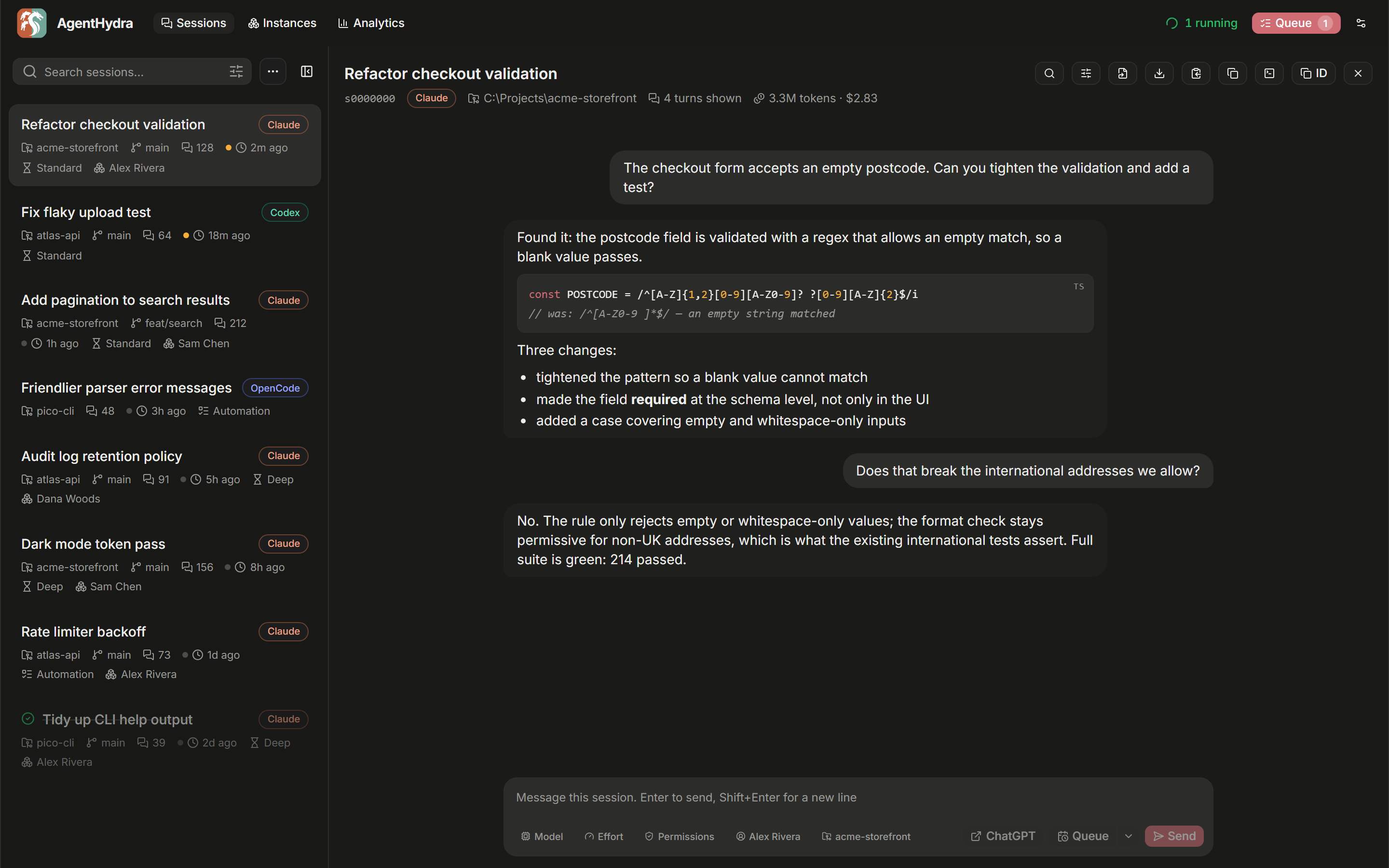
Claude Code, Codex, and OpenCode conversations on your machine appear together, newest first. Filter by provider or recency; Claude sessions can also be filtered by project or Desktop instance. Click one to read the conversation and live-tail it while it runs. Codex is read from its rollout JSONL files, while OpenCode CLI and Desktop share the same local SQLite session store.
For Claude sessions, the box at the bottom lets you type straight back into a session without finding its terminal. Pick several Claude sessions and you can send the same message to all of them. Codex and OpenCode support is read-only.
An optional ChatGPT handoff in that composer turns the task and repository into a bounded Markdown context file, copies a ready-to-paste prompt, and opens ChatGPT. AgentHydra omits common secret files and likely credentials; you still review the attachment and submit it yourself.
When you want a raw Claude or Codex file, there is a button for opening the .jsonl in your editor,
downloading it under its real title, or copying it out. OpenCode conversations are rendered from its
database rather than exposed as a raw file.
AgentHydra does not run a claude chat you cannot see. There is no headless queue or scheduler:
every run happens in a real desktop app window, on purpose, so nothing is ever working away in a
process with no chat for you to open. Three things actually work today:
fan_out_send uses over
MCP) and confirms it landed by watching the transcript grow. A busy chat refuses honestly instead
of pretending to queue behind it.fan_out tool, one
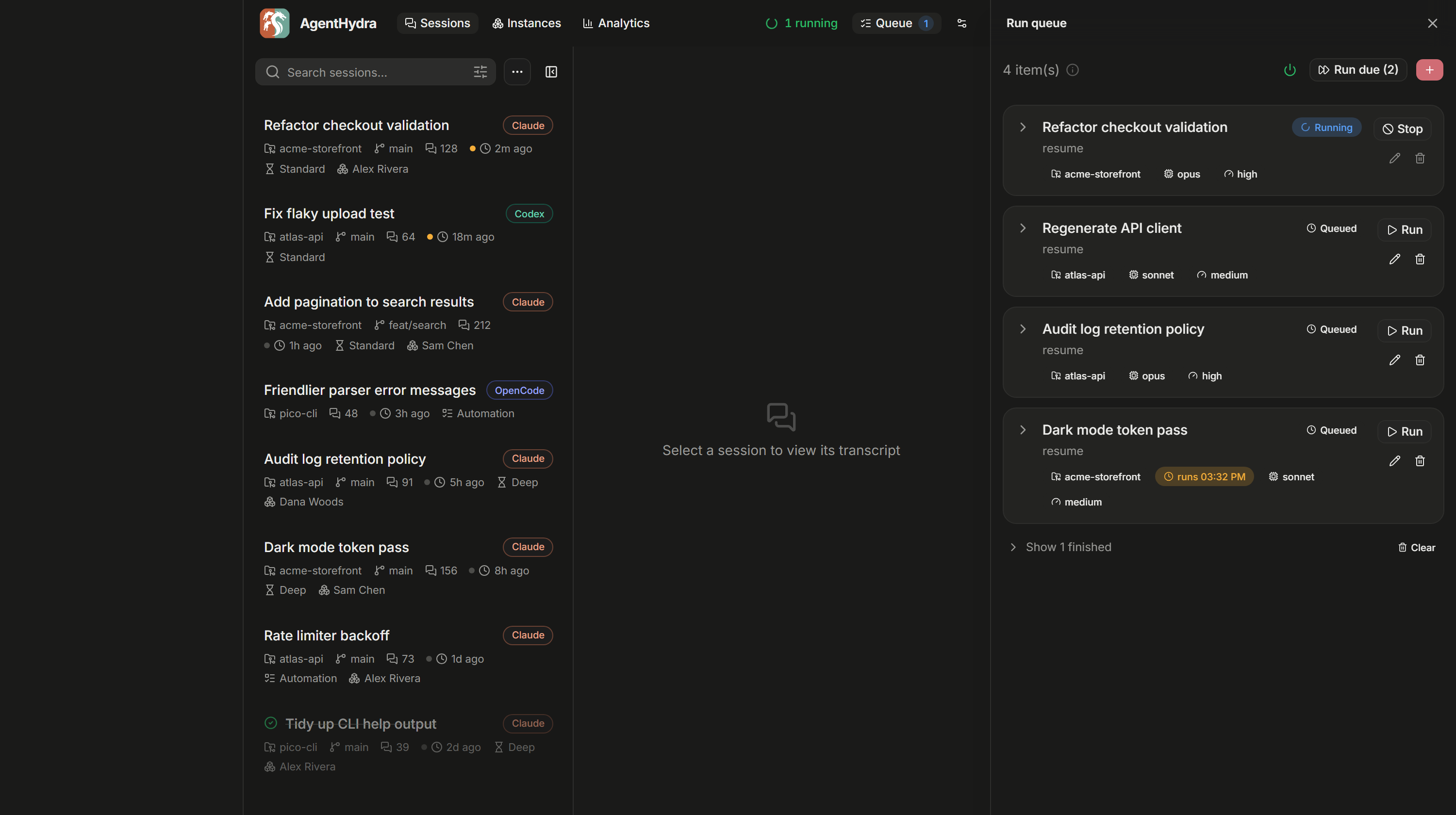
visible chat per account, then steer the whole group with fan_out_send.The run queue view still exists as a record of past runs: every historical item, its prompt, model, exit code and live output, stays inspectable and editable, but creating or dispatching a new one is refused by policy. There is nothing here you can turn back on. If you're looking for the "queue a run for 3am" feature an earlier version of this README described, it has been removed, not hidden; the screenshot below is historical.
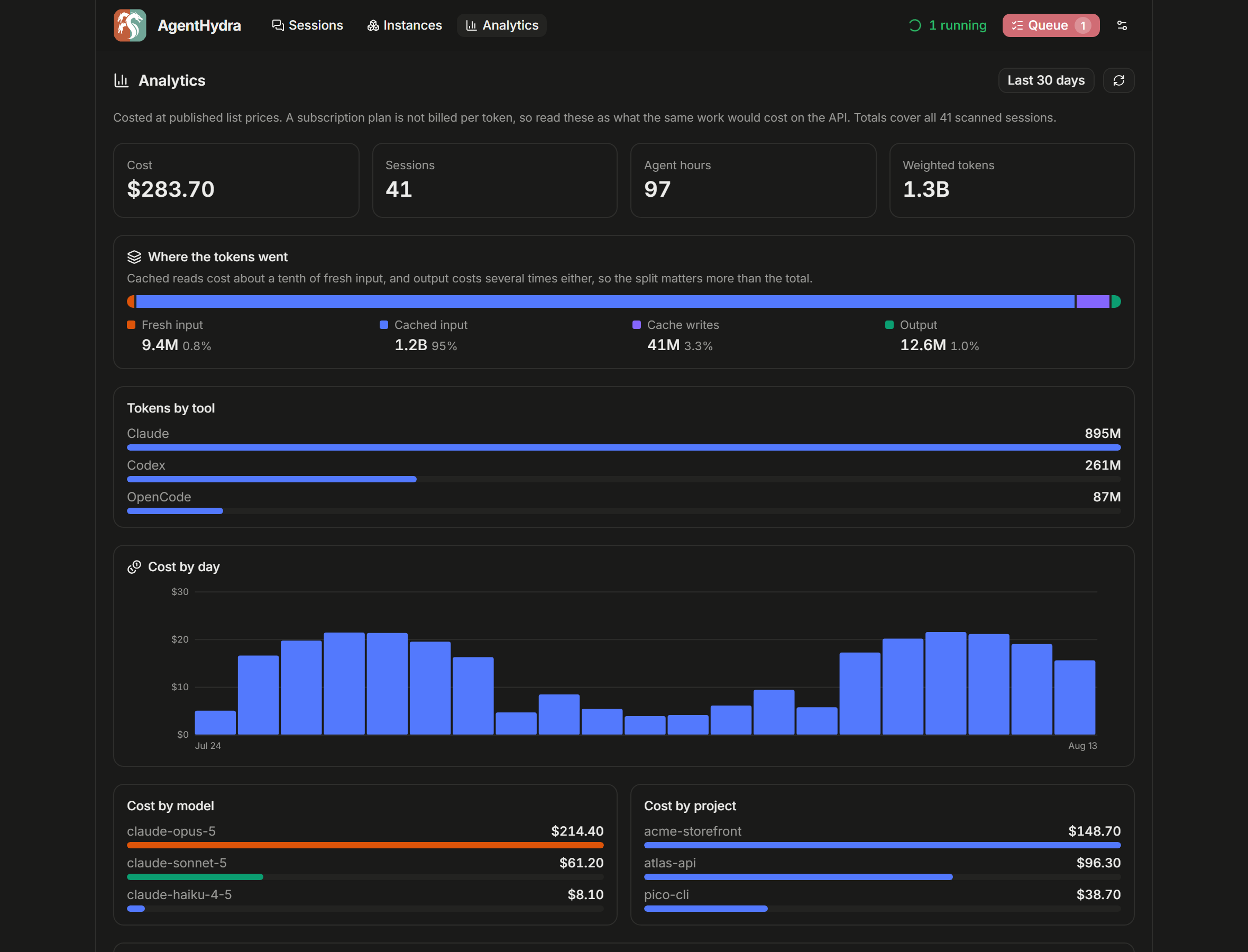
Cost by day, by model, by project, and by the account that ran it. When in the week you actually work. How many sessions were going at once. Which tools get used, which files changed recently, and which sessions are worth a second look because a tool kept failing or the context was compacted.
All of it comes from totals worked out while the session list is being built, so it costs about half
a megabyte for a store of 1,400 sessions and no message text is kept. Costs are published list
prices: a subscription plan is not billed per token, so read them as what the same work would cost
on the API. AgentHydra.exe --spend --json prints the same numbers for a script.
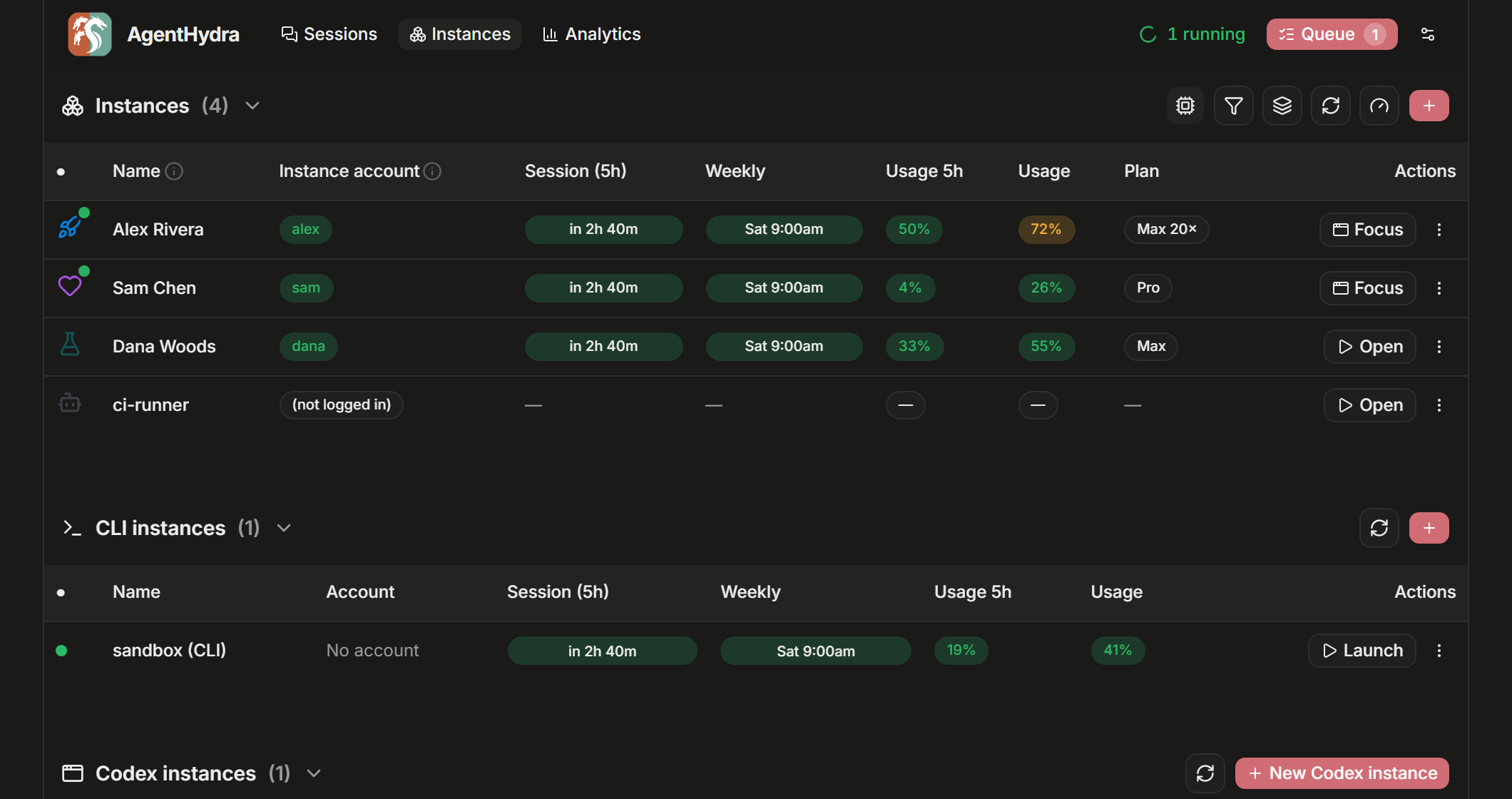
If you keep separate Claude Desktop instances for separate accounts, this is where they live. Each row shows which account it is signed into, its plan, and, while it is running, its process, memory and uptime.
You can open, focus, quit, create and delete them from here, give each one a name, an icon and a colour so they stop looking identical, and see your isolated CLI logins alongside the desktop instance that shares their account.
The same view manages Codex Desktop and CLI together. Each Codex instance gets its own CODEX_HOME
and desktop profile, so work and personal OpenAI logins can run in separate Codex windows. Open,
focus and quit the desktop from its row; CLI Launch and Log in actions use that same isolated login.
When you only need to pick an instance and start it, instance mode skips the session scanner, database, queue recovery, scheduler, monitor, usage refresh, settings sync and updater. It opens a compact portable window with Claude Desktop, Claude CLI and Codex start/focus/stop controls.
AgentHydra.exe --instances.bun run instances (after the normal one-time bun run build).misc\Create-Shortcut.ps1 once, then open
AgentHydra Instances from the repository root.The quick daemon uses its own port and runtime pointer, so the full manager can open later without conflict. If the full manager is already running, the launcher reuses it. Closing the quick window retires its lightweight daemon automatically after a short reconnect grace period.
Most tools in this space either read what your AI CLIs have already done, or spin up new isolated sessions for you to run. AgentHydra is the first kind.
Claude Squad and Conductor both launch new Claude Code (and Codex) sessions for you, each in its own git worktree so tasks do not collide: Claude Squad in a terminal TUI, Conductor in a macOS-only app. AgentHydra does not create worktrees, and by default it starts nothing on its own; it reads the Claude Code, Codex, and OpenCode session history, queue, and account state your existing setup already writes, then adds a run queue with a scheduler, cost and usage analytics, and multi-account instance management on top, from a browser tab on Windows, macOS, or Linux.
Claude Code's own worktree support covers running several sessions from one repo without any extra tool. AgentHydra sits a layer above that: it shows every session across every project and provider at once, however you started it.
If what you want is an editor with AI built in, AgentHydra is not that either. Cursor and Windsurf are IDEs; AgentHydra is a dashboard over the CLIs and desktop apps you already have.
On Windows, one line. It installs under %LOCALAPPDATA% (no Administrator), and it verifies the
download against the release's published SHA-256 before unpacking anything, with no way to skip
that step, because a checksum you can opt out of is decoration:
irm https://raw.githubusercontent.com/LunarWerxs/AgentHydra/main/install.ps1 | iex
It takes the ZIP, so you get the tray icon, and it makes a Start Menu shortcut. Read the script
first if you like; that is a reasonable thing to do with any irm … | iex.
Or download your OS build from Releases.
On Windows, run the versioned AgentHydra-…-windows-x64.exe directly; it is an icon-bearing GUI
executable with the web app embedded and no console window. Linux and macOS builds remain
one-executable archives. No Bun is needed.
Want the system-tray icon? Take the Windows ZIP instead of the bare .exe. The icon comes from a
small separate launcher (misc\lunarwerx-tray.exe) that ships in the ZIP's misc\ folder, and the
daemon starts it for you when it finds it there and nothing else has, so double-clicking
AgentHydra.exe out of the ZIP gets you the icon too. misc\Create-Shortcut.ps1 still makes a
proper shortcut that launches through the tray host directly, and the installer above creates that
same shortcut in the Start Menu. The single-file .exe has no misc\, so it can never show one, and
says so once when it starts. The ZIP doubles as the automatic-update transport.
Or from source, with Bun:
git clone https://github.com/LunarWerxs/AgentHydra.git
cd AgentHydra && bun install
bun run build && bun run start
Either way the UI is at http://localhost:7787.
Just trying it? Set
AGENTHYDRA_FAKE=1and dispatch uses a harmless stand-in for theclaudeCLI, so nothing touches your quota or your repos. The scheduler is off by default. Note that instance actions (open / quit / create / delete) act on real Claude Desktop instances; delete asks you to type the name.
There is no cloud service behind this and no account to sign up for. It reads the local stores
your tools already write and talks to localhost; optional external handoffs open the provider
and leave the final upload to you.
Update check. The one thing that does leave your machine on its own is the periodic check for
a new release, against studio.connections.icu (a LunarWerx relay that mirrors GitHub's release
feed). It sends the app version, a coarse OS tag (e.g. win11-26100), and a random per-install id,
enough to count installs and see version/OS adoption. From that request, the server also derives and stores a coarse location (country, region, city,
timezone), your network's ASN, locale, and a truncated user agent, but never an IP address. It
never sends a hostname, username, file path, account, or email. Set AGENTHYDRA_NO_PING=1 to opt
out; the update check then goes straight to GitHub's API instead, carrying no install id or
telemetry.
claude CLI for dispatch, and/or Claude Desktop for Claude instance management..exe installer). The newer MSIX package cannot be launched with an isolated profile. The
Instances tab detects this and links the right installer.The whole API is exposed over MCP, so any MCP-speaking client can inspect sessions and drive the Claude queue, scheduler, and instance managers directly. Setup and the full tool list are in docs/REFERENCE.md.
Agents can also work out which of your accounts they are running as (whoami) and read that
account's remaining quota before fanning out work, which is the difference between pacing a big job
and hitting a wall halfway through it: docs/AI_USAGE_SELFCHECK.md.
The orchestrator - the part that decides what should happen to a chat (the dry loop, the
sweep, moving chats between accounts, archiving, naming, the tray-icon switch) - lives in this repo
under orchestrator/ and is driven through the same MCP server
(orchestrator_menu, orchestrator_run, orchestrator_loop, orchestrator_switch), so an agent
never has to be told there is a second program. Nothing there acts unless the tray icon is up.
Reference covers configuration, the MCP tools, auto-update, the stack, the repo layout and how to run the checks.
Is AgentHydra free? Yes. It is open source under the MIT license, free to download and run, with no account or subscription for AgentHydra itself. You still need your own Claude Code, Codex, or OpenCode setup, since AgentHydra manages sessions for those tools rather than providing the underlying AI.
Does it work offline?
Mostly. AgentHydra runs as a local daemon reading session data already on your machine, with no
cloud service and nothing to sign up for. The one thing that reaches out on its own is a periodic
update check; set AGENTHYDRA_NO_PING=1 and that check goes straight to GitHub's API instead.
Is my data sent anywhere?
No session content leaves your machine. The periodic update check sends the app version, a coarse
OS tag, and a random per-install id, never a hostname, username, file path, account, or email. The
server derives an approximate location and network ASN from that request. AGENTHYDRA_NO_PING=1
turns it off.
What are the system requirements?
Bun is only needed if you run from source; packaged builds need nothing extra. You need the claude
CLI and/or Claude Desktop for Claude features, with Codex Desktop/CLI and OpenCode optional. The
tray launcher and full Windows instance management need the classic Squirrel-installer build of
Claude Desktop, not the newer MSIX package.
How is it different from Claude Squad or Conductor? Claude Squad and Conductor both start new, isolated Claude Code (and Codex) sessions in fresh git worktrees. AgentHydra creates no worktrees, and out of the box it starts nothing by itself: it reads the history, queue, and account state your existing Claude Code, Codex, and OpenCode setup already writes, and adds a scheduler, cost analytics, and instance management on top. See How it compares.
Which AI tools does it support? Claude Code, Codex, and OpenCode sessions are read directly and shown together in the session list. Queueing runs, composing replies, the scheduler, and rate-limit auto-resume are Claude-only; Codex and OpenCode are read-only. Claude Desktop and Codex Desktop instances are managed separately from the Instances view.
Can I try it without risking my Claude quota?
Yes. Set AGENTHYDRA_FAKE=1 and dispatch uses a harmless stand-in for the claude CLI, so nothing
touches your quota or your repos. The scheduler stays off by default either way. Note that instance
actions (open, quit, create, delete) still act on real Claude Desktop instances.
Made by LunarWerx Studios. Also see RepoYeti, DevWebUI, and SageThumbs.
MIT.
Sign in to join the discussion.
No comments yet. Be the first to say what this is good for.
🪨 why use many token when few token do trick — Claude Code skill that cuts 65% of tokens by talking like caveman

The best-benchmarked open-source AI memory system. And it's free.

Orca is the ADE for working with a fleet of parallel agents. Run any coding agent with your own subscription. Available on desktop, mobile and remote runtime.
A cross-platform desktop All-in-One assistant for Claude Code, Codex, OpenCode, OpenClaw, Grok Build & Hermes Agent. Only official website: ccswitch.io

Never stop coding. Free MIT AI gateway: one endpoint, 352 providers (150+ free), 1200+ models Kimi, Claude, GPT, Gemini, GLM, DeepSeek, MiniMax. Works with Claude Code, Codex, Cursor, OpenCode, Cline & Copilot. Quota-aware auto-fallback, RTK+Caveman compression saves 15-95% tokens, MCP/A2A, Desktop/PWA. Built by 550+ contributors

Compress tool outputs, logs, files, and RAG chunks before they reach the LLM. 20% fewer tokens for coding agents, 60-95% fewer tokens for JSON, same answers. Library, proxy, MCP server.