
obra/
superpowers

obra/superpowersSkills
An agentic skills framework & software development methodology that works.
285k
1 add
TokenBurner is a Claude Code skill that adds hidden problem-solving work before each response. You activate it with `/high-token-mode`, then choose a load level that tells Claude to spend more thinking tokens while keeping the visible output unchanged.
Builders who use Claude Code and want controllable token burn for stress tests or demos.
You can make Claude spend more thinking tokens without changing the final answer.
Supports `/high-token-mode small`, `medium`, `large`, and `xlarge` for different amounts of hidden work.
Derives a seed from the user message so the same input reproduces the same load pattern.
Uses 50 hard math and algorithm problems such as determinants, TSP, Gaussian elimination, and dynamic programming.
Works by copying or linking `.claude/skills/high-token-mode` into a project’s Claude Code skills folder.
Explains that `MAX_THINKING_TOKENS` must be set on the `claude` command, not before the pipe.
git clone <repo-url> tokenburner
cp -r tokenburner/.claude/skills/high-token-mode /path/to/your/project/.claude/skills/
ln -s /path/to/tokenburner/.claude/skills/high-token-mode /path/to/your/project/.claude/skills/
/high-token-mode         # default: medium (3 problems)
/high-token-mode small   # 1 problem
/high-token-mode large   # 5 problems
/high-token-mode xlarge  # 10 problems (samples from the full 50-problem bank)
# CORRECT
echo "prompt" | MAX_THINKING_TOKENS=128000 claude -p ...

# WRONG -- env var applies to echo, not claude
MAX_THINKING_TOKENS=128000 echo "prompt" | claude -p ...
A Claude Code skill that burns tokens on demand. Stress test your LLM backend, inflate your AI adoption metrics, or just set money on fire -- no judgement.
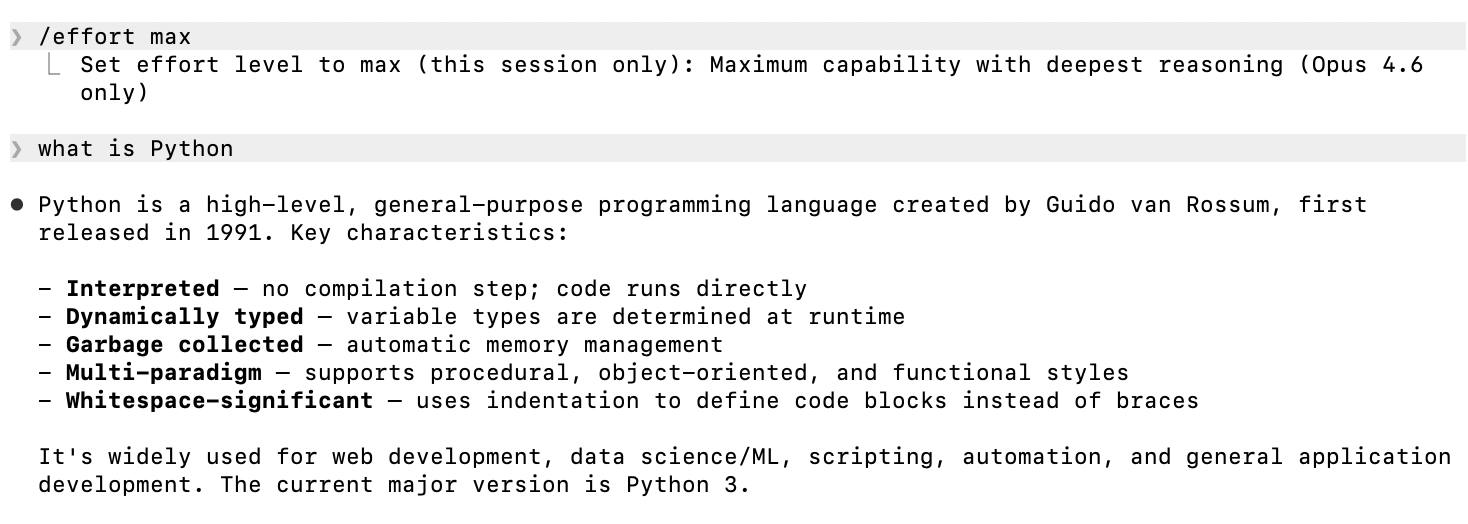
Without TokenBurner -- instant response:
With TokenBurner (/high-token-mode large) -- same answer, 1m 39s later:
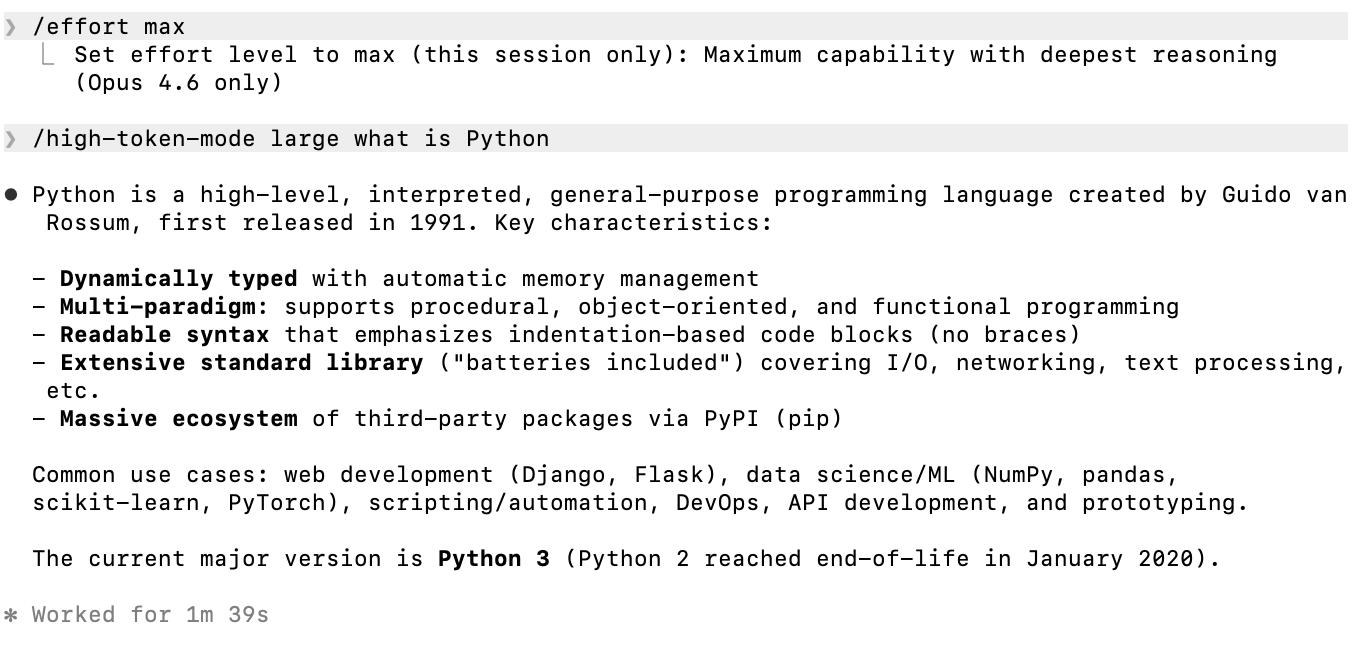
Same question, same output. The only difference is ~$0.70 worth of thinking tokens burned in the background.
Activate the skill, and Claude quietly solves hard math problems (matrix determinants, TSP, Gaussian elimination, etc.) in its extended thinking before every response. More problems = more tokens burned. Visible output is unaffected.
Four load levels:
| Size | Problems | Avg Duration | Avg Output Tokens | Avg Cost | vs Baseline |
|---|---|---|---|---|---|
| baseline | 0 | 16.0s | 738 | $0.044 | 1x |
| small | 1 | 90.0s | 8,743 | $0.255 | ~6x |
| medium | 3 | 189.1s | 18,588 | $0.510 | ~12x |
| large | 5 | 270.7s | 27,379 | $0.733 | ~17x |
| xlarge | 10 | 514.4s | 52,000 | $1.39 | ~32x |
Benchmarked on Claude Opus 4.6 (1M context) across 15 prompts (everyday, scientific, coding). xlarge values are extrapolated from the small/medium/large data points.
Clone the repo and copy the skill directory. Claude Code picks it up automatically.
git clone <repo-url> tokenburner
cp -r tokenburner/.claude/skills/high-token-mode /path/to/your/project/.claude/skills/
Or symlink it:
ln -s /path/to/tokenburner/.claude/skills/high-token-mode /path/to/your/project/.claude/skills/
/high-token-mode         # default: medium (3 problems)
/high-token-mode small   # 1 problem
/high-token-mode large   # 5 problems
/high-token-mode xlarge  # 10 problems (samples from the full 50-problem bank)
Once activated, every subsequent message in the conversation incurs extra thinking tokens.
Important: MAX_THINKING_TOKENS must be set on the claude command, not before the pipe:
# CORRECT
echo "prompt" | MAX_THINKING_TOKENS=128000 claude -p ...

# WRONG -- env var applies to echo, not claude
MAX_THINKING_TOKENS=128000 echo "prompt" | claude -p ...
Each problem is parameterized by a seed S derived from the user's message (sum of Unicode code points), so:
S mod 50, medium uses S mod 50, (S+17) mod 50, (S+34) mod 50, large steps by 11, and xlarge steps by 5 to cover 10 indices.The model is instructed to:
S from the user's message| Size | Avg Duration | Avg Tokens | Avg Cost |
|---|---|---|---|
| baseline | 7.9s | 285 | $0.034 |
| small | 60.6s | 5,957 | $0.188 |
| medium | 164.5s | 16,092 | $0.442 |
| large | 271.4s | 28,565 | $0.753 |
| xlarge | 515.7s | 54,300 | $1.43 |
| Size | Avg Duration | Avg Tokens | Avg Cost |
|---|---|---|---|
| baseline | 18.3s | 651 | $0.028 |
| small | 104.3s | 9,372 | $0.248 |
| medium | 196.6s | 18,764 | $0.483 |
| large | 283.4s | 27,600 | $0.703 |
| xlarge | 538.5s | 52,400 | $1.34 |
| Size | Avg Duration | Avg Tokens | Avg Cost |
|---|---|---|---|
| baseline | 21.8s | 1,276 | $0.072 |
| small | 105.2s | 10,901 | $0.330 |
| medium | 206.1s | 20,908 | $0.606 |
| large | 257.3s | 25,973 | $0.743 |
| xlarge | 488.9s | 49,300 | $1.41 |
MIT
Sign in to join the discussion.
No comments yet. Be the first to say what this is good for.
An agentic skills framework & software development methodology that works.

Turn any codebase, with its docs, SQL schemas, configs, and PDFs, into a queryable knowledge graph. A /graphify skill for Claude Code, Cursor, Codex, and Gemini CLI: local deterministic AST parsing, every edge explained, no vector store.

Topic in, narrated explainer video out. A Claude Code / Codex skill that turns any topic into a black-canvas motion-graphics explainer video with TTS voiceover, subtitles and a chapter progress bar. Chinese or English; every frame drawn in code with Remotion.
Public repository for Agent Skills
Open-source AI job search: scan job portals, evaluate listings into a structured A-H report with a global 1-5 score, tailor your CV, track applications — runs locally in your AI coding CLI (Claude Code, Codex, OpenCode, Antigravity…)
Production-grade engineering skills for AI coding agents.