

obra/
superpowers

obra/superpowersSkills
An agentic skills framework & software development methodology that works.
285k
1 add
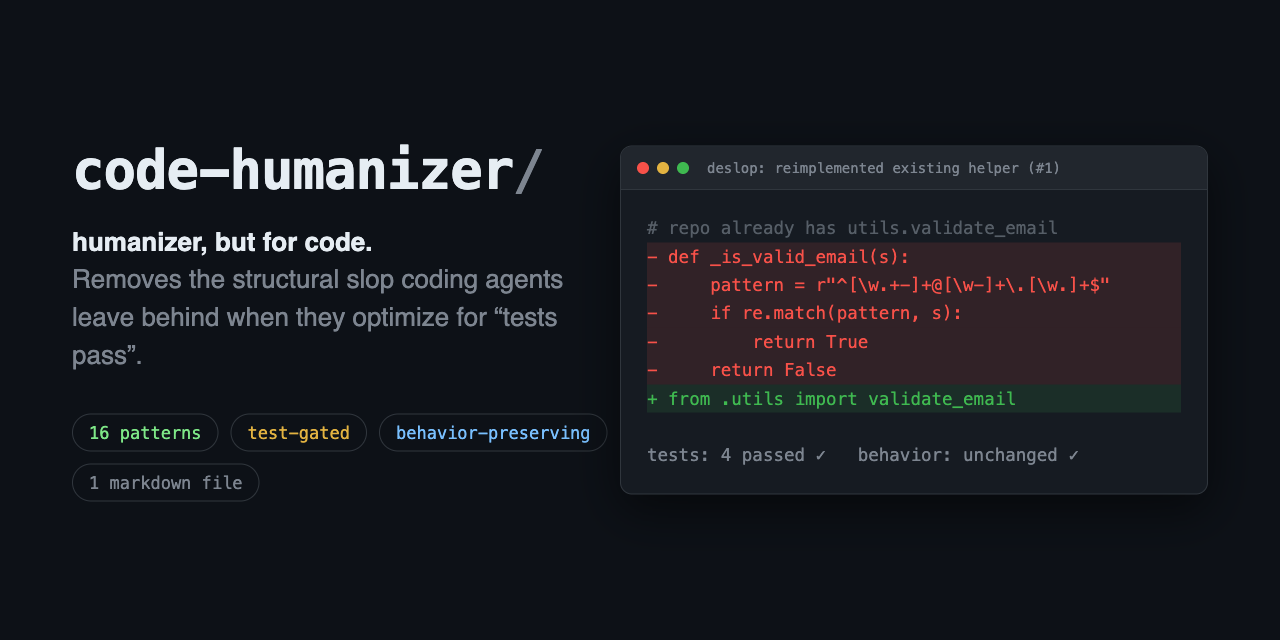
This is a packaged agent skill that looks for common AI-generated code habits like duplicate helpers, speculative abstractions, broad exception swallowing, and noisy leftovers. It can scan a repo, report findings with severity and evidence, or, with approval, make behavior-preserving fixes one pattern at a time while keeping tests green.
Builders who use coding agents and want reusable rules for spotting and fixing AI-shaped code debt.
You can have your agent clean up slop and guard future changes without silently changing behavior.
Finds slop patterns in a repository and outputs a findings table with severity, evidence, and a proposed fix.
Applies approved fixes one pattern at a time and runs tests after each step.
Checks new changes against the same catalog before and after implementation, while comparing duplication against the whole repo.
Treats behavior preservation as mandatory and reports latent bugs instead of silently changing them.
Covers duplication, speculative architecture, defensive slop, noise, and test slop with examples and detection signals.
npx skills add LeonardNJU/code-humanizer
# Claude Code
git clone https://github.com/LeonardNJU/code-humanizer ~/.claude/skills/code-humanizer
English | 中文



humanizer, but for code. An agent skill that removes signs of AI-generated code from a repository, and can guard new changes against the same patterns — the structural slop coding agents leave behind when they optimize for "tests pass" instead of "codebase stays healthy."
One command, picks your agents for you (Claude Code, Codex, Cursor, Cline, Gemini, Copilot, and more):
npx skills add LeonardNJU/code-humanizer
Or drop it in by hand — the skill is a single SKILL.md, no build step, no dependencies:
# Claude Code
git clone https://github.com/LeonardNJU/code-humanizer ~/.claude/skills/code-humanizer
Any harness that reads SKILL.md agent skills works the same way.
> use code-humanizer to scan this PR
> deslop pkg/report.py — you have my approval to fix
> this repo was vibe-coded, humanize it (report first)
> implement this change with code-humanizer guard
> keep experiments/ exploratory, but guard changes under src/
Default mode is scan → report (findings table with pattern #, severity 0–4, evidence, proposed fix, behavior risk). Fix mode runs on your approval, one pattern per commit, tests green after every step.
Guard mode applies the same catalog before and after an implementation: inspect the repository before creating helpers or abstractions, then audit only the resulting diff while checking duplication against the whole repo. It is a thin AI-slop-specific guardrail, not a general coding workflow and not permission to clean up unrelated code.
Exploratory work may keep deliberate temporary duplication, hard-coded values, or parallel variants when they stay contained. Those exemptions end when the code moves into a core package, shared module, stable API, or merge-ready path.
The prose humanizer catalogs AI writing tells (em-dashes, "it's not just X, it's Y", rule-of-three). This catalogs AI coding tells — 16 numbered patterns in 5 tiers, each with detection signals and before/after examples in SKILL.md:
Tier 1 — Duplication and reinvention
| # | Pattern | The tell |
|---|---|---|
| 1 | Reimplementing an existing helper (the signature tell) | a new private function that duplicates something in utils/a sibling module — agents write from the prompt outward, not from the repo inward |
| 2 | _v2 / _new / _impl clones | foo and foo_v2 both alive; the agent didn't dare modify the original, so now there are two sources of truth |
| 3 | Reinventing stdlib / installed deps | hand-rolled groupby, deep-copy-via-JSON, manual URL parsing |
Tier 2 — Speculative architecture
| # | Pattern | The tell |
|---|---|---|
| 4 | Single-implementation abstraction | an ABC / registry / "pluggable backend" with exactly one implementation, one registration, one call site |
| 5 | Dead "for future use" code | helpers with no call site; docstrings saying flexible, extensible, seamlessly |
| 6 | Wrapper that adds nothing | a function whose body is one same-argument call |
| 7 | Config/API sprawl for a local case | a new global flag or public parameter consulted from exactly one place |
Tier 3 — Defensive slop
| # | Pattern | The tell |
|---|---|---|
| 8 | Broad exception swallowing | except Exception: return "" — crashes (visible, debuggable) converted into corruption (invisible) |
| 9 | Unjustified try-import fallback | try: import ujson except ImportError: import json with no benchmark, no extras entry, no fallback test |
| 10 | Attribute-probing chains | hasattr/getattr/isinstance ladders accepting "dict or object or maybe None" |
| 11 | Paranoid re-validation | if x is not None on values that were just constructed |
Tier 4 — Noise
| # | Pattern | The tell |
|---|---|---|
| 12 | Narrating comments | the comment restates the next line (# Join the rows with newlines) |
| 13 | Boilerplate docstrings | the docstring is the function name with spaces; robust, comprehensive, seamless |
| 14 | Dead imports, unused variables, banners | leftovers from deleted attempts; # ===== SECTION =====; stray debug prints |
Tier 5 — Test slop (report-only by default)
| # | Pattern | The tell |
|---|---|---|
| 15 | Tests that assert the mock | every collaborator mocked; the test can never fail for a real reason |
| 16 | Trivial or duplicated assertions | asserting literals; the same case re-tested under three names |
Every finding gets a severity 0–4, where 1 = present but justified → exempt: fallbacks with documented reasons, defensive code at trust boundaries, plugin registries, migration-period _v2s stay untouched. The catalog is half the skill — the other half matters more:
Modern agents already recognize most slop when pointed at a file. Where they fail is discipline. In our baseline test, an agent without this skill cleaned a slop file nicely — and silently changed a public error type along the way (swapped an AttributeError for a "nicer" ValueError), in one un-reviewable mega-change, editing before ever running the tests.
So the skill's core is three iron rules the catalog hangs off:
[BEHAVIOR]-labeled commits.Plus a false-positive guard: severity 1 = "present but justified" (fallbacks with documented reasons, defensive code at trust boundaries, plugin registries, migration-period _v2s) — those are exempt. The goal is a healthier repo, not a body count.
First field test: a private ML research repo, 13.4k LOC of Python (21-module package + 36 experiment scripts + 20 test files), written largely by coding agents under human review. Scan mode, zero edits, git status clean before and after.
24 findings — and a sharp profile. Defensive slop (broad excepts, try-import fallbacks, probing chains, narrating comments): zero. Test slop: zero across all 20 test files. The debt was almost entirely Tier-1 duplication (11 findings, 40+ pasted instances), and the copies were already biting:
4 findings were exempted as justified (severity 1): a preregistration guard, a deliberate sampling-strategy comparison, bounded retries with a final raise. 8 of 36 scripts and 6 of 21 modules came back fully clean — and were reported as clean.
The take-away matched the skill's premise: agents working under review don't swallow errors — they rewrite what already exists. Repo-context duplication detection is the tier that matters.
The catalog is 16 patterns today and will never be finished — agents keep inventing new kinds of slop. If you've hit one that isn't covered, open an issue with a minimal before/after example (or a PR — even better). New patterns enter the catalog the same way the original 16 did: a real failing example first, then the rule.
Pattern-catalog format inspired by blader/humanizer. The debt taxonomy distills a research project on agent-induced technical debt (correctness-equivalent patch analysis); the iron rules come from watching capable agents fail without them.
MIT — use it, fork it, vendor it into your team's skills directory, rewrite the catalog for your stack, ship it inside something commercial. The only obligation is keeping the license notice. If it saved your repo from a _v2, a star is appreciated — never required.
All feedback and new-pattern reports go through GitHub issues.
Introduction threads: linux.do · NJU-AIA forum
Sign in to join the discussion.
No comments yet. Be the first to say what this is good for.
An agentic skills framework & software development methodology that works.
Turn any codebase, with its docs, SQL schemas, configs, and PDFs, into a queryable knowledge graph. A /graphify skill for Claude Code, Cursor, Codex, and Gemini CLI: local deterministic AST parsing, every edge explained, no vector store.

Topic in, narrated explainer video out. A Claude Code / Codex skill that turns any topic into a black-canvas motion-graphics explainer video with TTS voiceover, subtitles and a chapter progress bar. Chinese or English; every frame drawn in code with Remotion.
Public repository for Agent Skills
Open-source AI job search: scan job portals, evaluate listings into a structured A-H report with a global 1-5 score, tailor your CV, track applications — runs locally in your AI coding CLI (Claude Code, Codex, OpenCode, Antigravity…)
Production-grade engineering skills for AI coding agents.