
affaan-m/
ECC

affaan-m/ECCHarnesses
The agent harness performance optimization system. Skills, instincts, memory, security, and research-first development for Claude Code, Codex, Opencode, Cursor and beyond.
258k
bmalph installs two linked systems into a project: BMAD for planning and Ralph for autonomous implementation. It adds the right instructions, commands, skills, or rule files for the chosen platform, then moves planned work into Ralph’s task loop when you run `bmalph implement`. The workflow is built around the CLI and the bundled assets in `bmad/` and `ralph/`. That lets builders plan with one assistant, then hand the work to a repeatable implementation loop with the same project context.
Builders who want their coding assistant to follow a shared planning-to-implementation workflow across Claude Code, Codex, Cursor, or similar tools.
You can plan work in BMAD and hand it off to Ralph without redoing the setup by hand.
`bmalph init` installs BMAD, Ralph, and platform-specific instructions into the target project.
The CLI auto-detects the assistant platform from project markers and can also take `--platform`.
BMAD supports analysis, planning, and solutioning phases with commands like brainstorm, PRD, architecture, and stories.
`bmalph implement` turns BMAD artifacts into Ralph’s fix plan and spec files.
`bmalph run` starts Ralph’s loop, which picks stories, runs TDD-style implementation, commits changes, and advances through the plan.
`bmalph upgrade`, `bmalph doctor`, `bmalph status`, and `bmalph check-updates` keep the install current and healthy.
Commands are delivered as Claude Code slash commands, Codex skills, or a shared command index for other supported editors and CLIs.
`bmalph run --swarm` can split work across multiple Ralph workers in separate git worktrees.
npm install -g bmalph
cd my-project
bmalph init --name my-project

# To target a specific platform, add --platform (e.g. codex, cursor, windsurf)
# Without --platform, bmalph auto-detects strong project markers and
# prompts interactively when detection is ambiguous or missing
bmalph reset
rm -rf _bmad/ .ralph/ bmalph/
# Human-readable output
bmalph doctor

# JSON output for scripting
bmalph doctor --json






BMAD-METHOD planning + Ralph autonomous implementation, wired through platform-specific instructions, skills, and command indexes.
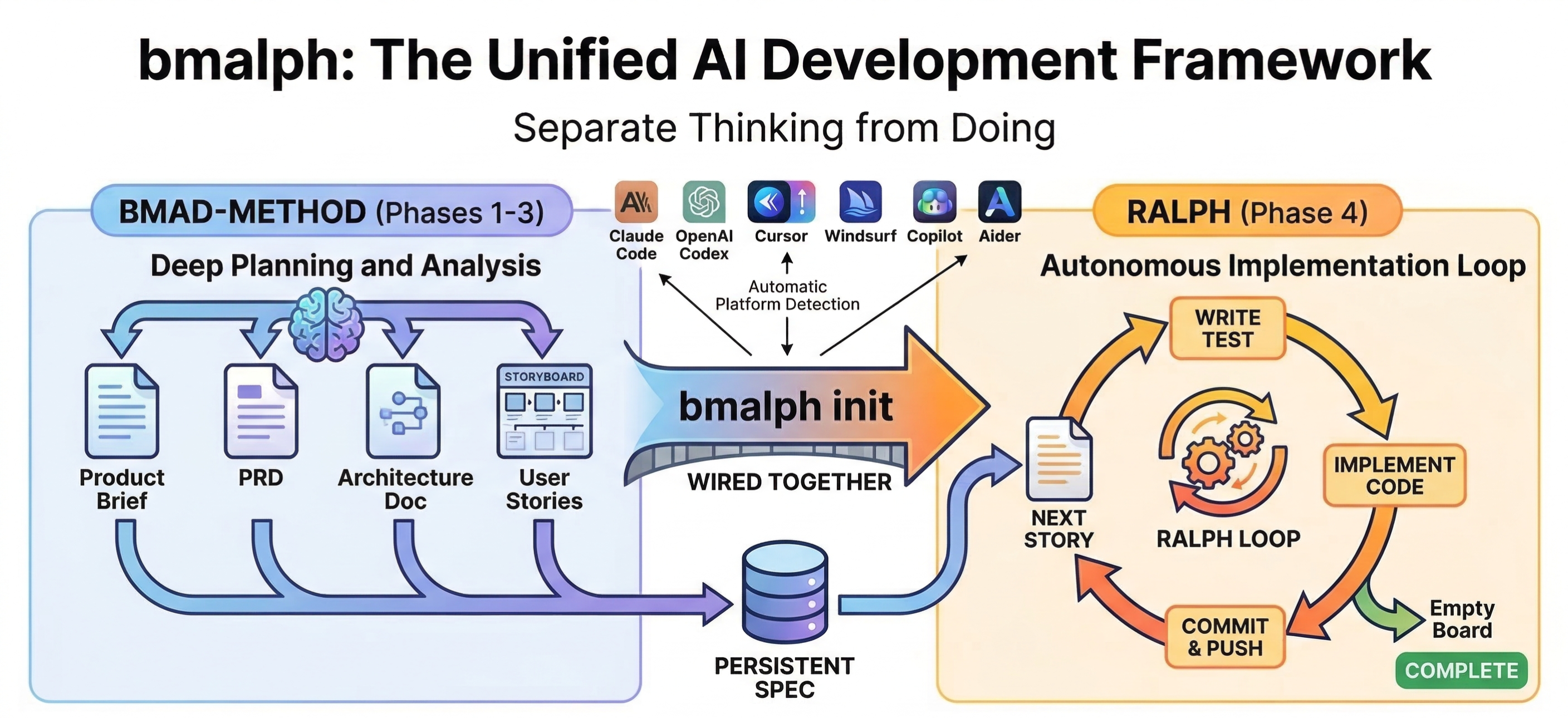
bmalph bundles and installs two AI development systems:
bmalph provides:
bmalph init — Install both systemsbmalph upgrade — Update to latest versionsbmalph doctor — Check installation healthbmalph implement — Transition from BMAD to Ralphbmalph run — Start Ralph loop with live dashboardbmalph check-updates — Check for upstream updatesbmalph status — Show project status and phasebmalph reset — Remove all bmalph filesbmalph watchbmalph run insteadbmalph works with multiple AI coding assistants. Each platform gets BMAD planning (Phases 1-3). The Ralph autonomous loop (Phase 4) requires a CLI-based platform.
| Platform | ID | Tier | Instructions File | Commands |
|---|---|---|---|---|
| Claude Code | claude-code | full | CLAUDE.md | .claude/commands/ directory |
| OpenAI Codex | codex | full | AGENTS.md | Codex Skills (.agents/skills/) |
| OpenCode | opencode | full | AGENTS.md | OpenCode Skills (.opencode/skills/) |
| Cursor | cursor | full (experimental) | .cursor/rules/bmad.mdc | _bmad/COMMANDS.md |
| Windsurf | windsurf | instructions-only | .windsurf/rules/bmad.md | _bmad/COMMANDS.md |
| GitHub Copilot | copilot | full (experimental) | .github/copilot-instructions.md | _bmad/COMMANDS.md |
| Aider | aider | instructions-only | CONVENTIONS.md | _bmad/COMMANDS.md |
Tiers:
claude), Codex CLI (codex), OpenCode (opencode), Copilot CLI (copilot), or Cursor CLI (cursor-agent; older agent installs are also supported)npm install -g bmalph
cd my-project
bmalph init --name my-project

# To target a specific platform, add --platform (e.g. codex, cursor, windsurf)
# Without --platform, bmalph auto-detects strong project markers and
# prompts interactively when detection is ambiguous or missing
cd my-project
bmalph init
Platform resolution: --platform flag > auto-detect from project markers > interactive prompt > default claude-code
Strong markers such as .cursor/, .claude/, .opencode/, .windsurf/, .github/copilot-instructions.md, and .aider.conf.yml are auto-detected directly. Root-only AGENTS.md and CLAUDE.md are treated as weak hints and may still trigger the interactive platform prompt.
This installs:
_bmad/ — BMAD agents and workflows.ralph/ — Ralph loop, libs, templates (drivers for claude-code, codex, opencode, copilot, and cursor)bmalph/ — State management (config.json, stores selected platform)CLAUDE.md, AGENTS.md, .cursor/rules/bmad.mdc).claude/commands/; Codex: .agents/skills/; OpenCode: .opencode/skills/; Cursor, Windsurf, Copilot, and Aider: _bmad/COMMANDS.md)If you already have BMAD installed (a _bmad/ directory), bmalph init works as a migration path:
_bmad/ (framework files) will be replaced with the bmalph-managed version_bmad-output/ (your planning artifacts: PRDs, architecture, stories) is not touched_bmad/, commit first so you can review changes with git diffWork interactively with BMAD agents in your AI coding assistant.
/bmalph to see your current phase and available commands.$analyst and $create-prd._bmad/COMMANDS.md and ask Cursor to run the BMAD master agent._bmad/COMMANDS.md as the command reference and ask the assistant to follow the named BMAD workflow.| Phase | Agent | Commands |
|---|---|---|
| 1 Analysis | Analyst | BP, MR, DR, TR, CB |
| 2 Planning | PM / UX Designer | CP, VP, EP, CU |
| 3 Solutioning | Architect / PM | CA, CE, IR |
Validation commands (validate-brief, validate-prd, validate-ux, validate-architecture, validate-epics-stories) run the same workflow in Validate mode. In Claude Code, invoke them as slash commands; on other platforms use the equivalent entry from _bmad/COMMANDS.md or Codex Skills.
Phase 1 — Analysis
BP Brainstorm Project — guided facilitation through brainstorming techniquesMR Market Research — market analysis, competitive landscape, customer needsDR Domain Research — industry domain deep diveTR Technical Research — technical feasibility, architecture optionsCB Create Brief — guided experience to nail down your product ideaPhase 2 — Planning
CP Create PRD — expert led facilitation to produce your PRD (required)VP Validate PRD — validate PRD is comprehensive and cohesiveEP Edit PRD — improve and enhance an existing PRDCU Create UX — guidance through realizing the plan for your UXPhase 3 — Solutioning
CA Create Architecture — guided workflow to document technical decisions (required)CE Create Epics and Stories — create the epics and stories listing (required)IR Implementation Readiness — ensure PRD, UX, architecture, and stories are aligned (required)Anytime Commands
Available in any phase for supporting tasks:
QS Quick Spec — lightweight spec for small tasks without full planningQD Quick Dev — quick implementation for small tasksDP Document Project — analyze existing project to produce documentationGPC Generate Project Context — scan codebase to generate LLM-optimized contextCC Correct Course — navigate significant changes mid-projectWD Write Document — tech writer agent for documentationMG Mermaid Generate — create Mermaid diagramsVD Validate Document — review documents against standardsBSP Brainstorming — interactive idea generation techniques (core, distinct from BP)ID Index Docs — create lightweight doc index for LLM scanningSD Shard Document — split large documents into smaller filesES Editorial Review (Structure) — propose document reorganizationAR Adversarial Review — critical content review for QAUS Update Standards — update tech-writer documentation standardsEC Explain Concept — create technical explanations with examples_bmad/COMMANDS.md — generated command reference for platforms without native slash commandsNote:
EPmeans Edit PRD in the bmm workflow (Phase 2) and Editorial Review — Prose in the core module.PMis Party Mode in core. The bmm meanings are the primary workflow codes.
Note: Ralph is only available on full tier platforms (Claude Code, OpenAI Codex, OpenCode, GitHub Copilot, Cursor). Instructions-only platforms (Windsurf, Aider) support Phases 1-3 only. GitHub Copilot and Cursor support is experimental.
Run bmalph implement from the terminal, or use the /bmalph-implement slash command in Claude Code.
This transitions your BMAD artifacts into Ralph's format:
.ralph/@fix_plan.md with ordered tasks.ralph/specs/ with changelog trackingThen start Ralph:
bmalph run
Advanced: Ralph loads the platform drivers internally. Start the loop with
bmalph run, or runbash .ralph/ralph_loop.shdirectly if you need to bypass the CLI.
Ralph picks stories one by one, implements with TDD, and commits. The loop stops when all stories are done or the circuit breaker triggers.
bmalph supports iterative development cycles:
BMAD (Epic 1) → bmalph implement → Ralph works on Epic 1
     ↓
BMAD (add Epic 2) → bmalph implement → Ralph sees changes + picks up Epic 2
Smart Merge: When you run bmalph implement again after Ralph has made progress:
[x]) are preserved in the new fix_plan[ ])Specs Changelog: .ralph/SPECS_CHANGELOG.md shows what changed in specs since the last run, so Ralph knows what's new or modified.
| Command | Description |
|---|---|
bmalph init | Install BMAD + Ralph into project |
bmalph upgrade | Update bundled assets to current version |
bmalph doctor | Check installation health |
bmalph check-updates | Check if bundled BMAD/Ralph versions are up to date |
bmalph status | Show current project status and phase |
bmalph implement | Transition BMAD planning artifacts to Ralph format |
bmalph run | Start Ralph loop with live dashboard |
bmalph reset | Remove all bmalph files from the project |
bmalph watch | (deprecated) Use bmalph run instead |
| Flag | Description |
|---|---|
--verbose | Enable debug logging |
--no-color | Disable colored output |
--quiet | Suppress non-essential output |
-C, --project-dir <path> | Run in specified directory |
--version | Show version |
--help | Show help |
| Flag | Description | Default |
|---|---|---|
-n, --name <name> | Project name | directory name |
-d, --description <desc> | Project description | (prompted) |
--platform <id> | Target platform (claude-code, codex, opencode, cursor, windsurf, copilot, aider) | auto-detect |
--dry-run | Preview changes without writing files |
| Flag | Description |
|---|---|
--force | Override pre-flight validation errors |
| Flag | Description |
|---|---|
--json | Output as JSON |
| Flag | Description |
|---|---|
--json | Output as JSON |
| Flag | Description |
|---|---|
--json | Output as JSON |
| Flag | Description |
|---|---|
--force | Skip confirmation prompts |
--dry-run | Preview changes |
| Flag | Description |
|---|---|
--dry-run | Preview changes |
--force | Skip confirmation prompt |
| Flag | Description |
|---|---|
--driver <platform> | Override platform driver (claude-code, codex, opencode, copilot, cursor) |
--review [mode] | Quality review: enhanced (every 5 loops) or ultimate (every story). Claude Code only |
--interval <ms> | Dashboard refresh interval in milliseconds (default: 2000) |
--no-dashboard | Run Ralph without the dashboard overlay |
--swarm [count] | Run N parallel workers in git worktrees (default: 2, max: 6). Requires >= 2 epics |
Deprecated: Use
bmalph runinstead. Thewatchcommand will be removed in a future release.
| Flag | Description |
|---|---|
--interval <ms> | Refresh interval in milliseconds (default: 2000) |
bmalph bundles 54 BMAD and bmalph command definitions. Delivery varies by platform:
.claude/commands/ (invoke with /command-name).agents/skills/ (invoke with $command-name).opencode/skills/_bmad/COMMANDS.md; ask Cursor to run the BMAD master agent_bmad/COMMANDS.md reference indexKey commands (Claude Code syntax):
| Command | Description |
|---|---|
/bmalph | BMAD master agent — navigate phases |
/analyst | Analyst agent |
/pm | Product Manager agent |
/architect | Architect agent |
/dev | Developer agent |
/sm | Scrum Master agent |
/qa | QA agent |
/ux-designer | UX Designer agent |
/tech-writer | Tech Writer agent |
/quick-flow-solo-dev | Quick Flow solo developer agent |
/create-prd | Create PRD workflow |
/create-architecture | Create architecture workflow |
/create-epics-stories | Create epics and stories |
/bmad-help | List all BMAD commands |
For the full list:
/bmad-help.agents/skills/.opencode/skills/_bmad/COMMANDS.mdUse bmalph implement (or /bmalph-implement in Claude Code) to transition from BMAD planning to Ralph implementation.
project/
├── _bmad/                     # BMAD agents, workflows, core
│   ├── config.yaml            # Generated platform/project config
│   ├── COMMANDS.md            # Generated command reference index
│   ├── _config/               # Generated manifests
│   │   ├── task-manifest.csv  # Combined task manifest
│   │   ├── workflow-manifest.csv # Combined workflow manifest
│   │   └── bmad-help.csv      # Combined help manifest
│   ├── core/
│   │   ├── agents/            # Master agent
│   │   ├── tasks/             # Workflow tasks
│   │   ├── workflows/         # Brainstorming, party-mode, etc.
│   │   ├── module.yaml        # Core module metadata
│   │   └── module-help.csv    # Core module help entries
│   └── bmm/
│       ├── agents/            # Analyst, PM, Architect, Dev, QA, etc.
│       ├── data/              # Templates (project-context-template.md)
│       ├── workflows/         # Phase 1-4 workflows
│       ├── teams/             # Agent team definitions
│       ├── module.yaml        # BMM module metadata
│       └── module-help.csv    # BMM module help entries
├── _bmad-output/              # BMAD planning artifacts (generated)
│   ├── planning-artifacts/    # PRD, architecture, stories
│   ├── implementation-artifacts/ # Sprint plans (optional)
│   └── brainstorming/         # Brainstorm sessions (optional)
├── .ralph/                    # Ralph autonomous loop (drivers for claude-code, codex, opencode, copilot, and cursor)
│   ├── ralph_loop.sh          # Main loop script
│   ├── ralph_import.sh        # Import requirements into Ralph
│   ├── ralph_monitor.sh       # Monitor loop progress
│   ├── .ralphrc               # Ralph configuration
│   ├── RALPH-REFERENCE.md     # Ralph usage reference
│   ├── drivers/               # Platform driver scripts
│   │   ├── claude-code.sh     # Claude Code driver (uses `claude`)
│   │   ├── codex.sh           # OpenAI Codex driver (uses `codex exec`)
│   │   ├── opencode.sh        # OpenCode driver (uses `opencode run`)
│   │   ├── copilot.sh         # GitHub Copilot driver (uses `copilot`, experimental)
│   │   ├── cursor.sh          # Cursor driver (uses `cursor-agent`/`agent`, experimental)
│   │   └── cursor-agent-wrapper.sh # Wrapper for Windows .cmd Cursor installs
│   ├── lib/                   # Shell libraries
│   ├── docs/generated/        # Generated documentation
│   ├── specs/                 # Copied from _bmad-output during transition
│   ├── logs/                  # Loop execution logs
│   ├── PROMPT.md              # Iteration prompt template
│   ├── PROJECT_CONTEXT.md     # Extracted project context (after bmalph implement)
│   ├── SPECS_CHANGELOG.md     # Spec diff since last run (after bmalph implement)
│   ├── SPECS_INDEX.md         # Prioritized spec file index (after bmalph implement)
│   ├── @AGENT.md              # Agent build instructions
│   └── @fix_plan.md           # Generated task list (after bmalph implement)
├── bmalph/                    # State management
│   ├── config.json            # Project config (name, description, platform)
│   └── state/                 # Phase tracking data
├── .claude/                   # Claude Code specific
│   └── commands/              # Slash commands (claude-code only)
└── <instructions file>        # Varies by platform (see Supported Platforms)
The instructions file and command directory depend on the configured platform. See the Supported Platforms table for details.
Ralph is a bash loop that spawns fresh AI coding sessions using a platform driver matching the configured platform:
claude with --output-format json, --permission-mode bypassPermissions, --allowedTools, and explicit --resume <session_id>codex exec --json --sandbox workspace-write with explicit --resume <session_id>opencode run --agent build --format json with optional --continue --session <session_id>copilot --autopilot --yolo with plain-text outputcursor-agent -p --force --output-format json, persists session_id for --resume, and switches to stream-json only for live outputEach iteration:
@fix_plan.mdSafety mechanisms:
--review [mode], Claude Code only). Enhanced: periodic review every 5 loops. Ultimate: review after every completed story. A read-only session analyzes git diffs and feeds structured findings into the next implementation loop@fix_plan.md items are checked offCursor-specific runtime checks:
bmalph doctor validates command -v jq in the bash environment Ralph usesbmalph doctor validates command -v cursor-agent and cursor-agent statusbmalph run --driver cursor runs the same bash-scoped preflight before the loop startsRun bmalph run to start the loop with a live dashboard, or bmalph run --no-dashboard for headless mode. Press Ctrl+C to stop the loop at any time.
bmalph run --swarm [N] spawns N Ralph loops in isolated git worktrees, each working on different epics simultaneously. Stories are partitioned by epic using greedy bin-packing for balanced distribution.
@fix_plan.md with only its assigned storiesswarm/worker-1, swarm/worker-2, etc.).ralph/ state is excluded from merges; the fix plan is rebuilt from combined completionsRequirements: clean working tree, at least 2 incomplete epics, full-tier platform, not on detached HEAD.
Ralph requires bash to run. On Windows, install one of:
Git Bash (Recommended)
# Install Git for Windows from https://git-scm.com/downloads
# Git Bash is included and works well with bmalph
# bmalph prefers Git Bash over broken Windows bash.exe shims
WSL (Windows Subsystem for Linux)
# In PowerShell as Administrator
wsl --install
# Then restart and run bmalph from WSL terminal
If you get permission errors:
# Claude Code only: broaden the tool allowlist in the managed config
# .ralph/.ralphrc
ALLOWED_TOOLS="Write,Read,Edit,MultiEdit,Glob,Grep,Task,TodoWrite,WebFetch,WebSearch,EnterPlanMode,ExitPlanMode,NotebookEdit,Bash"

# Keep interactive approval workflows out of unattended Claude loops
CLAUDE_PERMISSION_MODE="bypassPermissions"

# Keep the loop unattended by continuing after detected denials
PERMISSION_DENIAL_MODE="continue"

# Reset stale session state an
Sign in to join the discussion.
No comments yet. Be the first to say what this is good for.
The agent harness performance optimization system. Skills, instincts, memory, security, and research-first development for Claude Code, Codex, Opencode, Cursor and beyond.
from vibe coding to agentic engineering - practice makes claude perfect
🌊 The original agent meta-harness. Deploy intelligent multi-player swarms, coordinate autonomous workflows, and build conversational AI systems. Features adaptive memory, self-learning intelligence, RAG integration, and native Claude Code / Codex / Hermes and many more Integrated
Practical patterns, starters & CLI tools for loop engineering with AI coding agents. Design systems that prompt and orchestrate agents (inspired by Addy Osmani and Boris Cherny). Includes loop-audit, loop-init, loop-cost.

Git. Ship. Done - Core

The most RAM efficient harness