


obra/
superpowers

obra/superpowersSkills
An agentic skills framework & software development methodology that works.
285k
1 add
This repo packages a website-cloning workflow for terminal agents and editors. It guides an agent through reconnaissance, foundation setup, component specs, parallel build, and visual QA so you can turn a live site into a clean Next.js app.
Builders who want their agent to recreate a website from a URL and keep the result in a Next.js codebase.
You can turn a target website into a structured app without manually rebuilding each section from scratch.
Provides a `/clone-website` skill that takes one or more target URLs and runs the cloning process.
Breaks the job into reconnaissance, foundation, component specs, parallel build, and assembly with QA.
Ships agent instructions and skill copies for Claude Code, Codex, Cursor, Gemini CLI, Copilot, Windsurf, and others.
Writes detailed component specs into `docs/research/components/` with CSS values, states, behavior, and content.
Uses `scripts/sync-agent-rules.sh` and `scripts/sync-skills.mjs` to keep agent files aligned across platforms.
git clone https://github.com/YOUR-USERNAME/YOUR-NEW-REPOSITORY.git
cd YOUR-NEW-REPOSITORY
npm install
claude --chrome
/clone-website <target-url1> [<target-url2> ...]
Give your AI coding agent a URL and watch it recreate the website as a clean Next.js app.
Best results with Claude Code + Opus 5. Works with Codex, Cursor, Gemini, and more.

Quick Start · Watch Demo · Supported Platforms





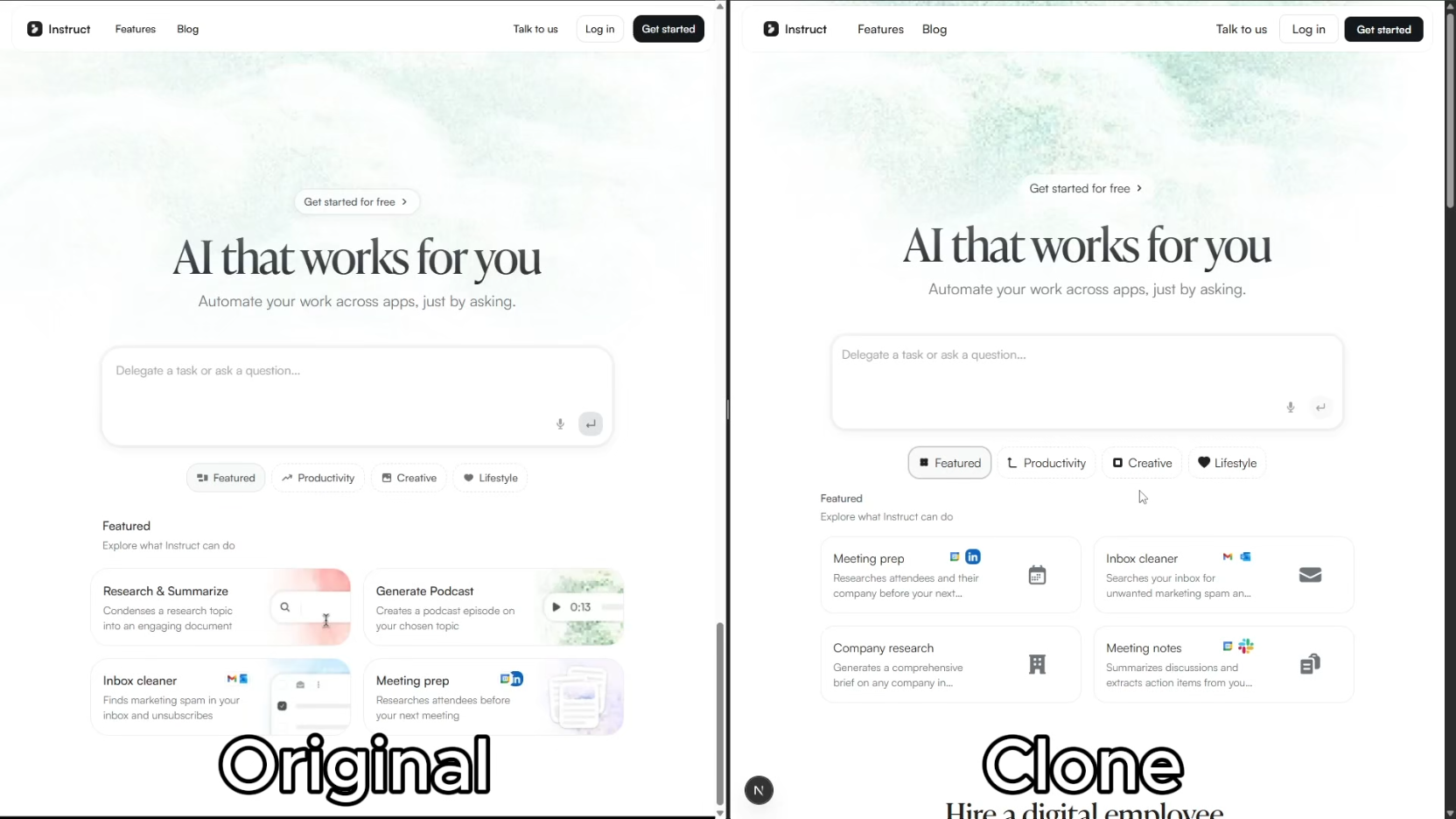
Click the image above to watch the full demo on YouTube.
Important: Start by making your own copy with GitHub's Use this template button. Do not clone this template repository directly for your website project, and do not open pull requests here with your generated website.
Create your own repository from this template
On the GitHub page for this project, click Use this template, then click Create a new repository.
Give your new repository a name, choose whether it should be public or private, then click Create repository. If GitHub shows an Include all branches option, you can leave it off.
This gives you your own separate project to work in, so your website changes stay in your account instead of coming back to the main template.
Open your new repository on your computer
After GitHub creates your copy, open that new repository. Click Code and open or clone your new repository with your preferred coding tool.
If you use the terminal, the command will look like this:
git clone https://github.com/YOUR-USERNAME/YOUR-NEW-REPOSITORY.git
cd YOUR-NEW-REPOSITORY
Install dependencies
npm install
Start your AI agent — Claude Code recommended:
claude --chrome
Run the skill:
/clone-website <target-url1> [<target-url2> ...]
Customize (optional) — after the base clone is built, modify as needed
Most supported clients expose
/clone-websitedirectly. If your client activates skills from natural-language requests, enterClone <target-url> using the clone-website workflow. Project instructions are inAGENTS.md.
| Agent | Status |
|---|---|
| Claude Code | Recommended — Opus 5 |
| Codex CLI | Supported |
| OpenCode | Supported |
| GitHub Copilot | Supported |
| Kiro | Supported |
| Cursor | Supported |
| Windsurf | Supported |
| Gemini CLI | Supported |
| Cline | Supported |
| Roo Code | Supported |
| Continue | Supported |
| Amazon Q | Supported |
| Augment Code | Supported |
The /clone-website skill runs a multi-phase pipeline:
flowchart LR
    P1["1. Reconnaissance"] --> P2["2. Foundation"]
    P2 --> P3["3. Component Specs"]
    P3 --> P4["4. Parallel Build"]
    P4 --> P5["5. Assembly and QA"]
docs/research/components/) with exact computed CSS values, states, behaviors, and contentEach builder agent receives the full component specification inline — exact getComputedStyle() values, interaction models, multi-state content, responsive breakpoints, and asset paths. No guessing.
src/
  app/              # Next.js routes
  components/       # React components
    ui/             # shadcn/ui primitives
    icons.tsx       # Extracted SVG icons
  lib/utils.ts      # cn() utility
  types/            # TypeScript interfaces
  hooks/            # Custom React hooks
public/
  images/           # Downloaded images from target
  videos/           # Downloaded videos from target
  seo/              # Favicons, OG images
docs/
  research/         # Extraction output & component specs
  design-references/ # Screenshots
scripts/
  sync-agent-rules.sh  # Regenerate agent instruction files
  sync-skills.mjs      # Regenerate /clone-website for all platforms
.kiro/skills/          # Generated Kiro workspace skill
.cline/skills/         # Generated Cline workspace skill
.roo/skills/           # Generated Roo Code workspace skill
.roo/commands/         # Generated Roo Code slash command
AGENTS.md           # Agent instructions (single source of truth)
CLAUDE.md           # Claude Code config (imports AGENTS.md)
GEMINI.md           # Gemini CLI config (imports AGENTS.md)
npm run dev    # Start dev server
npm run build  # Production build
npm run lint   # ESLint check
npm run typecheck # TypeScript check
npm run check  # Run lint + typecheck + build
docker compose up app --build # build and run the app
docker compose up dev --build # run the app in dev mode on port 3001
Two source-of-truth files power all platform support. Edit the source, then run the sync script:
| What | Source of truth | Sync command |
|---|---|---|
| Project instructions | AGENTS.md | bash scripts/sync-agent-rules.sh |
/clone-website skill | .claude/skills/clone-website/SKILL.md | node scripts/sync-skills.mjs |
Each script regenerates the platform-specific copies automatically. Agents that read the source files natively need no regeneration.
MIT
Translations: 日本語 · Simplified Chinese
Sign in to join the discussion.
No comments yet. Be the first to say what this is good for.
An agentic skills framework & software development methodology that works.
Turn any codebase, with its docs, SQL schemas, configs, and PDFs, into a queryable knowledge graph. A /graphify skill for Claude Code, Cursor, Codex, and Gemini CLI: local deterministic AST parsing, every edge explained, no vector store.

Topic in, narrated explainer video out. A Claude Code / Codex skill that turns any topic into a black-canvas motion-graphics explainer video with TTS voiceover, subtitles and a chapter progress bar. Chinese or English; every frame drawn in code with Remotion.
Public repository for Agent Skills
Open-source AI job search: scan job portals, evaluate listings into a structured A-H report with a global 1-5 score, tailor your CV, track applications — runs locally in your AI coding CLI (Claude Code, Codex, OpenCode, Antigravity…)
Production-grade engineering skills for AI coding agents.