FireRed-OpenStoryline turns complex video creation into natural, intuitive conversations. Designed with both accessibility and enterprise-grade reliability in mind, FireRed-OpenStoryline makes video creation easy and friendly to beginners and creative enthusiasts alike.
Deriving from the saying "A single spark can start a prairie fire", the name FireRed represents our vision: to spread our SOTA capabilities—honed in real-world scenarios—like sparks across the wilderness, igniting the imagination of developers worldwide to reshape the future of AI together.
✨ Key Features
- 🌐 Smart Media Search & Organization: Automatically searches online and downloads images and video clips that match your requirements. Performs clip segmentation and content understanding based on your thematic media.
- ✍️ Intelligent Script Generation: Combines user themes, visual understanding, and emotion recognition to automatically construct storylines and context-aware narration. Features built-in Few-shot style transfer capabilities, allowing users to define specific copy styles (e.g., product reviews, casual vlogs) via reference text, achieving precise replication of tone, rhythm, and sentence structure.
- 🎵 Intelligent Music, Voiceover & Font Recommendations: Supports personal playlist imports and auto-recommends BGM based on content and mood, featuring smart beat-syncing. Simply describe the desired tone—e.g., "Restrained," "Emotional," or "Documentary-style"—and the system matches suitable voiceovers and fonts to ensure a cohesive aesthetic.
- 💬 Conversational Refinement: Rapidly cut, swap, or resequence clips. Edit scripts and fine-tune visual details—including color, font, stroke, and position. All edits are performed exclusively via natural language prompts with immediate results.
- ⚡Editing Skill Archiving: Save your complete editing workflow as a custom Skill. Simply swap the media and apply the corresponding Skill to instantly replicate the style, enabling efficient batch creation.
NEWS
- 🎬 2026-04-02: Added the AI Transition Generation feature, which automatically creates transition shots based on the ending frame of one clip, the opening frame of the next, and a natural-language description, making scene transitions smoother and the narrative more coherent.
- 🚀 2026-03-22: Introduced an ASR-based rough cut skill for speech videos, enabling automatic removal of filler words, disfluencies, and repeated sentences, with timestamp-aligned segmentation for cleaner and more efficient speech editing workflows.
- 🔥 2026-03-12: Integrated with OpenClaw, adding two OpenClaw Skills —
openstoryline-install and openstoryline-use — covering the initial installation/first-run workflow and the actual usage workflow, respectively. Also added Skill usage instructions for Claude Code, making it easier for Claude Code to install and invoke the project in accordance with the repository guidelines.
- 2026-02-10: FireRed-OpenStoryline was officially open-sourced.
⚠️ Note: AI transitions rely on third-party AIGC video generation services, and the cost is relatively high. Due to variations in source material quality, prompts, and model performance, the generated results are somewhat unpredictable. It is recommended to enable this feature only when needed.
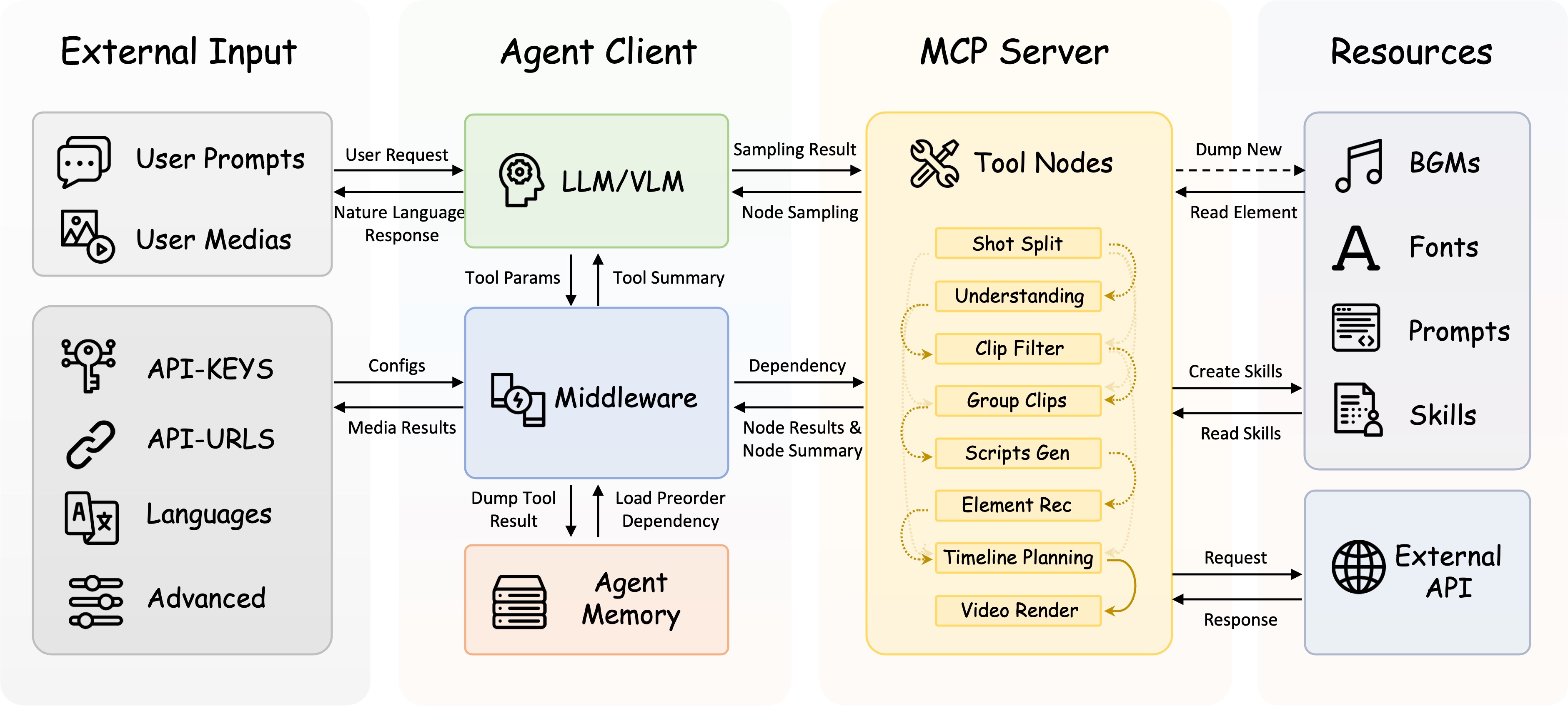
🏗️ Architecture
✨ Demo
| Zhongcao Style | Humorous Style | Product Picks | Artistic Style |
| | | |
| Unboxing | Talking Pet | Travel Vlog | Year-in-Review |
| | | |
🎨 Effects Note: Due to licensing restrictions on open-source assets, the elements (fonts/music) in the first row represent only basic effects. We highly recommend following the Custom Asset Library Tutorial to unlock commercial-grade fonts, music, and VFX for significantly better video quality.
⚠️ Quality Note: To save space in the README, the demo videos are heavily compressed. The actual output retains the original resolution by default and supports custom dimensions.
In the Demo: The first row shows default open-source assets (Restricted Mode); the second row shows Xiaohongshu App "AI Clip" asset library effects. 👉 Click to view tutorial
⚖️ Disclaimer: User footage and brand logos shown in the demos are for technical demonstration purposes only. Ownership belongs to the original creators. Please contact us for copyright concerns.
🤖 Use Through an Agent
FireRed-OpenStoryline supports usage through Agent Skills.
We provide two Skills:
openstoryline-install: for installation, configuration, and first-run verification.openstoryline-use: for starting the service and running the actual video editing workflow.
OpenClaw
Just tell OpenClaw: “I want to try OpenStoryline. Help me install the required Skills,” and it will automatically trigger the installation.
If the installation runs into problems, use the following commands to install them manually:
openclaw skills install openstoryline-install
openclaw skills install openstoryline-use
If your current OpenClaw version does not support openclaw skills install, or if installation still fails, you can use ClawHub instead:
npx clawhub install openstoryline-install
npx clawhub install openstoryline-use
Once installed, you only need to send your media assets to OpenClaw, and it can help you complete the entire process from installing FireRed-OpenStoryline to generating the final video.
Claude Code
This repository comes with built-in Claude Code Skills.
If you start Claude Code from the root directory of this repository, you can use the project-level Skills included in the repo directly. Claude Code can then help you install and use FireRed-OpenStoryline.
/openstoryline-install
/openstoryline-use
If you want to install these two Skills into your own global Claude Code configuration, run:
mkdir -p ~/.claude/skills
cp -R .claude/skills/openstoryline-install ~/.claude/skills/
cp -R .claude/skills/openstoryline-use ~/.claude/skills/
Other Compatible Agents (Experimental)
These Skills are based on an open Agent Skills format, so in theory they can also be installed into other compatible agents.
For example, you can install them into Codex via the Skills CLI:
npx skills add FireRedTeam/FireRed-OpenStoryline --skill openstoryline-install --agent codex
npx skills add FireRedTeam/FireRed-OpenStoryline --skill openstoryline-use --agent codex
Or use the commands below with the --global flag to install these Skills into the user-level directory so they are available across projects:
npx skills add FireRedTeam/FireRed-OpenStoryline --skill openstoryline-install --global
npx skills add FireRedTeam/FireRed-OpenStoryline --skill openstoryline-use --global
📦 Install
1. Clone repository
# If git is not installed, refer to the official website for installation: https://git-scm.com/install/
# Or manually download the code
git clone https://github.com/FireRedTeam/FireRed-OpenStoryline.git
cd FireRed-OpenStoryline
2. Create a virtual environment
Install Conda according to the official guide (Miniforge is recommended, it is suggested to check the option to automatically configure environment variables during installation): https://docs.conda.io/projects/conda/en/latest/user-guide/install/index.html
# Recommended python>=3.11
conda create -n storyline python=3.11
conda activate storyline
3. 📦 Resource Download & Installation
3.1 Automatic Installation (Linux and macOS only)
sh build_env.sh
3.2 Manual Installation
A. MacOS or Linux
-
Step 1: Install wget (if not already installed)
# MacOS: If you haven't installed Homebrew yet, please install it first: https://brew.sh/
brew install wget

# Ubuntu/Debian
sudo apt-get install wget

# CentOS
sudo yum install wget
-
Step 2: Download Resources
chmod +x download.sh
./download.sh
-
Step 3: Install Dependencies
pip install -r requirements.txt
If you plan to use storyline.local_asr, make sure torchaudio is installed in the same environment.
B. Windows
-
Step 1: Prepare Directory: Create a new directory named resource in the project root directory.
-
Step 2: Download and Extract:
-
Step 3: Install Dependencies:
pip install -r requirements.txt
If you plan to use storyline.local_asr, make sure torchaudio is installed in the same environment.
🚀 Quick Start
Note: Before starting, you need to configure the API-Key in config.toml first. For details, please refer to the documentation API-Key Configuration
1. Start the MCP Server
MacOS or Linux
PYTHONPATH=src python -m open_storyline.mcp.server
Windows
$env:PYTHONPATH="src"; python -m open_storyline.mcp.server
2. Start the conversation interface
🐳 Docker
Pull the Image
# Pull image from Docker Hub official repository
# Recommended for users outside China
docker pull openstoryline/openstoryline:v1.0.1

# Pull image from Alibaba Cloud Container Registry
# Recommended for users in China (faster and more stable)
docker pull crpi-6knxem4w8ggpdnsn.cn-shanghai.personal.cr.aliyuncs.com/openstoryline/openstoryline:v1.0.1
Start the Container
docker run \
  -v $(pwd)/config.toml:/app/config.toml \
  -v $(pwd)/outputs:/app/outputs \
  -v $(pwd)/run.sh:/app/run.sh \
  -p 7860:7860 \
  openstoryline/openstoryline:v1.0.1
After starting, access the Web interface at http://0.0.0.0:7860
📁 Project Structure
FireRed-OpenStoryline/
├── 🎯 src/open_storyline/           Core application
│   ├── mcp/                         🔌 Model Context Protocol
│   ├── nodes/                       🎬 Video processing nodes
│   ├── skills/                      🛠️ Agent skills library
│   ├── storage/                     💾 Agent Memory
│   ├── utils/                       🧰 Helper utilities
│   ├── agent.py                     🤖 Build Agent
│   └── config.py                    ⚙️ Configuration management
├── 📚 docs/                         Documentation
├── 🐳 Dockerfile                    Docker Configuration
├── 💬 prompts/                      LLM prompt templates
├── 🎨 resource/                     Static resources
│   ├── bgms/                        Background music library
│   ├── fonts/                       Font files
│   ├── script_templates/            Video script templates
│   └── unicode_emojis.json          Emoji list
├── 🔧 scripts/                      Utility scripts
├── 🌐 web/                          Web interface
├── 🚀 agent_fastapi.py              FastAPI server
├── 🖥️ cli.py                        Command-line interface
├── ⚙️ config.toml                   Main configuration file
├── 🚀 build_env.sh                  Environment Build Script
├── 📥 download.sh                   Resource downloader
├── 📦 requirements.txt              Runtime dependencies
└── ▶️ run.sh                        Launch script
📚 Documentation
📖 Tutorial Index
TODO
Acknowledgements
This project is built upon the following excellent open-source projects:
Core Dependencies
- MoviePy - Video editing library
- FFmpeg - Multimedia framework
- LangChain - A framework that provides pre-built Agents
📄 License
This project is licensed under the Apache License 2.0 - see the LICENSE file for details.
⭐ Star History









