
affaan-m/
ECC

affaan-m/ECCHarnesses
The agent harness performance optimization system. Skills, instincts, memory, security, and research-first development for Claude Code, Codex, Opencode, Cursor and beyond.
258k
project-brain gives a project a `brain/` folder, a few instruction files, and a handoff protocol so a new AI session can find the current state fast. The structure separates stable project facts, current status, decisions, and window-switch handoffs, then mirrors that setup into tool-specific files like `CLAUDE.md`, `.cursorrules`, `AGENTS.md`, and Copilot instructions.
Builders who want their agent to pick up a project after a context wipe without re-explaining everything.
You can resume work with the right project context instead of starting blind in every new session.
Defines `brain/PROJECT.md`, `MAP.md`, `STATUS.md`, `DECISIONS.md`, and `HANDOFF.md`, plus topic folders for systems, operations, planning, and feedback.
Installs as a plugin with a skill manifest so Claude Code can load the project brain automatically.
Provides adapter files for Claude Code, Cursor, Copilot Chat, and AGENTS.md-based tools.
Copies the brain layout and adapter files into an existing project with `./scripts/scaffold.sh`.
Checks a scaffold for missing core files, oversized status files, stale placeholders, and other structure problems with `./scripts/doctor.sh`.
Includes `examples/small-saas/` as a complete example of a populated brain folder.
/plugin marketplace add Ethan-YS/project-brain
/plugin install project-brain@sprout-labs
claude plugin marketplace add Ethan-YS/project-brain
claude plugin install project-brain@sprout-labs
./project-brain/scripts/doctor.sh /path/to/your/project
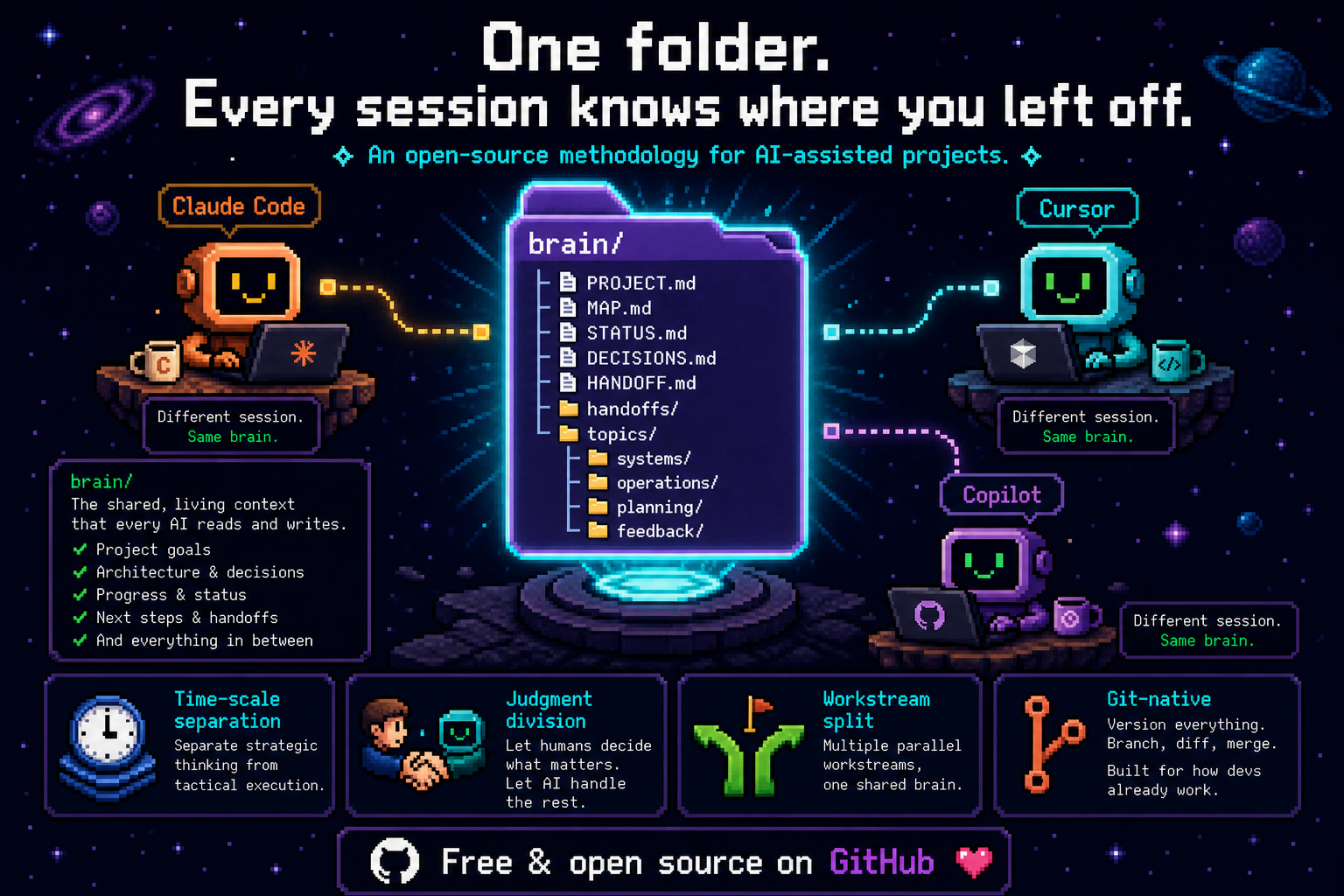
Different session. Same brain.
A folder structure + collaboration protocol that lets your AI assistant pick up a project after a context wipe — across new sessions, new windows, new collaborators.
Part of Sprout Labs — Local-first AI memory & agent safety, built independently by Ethan (Independent Product Designer & AI Builder, since 2016). ethanflow.com · LinkedIn · @ethanflow_lab · GitHub

Long-running projects with AI coding assistants (Claude Code, Cursor, Copilot, etc.) hit a counter-intuitive wall:
Larger context windows don't solve the problem. Better information structure does.
A wider window doesn't mean it gets read. Read doesn't mean located. Located doesn't mean prioritized. Without structure, every new session starts with "wait, what's going on here?" — and the AI either reads too much (wasting tokens) or misses the critical pieces.
Symptoms you'll recognize:
project-brain is a structural answer: a brain/ folder layout + a small set of protocols, designed so a fresh AI session can read 2-3 files and be productive.
In Claude Code, run these two slash commands:
/plugin marketplace add Ethan-YS/project-brain
/plugin install project-brain@sprout-labs
If /plugin isn't exposed in your Claude Code environment (some embedded / SDK contexts strip it), the CLI form does the exact same thing — run from any terminal:
claude plugin marketplace add Ethan-YS/project-brain
claude plugin install project-brain@sprout-labs
That's it. From any project after that, just say:
MAP.md + STATUS.md + (if exists) HANDOFF.mdThe skill handles four workflows: new-project kick-off, startup resume, window-switch handoff, and updates. Auto-trigger requires an explicit user request — it intentionally does not activate just because a brain/ folder exists.
Already installed the old way? If you previously cloned to
~/.claude/skills/project-brain, remove it first:rm -rf ~/.claude/skills/project-brain. The plugin install is the supported path going forward.
Update later:
/plugin marketplace update sprout-labsto fetch the latest version.
If you don't use Claude Code, or you just want the scaffold script:
git clone https://github.com/Ethan-YS/project-brain.git

# Scaffold into your project (defaults to all four AI adapters, English)
./project-brain/scripts/scaffold.sh /path/to/your/project

# Or pick specific adapters:
./project-brain/scripts/scaffold.sh /path/to/your/project --tools claude,cursor

# For projects documented in Chinese — gives Chinese brain/ + CLAUDE.md
# (other adapters stay English — they're consumed by AI tools, not humans):
./project-brain/scripts/scaffold.sh /path/to/your/project --lang zh

# Fill in brain/PROJECT.md on day one
# Walk through ⚠️ TODO ⚠️ placeholders
What the scaffold gives you:
| File | Tool |
|---|---|
brain/ | The project brain (PROJECT/MAP/STATUS/DECISIONS/HANDOFF + topics/) |
CLAUDE.md | Claude Code instruction file |
.cursorrules | Cursor instruction file |
.github/copilot-instructions.md | GitHub Copilot Chat |
AGENTS.md | Codex CLI / Aider / Continue (AGENTS.md convention) |
When a new AI session opens your project, the auto-loaded instruction file directs it to read brain/MAP.md + brain/STATUS.md. If brain/HANDOFF.md exists, it picks up the previous session's "still-warm-not-yet-written-down" thoughts.
./project-brain/scripts/doctor.sh /path/to/your/project
Read-only structural checks: missing core files, STATUS over 80 lines, decisions without "rejected alternatives," topics/ files not registered in MAP, stale ⚠️ TODO ⚠️ placeholders, etc. Reports issues but never fixes them — that's still your call. See scripts/doctor.sh.
If the empty templates feel abstract, see examples/small-saas/ — a fictional SaaS project ("Quill," a local-first notes app at v0.3) with every file filled in. Reading it is the fastest way to understand what each brain/ file looks like in real use.
brain/
├── PROJECT.md       What is this project? What do we explicitly NOT do?
├── MAP.md           Module structure + document index ("where do I find X?")
├── STATUS.md        Current state — overwritable, soft cap 80 lines
├── DECISIONS.md     Decision log — append-only, requires "rejected alternatives"
├── HANDOFF.md       Cross-window bridge — what's still in head but not yet written
├── handoffs/        Archive of past HANDOFFs (timestamped)
└── topics/          Per-problem-dimension docs
    ├── systems/      → "How is this designed?"
    ├── operations/   → "How do I operate it / what to do each release?"
    ├── planning/     → "What are we going to build / how to plan it?"
    └── feedback/     → "What is reality / users telling us?"
The five core files in brain/ are split by how often they change, not by topic:
| File | Volatility | When to read |
|---|---|---|
PROJECT.md | Almost never | First contact / scope ambiguous |
MAP.md | Slowly | Every new session |
STATUS.md | Frequently (per session) | Every new session |
DECISIONS.md | Append-only, event-driven | Tracing why something is the way it is |
HANDOFF.md | Per window-switch | New session start (if exists) |
Why volatility-based? Because mixing low-frequency content with high-frequency content forces the low-frequency content to be re-edited every session — the most common mode of doc rot.
brain/topics/ is divided into 4 dimensions: systems / operations / planning / feedback. A single business module (say, "payment") has its design in systems/, deploy logs in operations/, pricing strategy in planning/, user feedback in feedback/.
Why? Modules grow, shrink, get renamed, get merged. The four problem dimensions are far more stable.
Every entry in DECISIONS.md must include what was considered and rejected, and why. Without this, the file degrades into a worse version of CHANGELOG.md (which already records "what was done"). The unique value of decision logs is the paths not taken — that's where a project's judgment lives.
When the user says "update the project brain":
The AI should not push specialized judgments back ("which files do you want me to update?") — that hands the wrong layer of judgment to the wrong person.
Since v2.6, routine bookkeeping writes are tiered (METHODOLOGY §4.1): STATUS / HANDOFF / mechanical MAP registrations are write-then-announce — the AI writes after the work lands and reports it, with git as the review surface. DECISIONS / PROJECT remain ask-before-write. The explicit "update the project brain" checkpoint above keeps per-item approval either way.
Some projects naturally have parallel independent workstreams (e.g., development + operations + outreach in one product). For these, STATUS and HANDOFF split per workstream:
brain/
├── PROJECT.md           ← shared
├── MAP.md               ← shared
├── DECISIONS.md         ← shared
├── STATUS_dev.md        ← split per workstream
├── STATUS_ops.md
├── HANDOFF_dev.md
├── HANDOFF_ops.md
├── handoffs/
│   ├── dev/
│   └── ops/
└── topics/              ← shared
Single-workstream projects ignore this — they keep the default STATUS.md / HANDOFF.md.
This methodology didn't appear from a design session. It evolved through real use across multiple projects — each iteration triggered by friction we hit and couldn't ignore.
v1 (April 2026): After accumulating 15+ scattered docs and one 32KB monolithic file in a single project, every new AI session needed to re-read everything to figure out "what's going on here?" We refactored across 4 commits and established the basic structure: meta/ (continuity layer) + docs/ (problem-dimension classified). The core insight was separating files by volatility — stable / slowly-changing / per-session / append-only — to prevent the most common doc-rot pattern: low-frequency content getting re-edited because it lives next to high-frequency content.
v2 (April 30, 2026): We surveyed community approaches (Prompt Shelf 2026's three-file architecture, softaworks/agent-toolkit's session-handoff skill, Anthropic's official skills repo). We found:
The plan was "borrow the runtime layer, keep the structural layer." But across 8 rounds of refinement, the user systematically rejected mechanism creep. Every time the AI proposed "let me design auto-detection / triggering / staleness checking," the user said "no — that's a judgment I'll make myself."
This crystallized into the Judgment Division Principle (see Core principle 4): the user decides "should we record now"; the AI decides "what specifically to record"; the user reviews. Don't hide specialized judgment behind automation.
Companion design changes: merged meta/ + docs/ into a single brain/, added HANDOFF.md for cross-window continuity, replaced "hard keyword detection" with gentle inquiry ("does this count as decided?" instead of asserting "we decided X"), made placeholders visually loud (⚠️ TODO ⚠️), and made the git prerequisite explicit.
v2.1 (same day, evening): A second project — non-development, running parallel workstreams (official ops + outreach) — broke v2's hidden assumption that "one project = one workstream." The user had naturally evolved a workaround using STATUS_<workstream>.md naming. We folded it into the methodology as Multi-workstream Mode (Core principle 5): project-level files stay shared, status and handoff split per workstream.
The healthy evolution pattern wasn't "design everything upfront." It was "build what works now, let real-world friction drive the next version." Each version came from a specific, named problem. Each refinement was triggered by a real moment of pain.
If you take one thing from this repo: resist the urge to design comprehensive automation up front. Real friction tells you which mechanisms are worth building, and which would just hand specialized judgment to the wrong layer.
plugin.json (manifest) + marketplace.json (Sprout Labs marketplace entry)brain/ + 4 AI tool adaptersThis methodology is AI-agnostic. The repo includes adapter templates for:
CLAUDE.md for project-level instructions.cursorrules.github/copilot-instructions.mdAGENTS.md (the agents.md convention)brain/MAP.md + brain/STATUS.md)./scripts/scaffold.sh copies all four by default; use --tools claude,cursor to pick specific ones.
Requirements:
🌱 v2.4 — methodology stable, 140+ stars, multiple projects in active use. v2.4 ships as a one-command Claude Code plugin (the Sprout Labs marketplace). v2.3 added scripts/doctor.sh (structural health check) and a fully-filled example project (examples/small-saas/). v2.2 introduced the Claude Code skill manifest and adapter templates for Cursor / Copilot / AGENTS.md. External effectiveness data still pending — battle-tested by the maintainers daily; field reports from other users still being collected.
Built by Ethan, the person behind Sprout Labs. The methodology came out of a Jarvis-style AI collaboration workflow: eight rounds of iteration in a single working day, each triggered by a specific friction point — not a design session.
The methodology itself models the working approach: clear judgment division, refusal to automate away decisions that should be made by humans, and willingness to admit when v1 needs to become v2.
Released under Sprout Labs.
MIT — use it, modify it, share it. If it helps your workflow, a star on the repo is appreciated.
Issues and PRs welcome. The methodology is intentionally minimalist — proposals to add mechanisms should clearly identify the specific friction they solve. New traps (mistakes you've hit using this) are especially welcome.
Sign in to join the discussion.
No comments yet. Be the first to say what this is good for.
The agent harness performance optimization system. Skills, instincts, memory, security, and research-first development for Claude Code, Codex, Opencode, Cursor and beyond.
from vibe coding to agentic engineering - practice makes claude perfect
🌊 The original agent meta-harness. Deploy intelligent multi-player swarms, coordinate autonomous workflows, and build conversational AI systems. Features adaptive memory, self-learning intelligence, RAG integration, and native Claude Code / Codex / Hermes and many more Integrated
Practical patterns, starters & CLI tools for loop engineering with AI coding agents. Design systems that prompt and orchestrate agents (inspired by Addy Osmani and Boris Cherny). Includes loop-audit, loop-init, loop-cost.

Git. Ship. Done - Core

The most RAM efficient harness