
DietrichGebert/ponytailPlugins
Makes your AI agent think like the laziest senior dev in the room. The best code is the code you never wrote.
138k
1 add
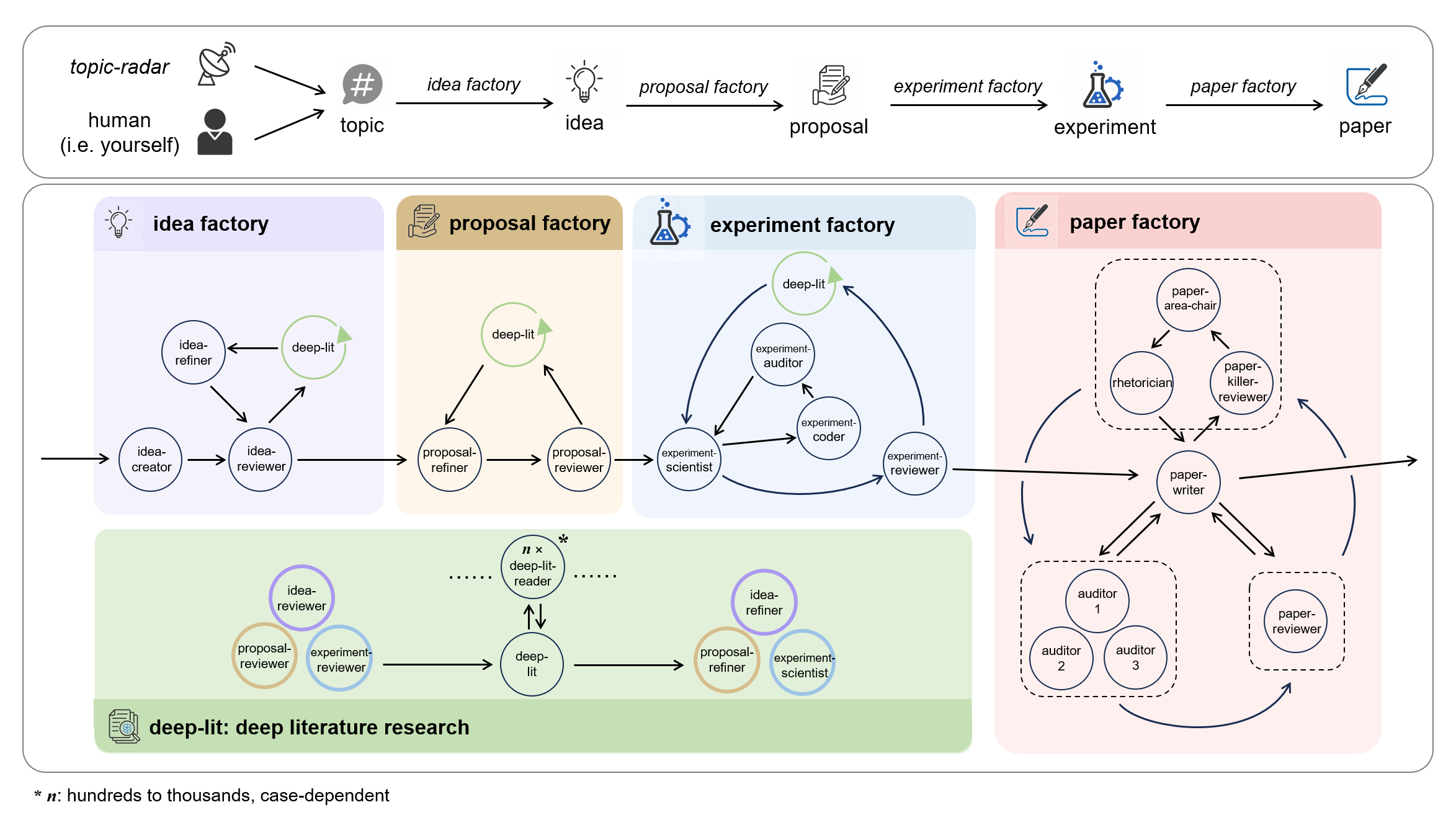
Agon plugs into Claude Code as a plugin that coordinates multi-agent research from a bare topic to running experiments. The workflow is explicit and file-backed, with stages for ideas, proposals, deep literature review, and experiment execution.
Builders who run Claude Code on research problems and want agents to create, review, and execute experiments with minimal handholding.
You can take a topic from first sketch to experiment runs without writing the experimental code yourself.
Moves work through `/idea-tick`, `/proposal-tick`, `/experiment-tick`, and `/deep-lit-tick`.
Includes agents for idea creation, literature reading, experiment coding, auditing, and review.
Writes progress through topic, idea, proposal, and workspace files so runs can be resumed and checked later.
Adds reusable skill files for literature survey, novelty checks, experiment planning, paper writing, and related tasks.
Includes hook config and a settings example for routing, parallelism, and Claude Code setup.
git clone https://github.com/AutoResearch-Factory/Agon.git
git clone https://github.com/AutoResearch-Factory/agon-artifacts.git
.
├── Agon/
└── agon-artifacts/
cd agon-artifacts
claude --plugin-dir ../Agon --dangerously-skip-permissions --effort medium



English | 中文
Agon (paper) takes a research project from a one-line topic to running experiments. Agents plan, implement, audit and review each other in closed loops, and every handoff goes through a file on disk — so a run is recoverable, auditable, and reusable across projects. The workflow stays minimal and explicit: topic → idea → proposal → experiment.
Agon is built on Prompt Economy: treat prompt engineering as engineering, and minimize the engineering effort it demands from humans. See the paper for deployment details across more than ten research domains.
Clone Agon and agon-artifacts:
git clone https://github.com/AutoResearch-Factory/Agon.git
git clone https://github.com/AutoResearch-Factory/agon-artifacts.git
Put the two directories side by side:
.
├── Agon/
└── agon-artifacts/
Then run Claude Code from the artifacts repository:
cd agon-artifacts
claude --plugin-dir ../Agon --dangerously-skip-permissions --effort medium
--dangerously-skip-permissions is required because the loops are meant to run unattended: subagents write files, launch experiments, and call tools for hours with nobody at the keyboard, and a permission prompt would stall the whole run. Give Agon its own machine, container, or user account if that matters to you.
In Claude Code, use these commands to move the research forward:
/idea-tick: create, review, refine, and literature-check ideas for a topic./proposal-tick: turn selected ideas into reviewed proposals./experiment-tick: coordinate scientist, coder, auditor, and reviewer roles for one workspace./deep-lit-tick: run the shared deep literature loop used by the other stages./deep-lit-tick Exhaustively survey the literature on <topic>, and write the result to topics/mmdd-<slug>-landscape.md.
/idea-tick <topic-slug> <topic> is becoming important. Brainstorm several research ideas.
/idea-tick <idea-slug> I have a vague idea about <topic>. Create the topic file, create the idea file, and refine the idea.
/proposal-tick <idea-1> <idea-2> <idea-3> Generate proposals for these ideas.
/experiment-tick <slug> Start the experiment.
/experiment-tick <slug> This is a debugging run. First explain the full procedure, then pause for my approval after each agent call.
Agon itself is a Claude Code plugin. Run it from a separate data workspace, commonly named agon-artifacts, so prompts/code and research data can evolve independently.
Expected data workspace layout:
agon-artifacts/
├── topics/
├── ideas/
└── workspace/
Optional local settings live at .settings.toml. Start from .settings.example.toml when you need to customize model routing or parallelism.
claude-ds is DeepSeek-backed Claude Code.
Before first launch, create an empty ~/.claude-ds/ and only handle symlinks. Claude will generate the rest on first launch:
CLAUDE.md mcp-needs-auth-cache.json memory/ plugins/ settings.json settings.local.json skills/backups/ cache/ downloads/ ide/ stats-cache.json projects/ sessions/ session-env/ file-history/ history.jsonl paste-cache/ shell-snapshots/ .claude.jsonclaude and claude-ds share skills, MCP, and pluginsAdd the claude-ds() function to ~/.bashrc:
claude-ds() {
  CLAUDE_CONFIG_DIR="$HOME/.claude-ds" \
  ANTHROPIC_BASE_URL="https://api.deepseek.com/anthropic" \
  ANTHROPIC_AUTH_TOKEN="$DEEPSEEK_API_KEY" \
  ANTHROPIC_MODEL="deepseek-v4-pro[1m]" \
  ANTHROPIC_DEFAULT_OPUS_MODEL="deepseek-v4-pro[1m]" \
  ANTHROPIC_DEFAULT_FABLE_MODEL="deepseek-v4-pro[1m]" \
  ANTHROPIC_DEFAULT_SONNET_MODEL="deepseek-v4-flash" \
  ANTHROPIC_DEFAULT_HAIKU_MODEL="deepseek-v4-flash" \
  CLAUDE_CODE_DISABLE_NONSTREAMING_FALLBACK=1 \
  claude --effort max "$@"
}
Notes:
# If not running interactively guard, so non-interactive shells such as Claude Code's Bash tool can see it[1m] suffix to the model ID to unlock 1M contextclaude-dsThe same wrapper pattern works for Codex and Grok via CLIProxyAPI (claude-codex, claude-grok).
| Item | Purpose |
|---|---|
DISABLE_TELEMETRY | Disable Statsig telemetry (usage stats, no code or file paths) |
CLAUDE_CODE_EXPERIMENTAL_AGENT_TEAMS | Let the main agent resume background/asynchronous subagents, and let subagents message each other |
cleanupPeriodDays: 3650 | Keep session history under ~/.claude/projects/ (default cleanup is after 30 days); set this at the top level of ~/.claude/settings.json |
Configure statusline
Tell claude or claude-ds: "call statusline-setup, I want [5h:6% 7d:69%(2d17h)] Ctx:7% Opus 4.6 (1M context)"
@misc{sun2026agonautonomouslargescaleomnidisciplinary,
      title={Agon: An Autonomous Large-Scale Omnidisciplinary Research System Built on Prompt Economy},
      author={Youran Sun and Xingyu Ren and Chugang Yi and Jiaxuan Guo and Kejia Zhang and Jianda Du and Haizhao Yang},
      year={2026},
      eprint={2606.24177},
      archivePrefix={arXiv},
      primaryClass={cs.SE},
      url={https://arxiv.org/abs/2606.24177},
}
Sign in to join the discussion.
No comments yet. Be the first to say what this is good for.
Makes your AI agent think like the laziest senior dev in the room. The best code is the code you never wrote.
Graphs that teach > graphs that impress. Turn any code into an interactive knowledge graph you can explore, search, and ask questions about. Works with Claude Code, Codex, Cursor, Copilot, Gemini CLI, and more.

OmO: Just type "mass ulw" keyword with your prompt. Now you are the master of graph engineering.
Persistent Context Across Sessions for Every Agent – Captures everything your agent does during sessions, compresses it with AI, and injects relevant context back into future sessions. Works with Claude Code, OpenClaw, Codex, Gemini, Hermes, Copilot, OpenCode + More
Opinionated Oxlint rules for rejecting low-evidence TypeScript and JavaScript patterns
Teams-first Multi-agent orchestration for Claude Code