MedSci Skills
English | 简体中文
59 skills that actually work. Built by a physician-researcher, tested on real publications.
MedSci Skills is an end-to-end research tool for physician and medical-engineering researchers — design → scaffold → validate → publish — for the clinical manuscript and the medical-AI model behind it. Its moat is the compliance layer — 49 reporting guidelines and risk-of-bias tools, reference/citation verification, and deterministic integrity gates before peer review — now extended by a model-engineering lane that scaffolds reproducible, leakage-safe training repos and audits model validation. Clinical AI model research engineering is in scope; a general AI-scientist platform is not. It competes on clinical submission reliability, not skill count.














Topic Discovery → Literature Search → Full-Text Retrieval → Study Design → Sample Size → Protocol → De-identification → Data Cleaning → Statistics → Figures → Writing → Humanize → Compliance → Journal Selection → Peer Review → Revision → Presentation
Created & maintained by Yoojin Nam, MD
Department of Radiology and Research Institute of Radiology, University of Ulsan College of Medicine, Asan Medical Center, Seoul, Republic of Korea

What is MedSci Skills?
MedSci Skills is an open-source Agent Skills collection for clinical
research — the manuscript and the medical-AI model alike — designed to be driven
directly by AI coding agents (Claude Code, Codex, Cursor, and GitHub Copilot). It helps
physician-researchers and biomedical/medical-engineering investigators move from
literature search, study design, statistics, and figures to reporting-guideline
compliance, citation/reference auditing, numerical-consistency checks, and
response-to-reviewer workflows — combining agentic writing with deterministic
integrity gates for submission-grade biomedical research. As of v5.0 it adds a
model-engineering lane: choose a paper-grounded architecture, scaffold a
reproducible, leakage-safe PyTorch training repo, and validate, document, and
evaluate a medical-imaging or LLM/MLLM model so the work reaches a paper — it
ships a minimal runnable default model for a forward-pass smoke test and
integrates MONAI / nnU-Net / timm / torchvision for production-grade models,
rather than reimplementing the ecosystem. Clinical AI model research
engineering is in scope; it is not a diagnostic tool, an autonomous author, or a
general AI-scientist platform, and every output requires human-expert verification.
New here? See the 3 workflows below, the
FAQ, the
research connectors it calls (keyless public APIs — nothing to set
up in the common case), and the
scope boundary.
Quick Start
No terminal? Use the classroom installer ZIP — download, unzip, double-click the installer, then restart your agent app (see Installation).
Have a terminal? Fastest path — one command, nothing to clone:
npx medsci-skills install # copies every skill into your agent's folder
Recommended (especially for clinicians): add --enable-update-notify so Claude Code shows a one-line "update available" notice when a new version ships — otherwise you stay on the version you installed and are never told. (No terminal at all? The classroom installer below turns this on for you.)
npx medsci-skills install --enable-update-notify # install + in-app update reminders
Have git? Install every skill in three commands:
git clone https://github.com/Aperivue/medsci-skills.git
mkdir -p ~/.claude/skills
cp -r medsci-skills/skills/* ~/.claude/skills/
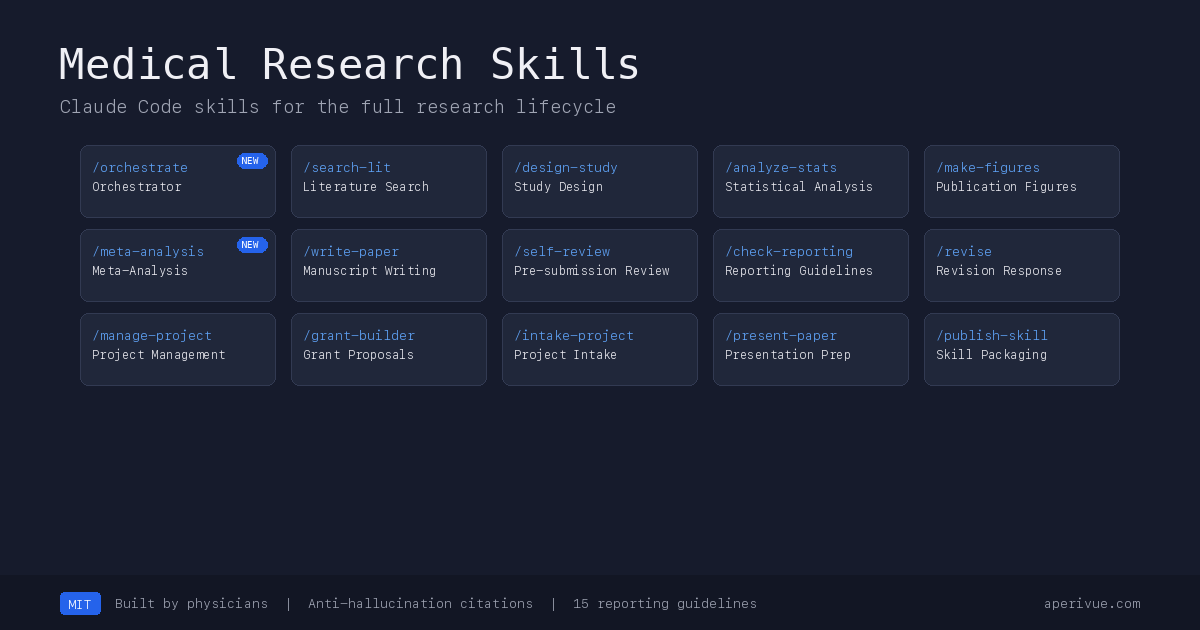
Restart Claude Code, then start with /orchestrate — it classifies your request and routes you to the right skill. Full install options (Codex, Cursor, individual skills) are in Installation.
Install with gh skill
MedSci Skills follows the Agent Skills standard, so GitHub CLI ≥ 2.90 can search, preview, and install any skill straight from this repo — no clone (a gh preview feature):
gh skill search medsci                                   # list the whole collection
gh skill preview Aperivue/medsci-skills check-reporting  # read a skill before installing
gh skill install Aperivue/medsci-skills check-reporting  # install just that one
gh skill install --all Aperivue/medsci-skills            # or install every skill
Search by a skill's own name (check-reporting, verify-refs, meta-analysis) or by medsci to list them all — both return this repo directly. A broad topic word like systematic review is shared by hundreds of skills across GitHub, so add --owner Aperivue to see only ours.
Install as a Claude Code plugin
Prefer plugins? One line adds the marketplace; /plugin then lets you browse nine category plugins and enable the ones you want:
/plugin marketplace add Aperivue/medsci-skills
/plugin            # browse nine category plugins; enable the ones you want
| Plugin | Covers |
|---|
medsci-literature | Literature search, full-text retrieval, Zotero sync, reference-integrity audits |
medsci-data | Study design, variable operationalization, sample size, data cleaning, de-identification, codebooks, dataset versioning |
medsci-modeling | Architecture selection, reproducible model-scaffold repos, model-validation audits, Model Card/Datasheet, model & LLM/MLLM evaluation |
medsci-analysis | Statistics, figures, batch/cross-national/replication analysis, meta-analysis |
medsci-writing | IMRAD & protocol drafting, AI-pattern removal, AI-search optimization, reviewer responses |
medsci-review | Self-review, peer review, reporting-guideline compliance |
medsci-submission | Submission packaging, journal selection, ICMJE/IRB form filling, grant proposals |
medsci-project | Orchestration, project intake/management, gap & topic discovery, author strategy |
medsci-presentation | Presentations/PPTX, PDF/document rendering, environment setup, skill publishing |
Install a single category and invoke its skills under that namespace:
/plugin install medsci-analysis@medsci-skills
/medsci-analysis:analyze-stats
All nine plugins share the same repository source, so this groups and enables skills by category — it is not a partial download. The marketplace tracks main, so a plugin's version is its git commit.
Note the name. A skill installed as a plugin is invoked under its plugin's namespace (/medsci-analysis:analyze-stats); the same skill installed into the skills folder by the npx, gh skill, classroom, or manual paths is invoked bare (/analyze-stats). Both run the same skill — press / and use Tab completion rather than typing the long form.
Want just one capability? Two skills are also published as focused standalone repos (generated mirrors; this repo stays the source of truth), each installable on its own with /plugin marketplace add Aperivue/<repo>:
Start here: 3 workflows
New users don't need all the skills at once. Most work starts as one of three
workflows. Each runs through /orchestrate or by invoking the named skills in
order; all outputs require human-expert review.
Workflow A — Manuscript pre-submission audit. Use when a manuscript is nearly
ready and you want it checked before a reviewer sees it. Skills: /self-review →
/check-reporting → /verify-refs → /sync-submission. In: your manuscript
(+ refs.bib, tables/figures). Out: anticipated reviewer comments, an item-by-item
reporting-guideline audit, a citation-integrity report, and a submission-package
drift check. Safety: it flags issues; you fix and verify them.
Workflow B — Data to manuscript package. Use when you have a cleaned dataset
and need a full draft. Skills: /clean-data → /analyze-stats → /make-figures →
/write-paper → /check-reporting → /find-journal. In: a cleaned CSV/parquet
- a research question. Out: reproducible analysis code, publication-ready figures,
an IMRaD draft, a reporting checklist, and a journal shortlist. Safety: statistics
and claims must be verified against your data; the toolkit never fabricates numbers
or references.
Workflow C — Systematic review / meta-analysis. Use when you are running an
SR/MA. Skills: /meta-analysis (with /search-lit, /make-figures,
/check-reporting). In: a research question + search strategy. Out: PROSPERO-style
protocol scaffolding, screening/extraction structure, PRISMA-consistent counts and
diagram, pooled-estimate figures, and a manuscript draft. Safety: screening and
extraction decisions stay with the human review team.
Live Demos: Five Study Types, Five Full Pipelines
Five public datasets. Five study types. Demos 1–3 each produce a complete manuscript, publication-ready figures, and a reporting-compliance audit; Demo 4 runs the medical-AI model-engineering lane end to end (scaffold → gates → training → evaluation → interpretability); Demo 5 takes that lane onto a GPU cluster and out to a genuinely external cohort, then reports where it broke.
Demo 1: Diagnostic Accuracy — Wisconsin Breast Cancer
from sklearn.datasets import load_breast_cancer
data = load_breast_cancer()  # 569 samples, zero download
Output from orchestrate --e2e (see full demo):
Full output list — manuscript, figures, STARD flow, checklist (click to expand)
Pipeline: analyze-stats → make-figures → write-paper → AI pattern scan → check-reporting (STARD) → self-review → DOCX build → present-paper
Demo 2: Meta-Analysis — BCG Vaccine Efficacy
library(metafor)
data(dat.bcg)  # 13 RCTs, 357,347 participants (Colditz et al. 1994)
Output from orchestrate --e2e (see full demo):
Full output list — manuscript, forest/funnel plots, PRISMA flow, checklist (click to expand)
| Output | Description |
|---|
| Manuscript | Pooled RR = 0.489 (95% CI: 0.344–0.696), ~2,200 words |
| Title Page | PRISMA title page with key points |
| DOCX | Submission-ready Word document |
| Forest Plot | 13 studies, RE model (REML), 300 dpi |
| Funnel Plot | Small-study / publication-bias visual |
| PRISMA Flow | D2-generated PRISMA 2020 flow diagram |
| Reporting Checklist | PRISMA 2020 — 57.1% (24/42) at check-reporting → 61.9% (26/42) after self-review fix |
| Self-Review | Initial 78 → 82 (REVISE) after 1 fix iteration; 3 major / 4 minor (majors are out-of-scope RoB/GRADE/references) |
| Pipeline Log | 7-step E2E execution trace |
Pipeline: analyze-stats (R metafor) → make-figures → write-paper → AI pattern scan → check-reporting (PRISMA 2020) → self-review → DOCX build → present-paper
Demo 3: Epidemiology — NHANES Obesity & Diabetes
# Pre-processed NHANES 2017-2018 CSV included
# 5,010 US adults after exclusions
Output from orchestrate --e2e (see full demo):
Full output list — manuscript, OR forest plot, STROBE flow, checklist (click to expand)
Pipeline: analyze-stats → make-figures → write-paper → AI pattern scan → check-reporting (STROBE) → self-review → DOCX build → present-paper
Demo 5: External Validation — MSD → AMOS spleen segmentation
The only demo that leaves the laptop, and the only one that reports a failure. It asks whether a
clinician can carry a deep-learning study to a defensible result without an engineer, then answers by
running a three-rung external-validation ladder on a GPU cluster and logging every point where the
answer was no.
| Rung | Cohort | n scored | Dice median [95% CI] |
|---|
| 1 internal | MSD held-out | 9 | 0.9595 [0.9367–0.9734] |
| 2 genuine external | AMOS CT | 298 / 300 | 0.8932 [0.8633–0.9108] |
| 3 modality shift | AMOS MRI | 59 / 60 | 0.0152 [0.0000–0.0626] |
| 3b counterfactual | AMOS MRI, rescaled | 59 / 60 | 0.3016 [0.1744–0.4048] |
Rung 3 is a constructed test, and the demo says so: the evaluation plan named the normalisation
contract and predicted the collapse before inference ran. The trained plan carries CTNormalization
into inference and there is no flag that says "this is MRI", so a Hounsfield-unit clip is applied to
arbitrary-unit images: 0 of 60 MRI cases contain a negative voxel (against 300 of 300 on CT), and a
median 23.2 % of voxels are flattened at the clip ceiling (against 2.7 %). The run exits 0 and
returns a file for all 60 cases, 20 of them empty. Only ground truth made it loud.
A fourth arm changes only the input intensity scale — same checkpoint, no retraining — and
recovers median Dice to 0.3016 (+0.2864 [+0.1204, +0.4048]) while staying −0.5916 below the
CT arm. So both mechanisms are real and differently sized: roughly 0.29 Dice is the preprocessing
contract, 0.59 a representation that does not transfer. The arm and its prediction were written
down before it ran.
And /profile-imaging had already flagged the mixed intensity scale before training — as a
Minor, where it sat in qc/ for nine days. So the gap this demo found is not detection; it is
routing and severity. A gate that fires correctly into a directory no later step reads is,
operationally, a gate that did not fire. See the full demo — including
FRICTION.md, which lists every point that needed engineering
knowledge, because the headline question is not answerable honestly without it.
Pipeline: profile-imaging → model-sourcing → preprocess-imaging (leakage gate, plus the
counterfactual that must fail) → model-validation (split gate) → nnU-Net training →
model-evaluation → make-figures → write-up. bash reproduce.sh re-runs the gates and the whole
across-cohort analysis on a laptop; training needs ~50 GPU-hours and says so.
Project Folder Structure
Each demo (and real project) follows this role-based folder layout:
project/
├── data/                          # Input data
│   └── raw_data.csv
├── analysis/                      # /analyze-stats + /make-figures outputs
│   ├── tables/
│   ├── figures/
│   │   └── _figure_manifest.md
│   ├── _analysis_outputs.md
│   └── analyze.py
├── manuscript/                    # /write-paper outputs
│   ├── manuscript.md
│   ├── manuscript_final.docx
│   └── title_page.md
├── qc/                            # Quality verification
│   ├── reporting_checklist.md     # /check-reporting
│   ├── self_review.md             # /self-review
│   └── _pipeline_log.md
├── submission/                    # Post-journal-selection (manual trigger)
│   └── {journal_short}/
│       ├── cover_letter.md
│       ├── checklist.md
│       └── peer_review.md
└── presentation/
    └── presentation.pptx
The E2E pipeline (orchestrate --e2e) produces everything up to qc/. The submission/ directory is created after journal selection via /find-journal.
What's New
v5.24.0 — a precision release: the gates were wrong about correct work. Fourteen shipped detectors were telling users something false, and the pattern behind most of them is one thing — a checker that accepts only its own generator's output and rejects the notation the world actually uses. check_xref did not recognise "Figures 1 and 2", so a float cited the ordinary way scored UNCITED and the submission blocker turned itself off (submission_safe: true on a package missing a figure). verify_refs read BibTeX's own and others — the et-al. every reference manager writes — as AUTHOR MISMATCH, the render-aborting verdict, on correct consortium references; and an entry whose last field was the DOI parsed as having none, silently disabling the CrossRef and author cross-checks that skill exists to perform. check_table_percentages invented a denominator for the most common table in clinical research and printed specific wrong replacement percentages at MAJOR. lint_consistency advised writing "type two diabetes". check_asset_anonymization passed a double-blind institution leak because it sat in a .yaml. check_slide_tells flagged the page numbers this repository's own template generator writes. fill_journal_abbrev.py had never run — it raised on its first entry, for every input, while another gate named it to the user as the remedy. And refinement_stop called a leftover TODO an optional Minor and told the loop to stop. Also: the release job's own failure had left v5.23.0 with zero assets and npm a version behind, with no way to retry a pushed tag — now create-or-update, outcome-asserted, and dispatchable; two of the four documented install paths were broken, and the worse one succeeded while making ~/.claude/skills itself the skill; and the front page said 36 detectors while the catalog, the audit document and the paper said 84. Every fix ships a regression test that goes red against the previous behaviour. No new skill or detector; 58 skills / 47 guidelines / 84 integrity detectors / 23 domain-probe modules. (See the CHANGELOG for v5.0–v5.23.)
v5.21 — verification-layer batch, mostly promoted from real submission failures. A marked (tracked-changes) manuscript is now built by driving Word's Compare from the command line and proved by a round trip — accepting every revision must reproduce