
obra/
superpowers

obra/superpowersSkills
An agentic skills framework & software development methodology that works.
285k
1 add
Old Coder is a markdown skill pack that wraps an agent in a spec-first, evidence-first workflow. The agent writes a test plan, implements the change, runs a gauntlet of checks, and hands back a report you can review instead of reading code.
Builders who want their coding agent to justify changes with tests, checks, and a final evidence report.
You can trust agent-written changes by reviewing the spec and evidence instead of the full code diff.
The agent writes a concrete test plan with examples and proposed tools before any implementation starts.
The workflow runs tests, types, lint, coverage, mutation testing, property-based tests, real execution, and other risk-based checks.
After the run, the agent produces a fresh, rerunnable report with the results you read instead of the code.
`old-coder-api` adds gates for compatibility, authorization, idempotency, pagination, rate limits, and operability.
`demo-rate-limiter/` shows the workflow end to end with a spec, evidence, tests, source, and a gauntlet script.
npx skills add https://github.com/amazingang/old-coder --skill old-coder
cp -r skills/old-coder ~/.claude/skills/
# or copy it to <project>/.claude/skills/
npx skills add https://github.com/amazingang/old-coder --skill old-coder-api
npx skills add https://github.com/amazingang/old-coder --skill old-coder --skill old-coder-api
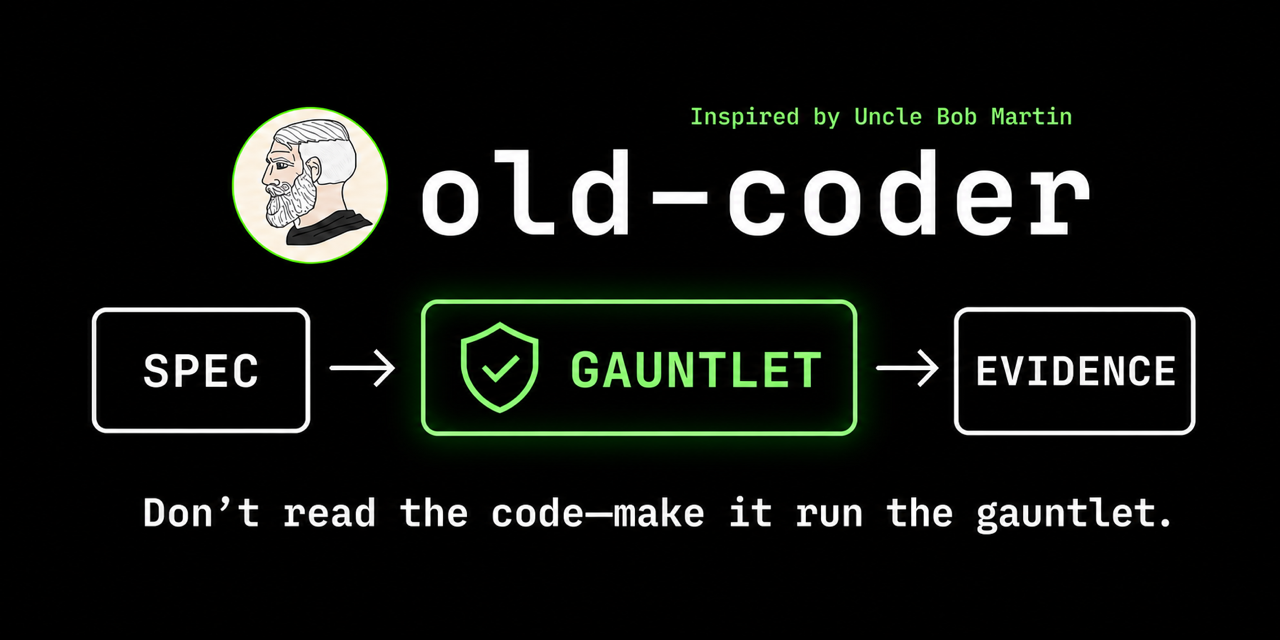
An old coder's strategy for the agent era: don't read the code — make it run the gauntlet.
A skill that makes coding agents prove their work. Instead of you reading every line, the agent pushes its code through a gauntlet of checks and hands you a test plan before coding and an evidence report after. You review those two documents, not the code.
It's plain markdown, so it works with any coding agent that follows instructions: Claude Code, Codex CLI, Cursor, Aider, or your own agent loop.
Install old-coder:
npx skills add https://github.com/amazingang/old-coder --skill old-coder
Or manually:
/old-coder or let it trigger on high-assurance requests:
cp -r skills/old-coder ~/.claude/skills/
# or copy it to <project>/.claude/skills/
skills/old-coder/SKILL.md to your AGENTS.md, rules file, or system prompt, and keep its references/ directory alongside it.old-coder-apiThis repository also includes a focused HTTP/JSON API design and review skill. Install it when you want compatibility, authorization, idempotency, pagination, rate-limit, and operability gates:
npx skills add https://github.com/amazingang/old-coder --skill old-coder-api
To install both skills:
npx skills add https://github.com/amazingang/old-coder --skill old-coder --skill old-coder-api
When both apply, old-coder owns workflow, approval, and evidence; old-coder-api owns the API contract, and its gate decisions become SPEC constraints and gauntlet checks.
From Uncle Bob (Robert C. Martin), on working with coding agents (original tweet):
My current strategy is to not read any of the code written by my agents. That’s the only way I can take advantage of their productivity. What I do instead is to surround the agents with extreme constraints. Unit tests, gherkin tests, QA procedures, quality metrics, mutation testing, test coverage, and a plethora of others. In the end, I have very high confidence in the code they produce because they’ve had to run the gauntlet of all of my constraints and tests.
If you're not going to read the code, the things you do read have to carry the trust instead.
flowchart LR
    SPEC["📋 SPEC<br/>agent writes a test plan,<br/>you approve it"]
    RED["🔴 RED<br/>write a test,<br/>watch it fail"]
    GREEN["🟢 GREEN<br/>write code until<br/>it passes"]
    REF["🧹 REFACTOR<br/>clean up,<br/>tests untouched"]
    G["🛡️ GAUNTLET<br/>run every check"]
    EV["📊 EVIDENCE<br/>you read the report,<br/>not the code"]
    SPEC --> RED --> GREEN --> REF --> G --> EV
    REF -. next behavior .-> RED
You read two documents:
The gauntlet in between:
| Check | The question it answers |
|---|---|
| Full test suite | Did anything break? |
| Types + lint + complexity | Any obvious mistakes? Any unreadable tangles? |
| Changed-line coverage | Is every new line actually exercised by a test? |
| Mutation testing | Plant bugs on purpose — do the tests catch them? |
| Property-based tests | Do the rules survive hundreds of random inputs? |
| Real execution | Does it actually run, outside the test harness? |
| Supply chain & secrets | Did the agent quietly pull in risky packages, or leak a key? |
| Suite health | Are the tests themselves stable, in any order? |
Plus a menu of domain-specific layers — concurrency, UI checks, API compatibility, performance, observability — picked per task from a risk model (see references/gauntlet.md).
Effort scales with risk: a typo fix runs a couple of checks; anything touching money, logins, data, or concurrency runs everything — plus the agent attacks its own code with hostile inputs first.
The agent grades its own homework, so the rules are strict: never weaken a test to make it pass; never report a check that didn't run; anything unverified is labeled unverified, never pass; if no human approved the spec, the report must say so and claim less confidence.
And one limit stated plainly: the gauntlet turns the constraints expressed in the spec into executable evidence; it cannot prove the spec is complete or authenticate its own checkers and mappings. That's why you approve the SPEC, and why EVIDENCE reports bounded, auditable confidence rather than absolute proof.
skills/old-coder/         reliable coding workflow (SKILL.md + references/)
skills/old-coder-api/     HTTP/JSON API design and review (SKILL.md + references/)
demo-rate-limiter/        a rate limiter built end-to-end under old-coder
The demo's evidence.md is the point of the exercise: 41 tests, 100% coverage (49/49 statements and 20/20 branches), and 22/22 planted bugs caught. More importantly, fresh-context verification of earlier green states still found real behavioral defects and an unsound mutation runner — evidence that a green gauntlet is not self-authenticating. The current report discloses both the fixes and the final state's verification status. Rerun the whole report:
cd demo-rate-limiter
python3 -m venv .venv && .venv/bin/pip install -r requirements-dev.txt -e .
./tools/gauntlet.sh
MIT
Sign in to join the discussion.
No comments yet. Be the first to say what this is good for.
An agentic skills framework & software development methodology that works.

Turn any codebase, with its docs, SQL schemas, configs, and PDFs, into a queryable knowledge graph. A /graphify skill for Claude Code, Cursor, Codex, and Gemini CLI: local deterministic AST parsing, every edge explained, no vector store.

Topic in, narrated explainer video out. A Claude Code / Codex skill that turns any topic into a black-canvas motion-graphics explainer video with TTS voiceover, subtitles and a chapter progress bar. Chinese or English; every frame drawn in code with Remotion.
Public repository for Agent Skills
Open-source AI job search: scan job portals, evaluate listings into a structured A-H report with a global 1-5 score, tailor your CV, track applications — runs locally in your AI coding CLI (Claude Code, Codex, OpenCode, Antigravity…)
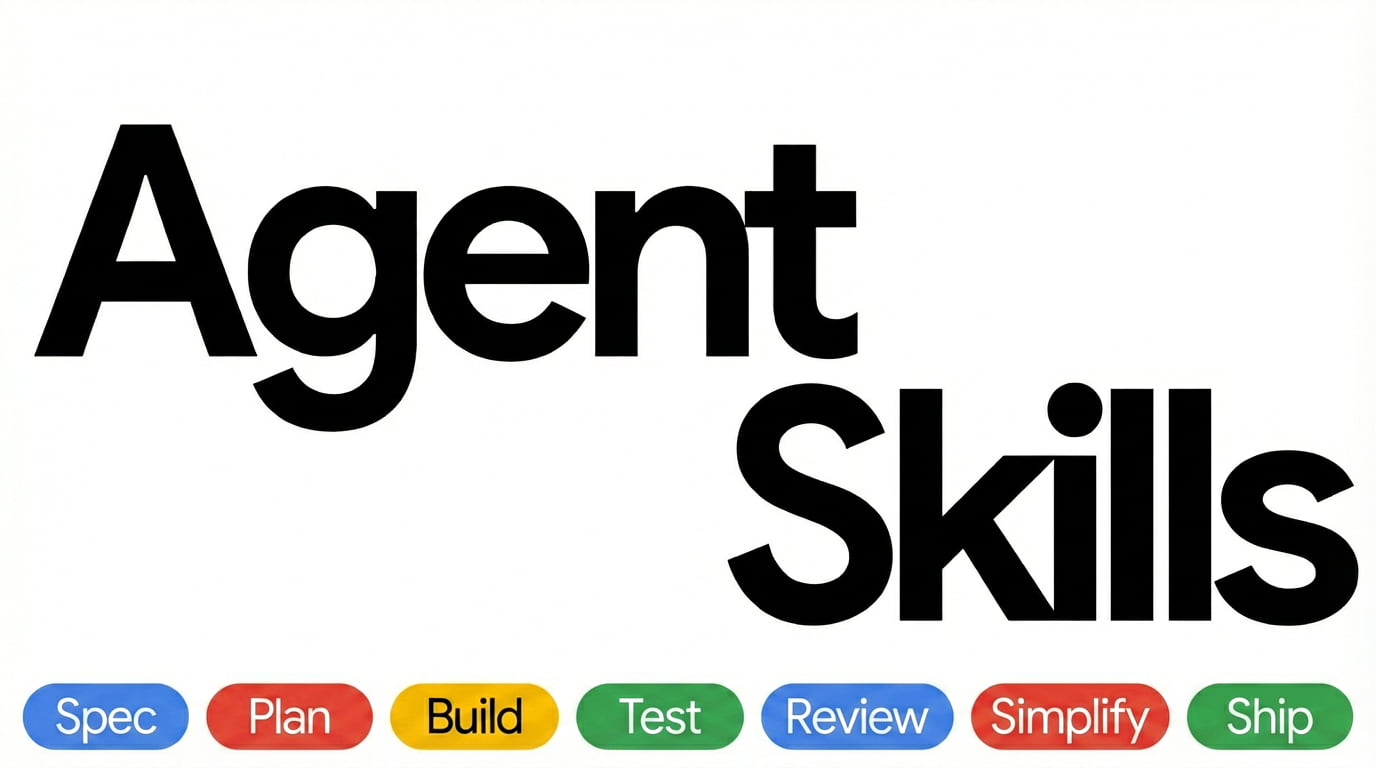
Production-grade engineering skills for AI coding agents.