
obra/
superpowers

obra/superpowersSkills
An agentic skills framework & software development methodology that works.
285k
1 add
This repo gives builders a reusable way to make product demo videos as React compositions, with motion rules that keep the result from looking like a screen recording. The agent workflow reads your product, proposes a shot list, writes the clip, and then renders and checks the frames before it passes.
Builders who want an agent to turn a real product into a polished demo video without starting from a blank motion system.
You can go from a product and its UI tokens to a rendered demo video with motion rules, preview stills, and a frame gate.
`.claude/skills/product-demo/` gives an agent the playbook for reading the product, drafting the flow, and writing the composition.
`src/motion.ts` defines the curves, durations, stagger, and landing behavior used to keep motion from snapping or teleporting.
`src/compositions/Demo.tsx` and the README’s beat-sheet method anchor every action to a frame number before the JSX is written.
`scripts/preview.sh` makes stills on every beat, and `scripts/render.sh` renders the clip, stitches it, and runs the gate.
`scripts/check-frames.mjs` checks for corrupted frames, luminance jumps, and loop seams before a render is accepted.
`scripts/adopt-theme.mjs` copies product tokens into `src/theme.css` and can also copy curve values into `src/motion.ts`.
npm install
npm run adopt ../src/app/globals.css   # take your product's real tokens
npm run studio     # preview at localhost:3000
npm run preview    # stills on every beat + a contact sheet — seconds
npm run render     # renders, stitches, and gates the result
cp src/compositions/Demo.tsx src/compositions/MyClip.tsx
npm run studio # localhost:3000, pick "myclip", scrub the timeline
sh scripts/preview.sh myclip
sh scripts/render.sh myclip 366 # 366 = which frame becomes the poster
bash scripts/add-sfx.sh myclip # out/myclip-sound.mp4
Point your coding agent at your product and get a demo video back — built in React, not recorded off a screen.
What's in it · Your first clip · Motion rules · Working with an agent · The frame gate · Licensing
The hard part is not making a video. It is making one that does not look like a screen recording. This repo is the motion vocabulary, the render pipeline and the frame gate that got mine there, plus the skill file that makes an agent follow them instead of improvising.

src/compositions/Demo.tsx — sixteen seconds, exactly what npm run render
gives you on a fresh clone. Nothing on screen snaps between frames: the counter
counts, the rows stagger, the pointer stops before it presses. A screen
recording of a real app shows every one of those as a teleport.
npm install
npm run adopt ../src/app/globals.css   # take your product's real tokens
npm run studio     # preview at localhost:3000
npm run preview    # stills on every beat + a contact sheet — seconds
npm run render     # renders, stitches, and gates the result
Node 20+. First render downloads a headless Chromium (~100 MB); if that fails see Troubleshooting.
Works with Claude Code, Cursor, or anything else that loads a skill file. It reads your product, puts up a shot list, and waits for you to correct it — what that looks like. Then it writes the composition, renders it, and refuses to pass a render it cannot verify.
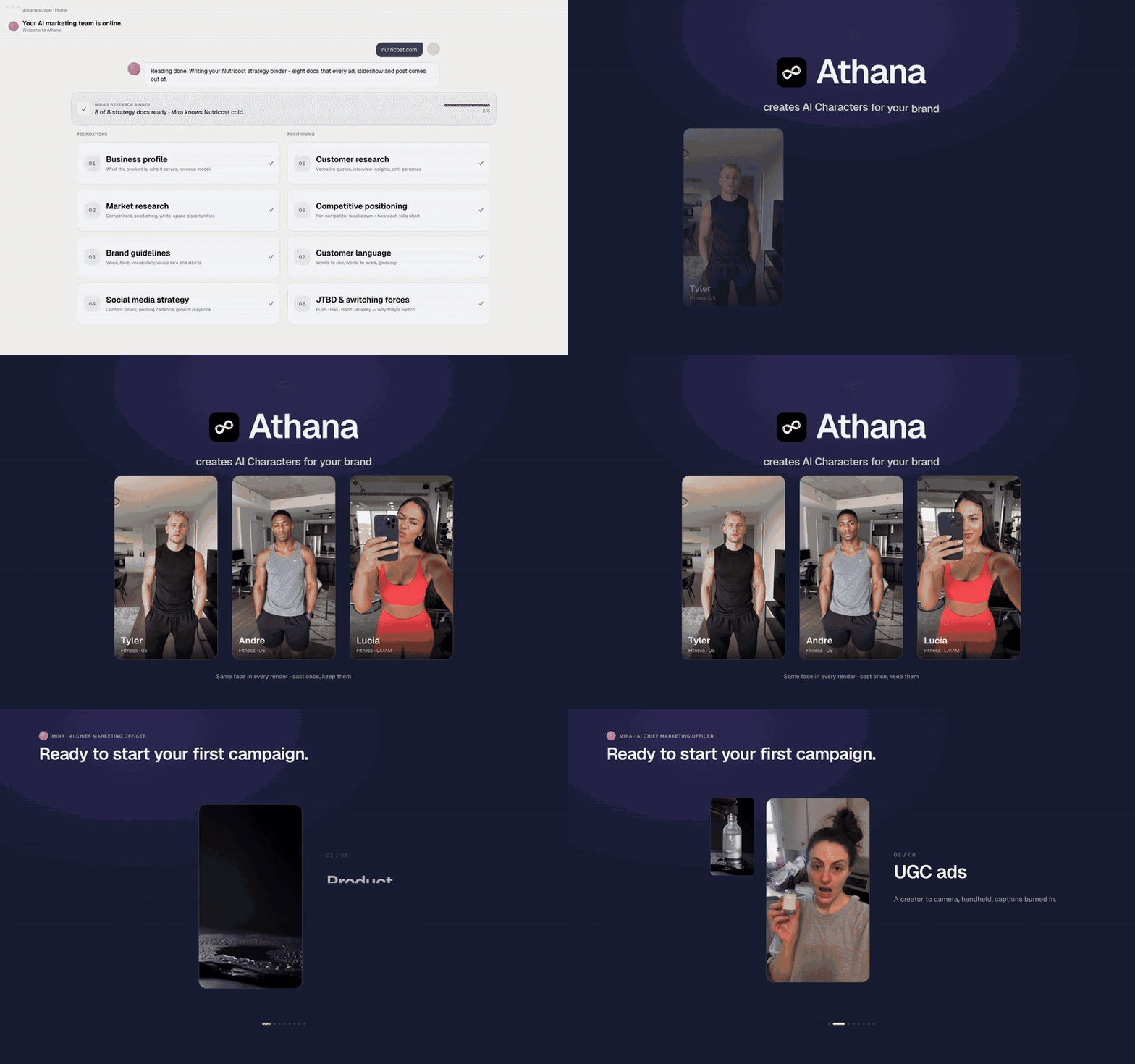
The same pipeline, cut for Athana — five movements, one flow, no screen recorder. It runs on that product's own assets, which is why the composition that ships here is the generic one above.
src/motion.ts | The vocabulary. Curves, durations, stagger, and the helpers that stop states teleporting. Imports nothing. |
src/title-card.tsx | The cold open — words rising out of per-word masks. |
src/chrome.tsx | The fake app window, the pointer, the click beats. |
src/compositions/Demo.tsx | A worked example. Copy this, change the flow. |
scripts/preview.sh | Stills on every beat, plus a contact sheet. What the gate cannot see. |
scripts/render.sh | Sequence render → 1536×960 mp4 + poster → gate. |
scripts/check-frames.mjs | The frame gate. See below. |
scripts/add-sfx.sh | Optional sound pass over the finished mp4. |
scripts/beats/ | One beat file per clip — where the sound is scored. |
.claude/skills/product-demo/ | The skill: the playbook an agent reads before touching any of it. |
AGENTS.md | What an agent needs on arrival — commands, and the rules it would otherwise break. |
AGENTS.md at the root is read natively by Claude Code, Codex, Cursor, Aider,
Copilot, Gemini CLI and Windsurf — an agent opening this folder is oriented
before you say anything. CLAUDE.md points at it rather than repeating it.
Cursor users who want the skill loaded as a skill: copy
.claude/skills/product-demo/ to .cursor/skills/. Same file either way.
A composition is a pure function of the frame number. useCurrentFrame()
hands you N, you return what the screen looks like at frame N. Nothing is
stateful and nothing animates on its own — if a value is not derived from the
frame, it does not move.
That is why every clip starts with a beat sheet: a block of named
constants for the frame each thing happens on. Look at the top of
src/compositions/Demo.tsx — FIELD_CLICK = 20, RUN_CLICK = 88,
TOAST_AT = 282. Decide those before you write any JSX, because every
entrance, colour change and cursor move is anchored to one of them.
Elements are positioned in absolute pixels rather than with flexbox. A demo is choreography: you need to know where a button is in order to put a pointer on it at frame 214.
cp src/compositions/Demo.tsx src/compositions/MyClip.tsx
Rename the export Demo → MyClip and DEMO_LEN → MYCLIP_LEN.
src/Root.tsx currently returns a single <Composition>. Wrap it in a
fragment and add yours next to it:
import { MyClip, MYCLIP_LEN } from "./compositions/MyClip";

return (
  <>
    <Composition id="demo" /* … */ />
    <Composition
      id="myclip"
      component={() => (
        <Clip body={<MyClip />} name="My Product" kicker="One line of promise" />
      )}
      durationInFrames={MYCLIP_LEN + TITLE_LEN}
      fps={FPS}
      width={WIDTH}
      height={HEIGHT}
    />
  </>
);
npm run studio # localhost:3000, pick "myclip", scrub the timeline
Scrubbing is where the work happens. Jump to a beat, look at it, adjust the constant, look again.
sh scripts/preview.sh myclip
Reads the beat sheet out of your composition and shoots a still on each beat
and again twelve frames later, then tiles them into
out/myclip-preview/contact.jpg. Seconds, where a render is minutes.
Do this before every render. The gate that runs afterwards measures two numbers per frame and cannot see whether the picture is right — a panel over the header, a phase drawn empty, a pointer pressing the number above the button all sail through it. Looking is the only thing that catches those, and this makes looking cheap.
It cannot see time, though. Rhythm only exists in motion, so watch the mp4 when it comes out.
sh scripts/render.sh myclip 366 # 366 = which frame becomes the poster
npm run render is just this with demo. Output lands in out/.
The example runs 480 frames — 16 seconds. That is a default, not a ceiling.
Length follows your flow rather than a template. Budget one step, add 66 for
the title and ~30 for the outro, and set MYCLIP_LEN to the total:
| pace | simple step | movement with its own beats |
|---|---|---|
| punchy | 70 | 170 |
| standard | 100 | 240 |
| cinematic | 140 | 330 |
A three-step flow lands near 14 seconds; a five-movement product story runs past 40. Nothing in the pipeline cares which you pick — the render, the gate and the sound pass all read the length off the composition.
Working with an agent, you do not do this arithmetic: it derives the number from the flow you described and shows its working, so you can answer "punchy" in one word instead of counting frames.
bash scripts/add-sfx.sh myclip # out/myclip-sound.mp4
A clip autoplaying in a page has to stay muted — browsers block autoplay with audio, and a scored file simply will not start. So for a page loop the silent mp4 is the deliverable and the scored one is an extra.
For a launch video nobody autoplays: sound can be the point, and the scored file is the one you ship. Either way the pass writes a new file and the silent original is never overwritten.
The pass runs over the already-rendered mp4 and copies the video stream byte
for byte (-c:v copy), so no frame is redrawn and the gate does not need
re-running. Beats live in scripts/beats/<id>.txt, written against the
beat-sheet constants at the top of your composition. Nine sounds, chosen by
level of motion rather than by element — the palette and the rules are in
scripts/add-sfx.sh and in the skill.
Run this first, before you draw anything:
npm run adopt                          # finds your stylesheet
npm run adopt ../src/app/globals.css   # or name it
npm run adopt ../app/globals.css --curves --dry-run
It reads your stylesheet and rewrites src/theme.css with your tokens —
--primary becomes the kit's --brand, a --poster/--backdrop becomes
--ground, and anything with no counterpart is derived from what did match
rather than left as a stranger's purple. --curves also copies your
cubic-bezier easings into src/motion.ts, so the film moves the way your
product moves. --dry-run reports and writes nothing.
It prints what it matched and what it could not, so a half-adopted palette is visible instead of silent:
  ✓ --brand              --primary                taken
  ~ --brand-soft         —                        derived from --brand
  ! --ground             —                        PLACEHOLDER — no match
Handles Tailwind 3 and 4, :root / .dark / [data-theme] /
prefers-color-scheme, and one level of var() indirection. It takes the
dark palette by default — the title card, the ground and the loop seam all
sit on a dark stage — so pass --mode=light for a light demo.
It copies, it does not link. Remotion cannot import an app stylesheet: that
pulls Tailwind plugins and font files that live on the app's own serving path.
So these are snapshots, the written file records its source and date, and a
token you change in the app afterwards needs a rerun. Hand-edits to
src/theme.css do not survive the next run — put a deliberate override in a
composition, or add your name to ALIASES in the script.
Then, by hand:
src/fonts.ts — swap the face. The script tells you which one your
stylesheet asks for, but cannot swap it for you: the family has to exist in
@remotion/google-fonts or be wired up as a local file. A fontFamily
string alone loads nothing; skip loadFont() and every frame silently
renders in a system fallback.MyClip.tsx — replace the flow with the real steps of your product, in the
real order, with copy taken from the live UI. A demo that walks a flow the
product doesn't have proves nothing, however good it looks.The palette is the cheap half. The copy is what makes a frame recognisable as
your software — the real button labels, the real row names, the real empty
state. npm run adopt cannot do that part, and the skill is written to stop an
agent inventing it.
These are the difference between a clip that reads as software and one that
reads as a screenshot slideshow. Long form in
.claude/skills/product-demo/references/motion.md.
on ? "var(--brand)" : "var(--border)"
snaps in one frame. Anchor a ramp at the frame the state changes and blend
the tokens through it.scale(0). Entrances start at 0.9–0.97 and travel ≤16px. A 40px
entrance reads as a slide deck.fontSize reflows the row
every frame.And the one that is not about motion: never put a lasting transform on
the container that holds the whole UI. A scale on the app frame resamples
every glyph inside it. Move what is in the frame, never the frame.
.claude/skills/product-demo/SKILL.md is written to be read by Claude Code,
Cursor, or anything else that loads skill files. It is not documentation with
a YAML header on top — it is a set of refusals.
If it can reach your repo, your running app or your site, it reads them — the running order of your marketing page tells it which features matter and in what order, and the app tells it what those features actually look like. Neither answers the other's question. Then it drafts the whole thing and asks you to confirm it, rather than interviewing you for what it could have looked up.
Four things have to be settled before a line of a composition gets written:
0. A demo of the whole product, or a scene about one feature? A product demo strings three to five features into movements on a through-line; a feature clip walks one flow start to finish. They are not the same clip at different lengths.
That answer also decides where the clip lives — whole product means a standalone launch video that plays once, one feature means a muted loop in a page section — and with it the loop seam, the sound, the length ceiling and the ending. Both crossings happen, so the agent picks and shows you the pick rather than assuming in silence.
1. What is being made on screen? Not the feature — the thing the viewer watches get built. "A revenue report", "a deploy going out".
2. What does it walk, in order? Real steps, or real features as movements with something carrying the viewer between them. Copy comes from the live product.
3. How does it end? By default on the finished thing — the flow completes and the last state holds long enough to read. No asset, no question. Only when the ending is media your product generates does it need a real file, and there it may propose one from your disk but never fabricate a stand-in.
Settled is not the same as asked. The agent drafts what it can read — the flow, the screens, the copy, the ending — and only three things come back to you, in one block rather than an interview:
Each option carries a line saying what it costs you, and the agent's own guess is already selected. That is the difference between this and a form: you are correcting a plan, not filling one in. The usual answer is one click, and so is the correction. In Claude Code it is a native picker; elsewhere the same three arrive in a single message.
The third one matters more than it looks. Reading your product gives a plausible flow, never the right one — the code does not record which path converts, which step people get stuck on, or which feature shipped last week and needs the attention. Only you know that. It is offered once and never pressed: ignore it and the agent reads your product and proposes a flow anyway.
Beyond those three it asks for exactly one more thing, and only sometimes: which file the ending shows, when the payoff is media your product generates and several would do. Fragments are fine as answers everywhere.
Length is deliberately not among them. Asked, it gets answered "short" on reflex, and a demo that rushes the steps it exists to show is the result. The agent derives it from your flow and shows the arithmetic instead — which is what the shot list below is.
The shot list settles what happens. What the clip looks like is decided by how much of your codebase the agent actually reads, and the skill makes that non-optional: nothing on screen may be invented.
Lists on screen — rows, cards, chips, steps — almost never live in the page.
They sit in a constants module with the real names, the real subtitles and the
real order, and the agent is told to grep a visible string back to its
definition and use the whole list. Light or dark is a property of the screen
rather than of the product. --primary is often not the accent the surface
you are drawing reaches for. Getting any of those wrong yields a clip that
renders clean, passes the gate, and is not your software.
It does not ask you for screenshots. Everything a screenshot would settle — the arrangement, the density, the ground, the accent — is in the markup and the classes, and asking for a picture is how an agent gives itself permission not to read them.
t0    title     "Acme Studio" · "Ask a question, publish the answer"
0     query     types "Revenue by channel, last quarter", hits Run
96    results   five channel rows stagger in, the counter lands on 1,940
184   filter    "Paid only" lights, three rows dim, the total recounts
274   publish   press, the confirmation springs into its slot
380   out       folds back to the dark ground
Four steps and a hold: 66 for the title, four steps just under the standard 100, and 34 to fold out — 480 frames, 16s. Ends on the published report. Say "punchy" for ~12s.
One line per phase, the frame it starts on, and the arithmetic behind the length — so a redirect costs you a word instead of a paragraph.
That checkpoint is the whole reason the interview exists. The failure mode of "make me a demo video" is a beautiful montage of output that never shows what a visitor would actually do, and getting question 2 wrong is the one defect that cannot be fixed in the edit — by the time you see it, the entire clip is built on it. Correcting a line in that list costs a sentence. Correcting it after the composition exists costs a rebuild.
Everything else it decides on its own and tells you in passing: the title copy, the pace, and which single element carries the hero beat of each phase.
If you only take one thing from this repo, take that section.
Every render is checked before it is allowed to pass.
scripts/check-frames.mjs looks for two defects. Corrupted frames, where
the page texture comes back wrapped or mirrored inside an otherwise correct
frame — it hits a handful out of hundreds, at random, so it reads as a flicker
rather than as damage, and no encoder setting fixes it because it is already
baked into the JPEG. And luminance jumps, including the loop seam: the
last frame cutting back to frame 0, which fires every time the video repeats
and which nobody inspects.
480 frames, 1536x960

tiled frames: none

luminance jumps over 25: none

loop seam: frame 479 Y=20.0 -> frame 0 Y=20.0   jump 0.0
What it does not check is the picture. Two numbers per frame — half
against half, and average luminance — is the whole of it. A panel over the
header, a phase drawn empty, a counter cut off, a pointer pressing the wrong
element: every one of those passes. That is what scripts/preview.sh is for,
and why it runs before this, not instead of it.
scripts/render.sh exits non-zero on a failure, and keeps the frame
sequence when it fails, printing the path. The flagged JPEG is what decides
whether the encoder is innocent, and being able to open it is the only reason
to render through stills at all.
For a clip that plays once rather than looping, pass STANDALONE=1 — the seam
check only means something for a clip that cuts back to its first frame, and
without the flag the gate fails a launch video for ending somewhere brighter
than it started. Remotion's docs also recommend
--concurrency=1 for flickering
and the render script always passes it — but a flag you have to remember is
not a guarantee.
Two known blind spots. Both come from the same heuristic: the tile check asks whether a frame's left half resembles its right half, which is anomalous in a dense interface and perfectly normal elsewhere.
Flat frames. Nearly one colour means matching halves by definition, so only
frames with real contrast are judged (FLAT = 120). On a pale, low-contrast
UI it will miss corruption a dark one would catch. Lower the threshold for a
light product; never raise it to make a failure go away.
Repeating or symmetric content. A grid background, a striped field, a centred layout — the halves match because the design says so. Measured against a motion-graphics render on a grid template, this produced nine false positives out of three hundred frames, every one of them a frame where the foreground text had left and only the grid remained. This detector is built for product UI. On graphic content, read every flag before believing it.
src/motion.ts — the vocabulary, and the part worth taking — imports
nothing at all: the bezier solver, the clamped span and the damped
oscillator behind pop() are written out in the file. It works unchanged
under Framer Motion, in a canvas loop, or in React Native.
Remotion itself is five symbols in four files — registerRoot,
Composition, Sequence, AbsoluteFill, useCurrentFrame, plus loadFont.
It bundles the app, drives the frame clock, runs headless Chromium and gives
you the Studio.
Timed out after 25000 ms while trying to connect to the browser!, with
an empty Chrome log. Almost never a Remotion problem.
Remotion's bundled Chromium will not launch on older systems — on macOS it wants 15 (Sequoia). Point it at an installed Chrome instead:
export CHROME_PATH="/Applications/Google Chrome.app/Contents/MacOS/Google Chrome"
remotion.config.ts picks that up automatically.
If you use CHROME_PATH, quit Chrome first. Launching a second instance
of an already-running browser hands off to the existing process and exits
without opening a debugging port. Nothing is logged, because nothing crashed.
The clip flickers. Run scripts/check-frames.mjs on the mp4 before
touching the encoder — that diagnosis is wrong twice as often as it is right.
Full debugging order in
.claude/skills/product-demo/references/render.md.
This kit is MIT. See LICENSE.
Remotion is not. Remotion is source-available under its own licence:
free for individuals, non-profits, and for-profit companies up to 3
employees; larger companies need a paid Company License from
remotion.pro. That applies to you as soon
as you npm install, regardless of what this repo's licence says. Check
where you land before you ship something commercial on it.
ffmpeg binaries come from ffmpeg-static and carry their own terms.
The motion rules above are a translation of
Emil Kowalski's writing and animation skills into the
constraints of a rendered file. Two things do not carry over: Remotion has no
CSS transitions, and prefers-reduced-motion is meaningless in an mp4.
Everything else about curves, properties, durations and stagger applies
unchanged, and his material is the best thing to read alongside this.
Built with Remotion.
Sign in to join the discussion.
No comments yet. Be the first to say what this is good for.
An agentic skills framework & software development methodology that works.
Turn any codebase, with its docs, SQL schemas, configs, and PDFs, into a queryable knowledge graph. A /graphify skill for Claude Code, Cursor, Codex, and Gemini CLI: local deterministic AST parsing, every edge explained, no vector store.

Topic in, narrated explainer video out. A Claude Code / Codex skill that turns any topic into a black-canvas motion-graphics explainer video with TTS voiceover, subtitles and a chapter progress bar. Chinese or English; every frame drawn in code with Remotion.
Public repository for Agent Skills
Open-source AI job search: scan job portals, evaluate listings into a structured A-H report with a global 1-5 score, tailor your CV, track applications — runs locally in your AI coding CLI (Claude Code, Codex, OpenCode, Antigravity…)

Production-grade engineering skills for AI coding agents.