

DietrichGebert/ponytailPlugins
Makes your AI agent think like the laziest senior dev in the room. The best code is the code you never wrote.
138k
1 add
dsh-usage adds a floating dock to DeepSeek Harness web so you can see balance, today, month, cache hit, and refresh status at a glance. It also opens a configurable panel with seven widgets, including usage logs, a heatmap, and a Claude Code channel comparison.
Builders who use DeepSeek Harness and want their agent usage, balance, and cache stats in one place.
You can check usage and balance without switching away from the Harness web UI.
Shows balance, today, month, and cache-hit stats in a small floating dock that stays visible and collapses into a balance pill.
Lets you pin, collapse, hide, and drag-reorder widgets, with live accent, background, and opacity controls.
Includes balance, today, this month, cache hit, channel share, usage log, and a 28-day activity heatmap.
Refreshes balance and usage data at startup and every five minutes.
Uses loopback-only JSON endpoints, resolves credentials server-side, and keeps prompts and replies off the wire.
dsh plugin --profile web add "github:Aisland-SJL/dsh-usage"
cd ~/.dsh/profiles/web
pnpm add @deepseek-ai/dsh-client-ui-primitives@0.1.1-rc.2 --save-exact
dsh plugin --profile web update dsh-usage
dsh plugin --profile web remove dsh-usage
A persistent floating dock, a fully customizable balance / token-usage panel, an activity heatmap, and a dual-channel usage comparison for the DeepSeek Harness Web GUI (dsh web).

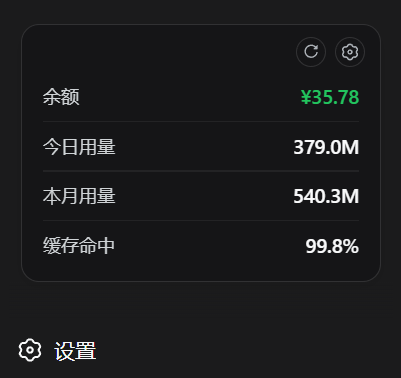
Your key numbers stay visible at all times — balance glows green (red only when out of credit), rows are separated by hairlines, and a settings gear plus one-click refresh sit in the corner. When the sidebar collapses, the dock folds into a tiny balance pill.
 |
|
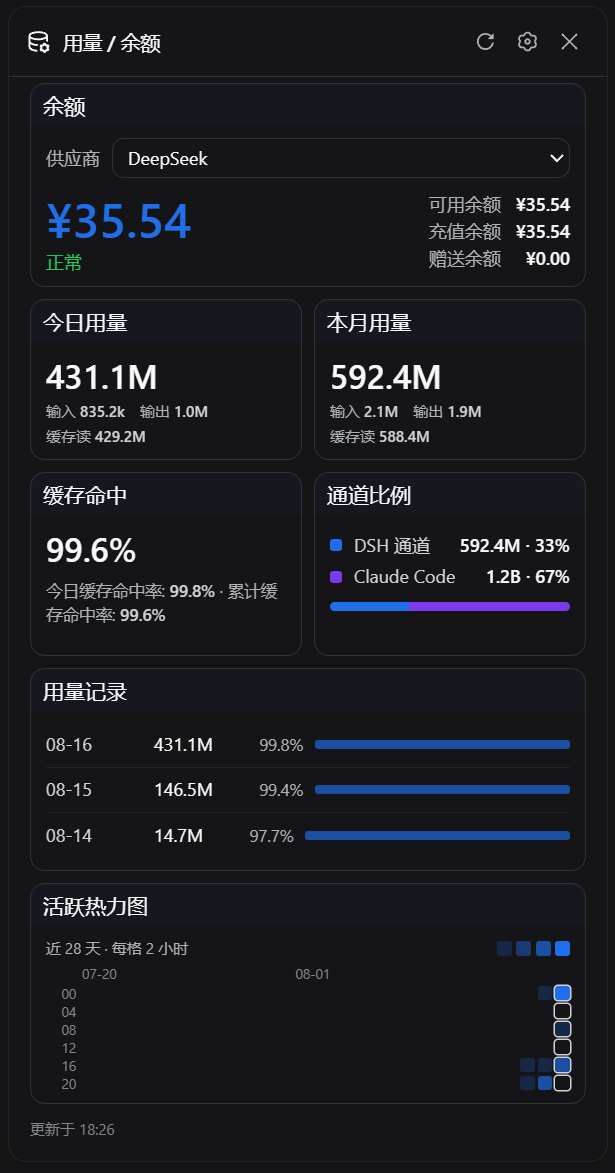
A two-column card layout; every widget has a detail and a compact form, and can be drag-reordered, collapsed, hidden, or pinned.
|  |
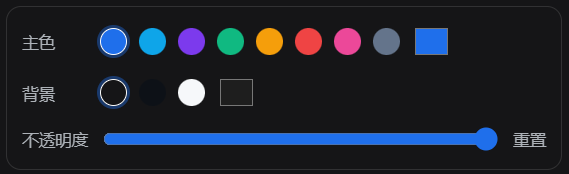
Accent (presets + color picker), background, and panel opacity are adjustable live. Drag-reorder, pin, collapse, hide — every number presents your way, echoing DeepSeek Harness's "everything is a plugin" spirit.
| Feature | Notes | |
|---|---|---|
| 💳 | Persistent dock | Pinned compacts always visible; collapses into a balance pill when the sidebar folds |
| 🎨 | Everything customizable | Widgets: pin / collapse / hide / drag-reorder with a dashed placeholder and glide animation; accent, background, opacity; persisted in localStorage |
| 📊 | Balance & usage panel | Provider picker, balance breakdown, today/month totals in k/M/B units, cache hit, usage log with per-model drilldown |
| 🔥 | Activity heatmap | GitHub-style dots: 28 days × 6 four-hour bands with date labels |
| ↔️ | Channel share | DSH channel vs Claude Code channel (incremental JSONL aggregation of ~/.claude/projects) |
| 🔄 | Background refresh | Refresh at startup, then every 5 minutes: balances, DSH tokens, Claude Code aggregation |
| 🔒 | Local-only security | Three loopback-only GET endpoints; credentials resolved server-side; upstream forced HTTPS with DNS pinning; Claude logs aggregate numbers only — message text never leaves the machine |
UI supports Chinese and English. Credentials come from Harness's ~/.dsh/.credentials.yaml; the plugin never reads, caches, or echoes secrets.
Requires a DeepSeek Harness web profile (@deepseek-ai/dsh >= 0.1.0-rc.6).
dsh plugin --profile web add "github:Aisland-SJL/dsh-usage"
The normal install declares and installs @deepseek-ai/dsh-client-ui-primitives@0.1.1-rc.2 as a runtime dependency. If you register a development checkout with link:, install the same exact package in the active profile because linked packages do not populate the profile dependency tree:
cd ~/.dsh/profiles/web
pnpm add @deepseek-ai/dsh-client-ui-primitives@0.1.1-rc.2 --save-exact
Restart dsh web, hard-refresh the browser, and the dock appears at the bottom-left. Update / remove:
dsh plugin --profile web update dsh-usage
dsh plugin --profile web remove dsh-usage
Balance providers read credential references from ~/.dsh/.credentials.yaml:
DEEPSEEK_API_KEY: sk-your-key-here            # official DeepSeek route
OPENROUTER_MANAGEMENT_KEY: sk-or-v1-...       # OpenRouter account (Management Key, not the inference key)
ZAI_API_KEY: your-zai-key                     # Z.ai open platform
Moonshot / Kimi profiles under llm-pi-ai are discovered automatically and reuse their apiKeyEnv. Providers without a public balance API show an explicit "no public balance interface" state — never a guess.
| Provider | Upstream endpoint | Default credential ref |
|---|---|---|
| DeepSeek | GET {origin}/user/balance | DEEPSEEK_API_KEY |
| OpenRouter | GET {origin}/api/v1/credits | OPENROUTER_MANAGEMENT_KEY |
| Moonshot / Kimi | GET {origin}/v1/users/me/balance | pi-ai provider apiKeyEnv |
| Z.ai / GLM | GET {origin}/api/paas/v4/balance | ZAI_API_KEY |
| Method | Path | Response |
|---|---|---|
GET | /api/usage/providers | Provider list, balance scheme, and status summary |
GET | /api/usage/balance?provider=<id> | Unified balance snapshot; refresh=1 forces an upstream query |
GET | /api/usage/usage | Per-day/per-model token aggregates, cache hit rates, 24-hour buckets (days[].hours), and the Claude Code channel (claude) |
Non-GET requests get 405, non-loopback callers get 403; every response is JSON with Cache-Control: no-cache.
npm install           # react/react-dom/jsdom for offline tests only
npm run check         # syntax checks for every module and script
npm test              # 83 offline tests: balance schemes, token folding, server boundary, client, e2e flows, Claude aggregation, package contract
npm run test:package # runtime dependency + client inject contract
Tests are fully offline — no network, and the real ~/.dsh is never touched (server tests redirect DSH_HOME to a temp dir). Dry-run the real Claude data: node scripts/validate-claude.mjs.
~/.dsh/storages/ hold only aggregated token numbers and fold cursors — no prompts, no replies.Sign in to join the discussion.
No comments yet. Be the first to say what this is good for.
Makes your AI agent think like the laziest senior dev in the room. The best code is the code you never wrote.
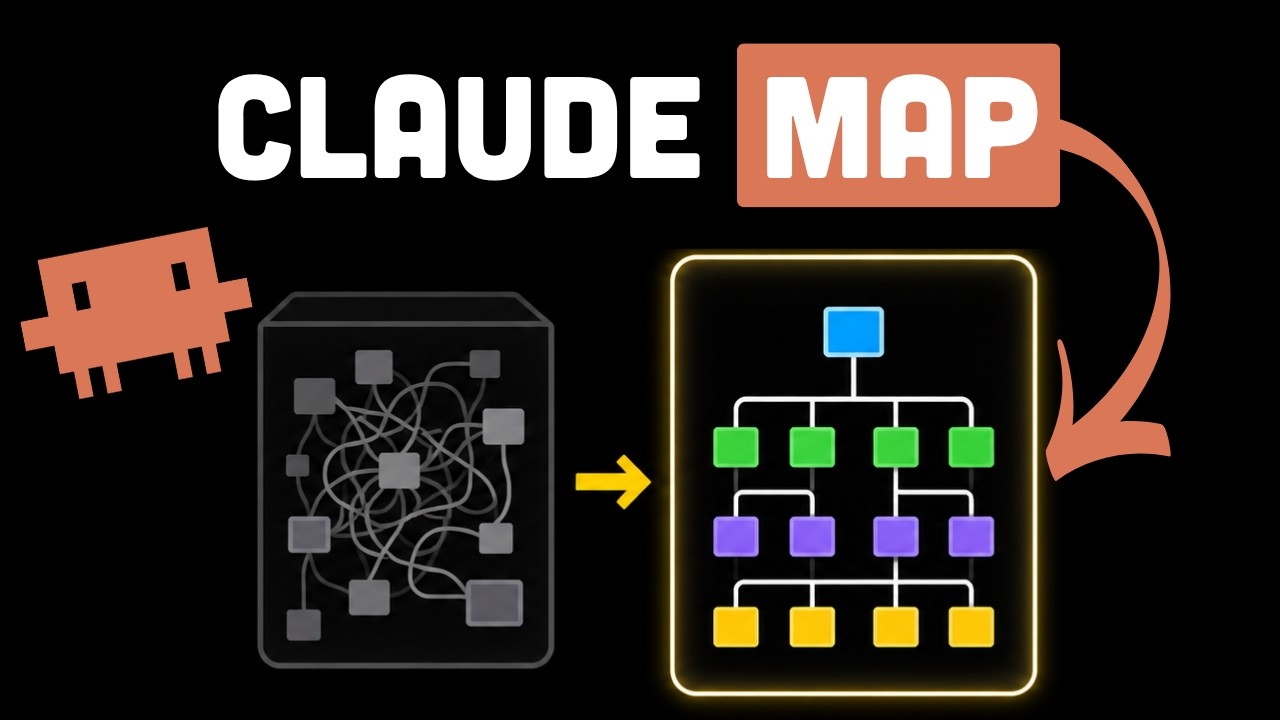
Graphs that teach > graphs that impress. Turn any code into an interactive knowledge graph you can explore, search, and ask questions about. Works with Claude Code, Codex, Cursor, Copilot, Gemini CLI, and more.

OmO: Just type "mass ulw" keyword with your prompt. Now you are the master of graph engineering.
Persistent Context Across Sessions for Every Agent – Captures everything your agent does during sessions, compresses it with AI, and injects relevant context back into future sessions. Works with Claude Code, OpenClaw, Codex, Gemini, Hermes, Copilot, OpenCode + More
Opinionated Oxlint rules for rejecting low-evidence TypeScript and JavaScript patterns
Teams-first Multi-agent orchestration for Claude Code