
JuliusBrussee/
caveman

🪨 why use many token when few token do trick — Claude Code skill that cuts 65% of tokens by talking like caveman
105k
1 add
fauxnix translates a supported bash command subset into PowerShell so agents can run Linux-style commands natively on Windows. It keeps the command flow deterministic, returns GNU-like output, and exposes the same engine through both a CLI and an MCP server.
Builders who want Claude Code, Codex, or another MCP client to run bash-style commands on Windows without WSL.
You can keep writing the bash commands your agent already knows and get native Windows execution with familiar output and errors.
Parses common bash syntax and turns it into PowerShell blocks for native execution.
Returns familiar `ls` columns, bash-style errors, and bash exit codes instead of PowerShell traces.
Exposes the shell as an MCP tool so connected agents can call it directly.
Keeps `cwd`, environment changes, `cd`, and positional parameters across tool calls.
Supports `bash_batch` for compiling and running multiple planned steps in one session.
Handles UTF-8 and GBK file and process output so common Windows locale issues do not break command use.
npx fauxnix-cli@latest "ls -la src | head -3"
npx fauxnix-cli@latest translate "find . -name '*.log' -mtime +7 -delete"
$ fauxnix "ls -la src | head -2"
-rw-r--r-- 1 me me 1204 Aug 16 09:12 ast.ts
-rw-r--r-- 1 me me 8192 Aug 16 09:12 cli.ts

$ fauxnix "cat nope.txt"
cat: nope.txt: No such file or directory        # not a PowerShell stack trace





Run Linux-style commands on Windows — natively, deterministically, no VM, no WSL.
fauxnix is a bash→PowerShell translation layer built for AI agents. Your agent keeps writing the
bash it already knows (ls -la | grep foo, find . -name '*.ts' | wc -l, kill -9 1234), and
fauxnix deterministically translates each command into PowerShell, executes it natively, and hands
back output that looks like GNU/Linux: ls -l columns, bash-style error messages, coreutils exit
codes, UTF-8/GBK handled automatically.
One-command install for Claude Code · Codex · OpenCode · Kimi Code · Qwen Code, plus any MCP client. 109 translated commands · 400+ automated tests · 253-case differential corpus verified against real GNU coreutils · zero LLM calls at runtime.
npx fauxnix-cli@latest "ls -la src | head -3"
npx fauxnix-cli@latest translate "find . -name '*.log' -mtime +7 -delete"
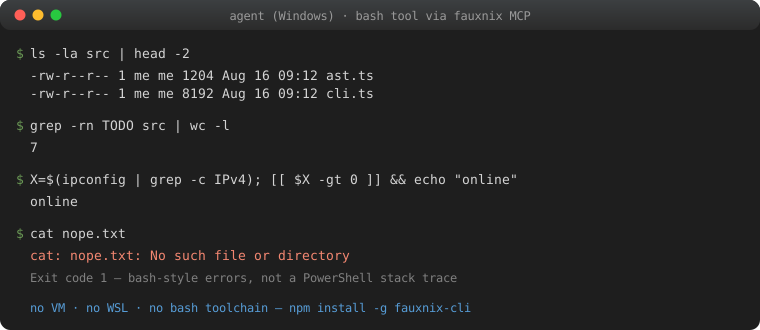
$ fauxnix "ls -la src | head -2"
-rw-r--r-- 1 me me 1204 Aug 16 09:12 ast.ts
-rw-r--r-- 1 me me 8192 Aug 16 09:12 cli.ts

$ fauxnix "cat nope.txt"
cat: nope.txt: No such file or directory        # not a PowerShell stack trace
npm install -g fauxnix-cli
fauxnix install --claude     # or --codex / --opencode / --kimi / --qwen
fauxnix doctor               # verifies encoding, harness config, and MCP round-trip
Idempotent; prints exactly what changed. Manual configurations below if you prefer to edit config files yourself.
npm package name is
fauxnix-cli(thefauxnixname on npm belongs to an unrelated 2015 websocket library); the installed command isfauxnix. Requires Windows with PowerShell 5.1+ (built-in) and Node.js ≥ 18.
Claude Code
claude mcp add fauxnix -- fauxnix mcp
Codex (~/.codex/config.toml or codex mcp add fauxnix -- fauxnix mcp)
[mcp_servers.fauxnix]
command = "fauxnix"
args = ["mcp"]
Note: in non-interactive codex exec mode, MCP tool calls are auto-denied by the approval
layer; pass --dangerously-bypass-approvals-and-sandbox (or run interactively and approve
once).
OpenCode (opencode.json)
{
  "mcp": {
    "fauxnix": { "type": "local", "command": ["fauxnix", "mcp"] }
  }
}
Kimi Code — MCP servers live in a JSON file, not the TOML config: ~/.kimi-code/mcp.json
{
  "mcpServers": {
    "fauxnix": { "command": "fauxnix", "args": ["mcp"] }
  }
}
Qwen Code (~/.qwen/settings.json)
fauxnix install --qwen
The installer preserves the rest of settings.json and writes an absolute Node + package-entry
launcher so Qwen startup does not depend on its working directory or PATH order. See
the Qwen example for the generated JSON shape.
Any MCP client — stdio server: fauxnix mcp. The tool name is bash (override with
FAUXNIX_TOOL_NAME). The tool description already teaches the model the supported subset, so no
system-prompt changes are required.
Copy-paste quickstarts with a 10-command smoke test per harness: docs/examples/
The MCP session persists cwd, environment variables, export/unset, cd -/OLDPWD, and
positional parameters (set -- / $1 / "$@") across tool calls — it behaves like a logged-in
shell, not a stateless exec. $0 is the MCP tool name, not a Windows path.
For workflows whose commands are already known, the MCP server also exposes bash_batch: it
compiles every step before execution, runs the plan atomically in one session, and returns one
structured result per step in a single MCP round trip (stops on first nonzero exit by default).
{
  "steps": [
    { "id": "write", "command": "printf 'a\\r\\nb' > data.txt" },
    { "id": "measure", "command": "wc -c data.txt" }
  ]
}
See compiled MCP batch plans for timeout, budget, cancellation, and preflight semantics.
Same model (DeepSeek-V4-Pro), same 5 tasks, three execution modes on one Windows machine —
full data in docs/benchmark-deepseek-v4-pro.md and
docs/benchmark-ark-models.md:
| PowerShell | fauxnix | Git Bash | |
|---|---|---|---|
| tool calls / unexpected errors | 14 / 9 | 7 / 0 | 4 / 0 |
| time (T1–T4) | 163s | 66s | 57s |
Across 7 models on the Volcano Ark Coding Plan, the PowerShell-vs-fauxnix gap held for every model tested — worst case (kimi-k2-thinking): 3.1× slower with 24 error events writing PowerShell vs zero errors through fauxnix. fauxnix lands within ~15% of the real-bash ceiling with no bash toolchain installed.
LLM agents are dramatically better at bash than at PowerShell — bash dominates training data, so
models on Windows often produce "looks right, doesn't run" commands (wrong quoting, curl that
isn't curl, mojibake from codepage mismatches, inscrutable CategoryInfo error dumps).
| fauxnix | Git Bash | WSL | Raw PowerShell | |
|---|---|---|---|---|
| agent writes plain bash | ✓ | ✓ | ✓ | ✗ |
| only needs Node (no bash toolchain / VM) | ✓ | ✗ | ✗ (VM, GBs) | ✓ |
| native Windows filesystem & environment | ✓ | mostly | ✗ (9P bridge) | ✓ |
| GNU-exact output, verified | ✓ 253-case differential | ✓ (is GNU) | ✓ | ✗ |
| CRLF / UTF-8 / GBK traps handled | ✓ | locale-dependent | ✓ | ✗ |
If Git Bash already works for you, keep it — we literally use it as our differential-testing
oracle. fauxnix is for when you can't or don't want to ship one: agent fleets where the bash
toolchain drifts or isn't detected (the Windows ARM64 Git-Bash detection
failure is a live example), CI runners,
locked-down machines, or anywhere a single npm install -g is easier than a toolchain.
fauxnix takes the third road: translate, don't emulate. A large, high-value subset of the Linux command line — file ops, text processing, process management, archives, networking basics — maps cleanly onto PowerShell + .NET. fauxnix implements that subset faithfully and fails loudly and helpfully on what it can't translate, so the agent never gets silently-wrong results. That matters as labs train computer-use agents on Mac fleets — the agent keeps writing bash; fauxnix makes the Windows box answer like the box the agent was trained on (RFC: computer-use parity).
109 commands, output-matched against real GNU coreutils on Windows (Git Bash) during development:
ls cp mv rm mkdir rmdir touch mktemp ln readlink realpath basename dirname stat file du df find chmod chown diffgrep egrep sed awk sort uniq cut tr — sed/awk scripts are parsed while
preparing an executable plan (unsupported constructs throw named errors, never silently
misbehave)echo printf cat head tail wc tee nl tac md5sum sha1sum sha256sum base64 seq yes xargscd pwd export unset env printenv ps kill pkill pgrep sleep which type whoami id groups date uname hostname uptime free nproc clear true false test [ [[ : pushd popd dirs sudo timeout man history less more source . eval exit alias set shiftcurl wget ping netstat ss ip ifconfig nslookup dig hosttar gzip gunzip zcat zip unzipThe curated agent-daily 60 carry a CommandSpec: unknown options fail with a GNU-style
usage error instead of being ignored. The generated docs/command-specs.md
is the exact list, coverage count, option table, and exclusion rationale; fauxnix list --json
exposes the same per-command metadata. find stays unspec'd so predicates like -name still
compile; sed/awk/egrep keep their command-specific parsers; tar remains native to
tar.exe so supported bsdtar options reach the executable. Implemented GNU holes include
cp -n / mv -n / touch -c / tee --append / grep -m / head --lines /
du --max-depth / env -u / ps -f / command -V / date --date=@SECONDS.
Plus shell syntax: pipes, && / || / ;, redirections (> >> 2> 2>&1 < &>, /dev/null),
quoting, $VAR $1 $# "$@" set -- shift, ${name:-word} ${name//pat/str}
${name:off:len} ${name[n]} ${#name[@]}, A=(x y z) array assignment, $(...) command
substitution, VAR=x cmd prefixes, ~ expansion, and POSIX-style path normalization
(/tmp, /d/foo → D:\foo). Exit codes follow bash conventions: 0 ok, 1 fail, 2 usage/serious,
127 command not found, 124 timeout.
Unknown commands (git, node, npm, python, cargo, gh, docker, ...) are passed through natively
with argv-style quoting. Windows .cmd/.bat shims necessarily pass through cmd.exe; fauxnix
preserves its supported punctuation and fails loudly for %, embedded double quotes, NUL, and
line breaks rather than passing a different argument.
bash command ──parser──▶ AST ──translator──▶ PowerShell script ──executor──▶ selected PowerShell
                                                                              │
agent ◀── GNU-style output, bash-style errors ◀── UTF-8 framed host protocol ◀┘
[Console]::Error.WriteLine for bash-style
stderr, $script:fx_exit for exit codes, $input for stdin.ansi mode), strips CLIXML serialization and
PowerShell noise from stderr, and rewrites common PowerShell errors (including zh-CN locale
messages) into bash phrasing. File reads are always sniffed per file (UTF-8 strict → GBK
fallback), so grep/sed/awk over GBK files works in either mode.-EncodedCommand (UTF-16LE) and transparently fall back to a temp .ps1 file
when the 32 KB command-line limit would be exceeded.PowerShell 7 is an opt-in, CI-tested tier: set FAUXNIX_PS=pwsh before starting fauxnix or its
MCP harness. The default is Windows PowerShell 5.1; invalid values fail loudly rather than
falling back. See PowerShell 7 support.
fauxnix optimizes for the commands agents actually run. Documented deviations:
X=1 standalone assignments follow export semantics (one session-wide environment; bash's
shell-var vs exported-var distinction does not exist), and a same-segment prefix is visible to
$VAR inside the command's own words (Z=in [[ $Z == in ]] is true here, false in bash where
word expansion precedes the temporary environment).yes is capped at 65,536 lines — PS 5.1 pipelines cannot signal upstream producers to stop, so
an unbounded yes | head would hang.tail -f, eval, alias, heredocs, env -i/--ignore-environment, background &, and
output/fd redirects on a non-last pipeline stage are rejected with operation-specific,
actionable error messages instead of misbehaving. Per-stage < remains supported.
(if/then/elif/else/fi, for x in ..., while/until, case ... esac (;; only),
backtick substitution, command -v, pipeline read, dotenv-style source, word-level
$((...)) arithmetic expansion, A=(x y z) arrays, and ${name//pat/str} /
${name:off:len} are supported.)command -v <builtin> prints /usr/bin/<name> where bash prints the bare builtin name;
exit codes and empty-result semantics match.chmod maps only the read-only bit; exec bits are no-ops on Windows. chown is a silent no-op
(as in Git Bash).ps aux columns are approximations (no per-process CPU% accounting, USER shows ?).gzip -c/pipeline stdin is text-faithful, not byte-faithful; file-mode gzip f is byte-exact.wc -l, counts that line (bash would count 0
if the producer omitted the trailing newline). printf 'x' | md5sum stays byte-exact.sed/awk support the common subset; hold-space, labels, arrays, loops throw named
"not supported" errors at translate time.curl/wget refuse loopback/private/reserved addresses (localhost, 127.x, ::1, 10.x,
172.16–31.x, 192.168.x, 169.254.x) as a safety default for agent-driven HTTP.FAUXNIX_NATIVE_ENCODING=ansi when your agents grep Chinese output of native Windows admin
tools.npm install
npm test # unit + real-PowerShell integration suite (Windows only, auto-skipped elsewhere)
$env:FAUXNIX_PS = 'pwsh'; npm test # same suite through PowerShell 7
npm run build
npx tsx scratch/run.mjs "any bash command" # quick live check
Differential vs Git Bash is opt-in (FAUXNIX_DIFF_ORACLE=1; skips if unset or bash.exe is
missing — Git Bash is not required). See test/differential/README.md.
The 253-case corpus enforces the RFC C-7 minimum of 200 cases and a 95% identity gate; the weekly
oracle runs from .github/workflows/differential.yml.
Architecture map: src/parser.ts (bash subset → AST) · src/translator.ts (AST → PowerShell +
executor wrapper) · src/executor.ts (spawn, redirects, session persistence) ·
src/commands/*.ts (per-command generators) · src/mcp.ts (MCP server) · src/cli.ts.
Roadmap: docs/rfc-roadmap-to-1.0.md — tracks, milestones, and the RFC process for proposing waves.
Trust model, host protocol, kill semantics, network guard, and reporting: SECURITY.md.
MIT © 20000419
Sign in to join the discussion.
No comments yet. Be the first to say what this is good for.
🪨 why use many token when few token do trick — Claude Code skill that cuts 65% of tokens by talking like caveman

The best-benchmarked open-source AI memory system. And it's free.

Orca is the ADE for working with a fleet of parallel agents. Run any coding agent with your own subscription. Available on desktop, mobile and remote runtime.
A cross-platform desktop All-in-One assistant for Claude Code, Codex, OpenCode, OpenClaw, Grok Build & Hermes Agent. Only official website: ccswitch.io

Never stop coding. Free MIT AI gateway: one endpoint, 352 providers (150+ free), 1200+ models Kimi, Claude, GPT, Gemini, GLM, DeepSeek, MiniMax. Works with Claude Code, Codex, Cursor, OpenCode, Cline & Copilot. Quota-aware auto-fallback, RTK+Caveman compression saves 15-95% tokens, MCP/A2A, Desktop/PWA. Built by 550+ contributors

Compress tool outputs, logs, files, and RAG chunks before they reach the LLM. 20% fewer tokens for coding agents, 60-95% fewer tokens for JSON, same answers. Library, proxy, MCP server.