
JuliusBrussee/
caveman

🪨 why use many token when few token do trick — Claude Code skill that cuts 65% of tokens by talking like caveman
105k
1 add
Agentinel is a local monitor for AI agent workloads. It scans processes, groups agent trees by project, flags leaks or zombie sessions, and uses your own Claude, Codex, Gemini, or OpenCode CLI to explain what it finds. It also includes disk hotspot scans and a cleanup planner that only acts after you confirm.
Builders who keep several agent CLIs, dev servers, and helper processes running on one machine.
You can spot runaway agents, memory leaks, and cleanup targets without digging through Task Manager or re-explaining the machine to another agent.
Runs a mini panel and full dashboard from one process, with state preserved when you hide the window.
Identifies Claude Code, Codex, Gemini CLI, OpenCode, MCP servers, and common dev servers, then groups them by project and process tree.
Tracks time since last CPU activity and flags zombies, duplicates, orphaned processes, and memory pressure with a rule engine.
Uses your installed agent CLI to read process trees and explain suspicious processes in plain language.
Scans hot folders and deep disk usage, estimates reclaimable space, and proposes safe cleanup actions for you to approve.
Ships reusable Claude Code and Codex files so another agent can run the read-only CLI and interpret the results.
pip install -r requirements.txt
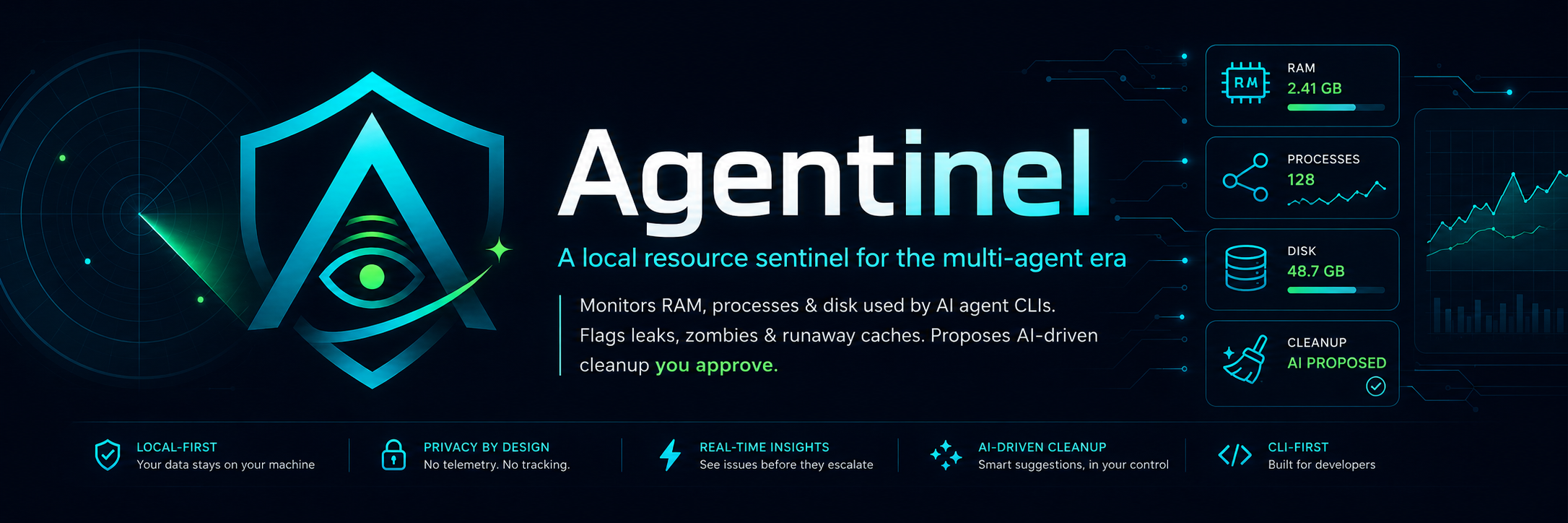




Agentinel = Agent + Sentinel. A cross-platform (Windows + macOS) desktop app that watches the resource footprint of the many AI agents you run at once — and gives you AI advice on what to clean up.
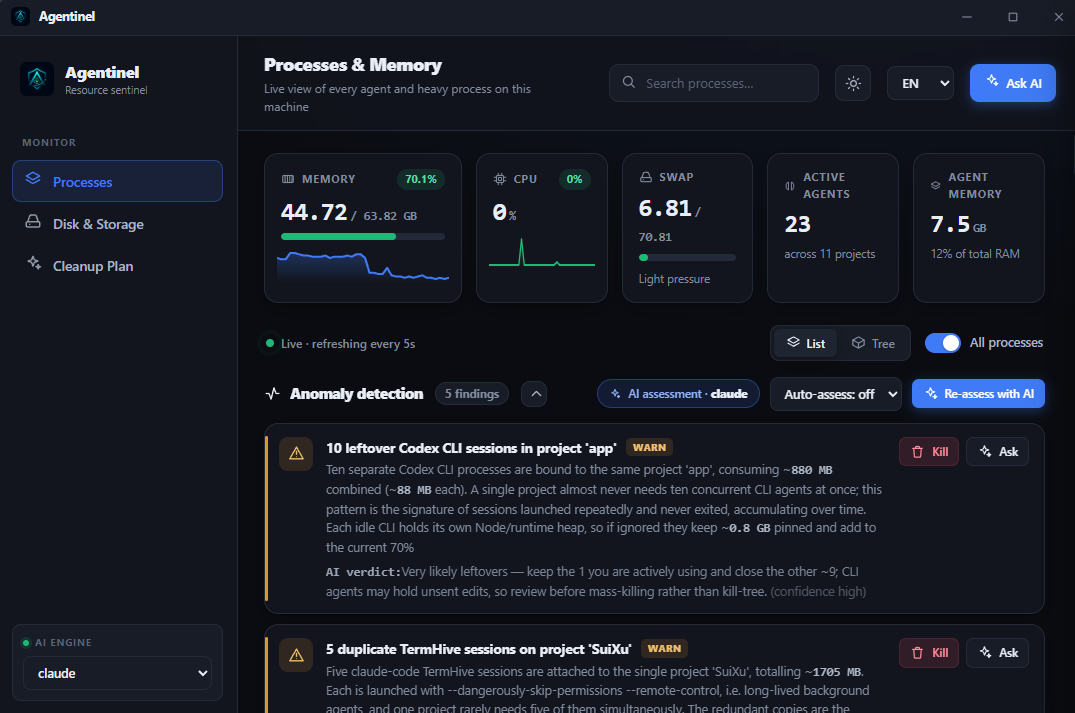
It does what a normal Task Manager can't: identifies agent processes, groups them by project, tracks parent/child trees, detects leaks / zombies / duplicate sessions, and explains it all using your own Claude / Codex / Gemini / OpenCode CLI — no extra API key. Read-only by design: every kill / suspend / cleanup runs only after you click.
Full dashboard — live processes, a system-health strip, and AI anomaly detection.
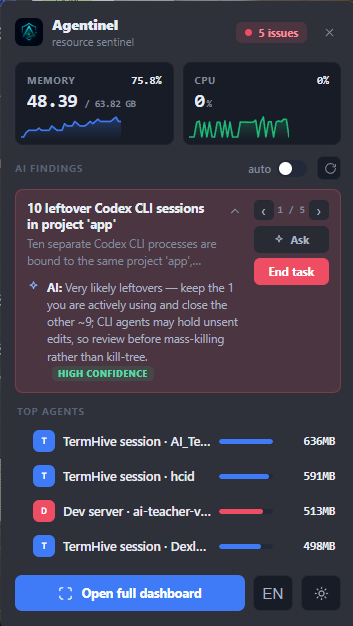
Menu-bar mini panel — a glance from the tray: live RAM/CPU, the AI-flagged leak, and your top agents.
agentinel.py and it lives in the system tray:
a resident mini panel for glances, and the full dashboard opened on demand. Both
share one process and one scanner. Closing the dashboard just hides it (state preserved —
no AI re-run); quit only from the tray.argv[0] fallback recognizes agents even when they rewrite their process title (e.g.
Claude Code showing a version number like 2.1.152).ps.claude / codex / gemini / opencode with fallback (ENGINES dispatch table
in agent_monitor/ai.py — add an engine in one line).agentinel scan --json / advise / doctor,
~12 MB, no WebView) plus a ready-made skill for Claude Code and Codex — so an
agent can check your machine and advise on demand. See CLI and
Use as an AI Skill.pip install -r requirements.txt
Python 3.9+. Windows needs the WebView2 Runtime (built into Win11); macOS uses the built-in WKWebView.
python agentinel.py     # ⭐ recommended — tray icon + mini panel + dashboard (one process)
python app.py           # full dashboard only
python mini.py          # mini tray panel only
From the tray: left-click the icon to show/hide the mini panel, "Open full dashboard" to open the main window, "Quit" to exit.
No GUI, ~12 MB (vs ~250 MB for the GUI) — great for terminals, scripts and AI skills. It talks to the same Monitor + AI engines as the app.
./agentinel scan                  # whole-system top 20, text table
./agentinel scan --agents-only    # agents only
./agentinel scan --top 50         # text table, top 50
./agentinel scan --json | jq      # JSON for scripts / skills / MCP
./agentinel advise                # run the AI, render markdown advice
./agentinel advise --engine codex # switch engine (claude|codex|gemini|opencode)
./agentinel doctor                # show detected AI CLIs + fallback order
(or python -m agent_monitor <subcommand> — the ./agentinel wrapper just auto-finds a
sibling .venv.)
The CLI is built to be driven by another agent. This repo ships a ready-made skill so Claude Code or Codex can answer "what's eating my RAM / any zombie agents / what can I clean up?" by running Agentinel and interpreting the result — same skill, both tools.
.claude/skills/agentinel/SKILL.md.
Auto-available inside this repo. To use it in any project, copy that folder to
~/.claude/skills/agentinel/..codex/prompts/agentinel.md. Copy it to
~/.codex/prompts/agentinel.md and invoke it with /agentinel.Both wrap the same read-only CLI (scan --json / advise); the skill never kills or
deletes — destructive actions stay in the GUI's confirm-to-run flow.
agentinel.py            ⭐ unified launcher — one process owns the tray + mini + dashboard
app.py                  full-dashboard window + JS↔Python bridge (js_api) + window controls
mini.py                 tray / menu-bar mini panel (pystray icon + frameless popover)
agentinel               bash wrapper for the CLI (auto-finds .venv)
.claude/skills/agentinel/SKILL.md   AI skill for Claude Code (read-only resource checks)
.codex/prompts/agentinel.md         same guidance as a /agentinel prompt for Codex
agent_monitor/
  __main__.py           enables `python -m agent_monitor` (CLI)
  cli.py                CLI subcommands: scan / advise / doctor (rich rendering)
  engine.py             detection, classification, project attribution, idle tracking,
                        process trees, rule engine, snapshots (thread-safe Monitor)
  actions.py            kill / kill-tree / suspend / resume (explicit calls only)
  ai.py                 ENGINES dispatch (claude/codex/gemini/opencode); chat / assess /
                        tree reading / plan review; output-language directive (EN/繁/简)
  disk.py               disk hotspot scan + growth history + full deep scan
  plan.py               cleanup plan: candidate actions + safe action blocks + executor
ui/
  index.html  app.js    full dashboard (sidebar, health strip, processes/disk/plan, drawer)
  mini.html             mini panel (live tiles, AI alerts, inline Q&A)
  style.css             design system (light/dark)
  logo-*.png  icon*.png  banner.png   branding assets
data/                   runtime data (lang.txt, disk_history.json…) — gitignored
Launch with AGENTMON_DEBUG=1 to open the WebView devtools.
Sign in to join the discussion.
No comments yet. Be the first to say what this is good for.
🪨 why use many token when few token do trick — Claude Code skill that cuts 65% of tokens by talking like caveman

The best-benchmarked open-source AI memory system. And it's free.

Orca is the ADE for working with a fleet of parallel agents. Run any coding agent with your own subscription. Available on desktop, mobile and remote runtime.
A cross-platform desktop All-in-One assistant for Claude Code, Codex, OpenCode, OpenClaw, Grok Build & Hermes Agent. Only official website: ccswitch.io

Never stop coding. Free MIT AI gateway: one endpoint, 352 providers (150+ free), 1200+ models Kimi, Claude, GPT, Gemini, GLM, DeepSeek, MiniMax. Works with Claude Code, Codex, Cursor, OpenCode, Cline & Copilot. Quota-aware auto-fallback, RTK+Caveman compression saves 15-95% tokens, MCP/A2A, Desktop/PWA. Built by 550+ contributors

Compress tool outputs, logs, files, and RAG chunks before they reach the LLM. 20% fewer tokens for coding agents, 60-95% fewer tokens for JSON, same answers. Library, proxy, MCP server.